

Scaling your content is a goal that sounds great in planning but can be challenging to execute. You know you need more content to grow, but the time it takes to research, write, edit, and find visuals for one blog post is significant. Producing that volume multiple times a week can be difficult.
This is where the promise of an AI content scaling tool comes in. These platforms are built to do the heavy lifting, turning what was once a multi-day process into a more efficient workflow. But with so many tools available, it can be hard to know which ones deliver quality content and which are suited for different needs.
I decided to find out by putting five of the top tools to the test. The goal was to see which platforms could genuinely help scale content creation withoutsacrificing quality. The right tool can make all the difference. For example, by using the eesel AI blog writer, we took our own site from 700 to over 750,000 daily impressions in just three months. It is all about scaling in a smart way.
What is an AI content scaling tool?
First, let's clarify what an AI content scaling tool is. It is not just a more advanced version of ChatGPT. While a basic AI writer might produce a block of text, leaving you with the editing, formatting, and other tasks, a true scaling tool manages the entire workflow from start to finish.
Think of it as a content-focused project manager, not just a writer. A proper scaling tool is designed to take a single keyword or topic and transform it into a complete, publish-ready draft.
Here’s what sets a real scaling tool apart from a simple generator:
- Automated, context-aware research: It does not just pull from a generic library of information. It actively finds relevant facts, data, and details specific to your topic.
- Structured content creation: It understands how a good blog post should be laid out. You get proper headings, subheadings, lists, and tables right from the start.
- Built-in SEO and AEO: It optimizes the content for traditional search engines (SEO) and for new AI-powered answer engines like Google's AI Overviews (AEO).
- Automatic asset generation: It creates visuals like images, infographics, and charts to go with the text, saving you a ton of time.
- A streamlined process: The whole idea is to get from a keyword to a media-rich article with as few clicks as possible.
How we chose the best AI content scaling tools
To keep things fair, I judged each tool on a few key criteria. The goal was to find the tool that delivered the best final article with the least amount of hassle.
Here’s what I looked for:
- Quality of Output: This was the most important factor. Does the content sound like it was written by a human who knows the topic, or does it have a generic, automated feel? We were looking for deep, well-researched content that is interesting to read.
- SEO & AEO Features: How well does the tool prepare you for search success? I checked for proper heading structures, keyword optimization, and formatting that aligns with Google's E-E-A-T (Experience, Expertise, Authoritativeness, and Trustworthiness) guidelines and the new world of AI answers.
- End-to-End Automation: I wanted a tool that could deliver a nearly-finished product. Does it generate a complete post with visuals, links, and quotes, or does it just hand you a text file that you have to spend hours polishing?
- Ease of Use: How complicated is it to get started? A great tool should be simple enough for a marketing team to pick up and use right away, without needing extensive training in prompt engineering.
- Value for Money: Does the price justify the time saved and the quality of the content it produces? A cheaper tool is not a better deal if you have to rewrite everything it gives you.
A quick comparison of the top AI content scaling tools
For those who just want the highlights, here’s a quick breakdown of how the five tools stack up against each other.
| Feature | eesel AI blog writer | Jasper AI | Copy.ai | Pressmaster.ai | SEO.ai |
|---|---|---|---|---|---|
| Best For | End-to-end SEO blog creation | Enterprise marketing teams | GTM workflow automation | PR & trend-based content | Hands-off, automated SEO |
| Automatic Assets | Yes (Images, tables, videos) | Images only | No | Yes (Infographics, carousels) | Yes (AI images) |
| AEO Optimized | Yes | Yes | No | No | Yes |
| Social Proof | Yes (Reddit quotes) | No | No | No | No |
| Starting Price | Free to try | $59/mo (annual) | $24/mo (annual) | $12/mo (annual) | $149/mo |
The 5 best AI content scaling tools
1. eesel AI blog writer
The eesel AI blog writer is laser-focused on one thing: turning a single keyword into a complete, publish-ready blog post that’s designed to rank. It is not just a writer; it’s an entire content engine. This is the exact platform we used to grow our daily impressions by over 1000x in just three months, so I can personally vouch for it.

What really makes it stand out is that it handles the entire process. The context-aware research is a massive time-saver, and it automatically generates everything you need for a media-rich post, including AI-generated images, infographics, and data tables. It even embeds relevant YouTube videos and pulls real, insightful Reddit quotes to add a layer of authenticity that many AI tools miss. The output is also optimized for AEO (Google’s AI Overviews), which is important for staying competitive. After more than a year of fine-tuning, the tone is genuinely human-like and ready to go with minimal edits.
Of course, no tool is perfect for everyone. Because eesel AI blog writer is so specialized in creating high-quality, long-form blog content, it’s not the right fit if your team is mainly focused on short-form content like social media captions or ad copy. It is built for serious SEO content scaling, and it is fantastic at it.
Pros:
- Creates complete, publish-ready articles, not just rough drafts.
- Automatically generates assets like images, tables, and infographics.
- Embeds YouTube videos and real Reddit quotes for extra authenticity.
- Optimized for both SEO and AEO to rank in traditional and AI search results.
- The writing tone is refined to sound genuinely human.
Cons:
- Hyper-focused on long-form blog content, so it is less suited for social media or ad copy.
Pricing:
- It’s completely free to try, so you can see the quality for yourself.
- Paid plans are credit-based, starting at $99 for 50 blog posts.
2. Jasper AI
Jasper AI has evolved from a writing assistant into a full AI Content Automation platform for enterprise marketing teams. It’s designed to handle a wide range of content types at scale and puts a heavy emphasis on features that large organizations need, like brand governance and collaboration.
The platform's strengths are in its control features. Jasper IQ acts as its central brain, letting you maintain brand consistency with custom Brand Voice profiles, Style Guides, and a central Knowledge Base. For bigger companies, security is a priority, and Jasper is SOC 2 compliant. Its collaborative Canvas and massive template library are great for managing large, multi-channel campaigns where different teams need to work in sync.
However, all that power comes with a steeper learning curve. While Jasper is versatile, users sometimes note that the output may require fact-checking and editing to align with a specific brand voice. It’s less of a one-click solution and more of a powerful assistant that still needs human guidance to get content across the finish line.
Pros:
- Excellent brand governance tools for keeping things consistent.
- SOC 2 compliant, making it a secure choice for enterprises.
- Great for managing large, multi-channel marketing campaigns.
Cons:
- Has a steeper learning curve than more specialized tools.
- Output may require editing and fact-checking.
Pricing:
- The Pro plan starts at $59/month per seat, billed annually.
- The Business plan, which includes advanced features like API access, requires custom pricing.
3. Copy.ai
Copy.ai has shifted from being a general copy generator to a complete GTM (Go-to-Market) AI Platform. It’s now built for sales and marketing teams who need to automate complex, multi-step processes like lead generation, prospecting, and personalized outreach.
This is where Copy.ai really excels. Its Workflows feature is incredibly powerful for automating data-heavy GTM tasks. You can set up triggers that enrich new leads with data, research target accounts, and draft personalized outreach emails automatically. With over 2,000 integrations, it’s great at pulling information from different sources to fuel its automations. It's a popular choice, trusted by over 17 million users.
The trade-off is that its main focus is no longer on creating high-quality, long-form content. Some users have noted that the output for long-form articles may require additional refinement to achieve a specific tone and style. It’s a powerful tool for workflow automation, but it’s not an end-to-end blog writer. It also lacks a built-in AI image generator, meaning you'll have to create your visuals somewhere else.
Pros:
- Excels at automating complex, data-driven sales and marketing workflows.
- Huge library of integrations to connect your tech stack.
- Powerful for tasks like lead enrichment and personalized outreach at scale.
Cons:
- Long-form content may be inconsistent in quality.
- Does not have a built-in AI image generator.
Pricing:
- Offers a free plan, but it is limited to just 2,000 words.
- The self-serve Chat plan starts at $24/month for 5 seats, billed annually.
4. Pressmaster.ai
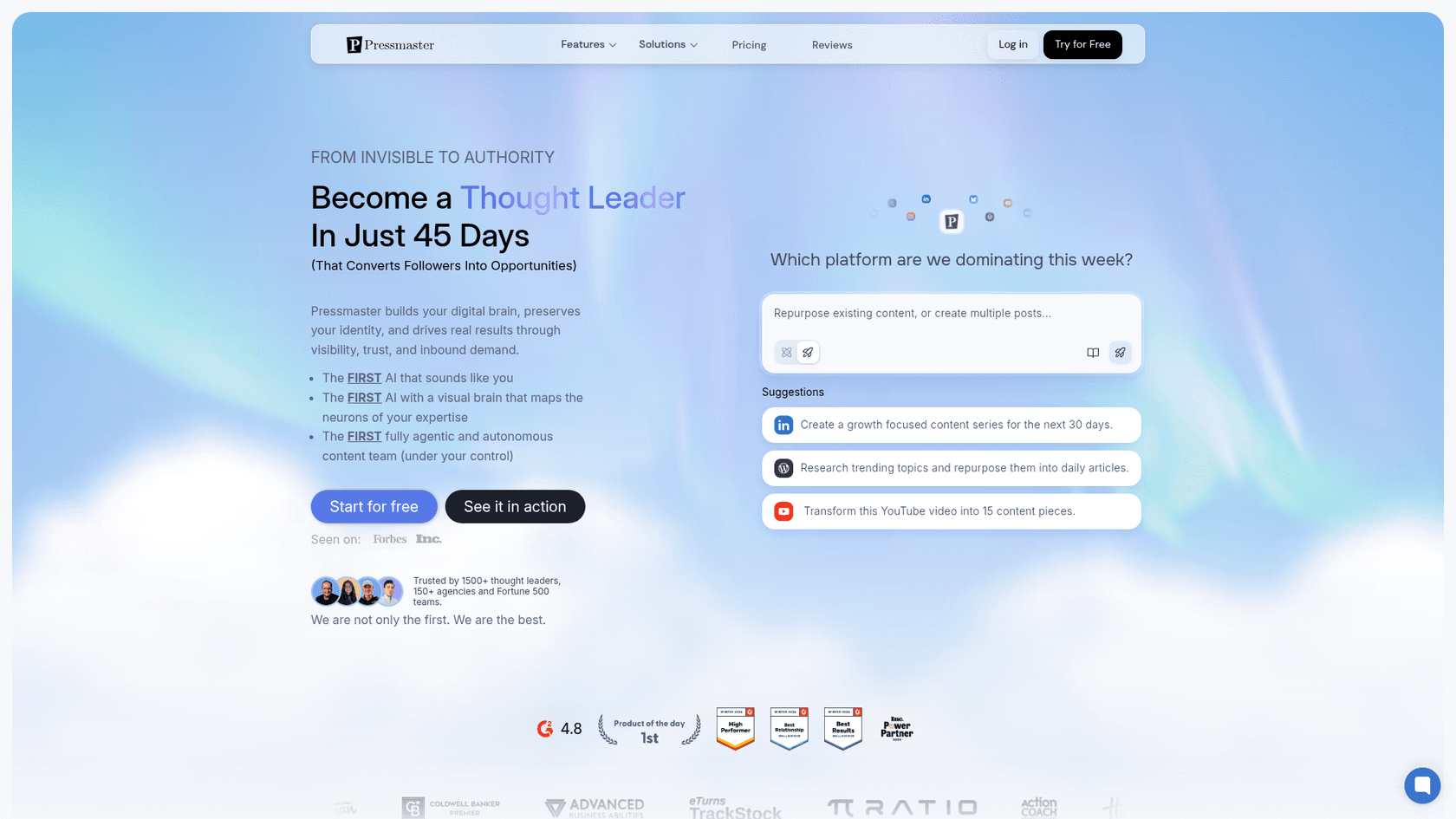
Pressmaster.ai is a highly specialized tool built for a specific crowd: founders, PR teams, and anyone focused on thought leadership. The entire platform is built around an "AI Twin" concept, where it learns your unique voice and expertise to generate content that feels authentic and timely.
Its most impressive feature is Trendmaster, which scans over half a million data sources to spot emerging trends weeks before they go mainstream. This gives you a serious advantage in creating relevant content. Another feature is the AI Interview, which turns a simple conversation with the AI into a series of articles and social media posts. It’s also great at generating visuals like carousels and infographics to go with its content.
The specialization of Pressmaster.ai is both its biggest strength and its main weakness. It’s fantastic for PR, social media, and building a personal brand. However, it is not designed for teams whose main growth strategy is scaling evergreen, SEO-driven blog content. If you are looking to build a foundation of high-ranking articles, this probably is not the tool for you.
Pros:
- Trendmaster feature provides a unique edge for creating timely content.
- Innovative AI Interview feature simplifies content creation.
- Generates shareable visuals like carousels and infographics.
Cons:
- Highly specialized for PR and thought leadership, not SEO blog scaling.
Pricing:
- The Starter plan begins at $12/month per user, billed annually.
5. SEO.ai
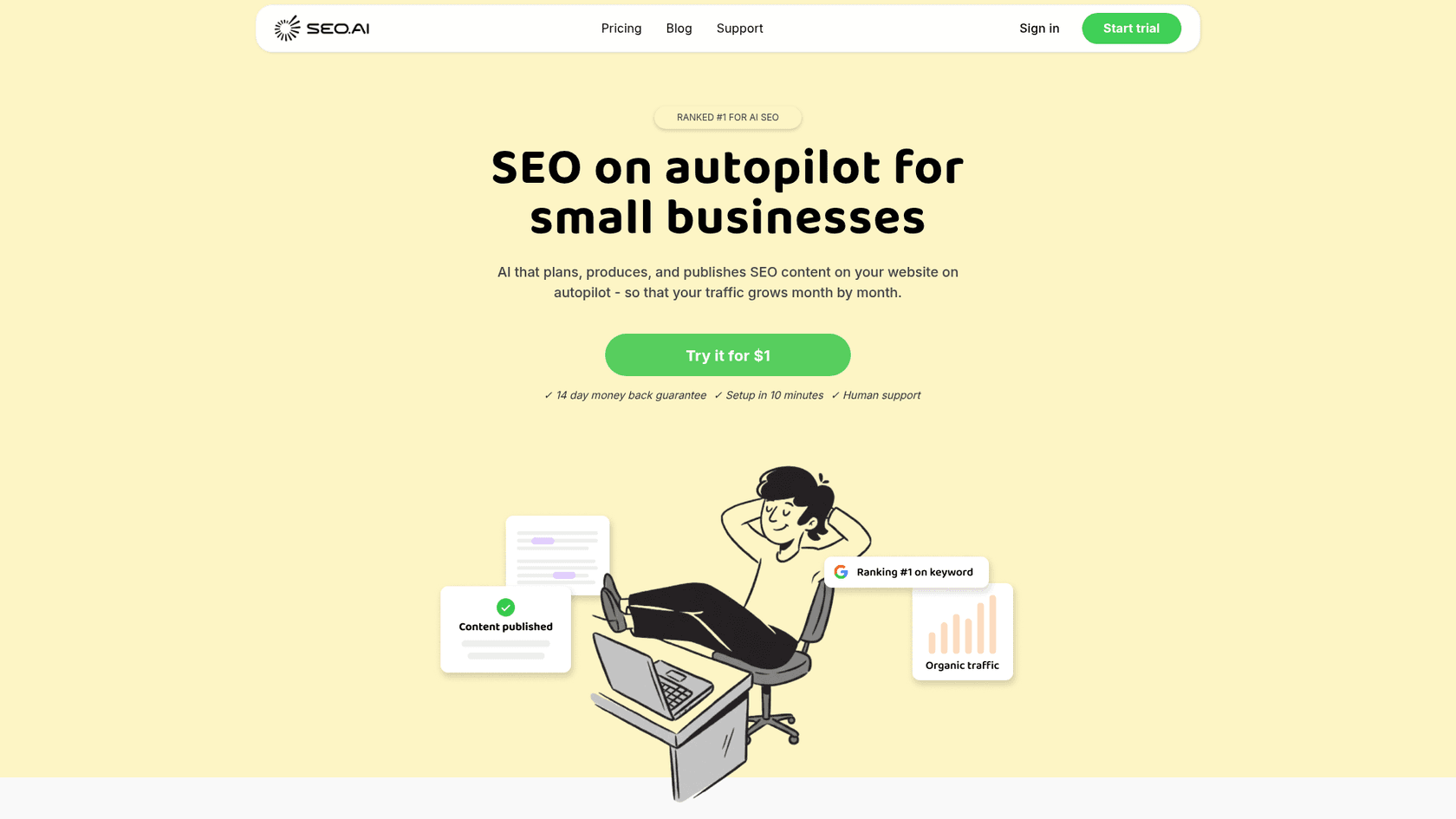
As the name implies, SEO.ai is all about putting your SEO content creation on autopilot. It’s a hands-off solution designed to manage the entire process for you, from keyword research and finding content gaps all the way to writing and auto-publishing articles directly to your website.
The platform's main draw is its end-to-end automation. It crawls your site to find topics you’re missing, then gets to work writing and publishing optimized articles that are aligned with E-E-A-T principles. One of its most unique features is the ability to generate AI images that incorporate your brand's existing visuals, which is a nice touch for brand consistency. It also supports over 50 languages, making it a solid choice for businesses with a global content strategy.
This "done-for-you" approach can be a bit of a double-edged sword. It is perfect for teams who want to set it and forget it. However, it might not be the best fit for more hands-on content teams who like to have creative control over the initial research and drafting process. It’s more of an automated service than a collaborative tool.
Pros:
- Complete end-to-end automation from research to publishing.
- Finds content gaps on your site automatically.
- Creates unique AI images that incorporate your brand's visuals.
- Supports over 50 languages for global SEO.
Cons:
- The hands-off approach may not suit teams that want more creative control.
Pricing:
- The Single Site plan starts at $149/month.
How to choose the right AI content scaling tool
Feeling a bit overwhelmed? Do not worry. Picking the right tool comes down to knowing what you need. Here are a few tips to help you decide.
I can totally relate, I’ve gone through the same cycle of trying every 'AI-powered' tool out there, only to end up juggling five tabs and editing everything manually anyway.

- Figure out what is slowing you down. Where do you waste the most time? If you are stuck on research and writing first drafts, an end-to-end tool is your best bet. If you just need help optimizing existing text, a more specialized tool might work better. Be honest about the problem you are trying to solve.
- Think beyond just text. Modern content needs visuals. A tool that only gives you a text file is leaving you with hours of extra work creating images, tables, and finding videos. Look for platforms that generate a complete post, visuals included.
- Test the "human-like" quality. Every tool claims its output sounds human. Do not take their word for it. Use their free trials to generate an article on a topic you know well. Does it sound like an expert wrote it, or does it just repeat generic, robotic phrases?
- Find a tool that learns your brand. The biggest time-suck is often editing AI content to match your brand's voice and mention your product naturally. A tool that can learn from your website's context, like the eesel AI blog writer, will save you countless hours of manual work.
Using an AI content scaling tool effectively
At the end of the day, there is not one single "best" AI content scaling tool that works for everyone. But there is definitely a best tool for the specific job you need to get done.
If you are a large marketing team that needs tight brand controls and collaboration features, Jasper might be your go-to. If you are focused on automating complex sales and marketing workflows, Copy.ai is a powerhouse. For PR and trend-jacking, Pressmaster.ai has a unique edge, and for a completely hands-off approach, SEO.ai will get the job done.
To see these principles in action, check out this video on how to effectively scale content and distribution with AI. It provides a great overview of turning AI-generated content into a powerful marketing engine.
But for teams that need to scale the creation of complete, high-quality, SEO-optimized blog posts with the least amount of manual work, the eesel AI blog writer is built for that exact purpose. The goal is not just to fill a content calendar; it is to publish articles that actually rank, drive traffic, and help you grow.
Ready to stop drafting and start publishing? Generate your first blog post for free with the eesel AI blog writer and see the difference for yourself.