
Creating a good content brief is a critical task. It often determines whether your content ranks, but it can also be a time-consuming process involving manual research, SERP analysis, and structuring. This can take up a significant part of your day.
What if you could shrink that whole process from hours down to just a few minutes? This is where AI comes into the picture. It automates the tedious parts, giving you a solid, data-backed foundation so you can get back to creative work.
This guide will show you how to create AI-powered content briefs, looking at three different methods. We'll also discuss how tools like the eesel AI blog writer are taking things even further by handling the entire workflow, from keyword to a post that's ready to go live. It's the same tool we used to grow our own blog from 700 to over 750,000 daily impressions in just three months.
Understanding the basics of AI content briefs
First, let's clarify the terms. A regular content brief is a set of instructions for a writer. It lays out the goals, audience, keywords, and structure for a piece of content.
An "AI content brief" builds on that concept. Instead of you manually sifting through Google results, an AI tool does the legwork. It checks the top-ranking pages for your keyword, finds common themes, pulls out key topics and questions, and builds an outline based on what's already performing well.
This approach offers several advantages:
- It's much faster. The most obvious benefit is speed. Research that used to take hours can now be completed in minutes, freeing you up for more strategic tasks.
- It's based on data, not guesses. Your brief is built on what's currently ranking on Google, not just a hunch about what might work.
- It keeps things consistent. Using a tool helps standardize the quality and detail of your briefs, which is great for maintaining consistency across your blog.
- It helps your SEO. The AI automatically finds important keywords, common questions, and related topics you need to include to be competitive.
The essential components of an AI content brief
Using an AI tool is a great shortcut, but it doesn't read minds. You still need to understand what goes into a solid brief to guide the AI and review its output. A good brief ensures the final article is not just optimized for search engines but is also genuinely useful and reflects your brand.
It comes down to four key areas: Audience, SEO, Structure, and Tone.
Defining your objectives
This is all about the purpose of the article. What do you want this piece of content to accomplish? Are you trying to attract organic traffic, generate leads for a new product, or educate your current users? Be clear about the goal so the writer knows what success looks like.
Defining your audience and their intent
Who are you talking to? Be specific. Don't just say "marketers." Think about their specific problems, what they already know, and where they're getting stuck. Are they a beginner or a seasoned pro?
Just as important is figuring out their search intent. What did they expect to find when they typed their query into Google?
- Informational: They need an answer (e.g., "what is a content brief?").
- Commercial: They're doing research before buying something (e.g., "best AI content brief tools").
- Navigational: They're looking for a specific website (e.g., "eesel AI login").
- Transactional: They're ready to make a purchase (e.g., "eesel AI pricing").
If your content doesn't match their intent, it's not going to rank.
The SEO details
Here's where you get into the specifics. Your brief needs to include:
- Primary and secondary keywords: The main keyword you're aiming for, plus a few related terms to include naturally throughout the text.
- On-page elements: Specific instructions for the meta title, meta description, and URL slug. These are important for getting people to click on your result in the search page.
The article's skeleton and structure
This is the basic framework of the article. Give the writer a logical flow with H2s and H3s already planned out. Under each heading, you can add a few bullet points covering key ideas, questions to answer, or specific data points to include. This gives the writer a clear roadmap and helps ensure nothing important gets missed.
Defining the tone and linking plan
Finally, set the tone. Should the article be casual and funny, or more formal and professional? Providing a few examples of your brand's voice can be a huge help. You should also include a list of internal links to other content on your site and suggest a few reputable external sources to cite. This is beneficial for both SEO and building trust with your readers.
Three different ways to create AI content briefs
Let's get into the practical applications. Not all AI briefing tools are the same. Depending on your process, budget, and needs, one of these methods might work better for you.
The all-in-one approach: eesel AI blog writer
This approach offers a streamlined workflow. Instead of creating a brief that you then pass to a writer, the eesel AI blog writer manages the entire process. It merges the brief and the first draft into a single step.
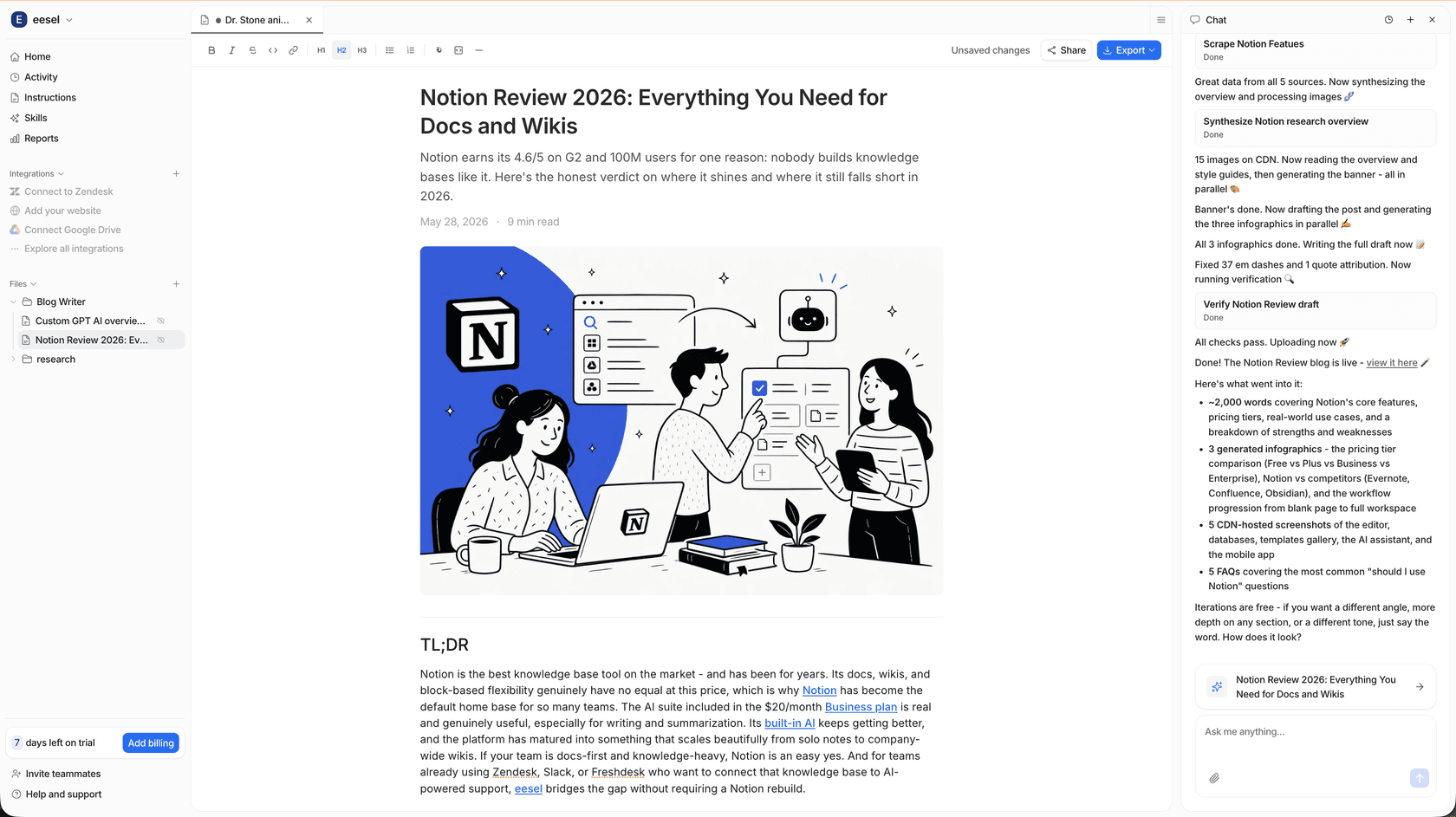
The process is straightforward. You provide a keyword, add your website URL so it can learn about your brand, and it handles the rest. It conducts SERP research, builds an outline, writes the article, and even adds visuals.
Here are some of its key features:
- It creates assets for you. It doesn't just produce text. It generates relevant images, infographics, and data tables to accompany the content, which saves manual work.
- It integrates social proof. It automatically finds and embeds relevant quotes from Reddit threads and YouTube videos to add more depth and real-world credibility.
- It's optimized for AEO. The content is structured for AI Answer Engines like Google's AI Overviews, which increases the chances of your content being featured in summary snippets.
- It's designed to sound human. The model has been refined to produce a natural, human-like tone, avoiding a robotic feel.
Pricing: eesel AI works on a credit system. You can get 50 blog posts for $99, and you can try it for free.
The DIY approach: Using a general tool like ChatGPT
This is a manual, hands-on method. You can use a general Large Language Model (LLM) like ChatGPT as a research assistant to help you build a brief piece by piece. This means you'll be guiding the AI with a series of very specific prompts.
For instance, you might ask it things like:
- "Give me a detailed blog post outline for the keyword 'how to choose a CRM' for an audience of small business owners."
- "Come up with five interesting titles for an article about remote team productivity."
- "Describe a typical B2B SaaS marketing manager who is having trouble with lead generation."
This can be useful for brainstorming, but it has some considerations:
- Requires manual assembly: You have to assemble the brief piece by piece, prompting for an outline, titles, keywords, and audience details, which can be time-consuming.
- Lacks live SEO data: General LLMs can't access the internet in real-time to see what's ranking today. Their information is based on their training data, which might be months or even years old.
- Potential for inaccuracies: These models are known to "hallucinate" or invent facts. Any data or stats they provide need to be carefully fact-checked. While OpenAI provides enterprise-grade security, the models aren't designed for live SERP analysis.
- Generic output: Because it's not analyzing your top competitors, it may produce a generic outline that doesn't have the specific insights you need to stand out.
Pricing: ChatGPT offers a free version, a Plus plan for individuals at $20/month, and a Business plan starting at $25 per user per month.
The specialist approach: Using SEO tools like SurferSEO and Frase
These tools are built specifically for creating SEO-focused content briefs and optimizing text. They are a middle ground between the DIY ChatGPT method and the all-in-one eesel AI workflow. They analyze top-ranking pages and provide a wealth of data to help you build a comprehensive brief.
SurferSEO
- What it does: SurferSEO is well-known for its in-depth SERP analysis. It tells you what you need to do to be competitive, from the ideal word count and keyword density to the exact topics to cover. Its "Content Score" gives you a live grade as you write.
- Considerations: Surfer is effective at telling you what to write, but it doesn't actually write it for you. It's an optimization tool, not a content generator. Some users also find it can be expensive for small teams.
- Pricing: SurferSEO's Standard plan is $99/month (billed yearly) and includes credits for 360 documents a year.
surferseo is great for detailed content optimization but pricey frase is a solid cheaper alternative better for content creation and outlines both work just depends on your needs

Frase

- What it does: Frase is also excellent at creating data-driven briefs. It scans the SERPs and pulls out key topics, headings, and common questions from places like Reddit and Quora. It's also designed to help with GEO (Generative Engine Optimization), which is similar to AEO.
- Considerations: Like Surfer, Frase is mainly a briefing and optimization tool. The AI writing feature is an optional SEO add-on that costs an extra $35/month, which can increase the total price.
- Pricing: Frase plans start at $39/month (billed annually) for 10 articles per month.
I wouldn't use either to actually generate content. I love Frase for doing research, generating content briefs to hand off to writers, and for optimizing existing content.
A quick comparison of different approaches
| Feature | eesel AI blog writer | ChatGPT (General LLM) | SurferSEO / Frase |
|---|---|---|---|
| Primary Function | Integrated content generation | General-purpose Q&A and text generation | SEO brief creation & optimization |
| End Product | Publish-ready blog post | Text snippets and outlines | A content brief or optimized text |
| Live SEO Data | Yes, analyzes SERPs | No | Yes, analyzes SERPs |
| Asset Creation | Automatic (images, tables) | No | No |
| Best For | Teams wanting a fast, end-to-end content workflow | Manual research and brainstorming assistance | SEO specialists building detailed briefs for writers |
| Pricing Model | Credits-based (e.g., $99/50 posts) | Monthly subscription (Free, $20/mo+) | Monthly subscription ($39/mo+) |
Common pitfalls to avoid when creating AI content briefs
Using AI for content briefs can save you a ton of time, but it's easy to stumble into a few common pitfalls. Here’s what to look out for to make sure your AI-assisted briefs lead to great content.
- Relying on it too much: Remember, AI is a tool, not a strategist. A human should always review the brief to add strategic thinking and ensure it aligns with your company's bigger picture. The AI can tell you what's already ranking, but you're the expert on your brand and your customers.
- Forgetting to be original: Since these tools analyze what's already successful, they can sometimes produce outlines that feel a bit derivative. Use the AI-generated brief as a solid foundation, but always look for ways to add your own unique perspective, data, or stories to make your content different.
- Losing your brand voice: An AI can't perfectly replicate your brand's unique personality. It's important to manually add notes about the tone, style, and specific phrasing to the brief so the writer knows exactly how it should feel.
- Skipping the "why": A great brief doesn't just give a list of headings. It explains why each section matters and what value it provides to the reader. This context helps the writer create something that's more than just a list of facts; it becomes a genuinely helpful resource.
For those who prefer a visual guide, watching an expert walk through the process can be incredibly helpful. The video below provides a detailed, step-by-step tutorial on building a comprehensive content brief from scratch, reinforcing the core principles we've discussed.
From brief to published post, faster
Ultimately, AI is an amazing assistant for creating data-driven content briefs quickly. Whether you prefer a hands-on approach with ChatGPT or a data-rich tool like SurferSEO, there's a method that can fit your process.
But the real goal isn't just to make a better brief; it's to create better content, faster. The most efficient modern workflows are those that bake the data-driven insights from the brief directly into the content creation process. This saves a massive amount of time and ensures the final article is perfectly aligned with the SEO strategy from the get-go.
Take the next step with eesel AI
Stop spending hours building briefs and then even more time writing. With the eesel AI blog writer, you can go from a single keyword to a fully researched, structured, and SEO-optimized blog post in a matter of minutes. It’s the fastest way to scale your content marketing without letting quality slide.
Try it for free today and see the difference for yourself.