
It feels like a new AI tool pops up every single day, doesn't it? The hype is real, and it’s getting tough to sort out what’s genuinely useful from what’s just another flashy gimmick. That's why I've spent the last few weeks putting the most popular AI copywriting tools to the test, trying to figure out which ones can actually speed up your workflow without making your content sound like a robot wrote it.
My goal was to find a tool that goes beyond churning out generic drafts. I wanted something that creates content that feels authentic, connects with an audience, and actually gets results. It's the same standard we hold ourselves to with our own content, which has been completely transformed by the eesel AI blog writer. This article is a breakdown of my findings on the top 5 tools, their pros and cons, and who I think each one is perfect for.
What exactly is AI copywriting?
Simply put, AI copywriting is using artificial intelligence to help generate written content for things like marketing, sales, or your company’s blog. These aren’t your old-school spell-checkers. Modern tools use some pretty advanced tech (large language models, if you want to get nerdy) to understand context, tone, and structure. They can generate completely original text that’s often surprisingly coherent.
I like to think of a good AI copywriter as a junior member of the team. It’s an assistant that can handle the heavy lifting of a first draft, research a topic, or structure an outline. It can save you a ton of time, but it still needs your strategic direction and a final polish to really make it shine. It’s not about replacing writers, but about giving them superpowers.
How can AI copywriting tools actually make your life easier?
Alright, let's get practical. How does this stuff actually help? The biggest win for me is smashing through writer's block. We’ve all been there, staring at a blinking cursor on a blank page. An AI tool can give you a starting point, suggest a few different angles for a topic, or help you outline an entire article in minutes. It's a lifesaver when you just need to get the ball rolling.
These tools are also amazing for scaling up your content. Imagine you need to write 50 unique product descriptions or a month's worth of social media posts. A task that would take days can be knocked out in an afternoon. They’re also fantastic for brainstorming. I often use them to generate dozens of headlines, ad copy variations, or different campaign ideas just to see what sticks.
Ultimately, the best approach is a partnership. Let the AI handle the initial draft and the tedious parts of research. You, the human, provide the strategy, creativity, personal stories, and unique brand voice that makes content truly connect with people.
My criteria for choosing the best AI copywriting tools
To keep things fair and consistent, I judged every tool against the same set of criteria. I wanted to make sure I was looking at the full picture, not just how well it could write a sentence. Here’s what I focused on:
- Quality of Output: How human-like and engaging is the content? Does it just need a few minor edits, or are you looking at a complete rewrite? Is it full of fluff, or does it have substance?
- Ease of Use: Is the interface clean and intuitive? Can you jump in and get good results right away, or do you need to watch hours of tutorials to figure it out?
- Features and Specialization: Does the tool offer a bunch of templates for different formats like ads, emails, and social posts? Or does it specialize in one thing, like long-form SEO content, and do it really well?
- Contextual Awareness: How well does the tool understand your instructions? Can it adapt to a specific brand voice, a particular audience, or a complex set of guidelines?
- Value for Money: Pretty straightforward. Does the price feel right for the features and quality you’re getting? Is it a monthly subscription or a credit-based model?
AI copywriting tools comparison
To give you a quick overview, here’s a little cheat sheet comparing the top contenders I tested. This should give you an at-a-glance idea of where each tool shines.
| Tool | Best For | Standout Feature | Starting Price (Monthly) |
|---|---|---|---|
| eesel AI blog writer | Complete, publish-ready SEO blog posts | Generates full articles with assets & embeds | $99 for 50 blog posts (credit-based) |
| Jasper | Versatile marketing content creation | Jasper IQ for brand consistency & Canvas | $69/month |
| Copy.ai | Sales & marketing (GTM) teams | AI-powered workflows for GTM tasks | $29/month |
| Writesonic | SEO and AI search visibility (GEO) | AI Visibility Tracking & Optimization | $49/month |
| Wordtune | Editing and rewriting existing copy | Real-time sentence rewriting & tone adjustment | $9.99/month |
The 5 best AI copywriting tools I tested
Now for the main event. Here’s a deeper look into each tool, based on the criteria I laid out. I spent time with each one, running the same kinds of tasks to see how they’d perform in the real world.
1. eesel AI blog writer
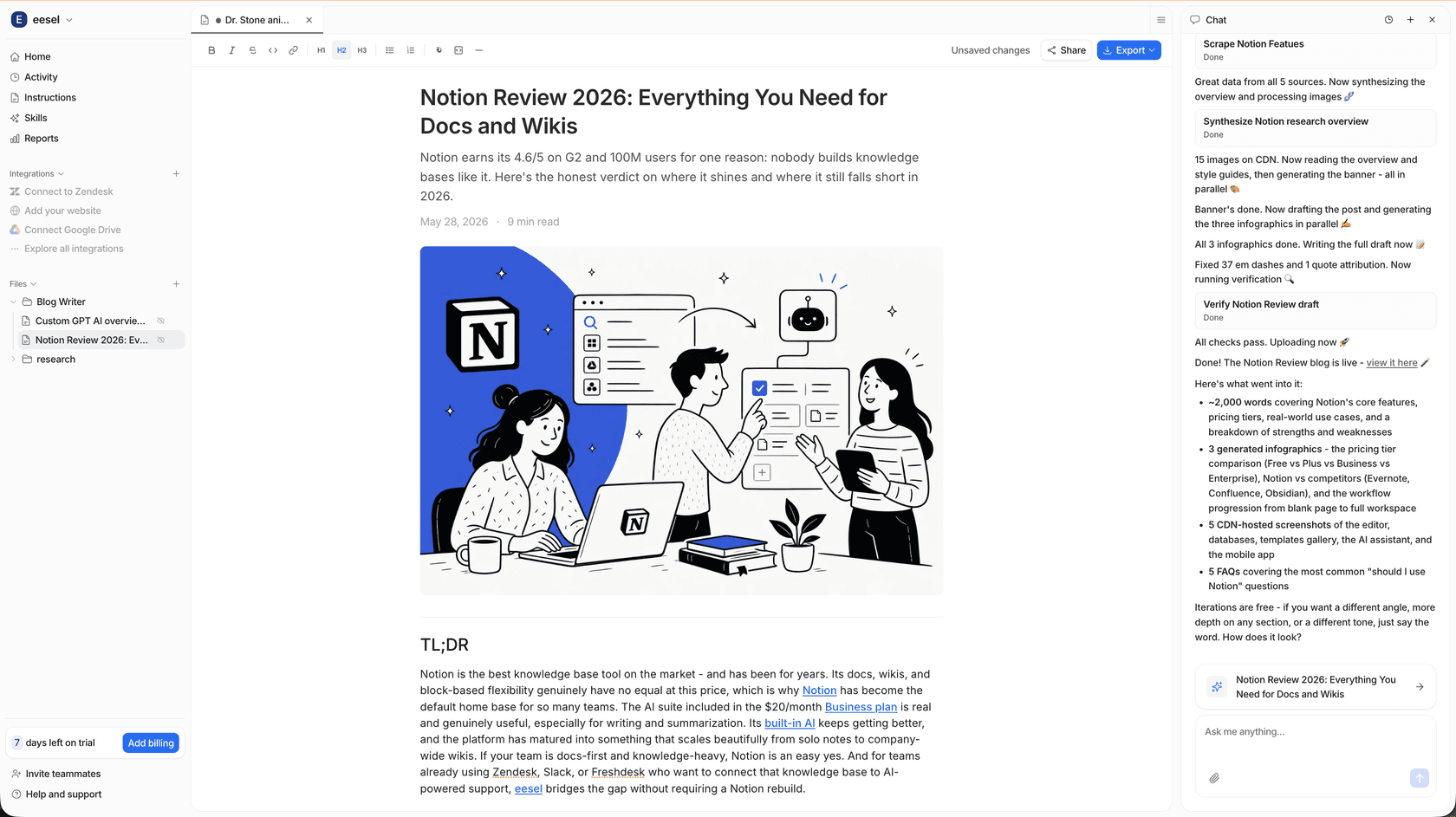
First up is the eesel AI blog writer, and I'll admit I'm a bit biased since it's the tool we use to power our own blog. Its whole approach is different. You don't just get a block of text; you give it a keyword, and it builds a complete, ready-to-publish blog post.
What sets it apart is that it handles the entire process. It does the research, structures the article with proper headings, and even adds assets like AI-generated images, tables, and relevant YouTube videos. My favorite feature is how it pulls in real Reddit quotes to add social proof and make the content feel like it was written by someone who actually hangs out where your audience does.
- Pros: The output is genuinely human-like and is optimized for both traditional SEO and the new wave of AI Answer Engines (AEO). The single biggest advantage is the speed to publishing. You get a finished article, not a rough draft that you have to spend hours formatting and finding visuals for.
- Cons: It's a specialist. It’s designed from the ground up to create amazing long-form blog content. If your main goal is to generate quick social media captions or a single line of ad copy, a more generalized tool might be a better fit.
- Pricing: You can try it out for free. After that, paid plans are credit-based, with $99 for 50 blog posts, which is great because you don't have a recurring monthly bill if you're not actively publishing.
2. Jasper
Jasper is one of the biggest names in the game, and for good reason. It’s a super powerful and flexible platform that’s really built for marketing teams that need to create a wide variety of content.
It’s packed with features. The Canvas lets you and your team work together on content in a free-form document, and its Jasper IQ feature helps maintain your brand voice and consistency across everything it generates. It also has a "Commands" feature that gives you more direct control over the AI's output, which is handy once you get the hang of it.
I like a mix of free Chat GpT and Jasper. Free Chat GPT is actually still better for brainstorming - Jasper doesn’t really always understand the same prompts, the same way. I could ask it to suggest an outline for an ebook blah blah blah and sometimes it takes a lot more correction than chat GPT.

- Pros: Versatility is its biggest strength. You can use it for social media posts, email campaigns, ad copy, landing pages, and more. It’s also built for collaboration, so it’s a solid choice for larger teams.
- Cons: There’s definitely a learning curve. To really master features like Studio and its new Agents, you need to invest some time. And while the output is high-quality, it often benefits from an editor's touch to add a unique brand personality. It’s also on the pricier side.
- Pricing: The Pro plan starts at $69/month per seat, with custom pricing for their Business plans.
3. Copy.ai
Copy.ai has shifted its focus to become more than just a writer. It’s positioning itself as an AI-native Go-To-Market (GTM) platform. This means it’s designed to inject AI across your entire sales and marketing process, making it ideal for teams focused on things like prospecting and lead generation.
It takes a workflow-based approach. For instance, its Prospecting Cockpit can help you research target accounts and draft personalized outreach emails in minutes. Other workflows can automatically process and qualify inbound leads, freeing up your sales team to focus on closing deals.
ease-of-use and friendly interface, compared to other competitors; quality of content is also superior (yet, here is a trick: in a paid plan, it seems to be much better than in a free one).
- Pros: Its main strength is in automating very specific GTM tasks. It’s a huge time-saver for sales teams who need to generate personalized outreach at scale without spending all day on LinkedIn.
- Cons: Because of its focus on GTM workflows, it’s less of a general-purpose writing tool. It does have a module for creating content, but it's not as specialized or powerful for long-form SEO articles as some other tools on this list.
- Pricing: There's a Chat plan with limited features that starts at $29/month for 5 seats. To get access to the more powerful workflow features, you'll need to jump up to a higher-tiered plan.
4. Writesonic
Writesonic is built for the modern SEO professional and content marketer. It’s not just about creating content; it’s an AI Search Visibility and Optimization Platform. It's designed to help you rank not only on Google but also in AI search results from places like ChatGPT and Perplexity.
It has some really interesting features, like AI Visibility Tracking, which shows you where your brand is being mentioned by AI answer engines. It can also suggest automated technical SEO fixes. Its AI Article Writer 6.0 is impressive, creating fact-checked articles with smart internal linking built right in.
- Pros: It’s one of the few tools that’s actively trying to solve the puzzle of Generative Engine Optimization (GEO). The platform gives you actionable data to improve your visibility in AI search, like pointing out where your competitors are being cited as sources and you’re not.
- Cons: It can feel a bit complex if you’re just looking for a simple writing assistant. The heavy focus on SEO and search performance might be overkill for someone who just needs help with general business copywriting.
- Pricing: The Lite plan starts at $49/month (or $39/month if you pay annually), but you'll need a higher-tier plan to access the more advanced GEO features.
5. Wordtune
Wordtune is different from every other tool on this list. It's not a content generator. It's an AI-powered writing assistant and editor that’s designed to improve the words you’ve already written.
Its main function is simple but powerful. You highlight a sentence you've written, and Wordtune will offer you multiple ways to rewrite it for clarity, conciseness, or a different tone (like making it more casual or formal). It also has a cool summarizer tool that works on long articles and even YouTube videos.
- Pros: It’s fantastic for polishing your own writing and helping you break out of those moments when you know a sentence sounds clunky but can’t figure out why. Its browser extension plugs right into Google Docs, Gmail, and other platforms, so it’s always there when you need it.
- Cons: It can’t create content for you. You can’t feed it a keyword and get a blog post back. It’s purely for augmenting and refining your own work.
- Pricing: It has a limited free plan that’s great for trying it out. The Unlimited plan is just $9.99/month when billed annually, making it the most affordable tool on this list by far.
How to get the most out of your AI copywriting tool
No matter which tool you choose, your results will depend heavily on how you use it. Here are a few tips to get the best possible content out of your new AI assistant.
Chat gpt. You have to train it though!
- Be a good manager: The AI is your assistant, not your replacement. You need to give it clear, detailed instructions (or prompts) to get good results. The old saying "garbage in, garbage out" has never been more true.
- Don't accept the first draft: The first output is just a starting point. Don’t be afraid to iterate. Ask the tool to try again with a different tone, to expand on a specific point, or to simplify a complex paragraph.
- Always add your human touch: The AI provides the foundation, but you have to build the house. Add your own stories, personal anecdotes, and unique brand voice. That’s what makes content truly connect with an audience and stand out from the sea of generic AI articles.
- Fact-check relentlessly: This is a big one. AI models can and do make stuff up. They’ll invent facts, statistics, and sources without blinking. Always, always verify any claims before you hit publish.
The future of writing: Human-led and powered by AI copywriting
AI isn't here to replace skilled writers. It's here to augment them. These tools are changing the job, shifting it to be more strategic. The most valuable skills are becoming prompt engineering, critical editing, and creative direction. By embracing these tools, you can free yourself from the more tedious parts of writing and focus on the high-level, strategic work that really moves the needle.
For those looking to dive deeper and see how different tools stack up, watching reviews and tutorials can be incredibly helpful. Seeing a tool in action provides a much clearer picture of its capabilities and workflow than just reading about it.I find it just never listens to my writing instructions. I always get the same AI tropes
The best way to understand the potential is to see it for yourself. You can generate your first complete, SEO-optimized article in just a few minutes with the eesel AI blog writer; it's completely free to start.