I tried dozens of the best AI tools for marketing, here’s what actually works

Stevia Putri

Katelin Teen
Last edited January 6, 2026

The internet is flooded with AI marketing tools right now. It feels like every day a new app pops up promising to change how you work. The problem is, most "best of" lists just repeat the same old names, making it hard to figure out what's genuinely useful and what's just hype.
That’s why I put this together. This isn't another generic list. It’s a hands-on, no-fluff review of the tools I've personally tested and found to actually make a difference for marketing teams. We’ll look at everything from generating ready-to-publish blog posts and creating slick AI videos to automating entire marketing workflows. My goal is to give you a practical guide to choosing the right tools to save time, scale your efforts, and get actual results.
What are AI marketing tools?
At their core, AI marketing tools are software that use artificial intelligence to make marketing tasks faster, smarter, and more effective. But that’s a pretty broad definition.
These tools go way beyond just writing a few lines of ad copy. They can help with a massive range of activities, including:
-
Market and competitor research
-
SEO and content optimization
-
Generating written content (blogs, social media, emails)
-
Creating visual assets (images, videos)
-
Automating repetitive tasks and workflows
Think of them less as a magic button and more as an "AI teammate." The best tools augment your skills, handling the tedious stuff so you can focus on strategy and creativity. This is a core part of the philosophy at eesel AI: AI should work alongside your team, boosting everyone's productivity, not trying to replace them.
How we picked the tools
This list wasn't put together by just looking at features on a pricing page. This selection is based on hands-on testing and is focused on practical outcomes for marketers. I wanted to find tools that don't just look good on paper but actually deliver in the real world.
The 'all-in-one' pitch is always tempting. Be careful though, a lot of these tools do 10 things just 'ok' instead of doing one thing really well.

Here were the core criteria for making the cut:
-
Quality of Output: Does the tool produce high-quality, usable results that don't require hours of heavy editing or rework? The goal is to save time, not create more work.
-
Ease of Use: How quickly can a busy marketer get started without needing a PhD in prompt engineering? An intuitive interface is a must.
-
Specific Function: Does the tool excel at a specific, high-value marketing task? I favored tools that do one thing exceptionally well over jacks-of-all-trades that are mediocre at everything.
-
Value for Money: Does the price justify the time saved and the results delivered? Is the ROI clear and tangible?
A quick comparison of AI marketing tools
For those of you who just want the highlights, here’s a quick rundown of the tools that made the list.
| Tool | Best For | Key Feature | Starting Price (Billed Annually) |
|---|---|---|---|
| eesel AI blog writer | Generating complete, publish-ready blog posts | Turns a keyword into an SEO article with assets & social proof | $99/mo for 100 blogs |
| Jasper | Versatile marketing copywriting & brainstorming | Brand IQ and a suite of templates & agents | $59/user/month |
| Surfer SEO | SEO content optimization and outlining | Real-time Content Score against competitors | $79/month |
| Runway | AI video generation and editing | Gen-4.5 text-to-video and AI Magic Tools | $12/user/month |
| Zapier | Workflow automation and integration | Connecting 8,000+ apps to automate tasks | Free plan available |
The 5 best AI marketing tools
Now, let's dive into the details of each tool and why it earned a spot on this list.
1. eesel AI blog writer
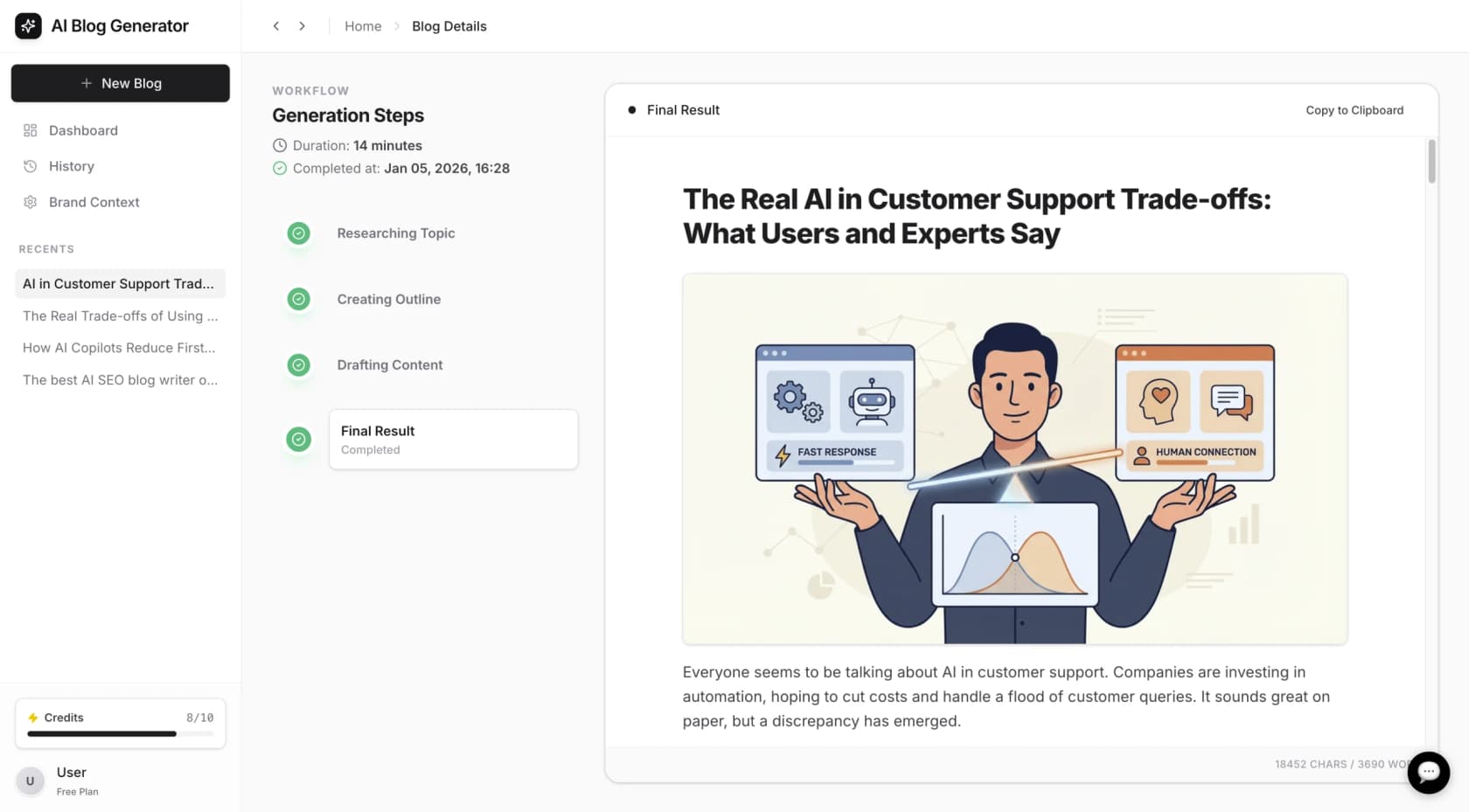
The eesel AI blog writer is a tool built to solve one of the biggest bottlenecks for any marketing team: creating high-quality, SEO-optimized blog content at scale. Its premise is simple but effective: it takes a single keyword and turns it into a complete, publish-ready article. This means a fully structured post with a title, intro, headings, images, and even an FAQ section. The team at eesel AI used this tool to grow their own blog from 700 to 750,000 impressions in just 3 months.
Pros: Its primary advantage is its focus on producing a finished product. It automatically generates and inserts AI images and infographics, finds and embeds relevant YouTube videos, and even pulls real Reddit quotes to add authenticity and social proof. This alone saves hours of manual work sourcing and formatting assets. It’s also optimized for AI Answer Engines (AEO), which is becoming important for getting visibility in Google's AI Overviews.
Cons: It’s a specialist. This tool is designed from the ground up for long-form blog content. If your team is primarily looking for a tool to generate short-form social media snippets or ad copy, you'll probably need to pair this with another solution. It is highly specialized in this one function.
Pricing: It’s completely free to try. The paid plan starts at $99 for 100 blog posts per month.
Ready to give it a shot? Generate your first blog for free.
2. Jasper
Jasper is one of the most well-known AI writing assistants. It’s a versatile tool with dozens of templates for almost any marketing format you can think of, from social media posts and product descriptions to video scripts and ad copy. Its "Brand IQ" feature allows it to learn your company's specific style, tone, and key messaging for more consistent output across all your content. They've also been rolling out newer features like "Agents" and "Content Pipelines" to help automate more complex marketing workflows.
Pros: Jasper’s versatility and feature set are suitable for a wide range of short-form copywriting tasks. The browser extension is handy, letting you use its AI capabilities on many platforms, from your CMS to your social media scheduler. For larger companies, it's worth noting that Jasper is SOC 2 compliant, which means it meets enterprise-grade security standards.
Cons: While it's excellent for generating drafts and brainstorming ideas, creating a full, media-rich blog post still requires manual effort. You'll need to structure the content, find your own visuals, add social proof, and do the final SEO optimization. It functions as an assistant to speed up the writing process, with the user managing the final structure, visuals, and optimization.
Pricing: The Pro plan starts at $59 per user, per month when billed annually.
3. Surfer SEO
If your main goal is ranking on search engines, Surfer SEO is a content intelligence platform that takes the guesswork out of SEO. You give it a target keyword, and it analyzes the top-ranking pages to give you a data-backed brief. This includes recommended word count, keywords to include, topics to cover, and even structural suggestions. Its real-time editor with a "Content Score" guides your writing, showing you how well you’re optimized as you type.
Pros: Surfer's data-driven approach provides clear optimization guidelines based on what Google appears to favor for a given query. The live score helps track optimization progress. It also integrates with tools like Google Docs, WordPress, and even Jasper, creating a smoother workflow.
Cons: The price point can be a bit steep, especially for smaller businesses or freelance marketers. Surfer primarily focuses on optimization. It tells you what to write about, but it doesn't do the writing for you. You still need to create the content yourself or use another AI tool to generate the text before you can optimize it in Surfer. API access is also limited to their highest-tier Enterprise plan.
Pricing: The Essential plan starts at $79 per month when billed annually.
4. Runway
Let's shift gears to visual content. Runway is a suite of powerful AI tools focused on video. Its main feature is the Gen-4.5 model, which can generate short video clips from simple text prompts. This allows marketers to create unique, eye-catching video content without needing a camera or complex editing software. Beyond text-to-video, it offers a bunch of other "AI Magic Tools" like instant background removal, automatic subtitle generation, and object tracking.
Pros: Runway's main benefit is that it makes sophisticated video production accessible, even without prior video editing experience. It's well-suited for creating unique B-roll for your existing videos, engaging social media clips, or abstract visuals for your website. Like Jasper, Runway is also SOC 2 Type II certified, ensuring your data is handled securely.
Cons: The technology is still developing. The video outputs can sometimes be a bit abstract or not perfectly aligned with your prompt. It's best suited for short, creative clips rather than long, narrative-driven videos that require precise control over every scene.
Pricing: Runway offers a free plan with some one-time credits to get you started. Paid plans are very affordable, starting at $12 per user per month when billed annually.
5. Zapier
Zapier isn't an AI content generator in itself, but it’s the "glue" that can connect many marketing tools and automate workflows. It’s an automation platform that lets you create "Zaps" (workflows) between different apps without writing a single line of code. With integrations for over 8,000 apps, the possibilities are nearly endless. Zapier has also been embedding AI features directly into its platform, allowing you to add intelligence to your automations.
Pros: Zapier’s primary feature is its extensive library of integrations, allowing users to connect many tools in their marketing stack. For example, you could create a Zap that automatically generates an AI image in Runway whenever a new blog idea is added to a Trello board, then posts it to a Slack channel for review. This can be effective for saving time on repetitive, manual tasks.
Cons: While simple Zaps are easy to set up, the learning curve can be steep for more complex, multi-step workflows. The number of tasks you can run per month on the lower-tier plans can also be restrictive for high-volume teams, so you might find yourself needing to upgrade as you automate more.
Pricing: A free plan is available for simple, two-step Zaps. Paid plans with more features and tasks start from $19.99 per month when billed annually.
How to choose the right AI marketing tool for your team
With so many options, how do you pick the right one? Here’s a simple framework.
-
Start with Your Bottleneck: Instead of choosing a tool based on popularity, look at your team's workflow and identify the single biggest problem or time-sink you need to solve. Is it the slow pace of content creation? Poor SEO performance? A lack of video content? A mountain of repetitive admin tasks? Your biggest pain point should guide your first purchase.
-
Consider the End-to-End Workflow: Consider how a tool fits into your entire workflow. While a tool that only writes text is helpful, you may still need to spend time on formatting, finding images, and optimizing for SEO. It's useful to look for tools that complete more of the job. For example, the eesel AI blog writer is built to deliver a publish-ready post, handling the writing, asset creation, and optimization in one step.
-
Test with Free Trials: Nearly every tool on this list offers a free plan or a trial period. Use them. There's no substitute for hands-on experience. Generate some content, build a workflow, and see if the output quality and user experience fit your team's process before you commit to a subscription.
To get a broader perspective on how different AI tools can fit into your marketing stack, here’s a helpful video that reviews some top contenders and their specific use cases.
The bottom line: Automate the work, not the strategy
AI marketing tools can handle repetitive, time-consuming tasks, allowing teams to focus more on strategy, creativity, and customer understanding.
Think of AI as a powerful assistant, not a replacement for a skilled marketer. Use these tools to execute your ideas faster and at a greater scale, but always keep your hands firmly on the strategic wheel.
To see how a tool can automate content creation, you can try generating a blog post with the eesel AI blog writer.

Frequently asked questions
Many of the top tools offer [free plans or trials](https://www.eesel.ai/blog/free-ai-tools-for-marketing). Zapier, Runway, and eesel AI all have free options to get you started. If your budget is limited, focus on a specialized tool that solves your single biggest bottleneck first. This ensures you get the most value and a clear return on your investment.
It varies. Some tools are specialists, while others are generalists. For example, the eesel AI blog writer is designed specifically for creating complete, long-form blog posts. A tool like Jasper is more of an all-rounder, with templates for social media, ads, and emails. The "best" tool really depends on the type of content you create most often.
No, they're best thought of as powerful assistants or teammates. AI tools are excellent at [handling the time-consuming parts](https://zapier.com/blog/how-zapier-uses-ai/) of content creation, like drafting, research, and asset generation. This frees up human marketers to focus on higher-level tasks like strategy, brand voice, and creative direction.
Start by identifying your team's biggest pain point or bottleneck. Don't get distracted by a long list of features. The most valuable tool will be the one that solves your most pressing problem, whether that's slow content production, poor SEO results, or too much time spent on manual tasks.
Most modern tools are designed to be user-friendly. Many, like Jasper, offer browser extensions that work across different platforms. For connecting multiple tools, a platform like Zapier is built specifically to [create automated workflows](https://zapier.com/blog/zapier-ai-guide/) between your apps without needing to write any code, making integration much simpler.
Share this article

Article by
Stevia Putri
Stevia Putri is a marketing generalist at eesel AI, where she helps turn powerful AI tools into stories that resonate. She’s driven by curiosity, clarity, and the human side of technology.
