It feels like a new AI tool drops every other day. One minute you’re catching up, the next you’re buried under a mountain of apps all promising to revolutionize your marketing. It’s a lot to sift through, especially when you’re trying to find free options that are not secretly 7-day trials.
I was curious to understand, with these many tools how you guys keep up? The fragmentation feels very hard to maintain, and needs more cognitive skills. I wish there was something that could combine the power of all these together into a single platform.

This guide highlights seven free AI tools for marketing. These tools are selected for their ability to save time, scale content creation, and improve results.
What are free AI tools for marketing?
Simply put, they are apps that use artificial intelligence to help with marketing tasks. They can be thought of as assistants that can automate, streamline, or enhance daily work.
They cover a ton of ground, including:
-
Content Generation: Writing blog posts, social media updates, and ad copy.
-
Data Analysis: Finding patterns in campaign data.
-
SEO Optimization: Helping figure out which keywords to target and how to rank higher.
-
Social Media Management: Scheduling posts and brainstorming ideas.
-
Ad Creation: Generating visuals and copy for paid campaigns.
Now, "free" usually means a freemium model. This means there is a forever-free plan that is genuinely useful. You will not get all the features of the paid versions, but you get more than enough to make a real difference.
How we picked the best free AI tools for marketing
To keep this list practical, every tool here had to meet a few key criteria:
-
Truly Free Tier: It had to have a forever-free plan that provides real value. No 14-day trials that leave you hanging.
-
Practical Impact: It needed to solve a real marketing problem and deliver tangible results, whether that’s saving hours of work or boosting performance.
-
Ease of Use: The tool should be intuitive enough for marketers to pick up and use quickly.
-
Quality of Output: The final product, whether it is a blog post or a design, had to be good enough to use with minimal tweaking.
Comparison of the top free AI tools for marketing
Here’s a quick look at the tools. This table can help you see at a glance which one might be the best fit for your needs.
| Tool | Best For | Key Free Feature | Limitations |
|---|---|---|---|
| eesel AI blog writer | Scaling SEO Content | One full, publish-ready blog post | One free post, then credit-based |
| ChatGPT | General Brainstorming & Drafting | Versatile text generation | Limited access to latest models, generic output |
| Canva Magic Studio | Social Media Visuals | AI-powered design tools & templates | Limited monthly access to premium AI tools |
| Semrush | SEO & Competitor Research | Website audit & keyword research | 10 queries/day; 100 pages per site audit |
| Buffer | Social Media Scheduling | Schedule 10 posts per channel (up to 3) | Basic analytics with 30-day history only |
| Zapier | Workflow Automation | 5 two-step automations ("Zaps") | 100 tasks/month; no multi-step Zaps |
| Veed.io | Quick Video Editing | Simple video editing with captions | Watermark on exports; 720p quality limit |
The 7 best free AI tools for marketing to try in 2026
Let's get into the details of each tool and what makes it worth a try.
1. eesel AI blog writer
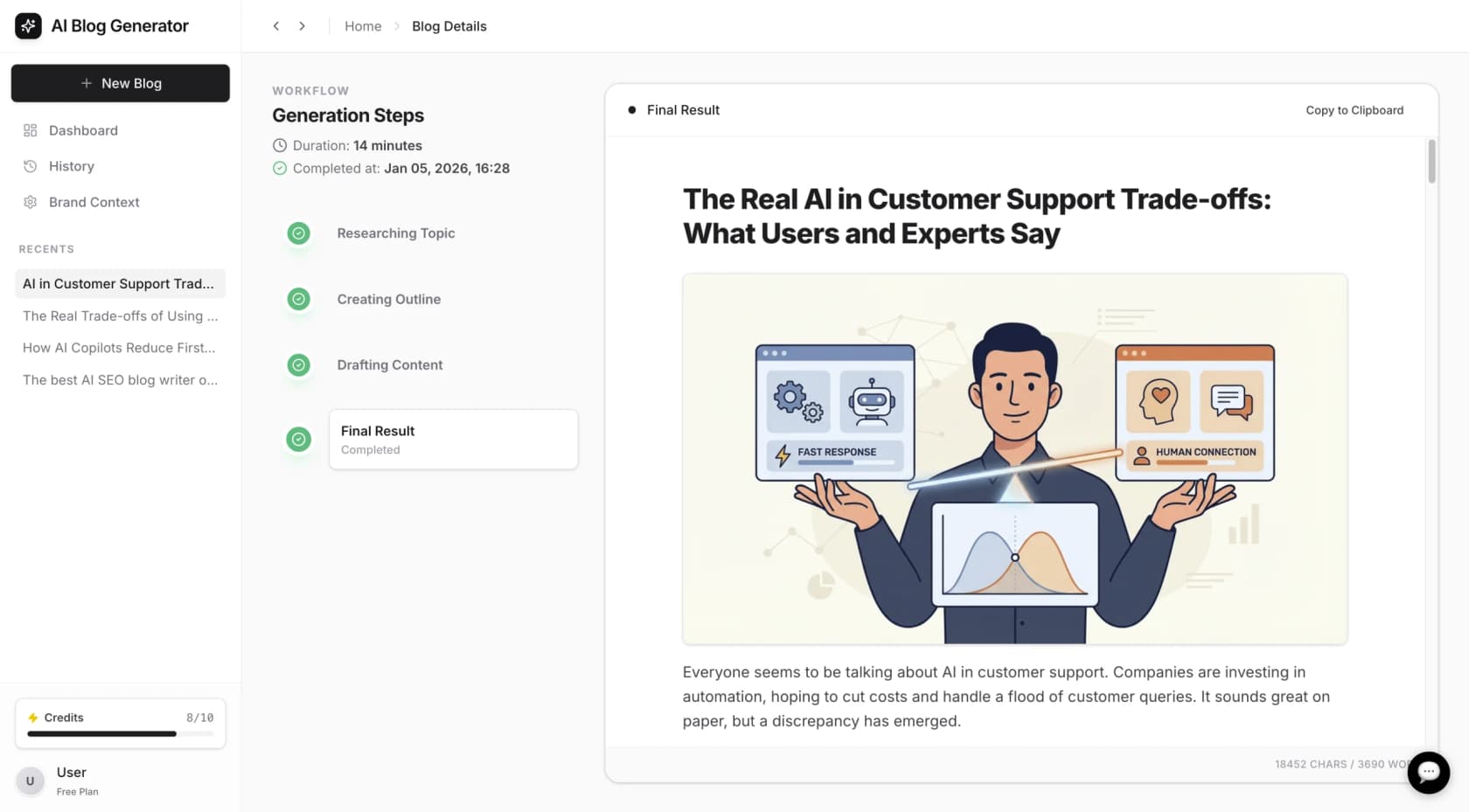
The eesel AI blog writer is designed to produce a complete, SEO-optimized blog post ready for publication. The process involves providing a keyword and your website URL. It generates a full article, complete with headings, AI-generated images, relevant Reddit quotes for social proof, and YouTube video embeds.
-
Pros: The output is a fully structured post with rich media and aims for a human-like tone. It is also optimized for AI Answer Engines (AEO), which helps content show up in places like Google AI Overviews and ChatGPT.
-
Cons: The free trial provides one complete blog post. After that, you will need to buy credits for high-volume creation.
-
Pricing: It is free to try. Paid plans start at $99 for 50 blog posts.
2. ChatGPT
ChatGPT is a versatile tool for a marketer's toolkit. It is useful for brainstorming and getting initial ideas down. You can use it to generate a list of blog topics, draft five different versions of ad copy, come up with answers to common customer questions, or summarize a long research paper.
ChatGPT (with plugins) , for content strategy, quick drafts, ad copy variations, and even SEO schema generation.
-
Pros: The conversational interface is intuitive and makes it easy to use for just about any task. The free version is powerful enough for most day-to-day marketing needs.
-
Cons: The free version gives you limited access to the latest models, has a knowledge cut-off date, and can produce generic-sounding text. You will likely need to do some editing to make the content match your brand's voice.
-
Pricing: A free plan is available. Paid plans like Plus, Pro, and Business give you access to more advanced models and features.
3. Canva Magic Studio
For marketers who are not trained graphic designers, Canva can be a very helpful tool. Their suite of AI features, called Magic Studio, takes this to another level. You can generate images from a text prompt, get layout suggestions, or create an entire presentation by describing what you want. It’s useful for creating social media posts, ad creatives, or blog thumbnails in minutes. It makes creating professional-looking visuals accessible.
-
Pros: The drag-and-drop interface is user-friendly, and the AI features are baked right in, making it feel seamless.
-
Cons: On the free plan, you get limited monthly access to premium AI tools. The more powerful features, like generating custom designs from a prompt, are mostly reserved for paying subscribers.
-
Pricing: A free plan is available. Canva Pro starts at $120/year for one person.
4. Semrush
Semrush is a comprehensive all-in-one marketing platform, but its free version offers powerful features for SEO. You can use it to do keyword research to find what your audience is searching for, track a handful of keyword positions, and run a technical audit of your website to find and fix critical SEO issues. It’s a great way to get a taste of professional-grade SEO data.
-
Pros: The free account gives you access to tools that provide actionable insights into your site’s health and your competitors' strategies.
-
Cons: The limitations are pretty tight. The free plan restricts you to 10 queries per day across all its main research tools and limits the site audit to crawling just 100 pages per month, which is suitable for small sites.
-
Pricing: A free plan is available. Paid Semrush plans start at $165.17/month when billed annually.
5. Buffer
Buffer is a clean, straightforward tool for planning and scheduling social media content. Its AI assistant is a handy addition, helping you brainstorm post ideas or rewrite your copy to fit different platforms like LinkedIn or X. The free plan is great for small businesses or anyone who needs to manage a few social profiles.
-
Pros: Buffer’s interface is uncluttered and easy to navigate. The free plan lets you connect up to three channels and schedule up to 10 posts per channel at a time.
-
Cons: The free plan’s analytics are very basic, offering only a 30-day history. It also lacks more advanced features like engagement tools or detailed reporting that larger teams might need.
-
Pricing: A free plan is available. The Essentials plan starts at $5/month per channel when billed yearly.
6. Zapier
Zapier connects different marketing apps and makes them work together. You can use it to create automated workflows (they call them "Zaps") without having to write a single line of code. For example, you can set up a Zap to automatically save new email attachments to Dropbox, add new leads from a Facebook Ad to your CRM, and then send them a welcome email. It can save significant time by eliminating repetitive tasks.
-
Pros: It integrates with thousands of apps, which means the possibilities for automation are practically endless. The free plan is a great way to learn how it works and automate a few time-consuming tasks.
-
Cons: The free plan is limited to 100 tasks per month and only allows for Zaps with two steps (a trigger and one action). For more complex, multi-step automations, you will need to upgrade.
-
Pricing: A free plan is available. Paid plans start at $19.99/month when billed annually.
7. Veed.io
If you need to create short-form videos for social media but have limited video editing experience, Veed.io is a useful tool. It is a web-based editor that makes creating simple videos straightforward. Its AI features include automatically generating subtitles for videos, removing background noise, and getting rid of awkward pauses. It’s designed for the speed that modern marketing demands.
-
Pros: It’s fast and intuitive for basic edits, adding text overlays, and generating captions. This is useful for Reels, Shorts, and TikToks where most users watch with the sound off.
-
Cons: The free plan puts a watermark on exported videos, which can look unprofessional. It also limits your export quality to 720p and caps video length at 10 minutes.
-
Pricing: A free plan is available. The Lite plan starts at $12/month per editor when billed yearly.
How to choose the right free AI tools for marketing
Here are a few practical tips on how to decide where to start. This simple three-step process can help guide your decision:
-
Start with your goal, not the tool: First, figure out the biggest bottleneck in your workflow. Is it writing blog posts? Creating images? Posting to social media? Once you know the problem, find a tool that solves that specific thing.
-
Understand the "free" tradeoff: Be realistic about the limitations. A watermarked video might be fine for an internal update, but perhaps not for a major ad campaign. A limit of 100 automated tasks might be perfect for a solopreneur, but it may not be enough for a growing team. Know what the limitations are.
-
Combine tools for a powerful stack: The best results come from using these tools together. No single free tool does everything. For example, you could use one tool for ideas, another to generate a full article, create social graphics for it with a third, and then schedule all your promotional posts with a fourth.
Start automating your marketing today
Free AI tools have made powerful marketing tech accessible to everyone, regardless of budget. You don't need a large team or a significant software budget to start automating tasks and getting better results.
For a broader look at how different AI tools can be integrated into a business workflow, the following video offers a great overview of several powerful and free options available today.
The key is to just start. Pick one or two tools from this list that solve a real problem for you, experiment with them, and see how they fit into your workflow.
For those focused on content creation, the eesel AI blog writer is one option for generating SEO-optimized posts from a keyword.
Frequently asked questions
What are the biggest limitations of most free AI tools for marketing?
The most common limitations are usage caps (like Semrush's 10 daily queries), feature restrictions (like Zapier's two-step Zaps), and cosmetic constraints (like Veed.io's watermarks). Free plans are designed to give you a solid taste of the tool's value, but the most powerful features are usually reserved for paid users.
Can I get professional results using only free AI tools for marketing?
Yes, professional results are achievable by strategically combining different free tools. By creating a workflow where each tool handles a specific part of a task (e.g., one for brainstorming, another for content generation, and another for scheduling), you can create a powerful and effective marketing stack.
How do I choose the best free AI tools for marketing for my small business?
Start by identifying your biggest time-sink. If you spend hours writing blog posts, try an AI writer. If creating social media images is a bottleneck, start with a tool like Canva. Do not try to adopt seven new tools at once. Solve your most pressing problem first, then expand from there.
Are free AI tools for marketing safe to use with my company's data?
It depends on the tool and the data. For most marketing tasks like content creation or SEO research, they are generally safe. However, you should always review the privacy policy of any tool and be cautious about inputting sensitive customer information or proprietary company data, especially into general-purpose AI models.
What is the best way to combine different free AI tools for marketing in my workflow?
The best way is to create a process flow. Map out the steps of a marketing task and assign a tool to each step. For example: 1. Use a tool for idea generation. 2. Use another for content creation. 3. Use a design tool for visuals. 4. Use a scheduling tool for promotion. This turns individual tools into a streamlined system.