
Blogging isn't what it used to be. What started as a corner of the internet for online diaries has become one of the most powerful ways for a business to grow. A great blog can build a brand, pull in thousands of visitors, and drive real revenue. But getting there takes more than just writing about what's on your mind.
What is professional blog writing?
Professional blog writing isn't just about being a good writer; it’s about creating content with a clear business goal in mind. Think of it less like a hobby and more like a core part of your marketing.
Here are the key things that set it apart:
- It’s all about the audience: Everything starts with the reader. Professional content is laser-focused on solving a problem or answering a question for a specific group of people. It’s about them, not you.
- It’s guided by data: Guesswork just won't work. Decisions are backed by data, whether you're using keyword research to find topics or looking at analytics to see what's resonating with your audience.
- It aligns with your brand: The content has a consistent voice that reflects your company's personality and expertise. Over time, this builds trust and makes your brand recognizable.
- It has a purpose: Every article has a clear goal. You know exactly what you want the reader to do next, whether that’s signing up for your newsletter, checking out another post, or giving your product a try.
The core elements of professional blog writing
A great blog post is a mix of smart planning, quality writing, and a bit of technical know-how. Let's break down what goes into it.
Strategic planning and research
Great content doesn't just happen; it starts with a solid plan. This is where you figure out what to write and why it matters.
First up is audience analysis. You really need to get inside your reader's head. What are their biggest headaches? What questions are they typing into Google? If you understand what they're looking for, you can create content that actually helps them.
Next is keyword research. This is how you find the exact phrases your audience is using and check if there's enough interest in a topic. The sweet spot is finding keywords that match your business goals and give you a realistic chance of ranking on the first page of Google.
Finally, you need a content outline. A good outline is your roadmap. It gives your post a logical structure, makes sure you answer the user's question completely, and stops you from rambling. It's the best way to ensure you cover all the important points.
High-quality content creation
Once you have a plan, it's time to start writing.
This begins with finding your brand voice. Do you want to sound educational, witty, or straight-up technical? Whatever you pick, stick with it. A genuine, conversational tone usually works best because it helps you connect with readers without sounding like a faceless corporation.
Then, focus on clarity and readability. Use short paragraphs, simple words, and a logical flow. Nobody wants to read a huge wall of text. Google’s own guidelines make it clear that helpful, high-quality content is what matters, no matter how it was made. Breaking up your text with headings, bullet points, and bolded text makes it much easier for people to scan and understand.
Lastly, don't be afraid of storytelling. Weaving in real-world examples, personal stories, or interesting stats makes your content way more memorable than a dry list of facts. It gives your writing some personality and helps you build a real connection with your audience.
SEO and AEO optimization
Writing great content is half the job; the other half is making sure people can find it. This means optimizing for search engines and the new wave of AI-powered answer engines.
The on-page SEO fundamentals are non-negotiable. This includes using your main keyword in your title, headings (H1, H2s), and meta description. It’s a simple way to tell Google what your page is about.
Your linking strategy is also a big deal. Internal links (linking to other pages on your site) help build your authority on a topic and keep readers on your site longer. External links (linking out to other credible sites) show that you've done your homework and help build trust.
Beyond old-school SEO, we now have AEO (Answer Engine Optimization). This is about setting up your content to be the direct answer in tools like Google’s AI Overviews, ChatGPT, and Perplexity. By structuring your content with clear headings, Q&A sections, and lists, you make it easy for AI to grab your content and present it as the definitive answer. Getting AEO right is a huge opportunity, as it can seriously increase conversions by putting your brand front and center when people need you most.
The modern workflow: Manual vs. AI
So, how does all this actually get done? The traditional way is slow and pricey, but modern AI tools are changing everything.
The traditional approach
The traditional method for creating a blog post can be time-consuming. It involves hours of manual research, piecing together an outline, writing a first draft, finding or creating images, and then going through multiple rounds of edits.
This process can lead to delays due to writer's block, challenges in maintaining consistent quality, and the high costs of hiring writers or an agency. For most companies, this model makes it nearly impossible to scale up content without a massive budget.
Limitations of generic AI assistants
The first wave of AI writing assistants, like the standard version of ChatGPT or Jasper, are useful for generating short-form copy. For professional, long-form blog posts, however, they often function best as a starting point.
These tools can sometimes produce generic drafts that require significant editing to sound natural and align with a specific brand voice.
Gemini feels like a tool built by engineers for content farms, not for writers. It can draft copy, sure but it often lacks edge, intuition, or emotional rhythm. The more I use it, the more I realize it’s not a co-writer; it’s a mirror.

Here are a few key things they're missing for a complete blog post:
- They don't create assets like images, charts, or infographics for you. You still have to do that yourself.
- They often don't do the deep, context-aware research needed to write with real authority.
- They can't naturally weave in your brand's messaging or social proof without a lot of complicated prompting.
How eesel AI blog writer creates publish-ready content
Specialized AI content platforms like the eesel AI blog writer are designed to address these challenges by handling the entire workflow, from a simple idea to a finished post.
The process is straightforward: you give it a keyword or topic, and the platform generates a fully structured, SEO-optimized blog post that’s ready to go live. It’s not a rough draft; it’s the final thing.
Here’s what makes it different:
- Context-aware research: The AI automatically finds relevant info for your topic. If you’re writing a comparison post, it will pull pricing data. For a product review, it will find technical specs. This makes sure the content is always well-researched and accurate.
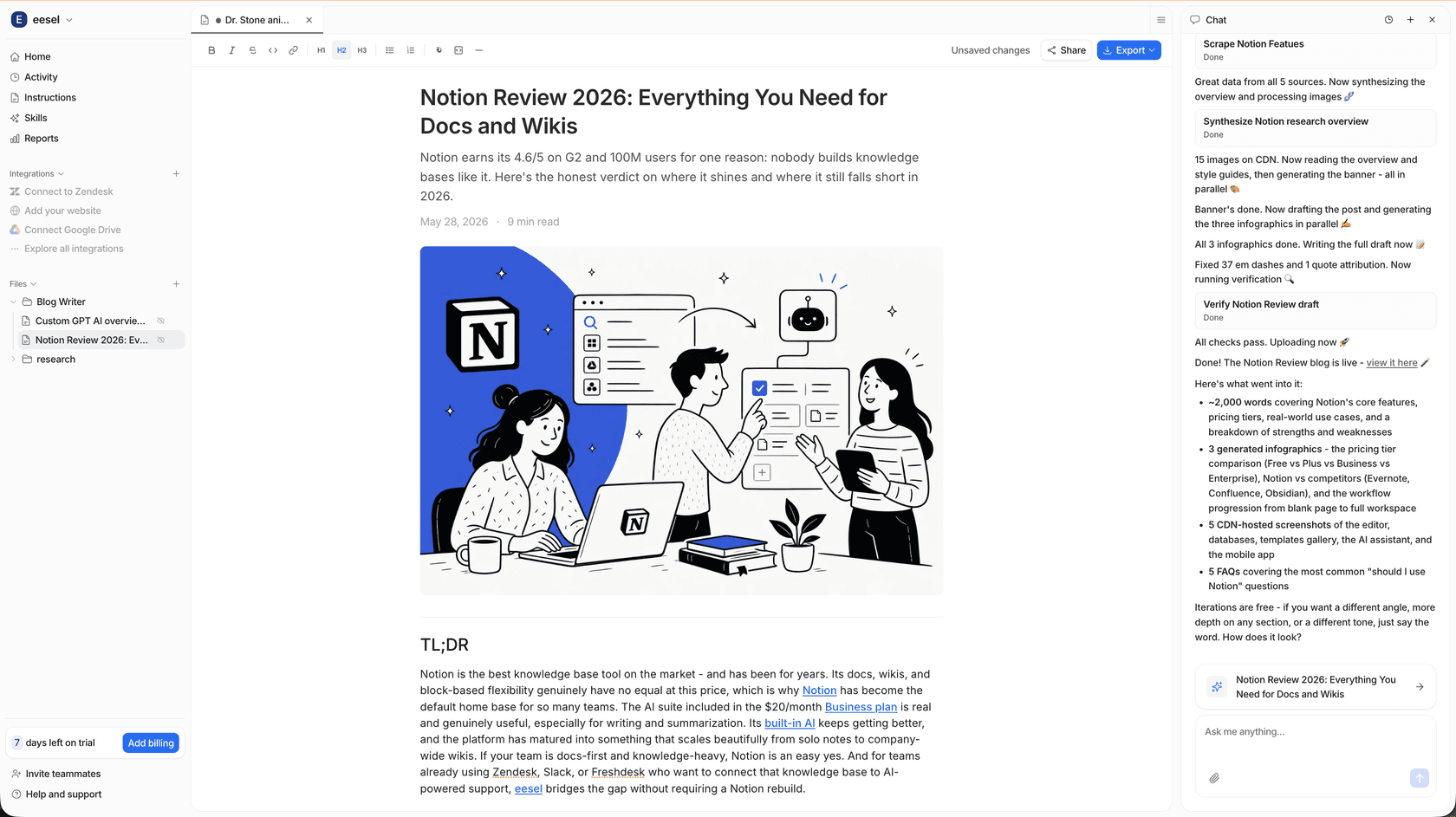
- Automatic asset generation: This is a huge time-saver. The platform creates and embeds relevant AI-generated images, infographics, and tables right into the article.
- Authentic social proof: To add credibility, it automatically finds and embeds relevant YouTube videos and real quotes from Reddit discussions.
- AEO-optimized by default: The content is structured with clear headings, lists, and FAQs, making it perfect for answer engines like ChatGPT and Perplexity.
Instead of just giving you a wall of text, it delivers a complete content package, saving you hours of work on every single post.
Measuring success
Professional blog writing isn't just about hitting "publish." It's about getting results. To know if your work is paying off, you need to track your performance and measure your return on investment (ROI).
Here are a few key metrics to watch:
- Impressions: How many times your content appears in search results. This is the top of your funnel.
- Organic Clicks & CTR: How many people are clicking from the search results to your site.
- Keyword Rankings: Where your content ranks for your target keywords. The goal is page one, ideally in the top three.
- Conversions: How many readers do the thing you want them to do, like signing up for a trial, downloading a guide, or contacting your sales team.
A case study: Scaling with AI
This growth illustrates how an AI-powered content engine can be a significant differentiator for any business focused on SEO.
To see how these principles come together, watching an expert walk through the process can be incredibly helpful. The video below provides a step-by-step guide on how to write a perfect blog post, from initial idea to final publication, reinforcing many of the strategies we've discussed.
Final thoughts
Professional blog writing has become a strategic game that mixes human creativity with powerful tech. The goal isn't just to write more articles; it's to consistently create valuable, easy-to-find content that aligns with your brand and drives real business growth.
For a long time, doing this at scale meant you needed a huge team and an even bigger budget. But with the right platform, any team can now build a professional content engine that gets results.
Start generating professional blog posts today
Tired of the slow, manual content grind? See how the eesel AI blog writer can turn a single keyword into a complete, SEO-optimized blog post in minutes.
It’s completely free to try. Generate your first publish-ready article now and see the difference for yourself.



