The internet is home to millions of blogs, with new posts going live daily. With so much content available, much of it can feel generic, written primarily to rank in search results rather than to build a genuine connection with the reader. It can be forgettable.
The difference between content that disappears and content that builds a loyal following is effective brand blog writing. It’s the art of taking your company’s unique personality, its values, and its distinct voice, and weaving them into every single post. It’s how you stop sounding like everyone else and start sounding like you.
This guide is here to help you do just that. We'll walk you through what brand blog writing actually is, why it's so important for building authority, and how you can do it consistently. We’re covering everything from defining your brand's voice to using the right tools to scale your content without losing that human touch.
We'll also show you how tools like the eesel AI blog writer can help you create on-brand content at scale. It's the same tool we used to grow our own daily impressions from 700 to over 750,000 in just three months.
What is brand blog writing?
Brand blog writing is the process of creating content that consistently reflects your brand’s identity, personality, and values in every article you publish.
This goes way beyond just slapping your logo on a post. Your brand isn't just a color palette or a font; it's the sum of every interaction people have with your company. Brand blog writing is about making sure your content is a core part of that experience. It covers the personality your brand projects (your voice and tone), your unique viewpoint on industry topics, and the core principles your brand stands for.
This approach differs from SEO-driven articles that are designed primarily to capture a keyword. While SEO is important (we all love organic traffic), generic content doesn't build relationships. Brand writing does. It aims to connect with the reader on a human level, turning a one-time visitor into a loyal follower.
When your content is consistent and authentic, people start to see you as a reliable source of information, which builds trust and credibility. Sharing a unique perspective confidently positions you as an authority in your niche. And when people resonate with your brand, they don't just follow a blog; they join a community. In a competitive market, a strong brand voice is your best tool for standing out.
The core pillars of successful brand blog writing
To really nail brand blog writing, you need to understand its core components. These are the pillars that hold up your brand's written identity, turning your blog from a collection of articles into a cohesive experience.
Defining your brand voice and tone
First, let's clear up a common point of confusion: voice and tone are not the same thing, but they work together.
Voice is your brand's core personality. It’s the constant, underlying character of your writing. Are you witty and informal? Authoritative and direct? Friendly and encouraging? This should stay consistent across everything you publish. Think of it as who you are.
Tone is the emotional inflection you apply to that voice. It’s flexible and adapts to the specific topic, audience, and goal of a piece of content. For example, a blog post announcing a new feature might have an upbeat, enthusiastic tone. A post addressing a customer pain point would shift to a more empathetic and supportive tone. Tone is how you say it in a given situation.
A great example is Mailchimp, whose voice is consistently friendly, helpful, and a little quirky. Compare that to a brand like IBM, whose voice is authoritative, professional, and technical. Neither is right or wrong; they’re just different personalities that attract different audiences.
Establishing your visual identity
Your brand’s personality isn't just about the words you use. Visual consistency is just as important for creating a memorable experience. This means your blog posts should be instantly recognizable as yours, even if someone just glances at the page.
A consistent visual identity starts with the basics, including a recognizable logo, color palette, and typography. For businesses that want to create a professional visual identity without hiring a designer, an online logo maker can be a practical way to develop a polished logo that fits their brand.
This includes the consistent use of fonts for headings and body text, incorporating your brand colors in graphics and call-to-action buttons, and having a specific style for your images, whether they’re custom illustrations or branded screenshots.
A tool like Canva's Brand Kit is perfect for this. It allows you to centralize your assets so that anyone on your team can create visual assets that are perfectly on-brand every single time.
Showcasing your unique perspective
This is a key element of your brand. With the increase in
and recycled information, your unique perspective is a significant asset. Don't just report on what's happening in your industry; take a stance. Have an opinion.An 'AI' writers will simply take a search query you specify. Download the text of the top 10 results. Text mine the results and find common words. Use the most popular semantic linking profile. Write the first iteration of text and then paraphrase. There is one major flaw with all 'AI' writers however. The semantic linking profile that it uses is the same across most 'AI' articles. Google can determine this by looking at the top results for your search query and look at how each article is written.

Your blog is the perfect place to connect your content back to your company's mission and values. For instance, if one of your core values is transparency, you could write a post breaking down your pricing structure and explaining why it's set up that way. If you value community, you could feature customer stories or expert roundups. This is how you move beyond simply providing information and start building a brand that people believe in.
How to be consistent with your brand blog writing
Knowing what on-brand content looks like is one thing. Producing it consistently, especially as your team grows, is a whole other challenge. Here’s a practical framework to keep everyone on the same page.
Create a brand style guide
If you don't have a brand style guide, make one. This document is your central source of truth for all things content. It’s the rulebook that ensures everyone writing for your brand is speaking the same language. It's not about stifling creativity; it's about providing a framework so creativity can flourish within your brand's identity.
Your style guide should include:
- Written Guidelines: Your brand mission, a detailed description of your voice and tone with examples, and specific grammar rules (e.g., do you use the Oxford comma? Are contractions okay?).
- Visual Guidelines: Correct logo usage, your color palettes with hex codes, and typography standards.
- Do's and Don'ts: Provide clear, side-by-side examples. For instance: Do: "Use simple, direct language." Don't: "Leverage corporate synergies to operationalize key business verticals."
Develop a content strategy
Random acts of content don't build a brand. A content strategy ensures that every blog post you publish has a purpose. It should align with your brand pillars and work towards a specific business goal, whether that's building awareness, generating leads, or educating customers.
Once you have a strategy, a content calendar helps you execute it. A calendar keeps your publishing schedule regular and predictable, which builds anticipation with your audience and reinforces your brand as a reliable source of information.
The challenge of scaling content
Here's a pain point almost every growing company feels. Maintaining brand consistency is straightforward when it's just one or two people creating content. But what happens when you bring on more team members, hire freelancers, or work with guest writers?
That's when inconsistencies start to creep in. The tone might be slightly off in one post. The formatting might be different in another. The unique perspective that defined your early content gets diluted. This is the challenge of scaling, and it’s where many brands start to lose that special something that made them stand out.
Tools and techniques for effective brand blog writing
So, how do you solve the scaling problem without hiring an army of brand police? The answer lies in using the right tools and techniques designed to help you create on-brand content, faster.
Using the eesel AI blog writer for content at scale
This is where a new generation of AI tools comes in, and it's a problem we were obsessed with solving. The eesel AI blog writer is a platform built specifically to solve the challenge of scaling on-brand content. It goes beyond generic AI writers by actually learning and applying your brand context to everything it creates.
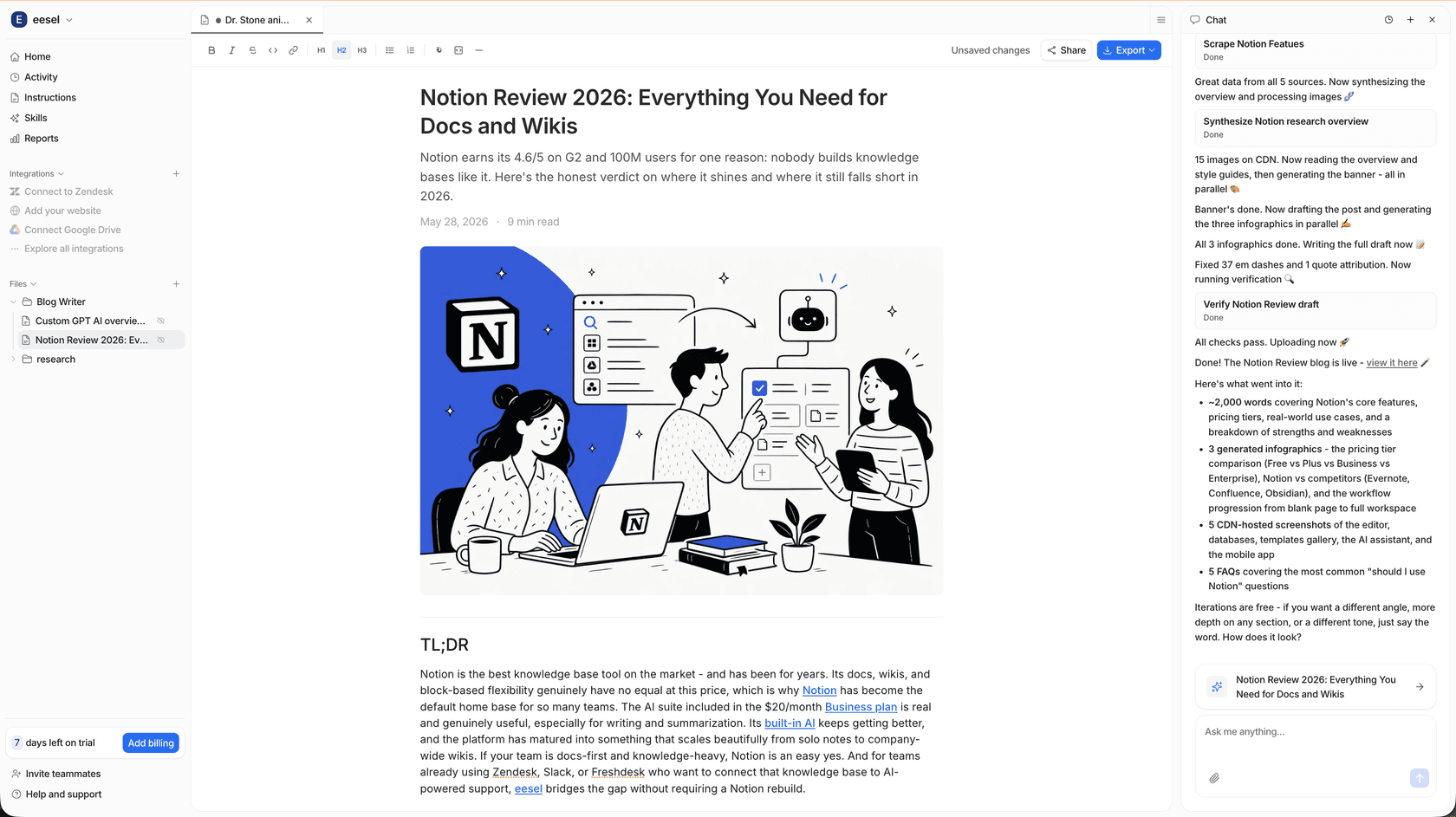
Here’s how it helps you stay on-brand, even at scale:
- It learns your brand instantly. You just provide your website URL. eesel AI automatically scans your site to learn about your products, services, voice, and messaging. This context ensures that any product mentions feel natural and relevant, not forced.
- It generates complete posts. Instead of giving you a rough draft that your team has to spend hours editing, it produces a publish-ready article with a full structure, including an intro, headings, FAQs, and a conclusion.
- It includes automatic assets. A huge part of brand consistency is visual. The tool creates and inserts AI-generated images, infographics, and data tables directly into the blog post, saving your team hours of design work.
- It adds social proof. To build trust, content needs to feel authentic. The eesel AI blog writer automatically finds and embeds relevant Reddit quotes and YouTube videos on your topic. This adds a layer of real-world proof and trustworthiness, which is crucial for E-E-A-T (Experience, Expertise, Authoritativeness, and Trustworthiness) in SEO.
It’s about using AI to write better and more consistently, embedding your brand's DNA into every piece of content.
Other essential tools for consistency
While an AI writer is powerful, it works best as part of a larger toolkit. Here are a few other essentials:
- Visuals: A platform like Canva is a must-have. Its Brand Kit feature lets you store your brand assets, making it easy for anyone on your team to create on-brand graphics.
- Grammar & Style: Tools like Grammarly Business take this a step further. You can create a company-wide style guide that provides real-time writing suggestions to your team.
- Planning: To manage your content calendar and keep the team aligned, a solid project management tool is key. Platforms like Asana or Trello are perfect for mapping out your content pipeline.
For a deeper dive into developing a unique voice that resonates with your audience, the following video offers some excellent, non-confusing ways to find your brand voice as a creative or small business owner.
Final thoughts on brand blog writing
Successful brand blog writing is a mix of three things: a clear identity, a solid strategy, and the right tools to execute it consistently. It's about moving beyond the endless chase for clicks and instead focusing on building a genuine connection with your audience. When you do that, you establish true authority and create something much more valuable than a high ranking: a loyal community.
Investing in on-brand content is investing in a long-term asset. It builds trust, fosters loyalty, and gives people a reason to choose you over competitors who all sound the same. It's how you turn your blog into your brand's most powerful voice.
Ready to scale your content without losing your brand's soul? Try the eesel AI blog writer for free and generate your first publish-ready, on-brand article in minutes.