


Why "AI blog writer" means very different things
There's a category-confusion problem at the heart of this whole space. Half of these tools market themselves with the same words and do completely different things underneath.
A 2026 example: Jasper, Writer.com, Frase, and eesel AI all describe themselves as "AI for content" on their homepages. Jasper is a marketing-team app for drafting on-brand campaigns. Writer is an enterprise platform for building agents that draft anything across regulated workflows. Frase is a SERP-mirroring research-plus-draft tool for SEO teams. eesel AI is an autonomous teammate that takes a keyword and ships a published, internally-linked blog post.
Four products. One marketing surface. Same homepage hero copy. Picking by feature list will burn you because the feature lists overlap; picking by category is what actually leads to a tool you keep using.
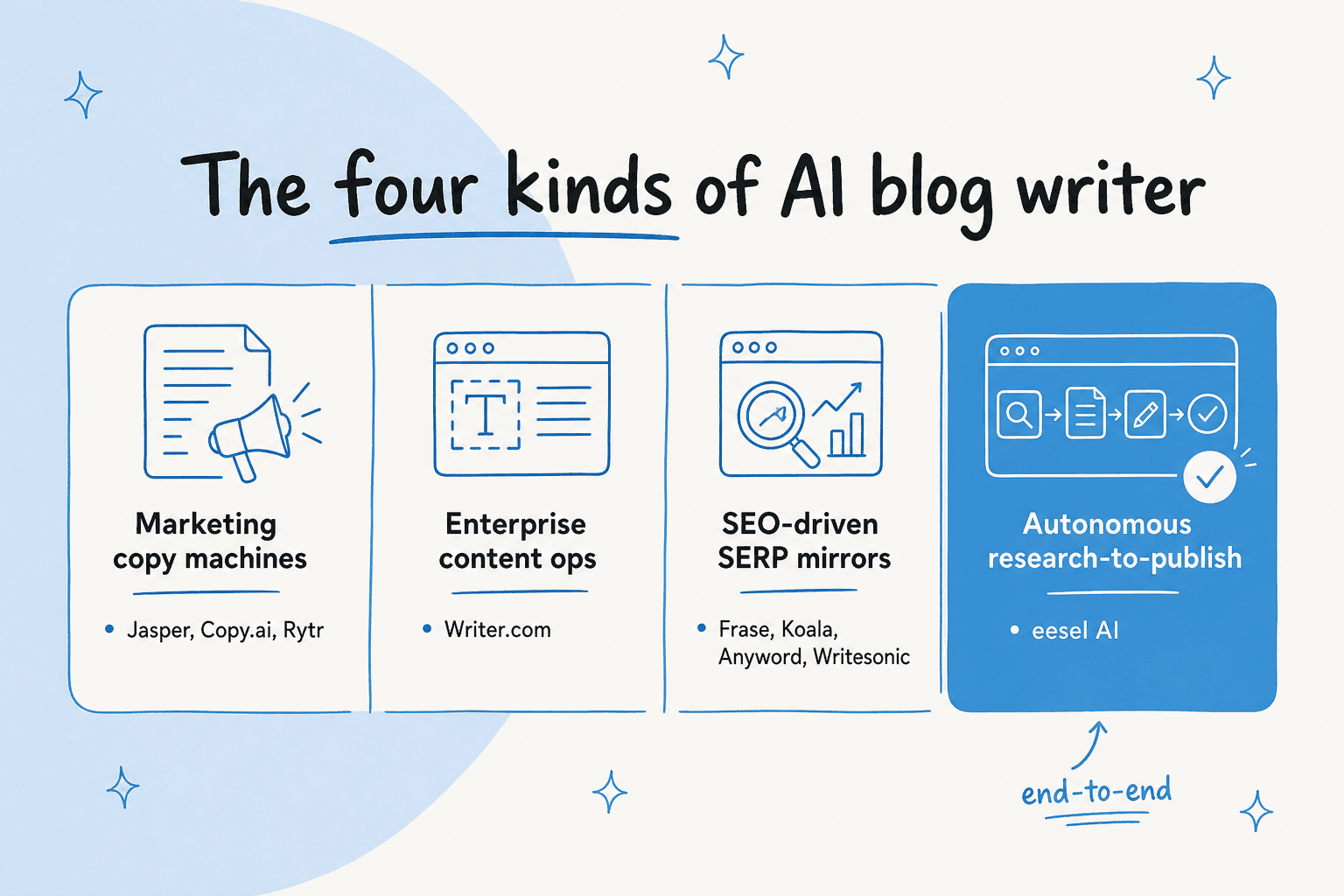
The four lanes, in plain language:
- Marketing copy machines. Templates, brand voice profiles, and a long-form editor. You drive; the AI assists. Examples: Jasper, Copy.ai, Rytr.
- Enterprise content operations. A platform for IT and content ops, with custom models, audit logs, and SSO. The buyer is procurement, not a marketer. Example: Writer.com.
- SERP-driven SEO writers. Tools whose default loop is "scrape the top 10 results for a keyword, then draft against that brief." Examples: Frase, Koala AI, Anyword Blog Wizard, Writesonic.
- Autonomous research-to-publish. You give it a keyword and a CMS connection. It ships a post. Example: eesel AI.
If you read no further, that mental model is the whole post.
How we picked these nine examples
We did three things before writing:
- Read every public marketing and pricing page for each tool in the last week of May 2026, then cross-checked the headline claims against G2, TrustRadius, Gartner, and Reddit threads where the platforms let us in.
- Wrote at least one full long-form post inside each tool to see what the actual drafting experience is like. Some of those drafts were great. Some collapsed at 600 words. Both are useful signal.
- Cross-referenced the bigger comparison work we've already published, including our 2026 AI blog writer test and the 6 best AI blog writer tools reviewed, so this piece doesn't repeat the same tests on the same tools.
The cut: tools had to be a blog writer, not just a generic LLM wrapper. ChatGPT and Claude are excellent for drafting, but they are not what people mean when they search for an "AI blog writer example." We left them off and instead grouped the tools that ship blog-specific features (research, SEO scoring, hero images, CMS publishing).
The nine AI blog writers at a glance
| # | Tool | Best for | Entry price (2026) | Output focus | Verdict |
|---|---|---|---|---|---|
| 1 | eesel AI | Teams that want autonomous research-to-publish | $4 per blog post | Researched, brand-voiced, fully published | Best for hands-off scale |
| 2 | Jasper | Marketing teams with a real brand voice | $59 / seat / mo (annual) | On-brand marketing copy + long-form | Best for brand-led teams |
| 3 | Writer.com | Regulated enterprises buying a platform | Contact sales | Custom agents, governance, brand voice | Best for enterprise content ops |
| 4 | Copy.ai | GTM teams blending content + sales workflows | $24 / mo (Chat) → $1,000 / mo (Growth) | Workflows + brand-voiced drafts | Best when content is part of GTM |
| 5 | Writesonic | Marketers chasing AI search visibility | $79 / mo (Starter) | GEO + SEO drafts + tracking | Best if GEO is on your roadmap |
| 6 | Frase | SEOs who want a brief and a draft in one | $49 / mo (Starter) | SERP-mirrored briefs and drafts | Best brief-led SEO writer |
| 7 | Koala AI | Solo SEOs who want one-click long-form | $9 / mo (Essentials) | 3,500+ word SEO articles, WordPress push | Best one-click blog generator |
| 8 | Anyword | Performance-marketing teams who score copy | $49 / mo (Starter) | Performance-scored marketing + blog | Best for copy you A/B test |
| 9 | Rytr | Solo creators on a budget | $7.50 / mo (Unlimited, annual) | Short and long-form drafts | Best cheap entry |
There's a more detailed comparison in our 2026 AI blog writing tools roundup, but the table above is enough to make a shortlist.
Below, each example gets the same five sub-sections in the same order: what it is, what we liked, what we didn't, pricing, and a labelled Our take.
1. eesel AI, autonomous research-to-publish
Best for: teams who want a published, internally-linked, brand-voiced blog post from a keyword without sitting in front of the model.
What it is
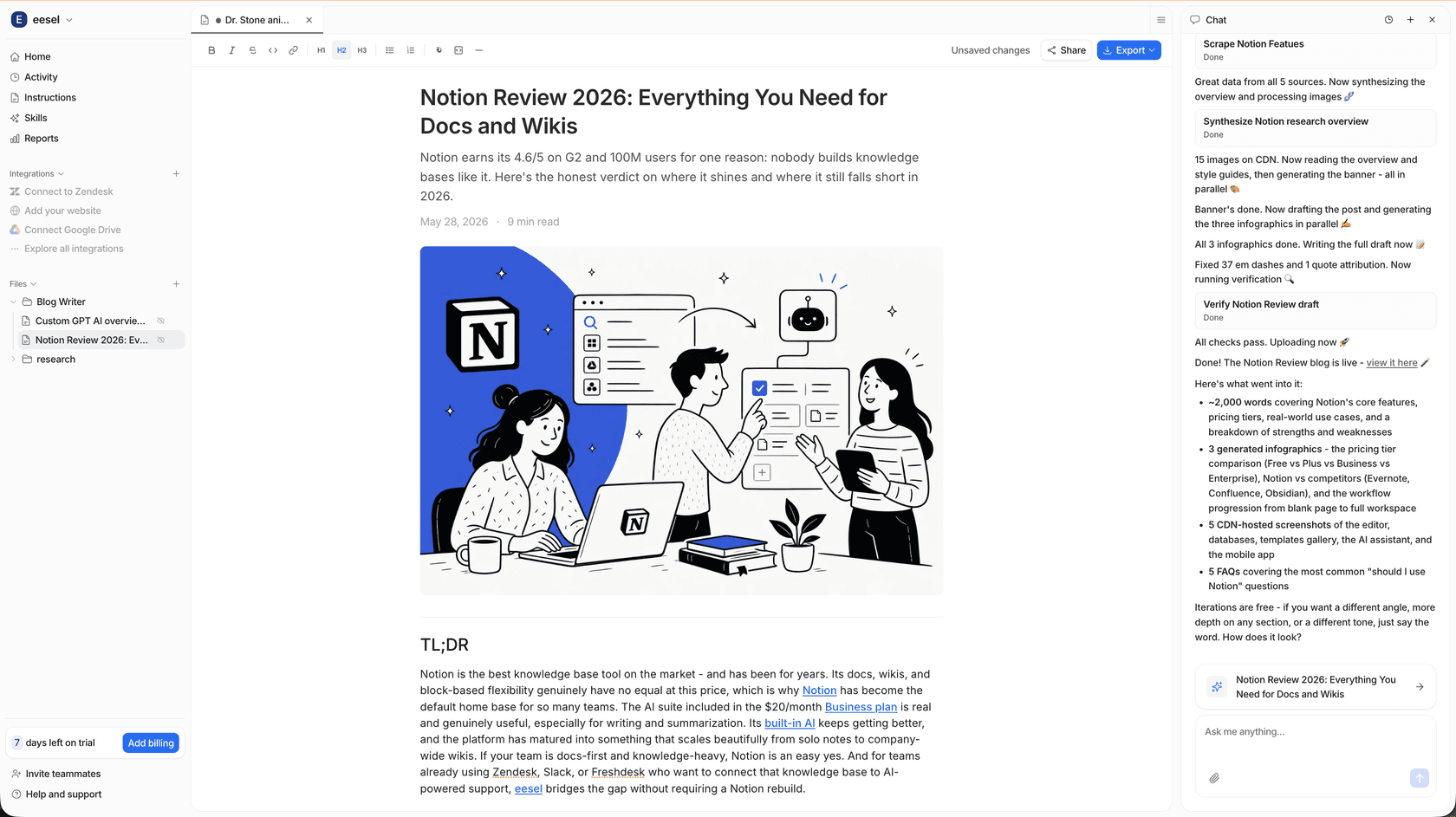
eesel AI sells itself as an AI teammate platform, and the Blog Writer is one of its named agent roles alongside the Helpdesk Agent and the E-commerce Agent (eesel homepage). The product pitch is meaningfully different from everything else on this list: you don't open an editor and prompt it. You hand the agent a domain and a keyword from the dashboard chat or a webhook, and it goes off and does the post.
In practice that means the agent scrapes the top 10 SERP results for the keyword, pulls your internal sitemap so it can interlink, follows the company-specific style and rules you've stored, generates a hero banner, decides on 3 to 5 in-body infographics or screenshots, writes 2,000 to 3,000 words against the brief, drops a 5-question FAQ schema block, and then publishes the result to WordPress, Webflow, Ghost, or your own CMS through an integration. The whole loop runs in roughly 12 to 20 minutes per post.
The clearest customer signal that this works at scale: a Webflow-based SEO content team is using the Blog Writer to ship roughly 360 posts per month (about 12 a day) from a single keyword-to-publish pipeline, with bulk review and bulk publish baked in.
What we liked
- The "give me a domain and a keyword" interface is genuinely faster than picking templates. The fastest path to a finished post we found on this list.
- Brand voice and rules are inherited from your sitemap and a few example posts. No multi-step voice training session.
- Localisation works without prompting. A German baby-textile e-commerce brand has used the Blog Writer about 15 times across keywords to produce 2,000 to 2,900-word German SEO posts with hero banners, in-body infographics, FAQs, and internal links, all in German out of the box.
- Pricing is per post, not seat-based. $4 per blog post means you don't pay for the seats that aren't writing.
What we didn't
- You give up real-time hand-editing. The agent is best at first-draft-to-published. If you're the kind of writer who wants to live inside the document for two hours, this isn't your workflow.
- Restrictive CMSes can break the publish step. If your CMS doesn't accept Markdown, doesn't support FAQ schema, or doesn't take metadata fields, you have to copy-paste. One licensed therapist on a restrictive site builder hit that exact wall before realising the constraint was on the publishing surface, not the writer.
- It's overkill for one-off drafts. If you write a post a month, you're not the buyer.
Pricing
No seats: $4 per blog post, and 100 free credits (no card) let you try before paying (eesel pricing). eesel's support agent is sold separately on credit plans from $299/mo for 500 credits (1 credit per ticket or chat), with everything included.
Our take: the only example in this list where the verb is "publish," not "draft." If you want a single agent that takes a keyword and ships a finished post into your CMS, this is the example. If you'd rather hand-write every draft yourself, the marketing copy machines below will fit you better.
2. Jasper, marketing teams with brand voice at scale
Best for: marketing teams whose biggest problem is keeping fifteen writers and ten freelancers on-brand.
What it is
Jasper is the canonical "AI for marketing teams" platform. The 2026 product surface is built around three layers: purpose-built marketing agents (SEO/GEO, campaigns, research, optimisation), content pipelines for execution (the Canvas long-form editor, Grid for systematic production, AI Studio for no-code agent building), and Jasper IQ, a context layer that stores brand voice, style guide, visual guidelines, knowledge base, and audience profiles so every output stays on-brand automatically.
The named customer list is heavy: Wayfair, Boeing, L'Oréal, Mars, Accenture, Anthropologie, Morningstar, HarperCollins, Prudential, EPAM, ServiceTitan, and more (Jasper homepage). Anthropologie reports that 60% of its SEO is now automated through Jasper, and Adidas put together a webinar describing how they used Jasper to generate 7,500 product descriptions in 24 hours (Adidas AI webinar).
What we liked
- Brand Voice is the strongest tool of its kind on the list. Upload reference docs and Jasper extracts tone, syntax patterns, and forbidden phrases. You can preview side-by-side variants before generating.
- G2 sentiment is strong. Jasper sits at 4.7/5 across 1,270 reviews, with 84% 5-star ratings (G2, Jasper).
- Multimodal coverage. Jasper's image pipelines and APIs are mature; the company claims up to 10x faster and up to 50% lower cost than traditional product-imagery production (Jasper homepage).
- The agent library is the real differentiator as the category shifts from "tools" to "agents."
What we didn't
- Output drifts to "generic / repetitive" without careful voice setup. G2's own auto-summary names this: "some users note that the content can occasionally feel generic or repetitive, requiring additional editing" (G2 review summary).
- The Pro plan is single-seat. Style Guide, Visual Guidelines, the API, and SSO are all Business-only, meaning the $59 to $69/seat Pro plan is effectively a single-writer plan (Jasper pricing).
- There's a real brand-voice failure mode. One paying G2 reviewer left a 0/5 review specifically because they switched to a different model:
"The output quality was very very bad. We ended up using ChatGPT (using 4o) to create our landing page and other pages because it could follow our brand voice perfectly. I tried tweaking how we framed our brand voice on Jasper in lots of ways but it pretty much gave similar type of output."
Verified user, Computer Software (SMB), 4/14/2025, G2 - Jasper

That's not the typical Jasper experience, but it's a real, dated, public complaint about the exact job Jasper sells.
Pricing
Two plans only and no free tier (Jasper pricing):
| Plan | Monthly | Yearly | Seats | Notes |
|---|---|---|---|---|
| Pro | $69 / seat | $59 / seat | 1 | Brand Voice (2), Knowledge (5 assets), no API, no SSO |
| Business | Custom | Custom | Multiple | Everything in Pro plus unlimited Brand Voices, Style Guide, Visual Guidelines, API, SSO, Studio, Grid, dedicated CSM, 12-month commit |
A 7-day Pro trial is available without a sales call. We dug into the line items in our Jasper AI pricing guide and our 2026 Jasper review, and rounded up alternatives in the best Jasper AI alternatives post.
Our take: still the right pick for a marketing team that genuinely cares about brand voice at scale and is willing to graduate to Business. If you're a freelancer or single-seat user, you'll feel the price and the gating. For specific head-to-heads see Jasper vs Copy.ai, Jasper vs Rytr, Jasper vs Writesonic, and Jasper vs Surfer SEO.
3. Writer.com, enterprise content ops
Best for: regulated enterprises buying a platform, not a tool.
What it is
Writer.com is a full-stack enterprise generative AI platform. The 2026 positioning is "not a tool you prompt, an agent you delegate to" (WRITER Agent). Writer's wedge is its in-house Palmyra LLM family (frontier models purpose-built for regulated enterprises) plus a developer-facing layer called AI Studio for building, governing, and deploying agents that act across enterprise data.
The named customer list explains the price point: Vodafone (VOIS), Vanguard, Salesforce, KPMG, Qualcomm, American Eagle, Uber, Dropbox, e.l.f. Cosmetics, Accenture, HubSpot, Hilton, Ally (Writer.com homepage). There are no SMB logos here, on purpose.
What we liked
- Brand voice enforcement is the most-praised feature across reviews. One TrustRadius review of WRITER puts it as "once the style guide is set up, it gently guides me towards the appropriate tone, preferred terminology, and brand voice while I write, almost as if an editor were over my shoulder" (SERP snippet from G2 - WRITER Reviews).
- Compliance posture is industrial-grade. SOC 2 Type II, GDPR, HIPAA (with BAA on Enterprise), and PCI all sit inside Writer's trust page.
- Playbooks for repeatable workflows. The canonical demo is a churned-customer win-back: Snowflake query, segment, personalise, Gmail send, Slack notify. Each step is governed.
- Departmental voice profiles let comms, legal, marketing, and product each have their own enforced voice on Enterprise.
What we didn't
- The "easy mode" is gated behind a sales conversation. No public dollar pricing exists on either plan tier (Writer plans). If your team is under 50 seats, this is friction.
- Performance on large documents is the most-repeated complaint across Gartner Peer Insights and TrustRadius, with multi-minute query times against Knowledge Graphs called out across multiple reviewers.
- Phased rollouts can feel restrictive. Gartner reviewers note an "agents must be approved" workflow that limits experimentation.
- It's not really a blog-first product. Writer can absolutely draft a blog, but you'd be buying a much bigger platform to get there. If blogs are the only thing you need, this is overkill.
Pricing
| Plan | Cost | Seats |
|---|---|---|
| Starter | 14-day free trial, then per-seat (price not published) | Up to 5 |
| Enterprise | Contact sales | Unlimited |
Expect five- to six-figure ACV territory based on Writer's competitive set (Glean, Cohere for Business, Microsoft 365 Copilot Enterprise) and the WRITER trust page feature gates.
Our take: the right answer for a procurement-led, compliance-heavy buyer who wants AI as part of a wider platform. The wrong answer for any team whose problem is "we want to publish blogs faster." For a leaner enterprise-friendly alternative aimed specifically at content scale, see eesel AI's pricing.
4. Copy.ai, GTM workflows that include content
Best for: GTM teams that want one platform for content, sales prospecting, and post-sales workflows.
What it is
Copy.ai used to compete head-to-head with Jasper as an AI copywriter. In 2026 the positioning is "The First AI-Native GTM Platform" (Copy.ai homepage). The building blocks are Workflows + Tables + Agents + Brand Voice + Chat, wired into a unified data layer that ingests CRM, docs, call transcripts, and website content.
If you're judging Copy.ai as a pure blog writer, you're looking at a sliver of the product. The blog use case lives inside Workflows, alongside prospecting cockpits, inbound lead processing, ABM, and deal coaching.
What we liked
- Workflows are genuinely useful. A canonical demo is "research a list of accounts in Tables, branch by industry, draft a tailored outbound email per account, then enqueue a marketing-blog draft for each segment." The blog draft is a side effect of the GTM motion.
- Brand Voice support landed where Jasper's did. One Reddit thread captured the feel: "On paper it looks good. They seem to remember brand voice and tone. I am hoping to write consistent copies for various marketing purposes saving time." (r/AskMarketing - How is copy.ai?)
- The integration list is heavy. Copy.ai claims 2,000+ integrations, anchored by Salesforce, HubSpot, Gong, Zapier, Outreach, and Salesloft (Copy.ai homepage).
- Security and IT posture is real. SOC 2, GDPR, SSO listed on the security page.
What we didn't
- The Chat-to-Growth pricing gap is enormous. $29/mo Chat jumps straight to $1,000/mo Growth for the first real Workflows tier (Copy.ai pricing). That's the steepest single jump in this list and the place buyers stall.
- Copy.ai's pure-writer chops have been quietly de-emphasised. The
/products/workflowsand/products/brand-voiceURLs both 404'd in our scrape; you have to find the live versions at/platform/what-are-workflowsand/platform/brand-voice. - Skeptic backlash on the r/copywriting subreddit treats AI copywriting as a category with suspicion. Not Copy.ai-specific, but worth knowing if your team has writers who feel threatened.
Pricing
| Tier | Seats | Workflow credits/mo | Annual price |
|---|---|---|---|
| Chat | 5 | none | $24/mo ($288/yr) |
| Growth | 75 | 20K | $1,000/mo ($12,000/yr) |
| Expansion | 150 | 45K | $2,000/mo ($24,000/yr) |
| Scale | 200 | 75K | $3,000/mo ($36,000/yr) |
| Enterprise | Custom | Custom | Not published |
A small free tier of "2,000 free words/month" still appears on Copy.ai's /reviews page CTA, but the live /pricing page doesn't honour it as a forever tier (Copy.ai pricing). Treat that as stale copy. We round up alternatives in our Copy.ai alternatives post.
Our take: Copy.ai is the right pick if you want one platform that includes content and a lot of other GTM motion. As a pure blog writer it's expensive for what you get. See Jasper vs Copy.ai if you're between those two.
5. Writesonic, AI Search Growth Engine for GEO + SEO
Best for: marketing teams trying to win citations in ChatGPT, Perplexity, Claude, and Gemini, not just Google.
What it is
Writesonic repositioned itself in 2026 from "AI Article Writer" to AI Search Growth Engine, and the rebrand is the most aggressive on the list. The new flow is Track → Prioritise → Act → Prove: track brand visibility across 10 AI search surfaces, surface 5 to 10 weekly actions to fix, run rewrites and outreach through agents, then prove the lift in citations and traffic at Day 14 and Day 28.
The dataset Writesonic claims to ride on is "2 billion+ real AI conversations" across 10 platforms and 50+ markets, updated weekly (Writesonic homepage). The old AI Article Writer lives on inside the platform as a metered article quota; the standalone product pages at /ai-article-writer-5 and /seo-writer return 404 as of 2026-06-09.
What we liked
- The GEO + SEO combination is real. Few competitors track citations across ChatGPT and Perplexity and Claude and Gemini in one place. If GEO is on your roadmap, this is a credible entry.
- Customer proof points are concrete. Maestra closed multiple six-figure deals from AI leads in 60 days; largest $350K+ ACV (Writesonic homepage). NP Digital (Neil Patel's agency) switched to Writesonic from "a $1B-valued competitor."
- Enterprise compliance is published. SOC 2 Type II, GDPR, HIPAA, SSO/SAML, hosted on Microsoft Azure (Writesonic homepage).
- G2 4.8 / 2,031 reviews (G2 - Writesonic) is the highest in this list.
What we didn't
- The blog editing reality is still real editing. A long-running r/SEO thread is blunt:
"You can turn 'full time blog writer' into 'owner spending 3 hours a week' with these tools. And yes, you're always gonna be heavily editing."

That caveat applies to most tools on this list, but Writesonic is the one whose marketing leans hardest on automation, so it's worth setting expectations.
- Plan gating is steep. Perplexity, Claude, Grok, DeepSeek, MS Copilot, Meta AI, and Google AI Mode tracking are Enterprise-only. SSO/SAML is Enterprise-only. The full Action Center is Enterprise-only (Writesonic pricing).
- The pivot is fresh. Reddit threads from 2 to 4 years ago skew toward "AI writer" framing; recent threads are quieter on Writesonic specifically. That's expected for a brand mid-repositioning, just something to factor in if you're scanning communities for sentiment.
Pricing
Annual billing (saves about 20%, monthly toggles higher), 7-day free trial without a credit card (Writesonic pricing):
| Plan | Annual price | Articles/mo | AI platforms tracked | Users |
|---|---|---|---|---|
| Starter | $79/mo | 15 | ChatGPT only | 1 |
| Basic | $199/mo | 25 | ChatGPT + Gemini + Google AIO | 2 |
| Growth | $399/mo | 50 (+20 add-on $100) | ChatGPT + Gemini + Google AIO | 3 |
| Enterprise | Custom | Custom | All 10 platforms | Custom |
Our take: Writesonic is genuinely the strongest example here if you believe AI search is the next channel. As a pure blog writer, it's overpriced for what you get; as a GEO platform that also writes, the math changes. Worth a head-to-head with Jasper vs Writesonic and a look at Claude vs Writesonic.
6. Frase, SERP-driven brief and draft in one
Best for: SEO teams who want their AI writer to come pre-loaded with a real SERP brief.
What it is
Frase is the closest thing to "Surfer SEO with a built-in AI writer" you can buy in 2026. The pitch is: hand it a keyword, and in ~30 seconds it scrapes the top 10 SERP results, identifies content gaps, surfaces topic patterns, and rolls everything into an outline. From there, the AI Writer drafts against the brief with live SEO and GEO scores. The new GEO layer tracks share-of-voice, appearance rate, and authority across ChatGPT, Perplexity, Claude, and Gemini.
Named customer logos include GitLab, Oracle, Coursera, Thomson Reuters, Thermo Fisher, Under Armour, ActiveCampaign, Andela, Toptal, Talkspace, Merkle, Digitas (Frase homepage). Kevin Indig, Director of SEO at Shopify, says "Our organic traffic is up 3x since we started" (testimonial on the Frase pricing page).
What we liked
- Brief generation is the standout strength. Frase wins this category in head-to-head Reddit threads.
- GEO is first-class on every plan. No need to upgrade to get AI-engine citation tracking.
- Programmatic SEO scales hard. Frase claims teams have built 10,000+ pages in a single workflow (Frase homepage).
- G2 4.8 / 500+ reviews, with 98% saying they'd recommend (Frase homepage).
What we didn't
- Identity questioned in the LLM era. Active 2025-2026 Reddit threads ask whether SERP-mirroring optimisation tools still earn their keep when an LLM can write to a brief without scraping. Frase's GEO pivot is a real answer to that; we'd still want to see another year of data.
- It's positioned as a cheaper Surfer SEO. The most frequent positioning in r/SEO threads is "Frase is cheaper, Surfer is deeper." That cuts both ways.
- Pricing copy is inconsistent. The AI Writing Tools page advertises $38/mo while the pricing page leads with $49/mo Starter. The math reconciles roughly at annual billing, but the headline number is whichever surface you land on.
Pricing
Monthly billing shown; annual is roughly 20% off (Frase pricing):
| Plan | Price | Articles/mo | Audits/mo | AI platforms tracked |
|---|---|---|---|---|
| Starter | $49/mo | 10 | 50 | 2 |
| Professional | $129/mo | 40 | 250 | 3 |
| Scale | $299/mo | 100 | 1,000 | 5 |
| Enterprise | Custom | Custom | Custom | 8 |
Our take: the most defensible SERP-driven brief tool in this list for solo SEOs and small agencies. If you write a lot of blogs with a "what does Google already rank for this?" first step, Frase is the example to try. For a deeper SEO comparison, see Claude vs Surfer SEO and the best LLM for blog writing.
7. Koala AI, one-click long-form SEO blog post
Best for: solo SEOs and affiliate site builders who want "AI Articles That Actually Rank" without setting up a research stack.
What it is
Koala AI is the no-frills "one click and you have a 3,500-word SEO blog post" example. The hero is KoalaWriter, which generates seven article types (Blog Post, Listicle, Local Places, Amazon Roundup, Amazon Single Product, YouTube-to-Blog, Rewrite) against models like Claude 4.5 Sonnet, GPT-5.2, or GPT-5 Mini. The April 2026 release of Brand DNA + KoalaWriter v2 is Koala's self-described "biggest update in Koala AI's history" (Brand DNA and KoalaWriter v2 announcement).
The thing community reviewers love most is the one-click WordPress push, called out by multiple Reddit users in 2025 and 2026 as the time-saver that flipped them off raw ChatGPT.
What we liked
- Long-form by default. "The Koala AI Writer is an artificial intelligence-assisted writing tool that stands out for its ability to create long (3500+ words) and high-quality content." (r/DeepDiveReviews - Is Koala AI Worth It?)
- Five products under one subscription. KoalaWriter, KoalaChat, KoalaImages, KoalaLinks (with 10+ million internal links created to date), and KoalaMagnets for embeddable site GPTs.
- The cheapest blog-specific entry plan in the list. $9/mo for Essentials with 15,000 words is hard to beat for the casual SEO.
What we didn't
- Trustpilot reality gap. Koala's on-site testimonial wall is uniformly 5★, but the real Trustpilot aggregate sits at 3.5/5 across 21 reviews. That gap is the most quotable contradiction in the dataset.
- The pricing footnote is load-bearing. Word counts are billed at the GPT-5 Mini rate; using the recommended Claude 4.5 Sonnet or GPT-5.2 doubles the word cost. The $49 Professional plan is effectively 50,000 high-quality words per month, not 100,000 (Koala pricing).
- Model lineup is inconsistent between pages. Homepage says GPT-5 and Claude 4; pricing says GPT-5.2 and Claude 4.5 Sonnet; the KoalaWriter feature page splits the difference. Treat the pricing page as authoritative.
Pricing
| Plan | Monthly | KoalaWriter words | KoalaChat msgs | Notes |
|---|---|---|---|---|
| Essentials | $9 | 15,000 | 250 | base features, WordPress integration |
| Professional | $49 | 100,000 | 1,000 | Deep Research, auto internal linking, KoalaLinks |
| Boost | $99 | 250,000 | 2,500 | 2x faster bulk |
| Growth | $179 | 500,000 | 5,000 | - |
| Elite | $350 | 1,000,000 | 10,000 | - |
| Scale | $750+ | 2.5M+ | 15,000+ | 3x faster bulk |
Free trial: 5,000 words, no credit card. Refund within 15 days if usage is under thresholds (Koala pricing).
Our take: the strongest pure "blog post in a click" example on the list, especially for affiliate sites and Amazon-roundup blogs. Cross-check the model-cost footnote before sizing up a plan.
8. Anyword, predictive performance scoring
Best for: performance-marketing teams who already A/B test landing copy and want their blog drafts scored the same way.
What it is
Anyword is the only example on this list that scores every draft variation it generates. The pitch on the homepage is direct: "Anyword's AI delivers industry-leading performance prediction… with 82% accuracy. In comparison, generic AI models like GPT-4o achieve only 52%." The score is built on the company's proprietary A/B-test dataset, and the Blog Wizard extends that scoring to long-form posts (SEO score, plagiarism check, brand voice alignment, research panel).
What we liked
- The predictive score is genuinely novel. No one else in the list assigns a number to "will this draft perform" at generation time.
- Performance API + Performance-RAG lets developers bolt predictions onto ChatGPT, Notion, Gemini, and custom agents (Performance API).
- Custom-built AI models on Business and Enterprise. Fine-tuned on the customer's own historical performance data.
- Customer voice is real: "Yesterday, I executed an entire landing page strategy in 1 day. It would have taken several weeks, and much more stress, before Anyword." - Verified reviewer, Software Advice.
- Enterprise trust posture. SOC 2, ISO 27001, GDPR, HIPAA, with 99.9 to 99.99% uptime (Anyword homepage).
What we didn't
- It's not really a blog-first tool. Anyword's strongest use cases are ads, landing pages, and email; long-form is a feature, not the hero.
- No free tier. A 7-day trial is the only non-paid entry (Anyword pricing).
- Predictions on the Starter tier are 1-click only. Real-time inline scoring kicks in at Data-Driven and above.
- Niche / sensitive-topic handling is a stated weakness in community reviews for content outside mainstream marketing.
Pricing
| Plan | Monthly | Yearly (per mo) | Seats | Predictions/mo |
|---|---|---|---|---|
| Starter | $49 | $39 | 1 | 50 (100 yearly) |
| Data-Driven | $99 | $79 | 3 | 100 (175 yearly) |
| Business | Custom | Custom | 3+ | 250 |
| Enterprise | Custom | Custom | Custom | 500+ |
API access and SSO are Enterprise-only (Anyword pricing). For more head-to-heads, see Jasper vs Anyword and Claude vs Anyword.
Our take: Anyword belongs in the example list because the predictive score actually changes how a marketer drafts. If you don't run A/B tests, you'll pay for a feature you won't use; if you do, this is the example to try.
9. Rytr, the cheapest place to start
Best for: solo creators, freelancers, and very small teams who want to try a paid AI writer for under $10/mo.
What it is
Rytr is the budget-friendly, freemium AI writing assistant that sits at the entry point of the category. It's templated rather than agentic: 40+ use-case templates, 20+ preset tones, tone-cloning on paid tiers, a Chrome extension, and a plagiarism checker. The company claims 8 million+ users and a "4.9/5 satisfaction from 1,000+ reviews on TrustPilot, G2 and other platforms" (Rytr homepage).
What we liked
- Genuinely cheap. Unlimited at $7.50/mo billed annually is the lowest paid tier in the list (Rytr pricing).
- Free tier doesn't require a credit card. 10,000 characters/month, 20+ tones, Chrome extension, custom use cases.
- G2 4.7/5 from 819 verified reviews (G2 - Rytr), with 85% 5-star, 12% 4-star.
- A real customer voice on the budget angle:
"Finally, an intuitively designed AI tool without the usual upfront learning curve friction. Implementation ready right out of the box. Free usage based around usage cap limits with time based resets, which is much better than the usual dead end trial period approach."
David L., Co-founder (Small-Business), 5/5, 7/19/2025, G2 - Rytr
What we didn't
- Character/credit caps are the #1 complaint. Even 5-star G2 reviewers list "usage cap could be more generous" as the main downside.
- Tone-of-voice paywall is a sore spot, with multiple reviewers asking for at least one custom tone unlocked on Free.
- Output reads as "generic" without human editing. Reviewers who use Rytr to augment (autocomplete, expand) report better results than those generating end-to-end.
- No team tier. All three plans are individual-seat; Premium is "for freelancers managing multiple brands," not for teams.
- ChatGPT pressure. Reddit threads from 2023-2024 increasingly question whether ChatGPT replaces the Rytr / Jasper category outright (r/WritingWithAI - Jasper or Rytr?).
- Marketing-site maintenance is visibly lagging. The
/featurespage is a 404 and the blog-section use case is "under construction" as of 2026-06-09.
Pricing
| Plan | Annual | Headline limit | Tone match | Plagiarism | Languages |
|---|---|---|---|---|---|
| Free | $0 | 10K chars/mo | None | None | 1 |
| Unlimited | $7.50/mo | Unlimited chars | 1 custom tone | 50/mo | 1 |
| Premium | $24.16/mo | Unlimited + 3x input | Up to 5 custom tones | 100/mo | 35+ |
G2's pricing summary shows the monthly-billing ceiling at $29/mo, which lines up with toggling off annual.
Our take: the right pick if you want to spend less than $10/mo to try a paid AI writer for a quarter before committing to anything bigger. Pair it with Claude vs Rytr if you're already paying for an LLM and wondering whether Rytr replaces it.
How to actually pick one
We get this question every week. The honest answer: pick by the type of work you're trying to remove, not by feature list.
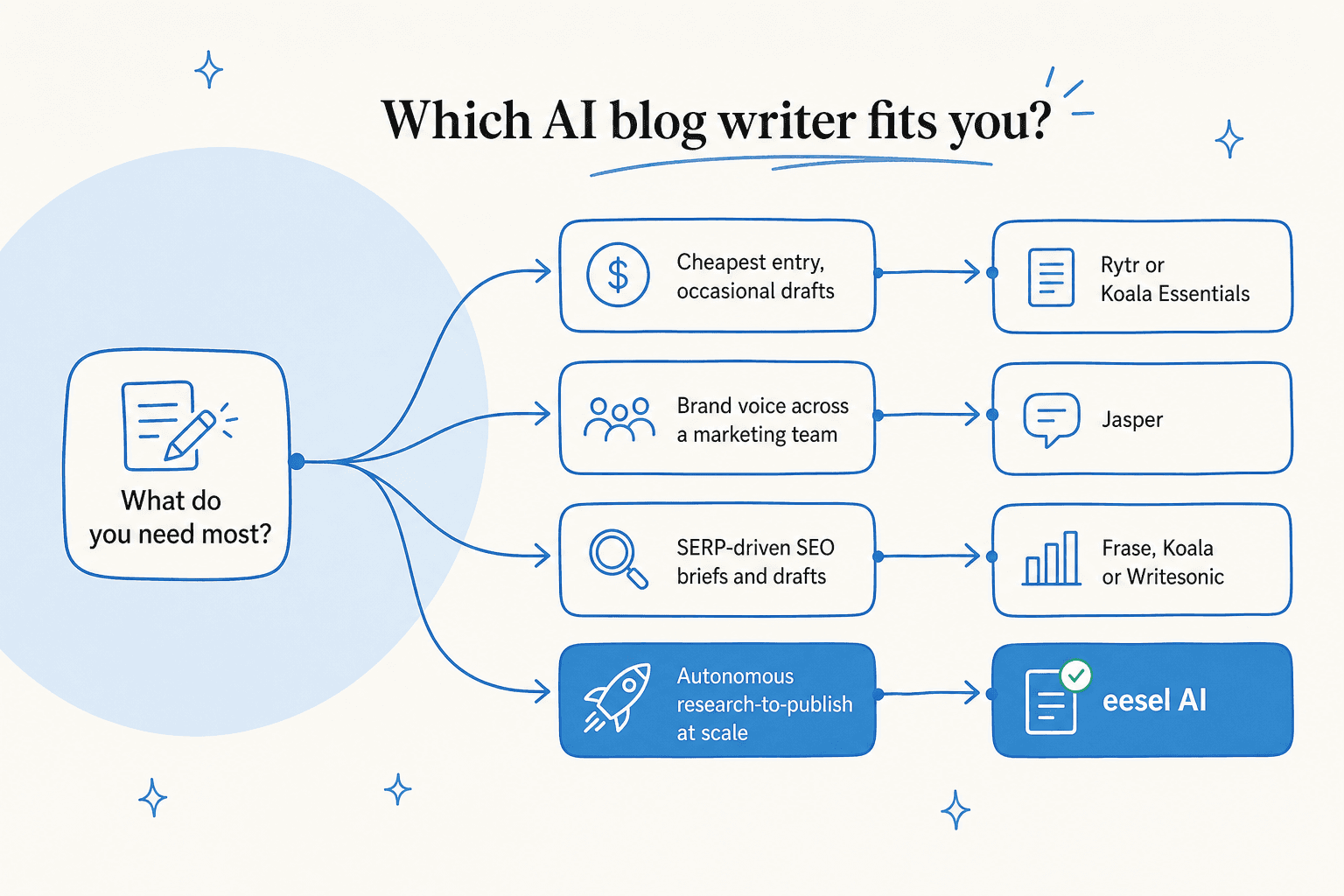
A quick read of the tree:
- "I want to spend less than $10/mo and try this category." Pick Rytr Unlimited or Koala AI Essentials. You'll feel the cap, but you'll learn what you want.
- "I want my writers to stay on-brand at scale." Pick Jasper (or Writer.com if you have a procurement team).
- "I want SERP-driven SEO drafts I can edit." Pick Frase or Koala. Add Writesonic if you want AI-engine citation tracking on top.
- "I want to research, draft, and publish without sitting in front of every post." Pick eesel AI. It's the only example on this list where the workflow ends in your CMS.
We compared the entry prices side-by-side so you can see the spread:
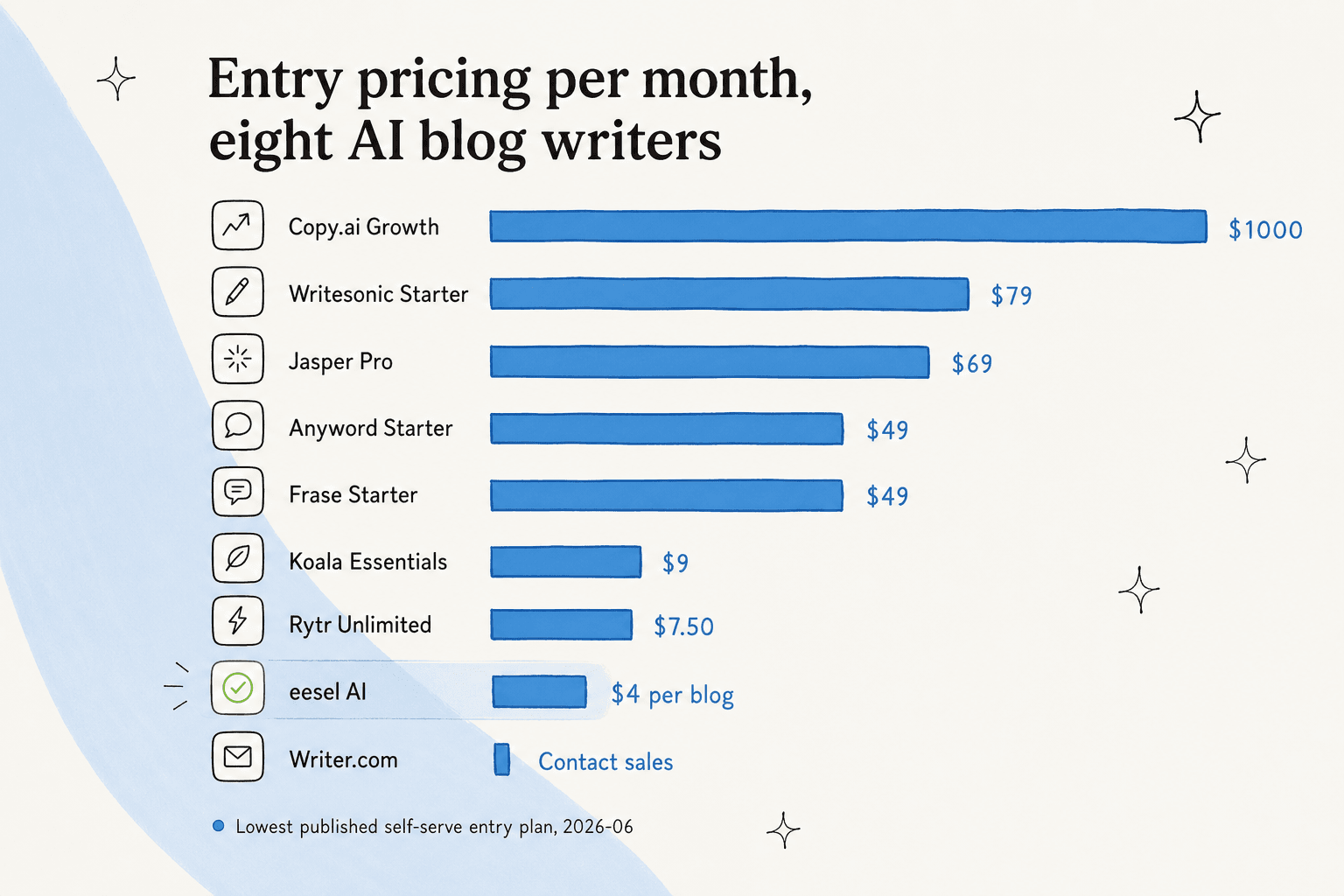
A few things jump out:
- The $7.50 to $79/mo cluster is where most solo and small teams will land. That covers Rytr, Koala, Frase, Anyword, Jasper, and Writesonic at entry tier.
- eesel AI's $4-per-post model is the only pay-per-post example. If you write 10 posts a month, that's $40 versus a $49+ subscription where the seat sits idle on slow weeks.
- Copy.ai's first real Workflows tier is $1,000/mo. Don't anchor your budget on Chat-tier ($24/mo) and then discover the cliff.
If you want a sharper "which one for which job" recommendation, our 2026 AI blog writer test puts six tools through the same prompt side-by-side, and the AI blog writer cost breakdown digs into the price-per-finished-post math we keep returning to.
Try eesel AI
Out of every example on this list, eesel AI is the only one whose workflow ends in your CMS instead of an editor window. You give the Blog Writer a domain and a keyword from the dashboard chat (or from a webhook, if you'd rather drop it into a scheduled run), and the agent researches the SERP, pulls your sitemap to weave in internal links, applies your stored brand voice, generates a hero banner and three to five in-body visuals, writes the draft with a built-in FAQ schema block, and publishes to WordPress, Webflow, Ghost, or your own CMS through a connector.
It's the same model behind the 360-posts-per-month keyword-to-publish operation we mentioned earlier in the eesel section, and pricing is $4 per blog post, with 100 free credits so you can try before paying (eesel pricing). Try eesel if hands-off scale is what you actually want.
Frequently Asked Questions
What is an AI blog writer, and how do these examples differ?
An AI blog writer is software that drafts long-form articles from a prompt, a keyword, or a brief. The nine examples in this post split into four very different jobs: marketing copy machines (Jasper, Copy.ai, Rytr), enterprise content ops (Writer.com), SERP-driven SEO writers (Frase, Koala, Anyword, Writesonic), and autonomous research-to-publish platforms like eesel AI. Picking by category first matters more than picking by feature list.
Which AI blog writer is best for someone on a tight budget?
For free-or-cheap blog drafting, Rytr's Unlimited plan at $7.50/mo billed annually and Koala's Essentials at $9/mo are the entry points worth knowing about, both confirmed on the Rytr pricing page and the Koala pricing page. Output quality drops noticeably below those tiers, so anything labelled "free unlimited" usually has a different catch. We dug into the trade-offs of the cheap tier in our free AI blog writer roundup.
Is there an AI that writes blog posts end-to-end without me babysitting it?
Most tools in this list are still drafting tools: you click a button, get a 1,500 to 3,500 word draft, and edit. eesel AI's Blog Writer is the closest example of end-to-end autonomy in the list. You give it a domain and a keyword, and it researches, drafts, places hero and in-body images, internal-links into your existing site map, and publishes to your CMS. For more on what truly autonomous looks like in practice, see our AI blog writer test.
How do AI blog writer examples compare on price?
Entry-tier self-serve prices in mid-2026 run from about $7.50/mo (Rytr Unlimited, annual) to $79/mo (Writesonic Starter). eesel AI charges $4 per blog post, Writer.com is contact-sales only, and Copy.ai's first real workflow tier is $1,000/mo. The pricing chart later in this post lays out the whole range, and we go deeper on cost trade-offs in our blog writer cost breakdown.
Are AI blog writer examples good enough for SEO content in 2026?
Short answer: yes, but only if the tool layers in real SERP research and you still edit. Tools like Frase and Koala AI are built around mirroring the top-ranking pages for a target query, while eesel AI does the research-and-link-graph step automatically before drafting. Generic LLM output without that research layer ranks poorly and reads generic. For a deeper take, see our review of the best AI for blog writing and the free SEO blog writing AI roundup.