Blogging in 2026 is a different beast. The internet is packed, people's attention spans are shorter than ever, and just hitting "publish" and hoping for the best is a recipe for disappointment. To make any noise, you need a blog that does more than just sit there; it needs to build your authority, pull in traffic, and consistently generate leads.
For most marketers, the problem isn't a lack of ideas. It's the sheer amount of work it takes to create high-quality, SEO-friendly content often enough to make a real difference. You're stuck juggling research, writing, editing, and formatting, all while a demanding content calendar breathes down your neck.
The secret isn't to work harder, it's to work smarter. You need a repeatable process that blends smart human strategy with the power of AI to do the heavy lifting. As one marketer on Reddit explains, it's about having a system with a unique angle, not just repeating what's already out there.
I've been writing blog posts for the last few years. Over time, I've come up with a good system that actually has a soul and not just pieced together purely for SEO that no one would enjoy reading... List out my angle so I can remind myself that I’m not just re-iterating stuff from other posts but have a different eye.
At eesel AI, this is exactly what we do. We built our own system using our internal tools, and it's how we took our blog from a modest 700 to over 750,000 daily impressions in just three months.
This guide isn't filled with vague theories. It’s the exact, step-by-step framework we use every day. We’re showing you exactly how to write expert-level blog posts that actually deliver results.
What is strategic blog writing and why it matters
Modern blogging has left the old "publish and pray" method in the dust. Today, it’s a key part of a marketing strategy, designed to systematically attract, engage, and convert a very specific audience. It’s about creating content with a clear purpose, where every article is a deliberate move toward a business goal.
When you nail it, a quality blog becomes a serious growth engine. Here’s why it’s so important:
SEO and organic traffic: Search engines are hungry for fresh, relevant content. Regularly publishing posts that answer your audience’s questions is the best way to climb the search rankings and bring in a steady flow of free, organic traffic.
Thought leadership and trust: A great blog positions your brand as an expert. When you consistently provide value and solve problems for your readers, you build the kind of credibility that turns curious visitors into paying customers.
Lead generation: Every single blog post is another chance to generate a lead. Whether it's a call-to-action for a free trial, an offer for a downloadable guide, or a simple newsletter form, your content becomes a direct pipeline to your sales funnel.
AEO (Answer Engine Optimization): This is a big one. With AI-powered search like Google AI Overviews becoming standard, having well-structured, high-quality content is no longer optional. These answer engines pull information directly from the best sources to answer questions. With Gartner predicting a 25% drop in traditional search traffic by 2026 because of AI, being the source for those answers is how you'll survive.
An infographic detailing the four key benefits of strategic blogging: SEO, thought leadership, lead generation, and AEO.
Foundational pillars of expert blog writing
Before you even think about writing your first draft, there’s some important strategic work to do. Getting these fundamentals right is what separates content that drives business from posts that just become more digital noise.
An infographic showing the three foundational pillars for expert blog writing: understanding your audience, crafting compelling titles, and writing engaging content.
Understand your audience and search intent
You can't write a great blog post if you don't know who you're writing for. It’s as simple as that.
Know your reader: Stop writing for a faceless crowd. Instead, picture one person. Create a simple buyer persona that details their job title, their biggest headaches, the questions they’re asking, and what they’re trying to accomplish. When you write directly to that person, your content immediately feels more personal and hits harder.
Do your keyword research: Good content starts with knowing the exact words your audience is typing into Google. Use keyword research tools to find topics that get a decent amount of searches but aren't impossible to rank for. You're looking for that sweet spot between high relevance and manageable competition.
Analyze the SERPs: This is probably the most important step, and it’s the one most people skip. Before you write anything, Google your target keyword and study the first page of results. Are they listicles? Detailed guides? Videos? The search results page (SERP) tells you exactly what Google thinks satisfies the user's intent. Your job is to create something that matches that intent, but is even better.
Craft compelling titles and outlines
Your headline is your first, and maybe only, chance to make an impression. If it doesn’t grab attention, the best article in the world will go unread.
The power of the headline: A great title does two things: it makes a clear promise about the value inside, and it creates enough curiosity to get the click. Don't treat it like an afterthought; it’s one of the most vital parts of your post.
Proven title formulas: You don't need to reinvent the wheel. Use formulas that are proven to work. Using numbers ("7 Ways to..."), asking an interesting question ("Are You Making This Common Mistake?"), or making a bold promise ("The Ultimate Guide to...") are all solid ways to frame your content.
Why outlining is your best friend: Staring at a blank page is terrifying. A detailed outline is the perfect cure for writer's block. It breaks the huge task of "writing a blog post" into smaller, more manageable pieces. It also makes sure your article flows logically and you cover everything you need to without going off on tangents.
Write engaging and readable content
Once you have your strategy sorted, it's time to write. But expert writing is about more than just getting the facts straight; it's about making those facts interesting and easy to read.
Use a conversational tone: Write like you talk. Use a friendly but authoritative voice that connects with your reader. Get rid of the corporate jargon and overly complex sentences. The goal is to make complicated stuff feel simple.
Structure for skimmers: People scan online, they don't read every word. Make your content easy to skim by using short paragraphs, clear H2 and H3 headings, bullet points, and bold text to highlight the key takeaways.
Weave in stories and examples: Facts are fine, but stories are what people remember. Use real-world examples, short anecdotes, or case studies to bring your points to life. This makes abstract ideas more concrete and helps the reader connect with the material.
How to scale content production with AI
After you've mastered the basics, the next challenge is scale. Manually researching, drafting, formatting, and finding images for every single post is a huge time drain. This is where AI goes from being a buzzword to your most valuable team member, changing your role from a manual writer to a strategic editor.
IMO opinion, AI is like most tools. Garbage in, garbage out. You can’t throw a Kw at it and expect a week written article. You still need to research proper KWs. You need to study the SERPs. You still need to perfect a great outline. Once all that is done, AI is a crutch, it can assist you.
The eesel AI blog writer is a complete content system designed to handle the entire workflow, from in-depth research to creating the final assets.
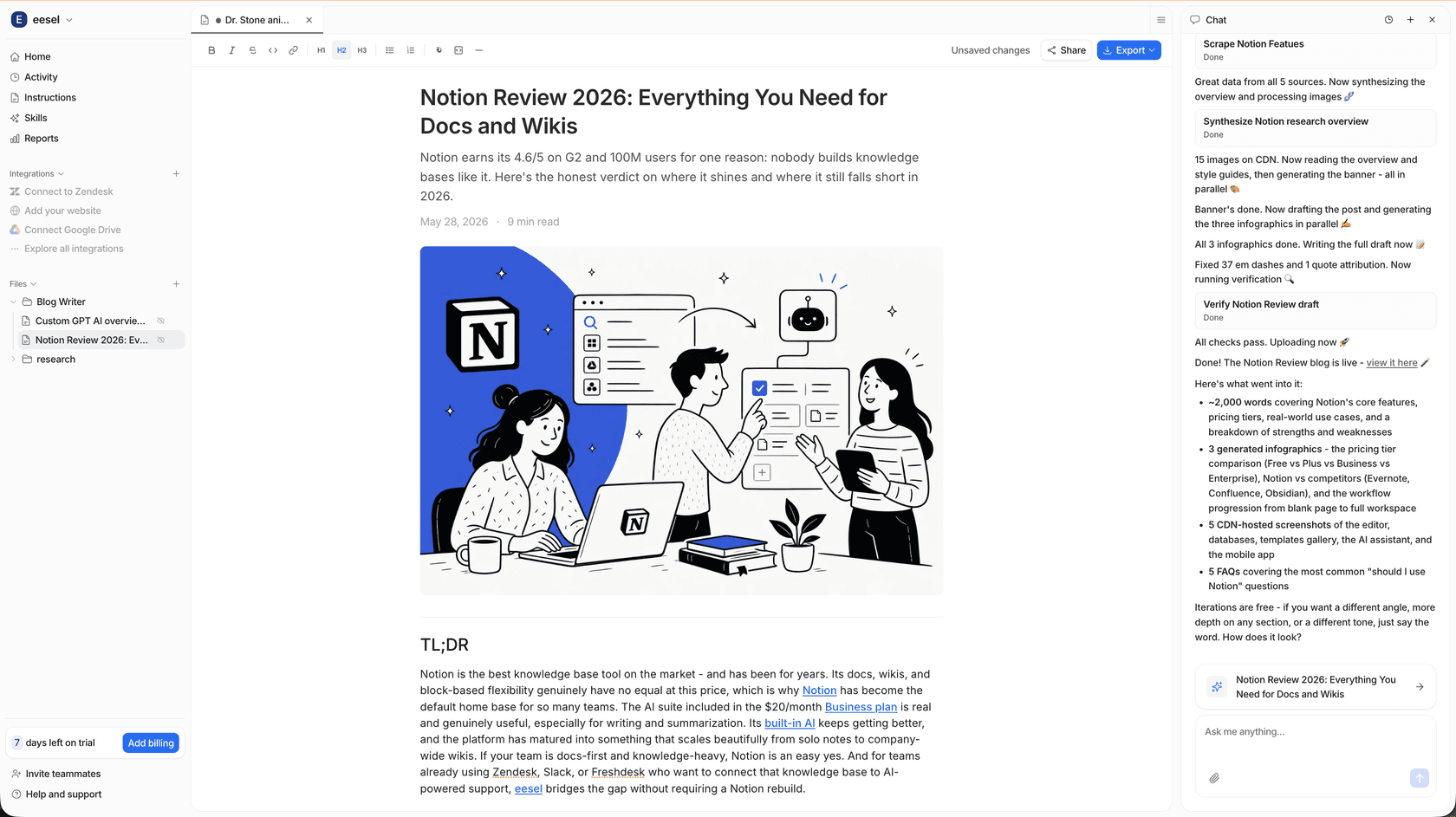
A screenshot of the eesel AI blog writer dashboard, a key tool in this expert guide to blog writing.
It can take a single keyword and turn it into a complete, publish-ready blog post in minutes. We spent over a year tweaking our models to ensure it produces content that meets the expert-level standards we've been talking about.
When it comes to the actual prose, or the writing itself, I use essentially no AI. I don’t like how AI writes... But for everything else, AI is great. I use it to help shape outlines. I’ll sketch what I want for the book, then work with AI over a couple of days to fill gaps and explore what might happen next. It isn’t just AI. A lot of it is my own imagination, but the back‑and‑forth helps.
Context-aware research: It understands the type of blog you need. If you’re writing a comparison post, it automatically looks for pricing data. For a product review, it finds technical specs. It even adds citations to credible sources on its own.
Automatic assets and media: A giant wall of text can be disengaging. eesel AI generates custom images, infographics, and data tables to break up your content and explain key points. It also finds and embeds relevant YouTube videos to increase engagement.
Authentic social proof: For a touch of real human perspective, it can find and insert real quotes from Reddit and other forums. This adds a layer of authenticity to the content.
Brand context integration: This is a huge one. Just give it your website URL, and the AI learns your brand’s voice, products, and positioning. It then weaves natural, contextual mentions of your company into the content, maintaining an informative tone.
A practical workflow for generating publish-ready blogs
Getting started is incredibly simple. The whole process is just three steps:
Provide a topic: Start with the target keyword you’ve already researched (e.g., "expert guide blog writing").
Add your context: Enter your website URL. This one step gives the AI all the brand context it needs to write in your voice and mention your products naturally.
Generate and publish: In just a few minutes, eesel AI delivers a fully structured, SEO-optimized post with headings, images, and media. All that’s left for you is a final human review before you hit publish.
A 3-step workflow diagram from our expert guide to blog writing, showing how to generate a blog post with AI.
This workflow frees you up to focus on high-level strategy and creative editing instead of getting stuck in the weeds of drafting. The best part? It’s completely free to try, so you can see the quality for yourself.
Essential elements for publishing and promotion
Writing an amazing post is a great feeling, but your job isn't done yet. A successful blog strategy needs a thoughtful publishing process and a plan to make sure your content actually gets in front of the people you wrote it for.
An infographic checklist for publishing and promotion from our expert guide to blog writing, covering on-page SEO and content distribution.
On-page SEO and formatting best practices
These small details can make a big difference in how you perform in search results.
Meta information: Your meta title and meta description are what people see on Google. Write a compelling title and a description that clearly summarizes the post's value to get more people to click.
Image optimization: Search engines can't "see" images, so you have to give them clues. Use descriptive file names (like expert-blog-writing-process.jpg) and write clear alt text that explains what the image shows. This is good for accessibility and can help your images rank in Google Images.
Internal and external linking: Linking is super important for SEO. Link to other relevant posts on your own site (internal links) to keep readers on your site longer and help search engines understand its structure. Also, link out to credible, authoritative external sources to back up your claims and build trust.
Create a promotion and distribution plan
Don't just publish your content and walk away. You have to actively promote it.
Social media: Share your new post across your social channels. But don't just drop a link; customize the message for each platform. On LinkedIn, you might share a professional insight, while on Twitter, you could pull out a key statistic or a punchy quote.
Email newsletter: Your email list is one of your most powerful tools. Send your latest content directly to your subscribers. It's a fantastic way to drive repeat traffic and connect with the audience you've already built.
Community engagement: Find online communities where your target audience spends their time, like relevant subreddits or LinkedIn Groups. Share your article, but only when it genuinely adds to the conversation. Don't be a spammer; participate in the community and offer your content as a helpful resource.
Your journey to becoming a better blogger
Becoming an expert blogger doesn't happen by accident, but it's not rocket science either. It all comes down to a consistent process built on a few key ideas: start with smart research, create well-structured content, use AI tools to scale up, and be proactive about promotion.
For a visual walkthrough of a complete blogging process, from brainstorming to final draft, Neil Patel offers a comprehensive look at his own successful formula. Watching an expert break it down can help solidify the concepts we've discussed.
This video from Neil Patel shares a perfect formula for creating blog posts for any type of business. Consistency is the name of the game. The framework in this guide gives you a clear roadmap. It’s a marathon, not a sprint, but having the right process makes it a race you can win. Now, it's time to take that first step and put it into action.
The main goal is to move beyond just publishing content and instead create a strategic system that consistently attracts the right audience, builds authority, and generates leads for your business. It's about turning your blog into a reliable growth engine.
How does AI fit into a blog writing framework?
AI, particularly a tool like the eesel AI blog writer, acts as a force multiplier. It handles the time-consuming tasks like research, drafting, and asset creation, allowing you to focus on strategy, editing, and promotion. It helps you scale your content production without sacrificing quality.
Is this guide only for marketers?
Not at all. The principles in this guide are foundational and can be applied by anyone, from beginners starting their first blog to experienced marketers looking to refine their process. The focus on a repeatable system makes it accessible for all levels.
What is an often overlooked step in the blog writing process?
One of the most critical and often skipped steps is analyzing the SERPs (Search Engine Results Pages). Before writing, you should always Google your target keyword to see what kind of content is already ranking. This tells you exactly what Google thinks users want to see.
Can you get good results by following a strategic blog writing process?
Absolutely. The framework outlined in this guide is the exact process we used at eesel AI to grow our blog from 700 to over 750,000 daily impressions in just three months. Consistency and following the process are key.