


How we tested
The original testing described below covers Jasper, Copy.ai, Writer, Writesonic, Anyword, Koala, Frase, and Rytr. AI Summarizer was added in September 2026 based on a review of its published features and pricing, not the same hands-on test.
We ran every tool through three jobs: draft a 1,500-word "how AI search citations work" article, write a five-email onboarding sequence in a defined brand voice, and produce a product comparison post with a real-data table. For each, we tracked first-draft quality, brand-voice fidelity, SEO scaffolding, ease of publish, and what we paid against what the meter said. Where we couldn't run a job ourselves - Writer is contact-sales and the agent suite is gated behind a demo - we leaned on Gartner Peer Insights, TrustRadius, and verified G2 reviewer notes.
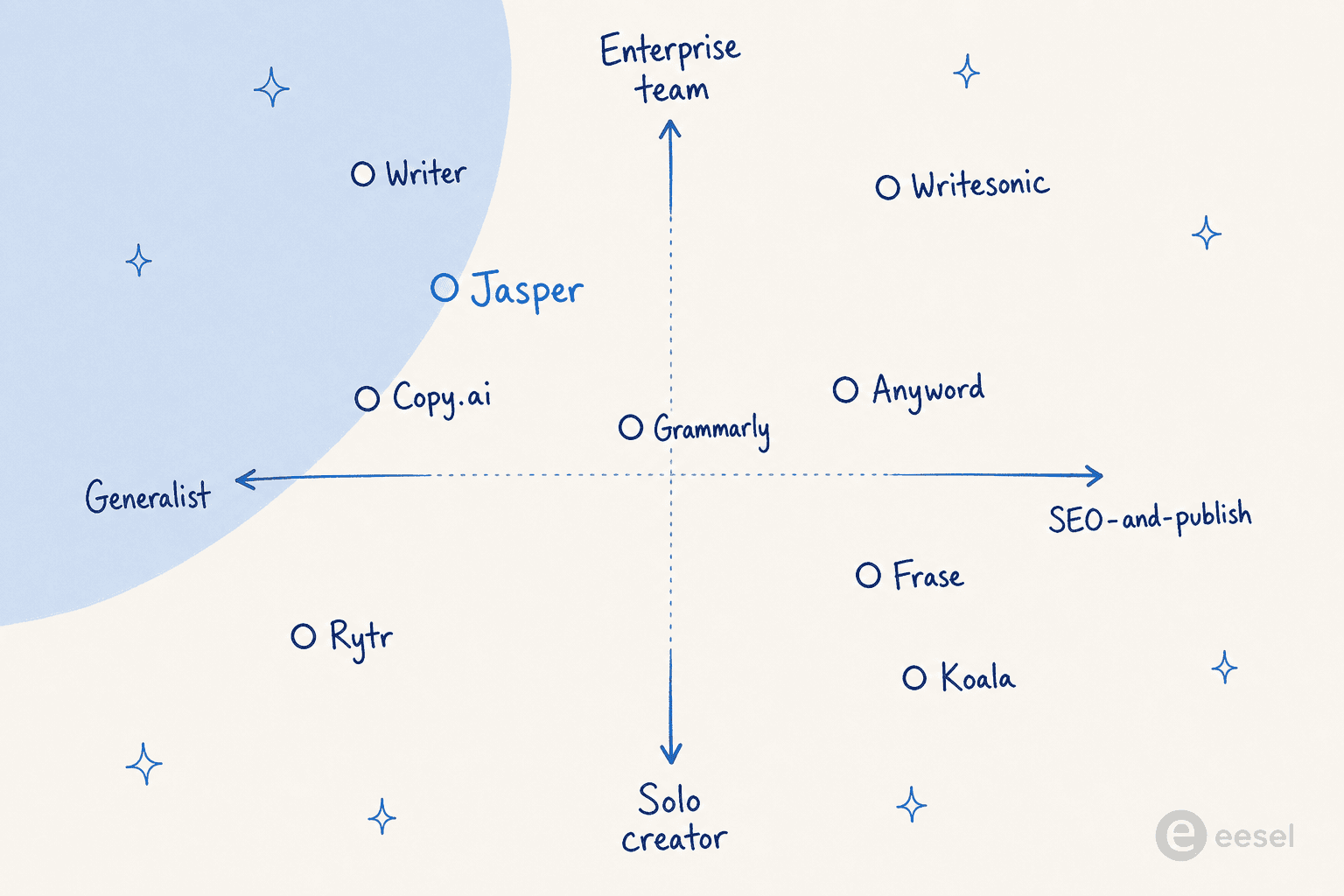
A note on the lineup: this is a comparison of AI writing tools, not AI writing detectors, copy editors, or general LLM chat. That's why Grammarly - superb for inline proofreading and now part of the Superhuman suite - sits on the bench here. If you want a dedicated proofreading layer instead of a generative drafting tool, its dedicated review is the better read.
The comparison table
The table below summarises everything we'll dig into. Note the deliberately uneven columns: pricing transparency, AI-platform coverage, and security posture are the dimensions buyers most often miss in a feature-page-driven comparison.
| Tool | Best for | Entry price | Brand voice | SEO scoring | One-click publish | Compliance | G2 rating |
|---|---|---|---|---|---|---|---|
| Jasper | Marketing teams that want a platform | $59/seat/mo (Pro, annual) | Brand IQ - 2 voices on Pro, unlimited on Business | Via Optimization agent | No native CMS publish | SOC 2 | 4.7/5 (1,270 reviews) |
| AI Summarizer | All-in-one writing and summarization | Free; $7/mo Go | Not verified | Not verified | Not verified | Not verified | Not verified |
| Copy.ai | GTM workflows beyond writing | $24/mo Chat tier; $1,000/mo Growth | Brand Voice + Infobase | None native | No | SOC 2, GDPR, SSO | 9.6/10 ease of use |
| Writer | Regulated enterprise | Contact sales | Departmental voice profiles (Enterprise) | None native | Via connectors | SOC 2 Type II, HIPAA, GDPR, PCI | TrustRadius 8.4/10 |
| Writesonic | AI search visibility (GEO) | $79/mo Starter | Limited; Brand Explorer Enterprise-only | GEO + SEO Action Center | No | SOC 2 Type II, HIPAA, SSO (Enterprise) | 4.8/5 (2,031 reviews) |
| Anyword | Performance-predicted copy | $39/mo Starter (annual) | Brand voice hub + custom models (Business+) | Blog Wizard SEO score | No | SOC 2, ISO 27001, GDPR, HIPAA | 4.8/5 (1,226 reviews) |
| Koala | SEO long-form + one-click WP | $9/mo Essentials; $49 Pro | Brand DNA (April 2026) | Real-time SERP analysis | WordPress, Shopify, Webflow, Ghost | Not published | Trustpilot 3.5/5 (21 reviews) |
| Frase | SERP-driven briefs + GEO | $39/mo Starter (annual) | Voice profiles, every plan | Real-time SEO + GEO | Via Zapier | SOC 2 Type II, GDPR (Enterprise) | 4.8/5 (301 reviews) |
| Rytr | Solo creators on a budget | $0 Free; $7.50/mo Unlimited | 1 custom tone (Unlimited), 5 (Premium) | None | No | Standard | 4.7/5 (819 reviews) |
A few things worth flagging in the table. Copy.ai's pricing has the steepest cliff in the category - the jump from the self-serve Chat plan ($29/month monthly) to the lowest GTM tier (Growth, $1,000/month) is where most buyers stall, and it's not signposted clearly on the pricing page. Writer's "two-tier plan structure with no published dollar amounts" is the stated policy on /plans/ - every CTA is "Request a demo," and the Starter trial alone won't get you a price. And Koala's headline word counts assume the cheapest model: switch to the recommended Claude 4.5 Sonnet and you spend words at double the rate, so the advertised 100,000 words on Professional is effectively 50,000 in practice.
The nine AI writing tools compared
1. Jasper - best for marketing teams that want a real platform
Jasper has been the bellwether AI writing tool since GPT-3, and the 2026 product looks nothing like the 2022 "write me a blog intro" template generator. Today it's organised as three layers: purpose-built marketing agents (SEO, campaigns, research, Optimization), content pipelines for scaled execution (Canvas, Grid, AI Studio), and Jasper IQ - the context layer that stores brand voice, style guide, audience profiles, and multi-modal knowledge so every generation across the team stays on-brand automatically.
The customer roster is the loudest signal in the category: Wayfair, Boeing, L'Oréal, Mars, Accenture, Anthropologie ("60% of SEO now automated with Jasper"), Adidas ("7,500 product descriptions written by Jasper in 24 hours"), HarperCollins, Hilton, Cox Automotive. If your buying committee includes anyone who recognises those logos, that matters.
Pricing. Two plans. Pro at $59/seat/month annual ($69 monthly) - single seat, Style Guide / Visual Guidelines / API / SSO are not included. Business is custom; the qualifier from G2 reviewers is that anything truly enterprise lives there.
Where it stumbles. Across G2, the dominant negative is exactly what G2's auto-summary admits: "some users note that the content can occasionally feel generic or repetitive, requiring additional editing." The other recurring tell is brand-voice fidelity. One paying SMB customer reported switching to ChatGPT because it "followed their brand voice better" - a direct contradiction of Jasper's "AI that sounds like you" positioning.
"Quick drafts are okay, but structure and tone for blogs often felt off."
r/SaaS thread, My experience using Jasper for website content

Verdict. If you're a marketing team of 5+ who needs brand voice consistency across email, social, blog, and ads - and you can stomach a $59–$69/seat-month entry - Jasper is still the safe pick. If you're a solo creator or a small team that mostly publishes blog posts, you're paying for a platform you're not using. For more on the model and where it fits, see our Jasper review and Jasper alternatives.
2. AI Summarizer - best for an all-in-one writing toolkit
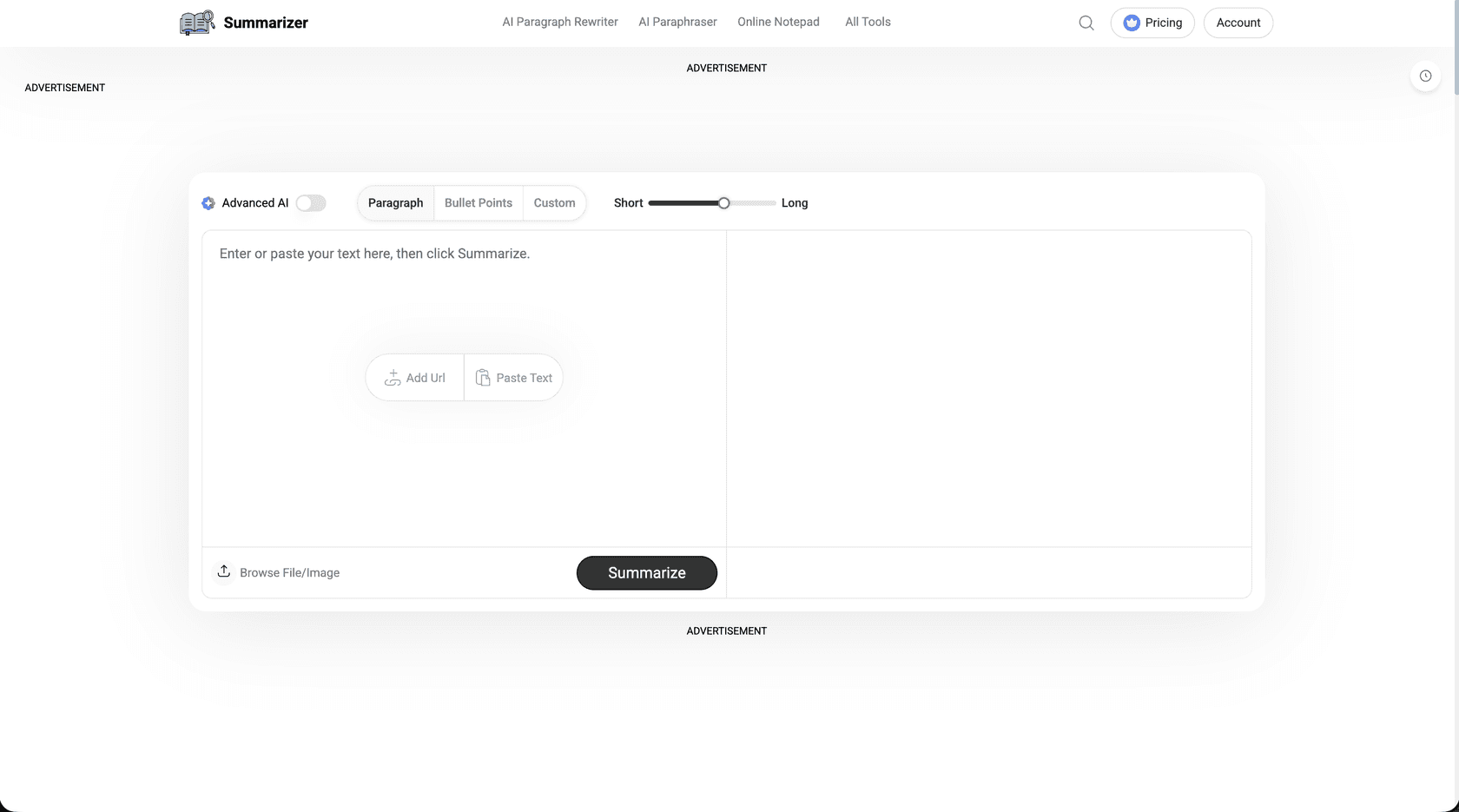
AI Summarizer is a platform primarily known for its AI-powered summarization. Rather than working as a standalone text summarizer, it brings together a collection of AI-powered tools for writing, refining, editing, and proofreading under one roof.
It helps users generate emails, paragraphs, sentences, essays, stories, and other types of content using dedicated tools. Along with content creation, the platform offers tools for paraphrasing, grammar checking, AI content humanizing, and plagiarism detection.
The platform features a straightforward interface, with dedicated tools for specific writing, editing, and proofreading tasks. Users can select the utility they need without setting up a complex workflow.
Pricing. AI Summarizer follows a freemium model, with free access subject to tool-specific limits. Paid monthly plans are Go at $7/month, Plus at $10/month, and Pro at $25/month. Annual plans cost $67/year for Go, $80/year for Plus, and $200/year for Pro. Check the current plans and usage limits before subscribing.
Verdict. AI Summarizer is an option for users who want summarization, content creation, editing, and proofreading in one writing toolkit. Compare its per-tool limits against your workload, and review generated content before publishing.
3. Copy.ai - best when the writing is downstream of the workflow
Copy.ai is mid-rebrand. The "AI writing assistant" framing that drove 17 million signups has been almost entirely retired from the homepage, replaced with "The First AI-Native GTM Platform." The new pitch: replace a fragmented stack of point AI tools with one platform built around Workflows, Tables, Agents, and Brand Voice.
The writing is still in there - buried inside Workflows as the "Content Creation" use case - but it's no longer the front door. The two strongest praise themes from real users are still "beats the blank page" and brand voice consistency, both tied to the legacy First Draft Wizard.
"Out of all the GPT-3 programs I've tried, Copy.ai has had the most realistic copy. Of course it needs editing but you'll never have blank page syndrome again."
Bill D., G2 reviewer (source)
Pricing. This is the part to read twice. There's a self-serve Chat tier at $24/month annual that gives you the chat interface without Workflows. Above that, the next tier is Growth at $1,000/month annual, with 20,000 workflow credits - and that's where any GTM use case actually lives. The Chat-to-Growth gap is a ~40× jump and it's where most buyers stall.
"I stopped at those three main list tools: WriteSonic, CopyAI, and Jasper. And two additional ones, which are Gocharlie and MarketOwl."
r/marketing, AI marketing tools pros and cons
Verdict. For a small team that needs an editorial AI writer, the Chat tier is a fine, cheap alternative to Jasper Pro. For anyone who reads "AI-native GTM platform" and recognises the use case (inbound lead processing, prospecting cockpit, deal coaching), Growth is the right tier and the right tool - but you need a GTM motion to justify $12,000/year. For more, see our Copy.ai review and the deeper Copy.ai pricing guide.
4. Writer - best for the regulated enterprise
Writer sells to an entirely different buyer than the rest of this list. The homepage tagline - "where the world's leading enterprises orchestrate AI-powered work" - is not marketing fluff. The reference customers are Vodafone, Vanguard, Salesforce, KPMG, Qualcomm, Accenture, Dropbox, Hilton, Ally, and the Trust page lists SOC 2 Type II, GDPR, HIPAA, and PCI compliance - not boilerplate, but the gating criteria for a sale at any of those names.
What you're actually buying is the platform: WRITER Agent ("not a tool you prompt - an agent you delegate to"), AI Studio (the dev/IT layer for building governed agents), Palmyra LLMs (Writer's own in-house model family), and a Knowledge Graph RAG layer over your enterprise data.
"Once the style guide is set up, it gently guides me towards the appropriate tone, preferred terminology, and brand voice while I write, almost as if an editor were over my shoulder…"
verified TrustRadius reviewer (source)
Pricing. Writer publishes a two-tier plan structure - Starter and Enterprise - with no public dollar amounts on either. Starter is a 14-day self-serve free trial, then a per-seat plan with fixed credit limits. Enterprise is contact-sales only and unlocks Agent Builder, departmental brand voices, SAML SSO, BAA for HIPAA, and unlimited Knowledge Graph. Based on Writer's competitive set (Glean, Cohere for Business, Microsoft 365 Copilot Enterprise), expect five- to six-figure annual contracts.
Where it stumbles. The dominant frustration in Gartner Peer Insights is "performance on large documents" - multi-minute query times against the Knowledge Graph come up across reviews. The other recurring complaint is that the heavy-hitter features (Agent Builder, advanced connectors, departmental voices) are Enterprise-only, which makes Starter feel like a marketing brochure rather than a usable product.
Verdict. Don't put Writer on your shortlist unless you're at a large company with a compliance team. If you are, the brand voice enforcement is the strongest in the category and the customer logos are a real moat. For everyone else, the contact-sales wall isn't worth bouncing off.
5. Writesonic - best for AI search visibility, not AI writing
Writesonic is the most aggressively repositioned product on this list. The 2022 "AI Article Writer" home page is gone; in its place is "The AI Search Growth Engine" - track your brand's visibility across ChatGPT, Perplexity, Claude, Gemini, Grok, DeepSeek, Microsoft Copilot, Meta AI, Google AI Mode, and Google AI Overviews, then act on a weekly Action Center of 5–10 prioritised fixes.
The pivot is real. The AI Article Writer still exists, but it's now a metered monthly quota inside the platform (15–50 articles depending on plan), not a standalone product page. The headline claim is the most-citable in the category: "2 billion+ real AI conversations" in the AI Search Dataset, updated weekly across 10 platforms.
"You can turn 'full time blog writer' into 'owner spending 3 hours a week' with these tools. And yes, you're always gonna be heavily editing."
r/SEO thread on Writesonic AI generated blogs and articles
Pricing. The pricing page makes the GEO focus obvious in what it gates. Starter is $79/month and tracks ChatGPT only. Basic ($199/mo) adds Gemini and Google AIO. Growth ($399/mo) tops out at three AI platforms. Perplexity, Claude, Grok, DeepSeek, Microsoft Copilot, Meta AI, and Google AI Mode tracking are Enterprise-only - as is SSO, Looker Studio, and the full Action Center.
Verdict. If your KPI is "show up when ChatGPT and Perplexity answer questions in our category," Writesonic is the only tool on this list explicitly built for it, and the Maestra case study ("multiple six-figure deals from AI leads in 60 days; largest $350K+ ACV") is concrete. If you want a writing tool, the AI Article Writer is fine but it's not Writesonic's centre of gravity anymore. For the head-to-head, our Writesonic vs Frase comparison covers the SEO + GEO dimensions.
6. Anyword - best for performance-predicted copy
Anyword does one thing no other tool on this list does at the same depth: it scores how a piece of copy will perform before you publish it. The headline accuracy claim, verbatim from the homepage: "Anyword's AI delivers industry-leading performance prediction - accurately determining which of two content variations will perform better based on audience, business goal, and channel - with 82% accuracy. In comparison, generic AI models like GPT-4o achieve only 52%."
(A second framing on the same page hedges to 70% vs. 52%, so the honest range to cite is 70–82% depending on the comparison.)
Around the predictive score, Anyword wraps a Brand Voice hub, the long-form Blog Wizard (SEO score, plagiarism check, brand-voice alignment), a Data-Driven Editor for short-form, and a Performance API that lets you bolt predictions onto ChatGPT, Notion, or a custom agent.
"Yesterday, I executed an entire landing page strategy in 1 day. It would have taken several weeks - and much more stress - before Anyword."
verified reviewer, Software Advice
Pricing. Four tiers: Starter $39/mo annual, Data-Driven $79/mo annual, Business and Enterprise are custom. The catch is that the most-marketed feature - custom-built AI models trained on your own performance data - only kicks in at Business. API access and SSO are Enterprise-only, a mid-market friction point.
Verdict. If you run paid acquisition or landing pages where the score-then-test loop maps to revenue, Anyword is the rare tool whose differentiator is something you can measure. If you're publishing blogs or knowledge-base content, the predictive layer doesn't really fire - you're paying for the wrong feature. See our Anyword review for the deeper write-up.
7. Koala - best for one-click SEO blogs
Koala wins on focus. The pitch - "AI Articles That Actually Rank" - is exactly what KoalaWriter is engineered for, and the platform doesn't pretend to be anything else. Pick a target keyword, pick an article type (Blog Post, Listicle, Local Places, Amazon Roundup, Amazon Single Product, YouTube-to-Blog, Rewrite), pick a model (Claude 4.5 Sonnet recommended, GPT-5.2, or GPT-5 Mini), and Koala produces a long-form publish-ready article - typically 3,500+ words - with automatic internal linking, schema markup, and one-click push to WordPress / Shopify / Webflow / Ghost.
The April 2026 v2 release added Brand DNA (captures your business context and feeds every generation), Service Pages as an article type, and Deep Research mode ("100× more context, pulling from authoritative sources to create factual, well-cited content").
"Out of all the AI writers, KoalaWriter is the one I choose. Coupled with NeuronWriter for content optimization, it is a great combo!"
r/learnmachinelearning, Review of KoalaWriter
Pricing. Starts at $9/month for Essentials, but the sweet spot is Professional at $49/month - that's where Deep Research, automatic internal linking, AI editing, KoalaLinks, and KoalaMagnets unlock. There's a critical footnote: word counts are billed at the cheapest model (GPT-5 Mini). Switching to the recommended Claude 4.5 Sonnet or GPT-5.2 doubles the word cost, so the $49 Professional plan's 100,000-word allotment is effectively 50,000 high-quality words.
Where it stumbles. Koala's own Trustpilot score is 3.5/5 across 21 reviews - meaningfully lower than its uniformly-5★ on-site testimonial wall. The model-cost footnote is also genuinely sneaky: if you read only the pricing page without scrolling to the FAQ, you'll buy the wrong tier.
Verdict. For a solo creator or small affiliate site whose KPI is publish-volume, Koala is hard to beat - the one-click WordPress push is the single most-praised feature across every community thread we read. For a brand that needs editorial polish, the output still wants a human pass. See our deeper take on the category for context.
8. Frase - best for SERP-driven briefs with GEO baked in
Frase is the right answer to a specific question: "I write SEO content for a living and I need one tool to do SERP research, brief, draft, score, and now track AI engine citations." Its core flow is SERP-mirroring - scrape the top 10 results for a keyword in 30 seconds, identify the content gaps, surface the H2/H3 patterns, then write into a real-time SEO + GEO scoring editor.
The GEO angle is the most differentiated thing on Frase right now. Every plan includes GEO content optimization, structured for ChatGPT, Perplexity, Claude, and Gemini citations, and AI Search Tracking reports share of voice, appearance rate, authority rate, and momentum across those engines. Most competitors gate that behind a higher tier or a separate product. Frase doesn't.
Pricing. Starter $39/mo annual, Professional $129, Scale $299, Enterprise custom. The explicit policy from the pricing FAQ: "Plans differ in volume, not capabilities." So even Starter gets the AI Agent, brand voice, content calendar, auto internal linking, and API/MCP access - you just get less of each.
"Frase has been pitched as 'cheaper Surfer SEO' for years. The Surfer team owns optimization depth; Frase owns content creation and pricing."
paraphrased from a recurring theme in the Surfer vs Frase Reddit thread
Verdict. If your job is to ship SEO blogs and you want one tool, Frase is the rare pick that holds up against both Surfer SEO (more optimization depth, less affordable) and the more general AI writers (cheaper, less SEO discipline). The Frase AI review goes deeper on the per-feature scoring; the Frase vs Surfer comparison is the head-to-head if you're already running Surfer.
9. Rytr - best for the solo creator on a budget
Rytr is the cheapest credible tool on this list and one of the only ones with a real free-forever tier - 10,000 characters/month, 20+ preset tones, Chrome extension, custom use cases, no credit card. With 8 million+ users and a 4.7/5 G2 score across 819 verified reviews, the audience is solo content creators, freelance copywriters, and small-business marketers - and the tool is honest about that.
The two paid tiers are also priced like Rytr remembers freelancers exist. Unlimited at $7.50/month annual gets you unlimited characters, one custom tone, a Chrome extension, and 50 plagiarism checks; Premium at $24.16/month annual ups custom tones to 5, plagiarism checks to 100, and adds 35+ languages.
Verdict. If you publish short-form (emails, social posts, product copy, blog sections) and don't need agents, workflows, or SEO scoring, Rytr is genuinely the most cost-effective pick. It's not the right tool for a marketing team or for someone whose KPI is long-form SEO traffic - that's where Jasper, Koala, or Frase earns the extra $40/month. For the alternatives list, see our Rytr alternatives writeup.
How the three pricing models actually work
The tools above illustrate different billing models, and the difference matters more than the per-month price. If you screenshot one infographic from this post, make it this one:
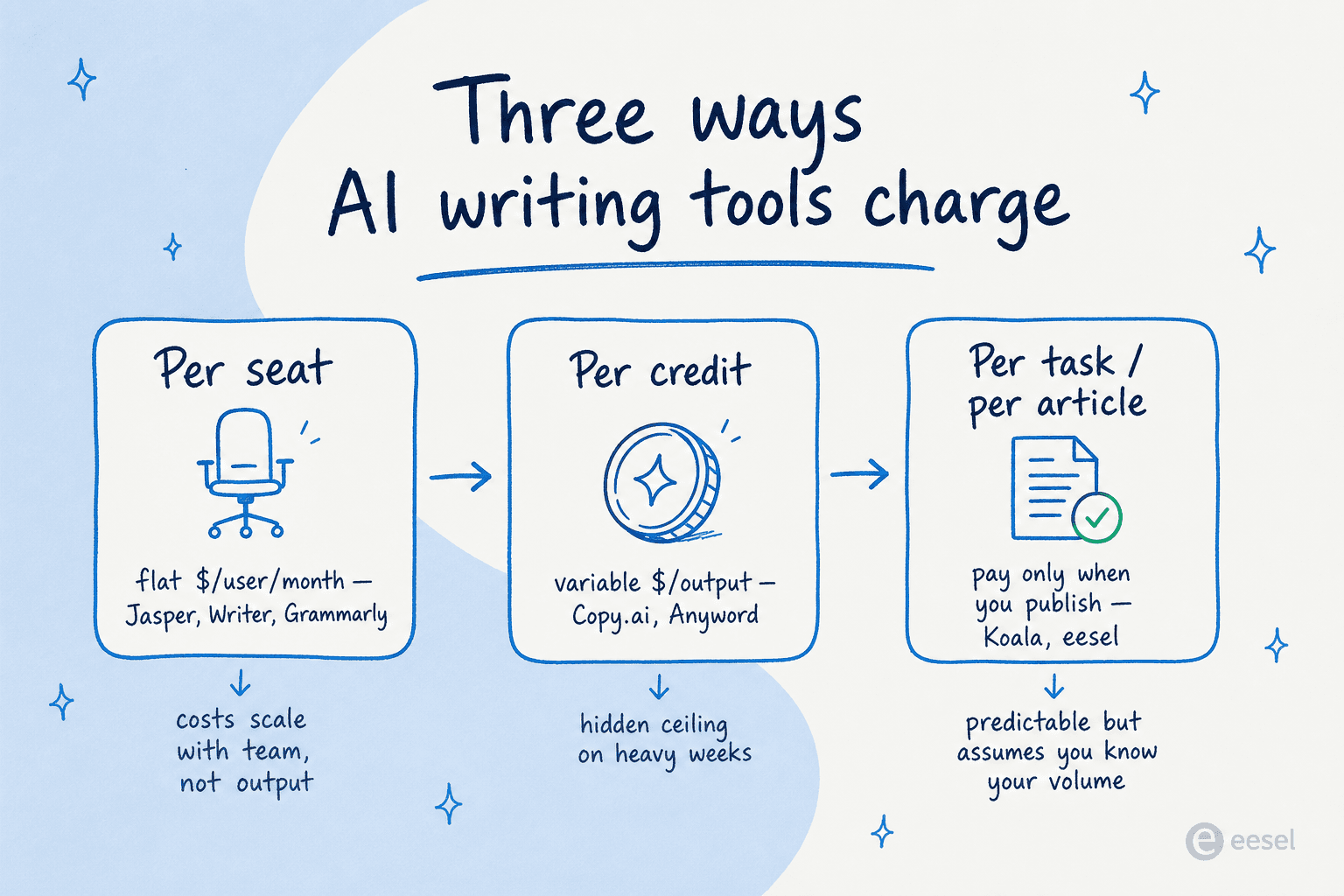
Per-seat pricing is what Jasper, Writer, and Grammarly use. Predictable, but costs scale with team size, not with how much you actually publish. A five-person team paying $69/seat/month on Jasper Pro spends $4,140/year even if they generated nothing in a given month.
Per-credit pricing is what Copy.ai (workflow credits) and Anyword (predictions) use. You buy a monthly bucket, and a heavy week burns it. The recurring frustration here is the hidden ceiling: a creator who runs a content sprint at the end of a quarter can quietly run out of credits with two weeks left in the month.
Per-task pricing is the newer model and it's what Koala (per article, roughly) and eesel (per generation) use. eesel charges $4 per blog post draft - you only pay when something publishable comes out the other side. The trade-off is that you need to know your own publishing volume to budget it well. For a team publishing 30 posts a month, that's $120; for a team publishing 200 posts a month, it's $800 at the same per-post rate.
The content workflow these tools should cover
Whatever pricing model you pick, the practical bar for an AI writing tool in 2026 is the same: how much of the end-to-end content workflow does it actually cover?
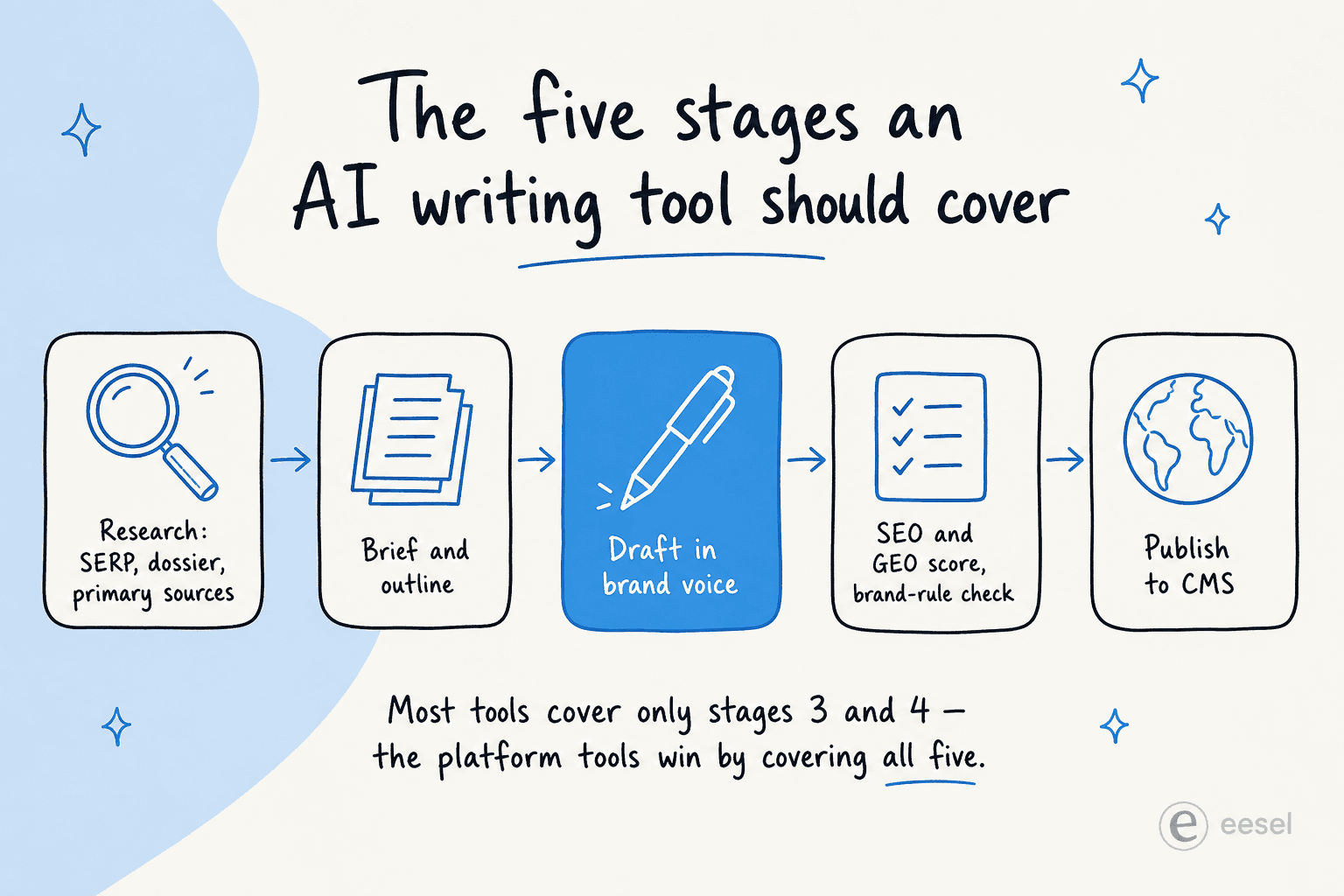
Most tools on this list cover stages 3 (draft) and 4 (SEO/GEO optimize) cleanly. Stages 1 (research) and 5 (publish) are where the platform tools win, and where the writers-only tools quietly hand back to the human. Frase covers research with SERP scraping. Koala covers publish with one-click WordPress. Writesonic covers research with the AI Search Dataset. eesel's Blog Writer agent is built explicitly to cover all five - research from primary sources, generate a brief, draft in a configured brand voice, score for SEO and AI citation readiness, and publish into WordPress, Webflow, Ghost, or HubSpot - which is what makes the per-task pricing make sense: the unit you're paying for is a publishable post, not a token bucket.
A recurring shape we saw in research: a team buys a writer (Jasper, Copy.ai, Rytr) for stages 3–4, then bolts on Surfer or Frase for stage 4 properly, then writes a separate script for stage 1, then copies and pastes into the CMS for stage 5. The stack is what kills the time savings the writer promised in the first place. If you can collapse the five stages into one tool, the maths changes.
Try eesel

The reason eesel's Blog Writer agent doesn't sit elsewhere in this list is that it's a different shape of product: a task-priced agent that researches, drafts, brand-voices, and publishes a long-form post end-to-end, rather than a per-seat editor you sit in. The same agent platform also runs eesel's helpdesk and Slack agents, so the brand-voice and knowledge layer is shared across content and support - which solves the "why does our help center and our blog sound like two different companies" problem most marketing teams have.
The concrete differences from the tools above:
- Pay per generation, not per seat. $4 per blog post draft. No platform fee, no per-seat fees. Free to start with 100 free credits.
- Real research, not a one-shot prompt. The agent scrapes primary sources, builds a research folder, and cites every claim. Ringly.io ran this workflow to scale to 360+ posts per month on Webflow CMS.
- Brand voice from your existing knowledge. Connects to Notion, Google Drive, Confluence, SharePoint, past blog posts, and your help center - the brand voice and the SEO targets come from material you've already written.
- Publish straight into the CMS. WordPress, Webflow, Ghost, HubSpot integrations.
The free credits are enough to test the whole research-to-publish loop on a real post. Start a free trial - no credit card.