

The promise of AI content tools is significant: producing high-quality blog posts to scale marketing efforts faster and more affordably. However, the results can be mixed. Users may find themselves spending hours on prompts only to receive generic text that requires extensive editing, missing the mark on search intent and taking more time than it saves.
This is why I tested the most popular tools available to find the few that deliver on their promise. This is a curated roundup of tools I’ve personally evaluated. This common challenge led us to develop our own tool, the eesel AI blog writer, which we used to grow our blog impressions from 70,000 to over 750,000 in just three months.
What exactly are AI content writer tools?
At their core, AI content writer tools are software applications that use large language models (LLMs) to generate human-like text. You provide them with a prompt, and they generate content.
There is a notable difference between a general-purpose chatbot like ChatGPT and a specialized platform. While you can ask ChatGPT to write a blog post, a dedicated AI content writer is designed specifically for that task. They come with features for SEO, structuring long-form content, and understanding marketing goals.
They can assist with everything from brainstorming ideas and creating outlines to drafting entire articles, helping you overcome the challenge of a blank page.
How we chose the best AI content writer tools for this list
To ensure this list was useful, I judged each tool based on a few key criteria to see how they performed in real-world scenarios:
- Content Quality: How human-like is the output? Is it well-researched and accurate, or does it feel thin? Most importantly, how much editing does it need before you would feel comfortable publishing it?
- Ease of Use: How quickly can you get started? Is the interface intuitive, or does it require a steep learning curve to get from an idea to a finished draft?
- Key Features & Use Case: What is the tool's specialty? Is it built for creating long-form SEO content, automating marketing campaigns, or writing short social media posts?
- Value for Money: Does the price reflect the quality of the results? The value of a tool depends on the quality of its output, not just its price.
Comparison of the best AI content writer tools
Here’s a quick side-by-side look at the tools that made the cut.
| Tool | Best For | Standout Feature | Pricing |
|---|---|---|---|
| eesel AI blog writer | Generating publish-ready blog posts | Automatic assets & social proof | Free to try; $99 for 50 blogs |
| Jasper | Marketing teams needing on-brand content | Content Pipelines & Jasper IQ | Starts at $59/month (billed annually) |
| Copy.ai | GTM teams automating workflows | AI-powered GTM workflows & agents | Free plan available; paid from $24/month |
| Surfer | Optimizing content to rank on search | Real-time Content Score & AI Tracker | Starts at $79/month (billed annually) |
| ChatGPT | All-around brainstorming and drafting | Versatility and access to GPT-5 models | Free version available; Plus at $20/month |
| Claude | Natural-sounding prose and deep analysis | 200K token context window | Free version available; Pro at $17/month (billed annually) |
The 6 best AI content writer tools in 2026
Alright, let's dive into the details. Here’s a breakdown of each tool, what it’s good for, and where it might not be the best fit.
1. eesel AI blog writer
The eesel AI blog writer is focused on one task: turning a single keyword into a complete, SEO-optimized blog post that’s ready to publish in minutes. We built this tool for ourselves and used it to publish over 1,000 articles, increasing our own blog impressions from 70k to 750k in three months.
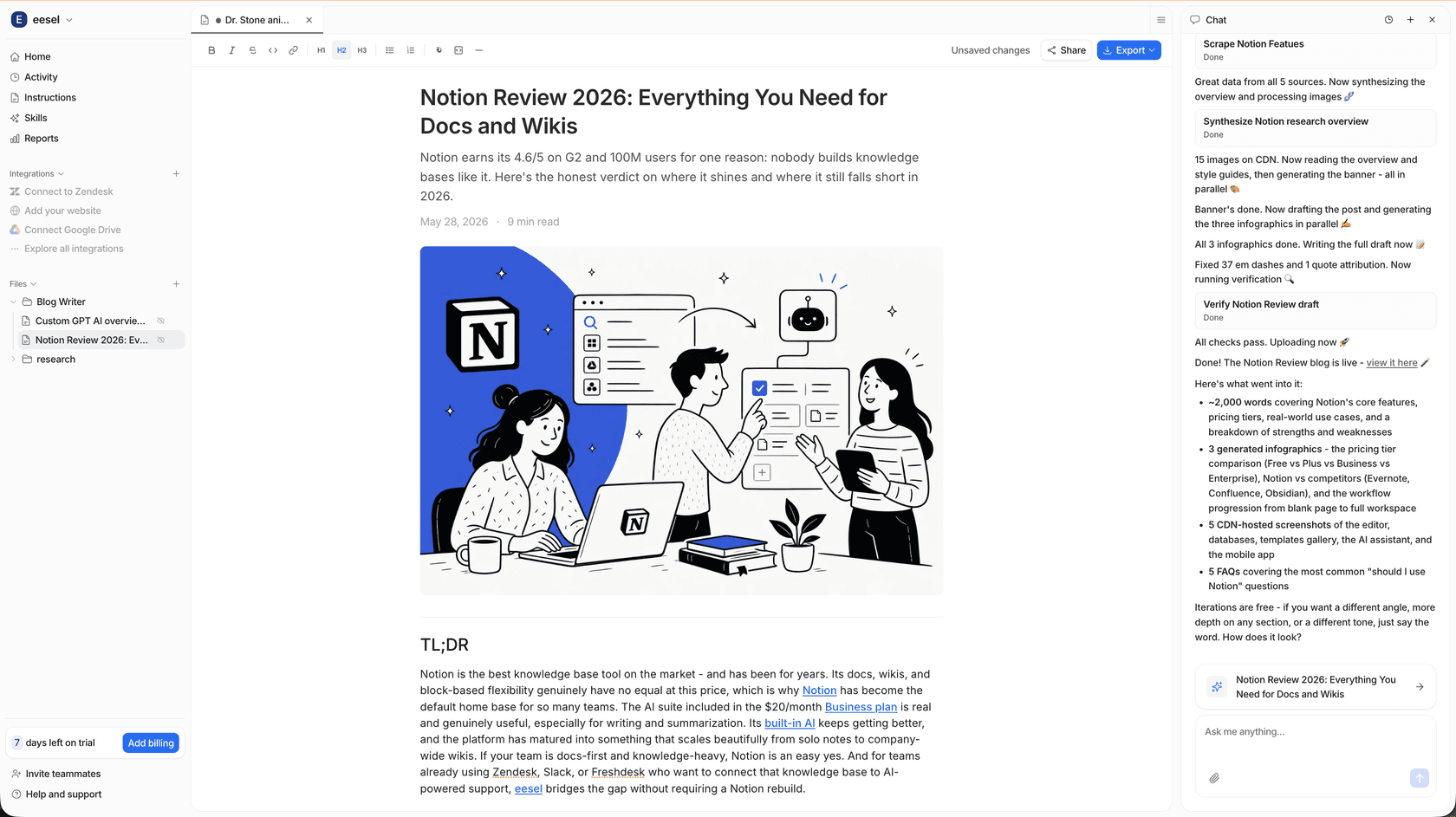
A key feature is that it doesn't just produce a wall of text; it creates a finished asset. It automatically generates and inserts relevant AI images, infographics, and data tables directly into the article. It also finds and embeds related YouTube videos and real Reddit quotes, adding a layer of social proof and authenticity. The content is also optimized for both traditional SEO and modern Answer Engine Optimization (AEO), so it’s designed to perform well in places like Google AI Overviews and Perplexity.
It is a specialized tool built for creating high-quality, long-form blog content. If you're looking for a tool to write short-form copy like social media captions or ad headlines, this may not be the one for you.
Pricing:
- You can generate your first blog free to see the quality for yourself.
- The Early Bird plan is a simple $99 for 50 blog generations.
Why it's on the list: If you’re serious about using content marketing and SEO to grow your business, the eesel AI blog writer automates the research, drafting, and visual asset sourcing parts of the process while delivering human-like content.
2. Jasper
Jasper is a comprehensive AI content platform designed for larger marketing teams that need to create a wide variety of on-brand assets at scale. Its standout feature is Jasper IQ, which acts as a central brain for your brand. You provide it with your style guide, product information, and company facts, and it uses that knowledge to maintain consistency across all content. It also offers Content Pipelines that let you automate the entire content creation workflow, from idea to final approval.
Jasper's strength is its deep focus on brand consistency and team collaboration. Features like Jasper Agents can automate repetitive marketing tasks. Plus, it's SOC 2 compliant, a key security checkbox for many enterprise-level companies.
A consideration for Jasper is that users need to source and add their own visuals. Images, videos, and charts must be added manually. Drafts on complex topics may have inaccuracies and require editing to align with search intent.
Pricing:
- The Pro plan starts at $59 per user per month when billed annually.
- They also offer custom Business plans for teams that need API access and more advanced features.
3. Copy.ai
Copy.ai has positioned itself as a Go-to-Market (GTM) AI Platform aimed at uniting sales and marketing teams. Its strengths lie in automating complex, multi-step processes using its AI-powered Workflows and Agents. It can be seen as a GTM automation engine more than just a writer.
One of its interesting aspects is its LLM-agnostic approach, meaning it uses the best language model for the given task. It is powerful for automating sales prospecting, processing inbound leads, or creating personalized campaigns for account-based marketing.
The platform's focus is on sales and marketing workflows rather than long-form content creation. In generating blog posts, drafts may sound generic and contain placeholder phrases that require manual removal.
Pricing:
- A free plan is available with a monthly word limit, which is great for trying it out.
- The paid Chat plan starts from $24 per month when billed annually.
4. Surfer
Surfer is an SEO optimization platform first and an AI writer second. Its primary strength is analyzing the top-ranking pages for a target keyword and providing data-driven recommendations to help you outrank them.
The real-time Content Score is a helpful feature for SEOs. As you write, it provides a score from 0-100 and suggests which keywords to add, content length, and heading structure. Its AI Content Humanizer is also useful for rewriting robotic-sounding text, and the new AI Tracker helps you monitor brand visibility in AI chats.
Surfer is designed for optimization rather than initial content creation. While its AI assistant can help rephrase sentences or generate paragraphs, it’s not designed to write a full article from scratch. It works best when used to refine a draft written by another tool or a human.
Pricing:
- The Essential plan starts at $79 per month when billed annually.
- There's no free plan, but they do offer a money-back guarantee.
5. ChatGPT
ChatGPT remains one of the most versatile and powerful AI assistants available. It’s a fantastic all-rounder for a huge range of tasks, from brainstorming blog topics and summarizing articles to writing initial rough drafts.
Its conversational interface makes it incredibly easy and intuitive to use. The free version gives you access to very advanced models like GPT-5 (with some usage limits), making it a powerful tool for ideation and drafting.
The quality of the output depends on the quality of the prompt. Because it's a general-purpose tool, it doesn't have the specialized features needed to create a complete, publish-ready blog post. It won't automatically generate assets, structure content for SEO, or embed social proof.
Pricing:
- A very capable free version is available with some usage limits.
- The Plus plan is $20 per month.
- The Pro plan is $200 per month for unlimited usage.
6. Claude
Claude, from Anthropic, is known for generating text that sounds remarkably natural and nuanced. It is often a preferred choice for writers who prioritize a sophisticated, human-like writing style.
Its primary differentiator is its prose, which often feels less machine-generated. It also has a large 200,000 token context window, which allows it to analyze massive documents, such as a research paper or a short book, in a single prompt.
Similar to ChatGPT, it is a general chatbot and does not include specialized workflow features for blog creation. You won't get automatic images, SEO frameworks, or other features of a dedicated blogging tool.
Pricing:
- There's a free version available with daily message limits.
- The Pro plan starts at $17 per month when billed annually, or $20 if you pay monthly.
A quick guide to creating content with AI content writer tools
No matter which tool you pick, your process makes all the difference. Here’s a simple framework to get the best results:
- Start with a clear prompt. Don't just give the AI a keyword. Tell it about your target audience, your brand voice, the key points you want to cover, and anything it should avoid. The more context you provide, the better the output will be.
- Use it as a first draft machine. The AI's job is to do the heavy lifting of research and getting words on the page. Your job is to be the expert editor. Go through the draft to refine the content, add your unique perspective, and check for accuracy.
- Fact-check everything. AI models are known to "hallucinate," which is another way of saying they can generate incorrect information. Always verify any stats, facts, or claims with a reliable source before you publish.
- Add your unique voice. The final piece needs to sound like it came from you. This is where you weave in your own stories, opinions, and insights. This human layer is what separates great content from the sea of AI-generated noise.
used seowriting for a bit but it felt super robotic after a while lol. koala’s chill but tbh i’ve been leaning more on WalterWrites lately when i need stuff to sound less AI-y… helps a ton if you’re tryna dodge that GPTZero/Turnitin vibe

Choosing the right AI content writer tool
The best tool depends on your specific goals. For versatile brainstorming, ChatGPT is a strong choice. For detailed on-page SEO, Surfer offers valuable features. For large marketing teams focused on brand consistency, Jasper provides a suitable platform.
For those whose goal is to efficiently scale high-quality, long-form blog content designed to rank and engage readers, a specialized tool is recommended. The eesel AI blog writer was developed for this purpose.
Generate your first blog free with the eesel AI blog writer and see the difference for yourself.