


New AI content generator tools appear frequently, each promising to change content creation. However, it can be difficult to distinguish which tools are genuinely helpful and which produce generic text. Many reviews function as lists of affiliate links, making it hard to find objective information.
This guide provides a hands-on comparison of the top platforms currently available. We have used these tools for our marketing and content work and will break down what each tool does well, its limitations, and its ideal user. This includes the tool we used at eesel AI to grow our blog's daily search impressions from 700 to over 750,000 in just three months.
What is an AI content generator?
An AI content generator is a tool that uses artificial intelligence to write things for you. The technology behind them is based on large language models (LLMs), like the GPT series from OpenAI. These models have been trained on a massive volume of text from the internet, which is how they learn to understand grammar, context, and different writing styles.
When you give one of these tools a prompt, like a keyword or a detailed question, it figures out what you're asking for and generates a response by predicting the most logical sequence of words. This process, illustrated in the diagram below, allows them to create all sorts of content, from a quick social media post to a full-length blog article.
How we evaluated the best AI content generator tools
To make this list useful, we ignored marketing hype and focused on what really matters when using these tools daily. We judged them based on four main criteria:
- Quality of output: Is the text accurate, does it make sense, and does it sound like a human wrote it? The main question is how much editing it needs before you would feel comfortable publishing it.
- Ease of use: Can a new user figure it out without a manual? We looked for tools with a simple interface that you can start using right away.
- Key features: What makes each tool special? We paid attention to things like built-in SEO tools, custom brand voices, and the ability to create visuals like images and charts automatically.
- Pricing and value: Is it worth the money? We preferred tools with clear pricing and a free trial or a decent free plan so you can try before you buy.
AI content generator comparison table
Here’s a quick overview of the best AI content generator tools we will be covering.
| Tool | Best For | Key Feature | Starting Price |
|---|---|---|---|
| eesel AI blog writer | Publish-ready SEO content | Automatic asset & media embeds | Free to try ($99 for 50 blogs) |
| Jasper | Enterprise marketing teams | Brand IQ & team collaboration | $59/month (billed yearly) |
| ChatGPT | General purpose & brainstorming | Conversational chat interface | Free plan available |
| Copy.ai | Marketing & sales workflows | Pre-built GTM AI workflows | Free plan available |
| Writesonic | SEO & AI search visibility | AI Search Tracking (GEO) | $39/month (billed yearly) |
| Rytr | Fast, affordable short-form writing | 40+ use cases & tones | Free plan available |
A closer look at the 6 best AI content generator tools
Let's dive deeper into each tool to see what they do best and where they might not be the right fit.
1. eesel AI blog writer
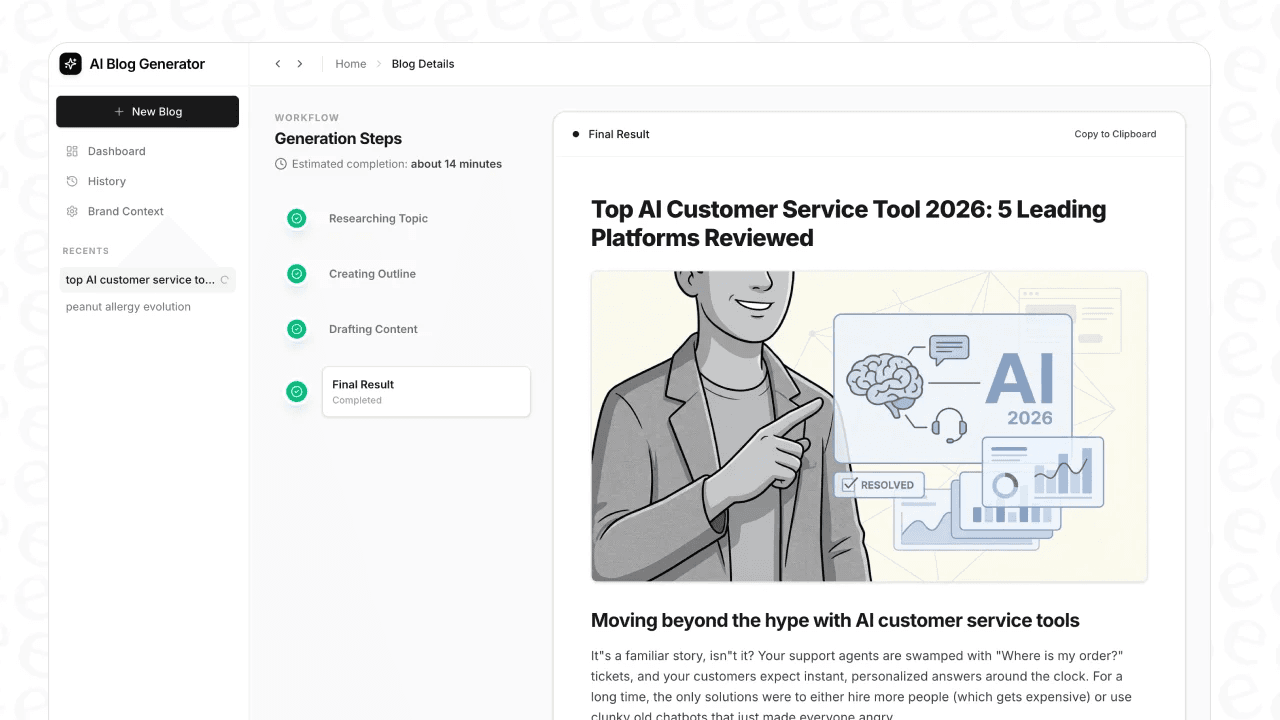
The eesel AI blog writer is designed to generate a complete, SEO-optimized, and media-rich blog post from a single keyword. The platform conducts context-aware research, automatically creates and inserts relevant assets like infographics and tables, and embeds YouTube videos and Reddit quotes to add authority. The content is also optimized for AI Answer Engines (AEO) to prepare for future search trends.
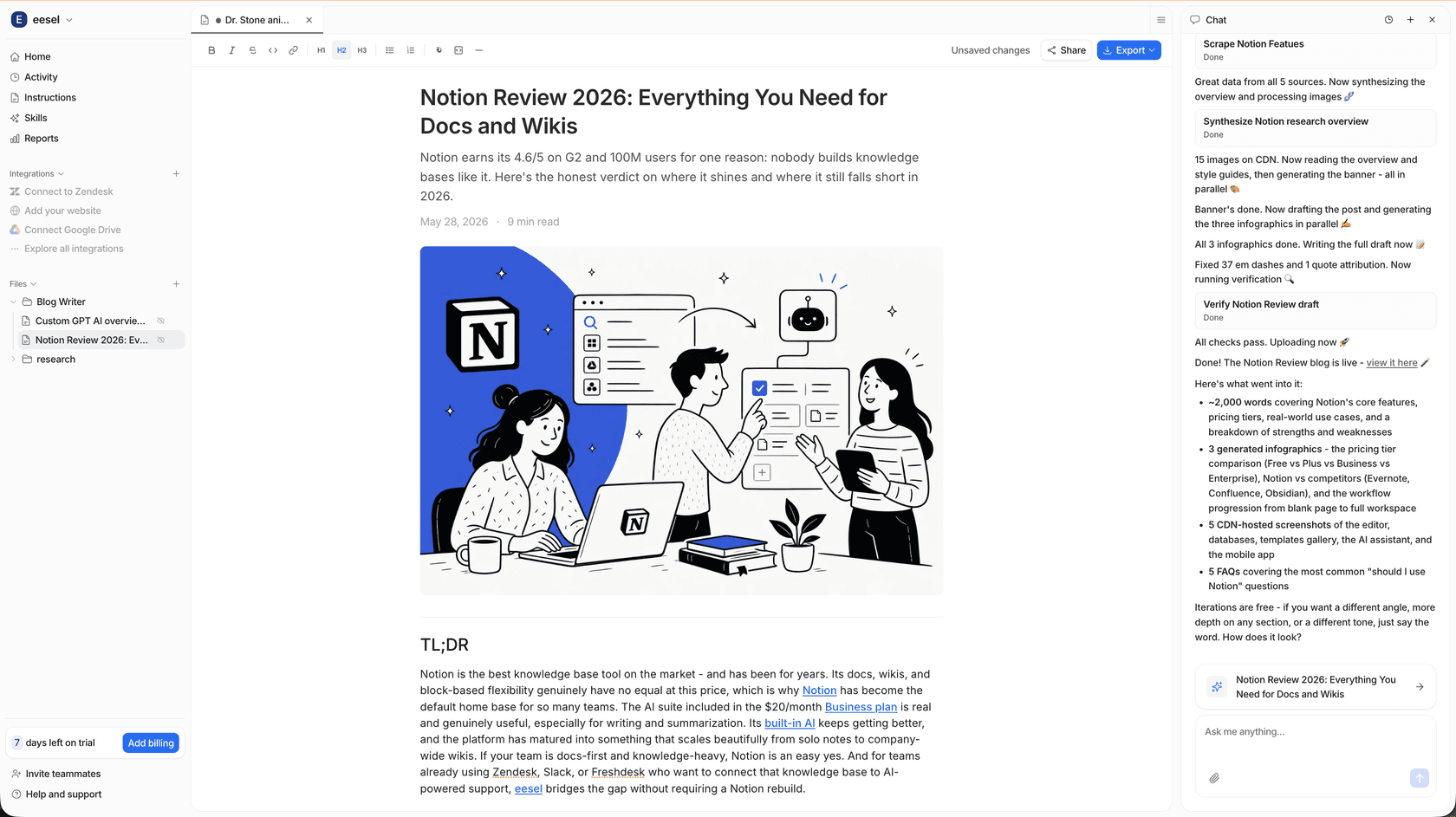
The main focus of the eesel AI blog writer is on creating a final, publishable asset, which reduces manual work. It is built specifically for SEO, making it effective for content marketers aiming to grow organic traffic. As a specialized tool for long-form blog content, it may not be the ideal choice for teams that need a general tool for ad copy or social media posts. It is free to try, with paid plans that are credit-based, starting at $99 for 50 complete blog posts.
2. Jasper
Jasper is a well-known tool in the AI content space, built for marketing teams. Its Brand IQ feature allows users to set up a specific brand voice, style guides, and product catalogs to maintain content consistency. Its strengths include features for larger companies, such as role-based permissions, campaign workflows, and collaboration tools. The platform is LLM-agnostic, selecting a suitable language model for each task.
I like a mix of free Chat GpT and Jasper. Free Chat GPT is actually still better for brainstorming - Jasper doesn’t really always understand the same prompts, the same way. I could ask it to suggest an outline for an ebook blah blah blah and sometimes it takes a lot more correction than chat GPT.

While Jasper is versatile for broad marketing strategies, its long-form blog content generation primarily focuses on text. This means users will need to create or source visuals, charts, and other media separately. Jasper offers a 7-day free trial, and its Pro plan starts at $59 per user per month with annual billing.
3. ChatGPT
ChatGPT, from OpenAI, is the tool that made conversational AI a household name. It's good at a massive range of tasks, from brainstorming blog ideas and summarizing documents to rephrasing sentences and writing creative text on just about anything.
Its conversational style is its biggest strength; it feels more like a creative partner than a piece of software. You can tweak its output with a simple back-and-forth chat, asking for changes and new ideas easily. The free version is quite capable, and paid plans give you access to faster, more advanced models.
I think people find plain ol' ChatGPT better than a lot of writing tools like these because ChatGPT is collaborative, and most other writing tools want to try to 'do your writing for you.' But AI isn't quite good enough yet to pull that off.
The main draw of ChatGPT is its incredible versatility. It's a great assistant for coming up with ideas, creating outlines, and writing quick drafts. As a generalist tool, it lacks the specialized workflows, built-in SEO tools, or automatic asset generation found in more focused platforms. This may require more time for prompt engineering and formatting to produce a final piece of content.
ChatGPT offers a solid free version, and paid plans like Plus begin at $20 per month.
4. Copy.ai
Copy.ai calls itself a GTM (Go-to-Market) AI Platform, and it's aimed squarely at sales and marketing tasks. Instead of giving you a blank page, it provides a library of pre-built workflows to help you generate everything from cold emails and SEO briefs to sales copy.
It’s a good choice for teams that need to produce structured copy quickly and consistently. The platform is LLM-agnostic and uses AI-powered workflows to streamline multi-step processes across the entire customer journey. This helps maintain a consistent quality, whether you're writing a case study or a LinkedIn ad.
Pros: ease-of-use and friendly interface, compared to other competitors; quality of content is also superior (yet, here is a trick: in a paid plan, it seems to be much better than in a free one)... Cons: Delivery speed definitely needs improvements, as does the fact that there are not many integrations available. Another con is the absence of an AI image generator, which makes you switch between tabs and is not worth paying $49 per month.
The guided workflows are a big advantage because they don't require much input to generate good results. The main thing to consider is that its focus on the entire GTM playbook, including prospecting, might be more than a dedicated content team really needs.
Copy.ai has a free plan with usage limits. The paid Chat plan starts at $29/month for up to 5 users and includes unlimited words in the chat.
5. Writesonic
Writesonic is an AI writing platform designed to help brands get more visibility in traditional search engines (SEO) and the newer AI answer engines like ChatGPT and Perplexity. They call this approach Generative Engine Optimization (GEO) and are positioning themselves for the next evolution of search.
The platform offers standard SEO tools alongside content generation, with features like an AI Article Writer that pulls real-time data from Google, analyzes competitors, and suggests internal links. The unique GEO features track a brand’s presence on different AI platforms and offer tips to improve it.
Writesonic is a good tool for marketers who want a more comprehensive, future-facing search strategy. It is worth noting, however, that its advanced GEO tracking features are only available on the higher-tier Professional plan, which could be a factor for smaller teams.
Writesonic has a free trial, and the paid Lite plan starts at $39/month with annual billing.
6. Rytr
Rytr is a simple, quick, and very affordable AI writing assistant. It's especially good for short-form content like social media posts, email subject lines, product descriptions, and ad copy. Its clean, straightforward interface makes it one of the easiest tools to get started with.
One of its standout features is the option to pick from over 40 use cases and 20+ tones of voice. You can instantly switch between styles like "convincing," "humorous," or "inspirational" to match the output to a specific audience.
The biggest advantage of Rytr is its accessibility, both in terms of price and ease of use. It’s a great entry-level tool that offers unlimited word generation on all its paid plans. However, it isn't designed for creating complex, long-form content and can sometimes produce repetitive text. The free plan is also very limited, with a cap of only 10,000 characters per month.
Rytr offers a free plan, and paid subscriptions start at $7.50 per month when billed annually.
How to choose the right AI content generator for you
With so many tools available, picking the right one can be tricky. Here’s a simple way to think about it, which we've also summarized in the graphic below.
- Focus on your main goal. Are you writing long, SEO-focused blog posts, quick social media updates, or technical sales emails? A tool built for a specific purpose will usually work better than a general one. For serious blog content meant to rank, a platform like the eesel AI blog writer is designed for exactly that.
- Think beyond the text. Good content is more than just words. If you need images, charts, and data for your articles, pick a generator that includes asset creation. This will save you a ton of time compared to making or finding visuals yourself.
- Try before you buy. Almost every tool on this list has a free trial or a free plan. Use it. Create a real piece of content and see how much time it actually saves you once you factor in editing, formatting, and creating assets.
- Prioritize the workflow, not just the features. A slick interface doesn't matter if the process is clunky. The goal is to produce high-quality content faster, so choose the tool that fits best with how you already work.
For a visual overview of the current landscape of AI content tools, the video below offers a helpful comparison of some of the top options for content creators in 2026.
Final thoughts
AI content generators have evolved from simple text spinners into useful creative tools. They are best viewed as assistants that handle the initial draft, allowing human writers to focus on strategy, unique insights, and final polishing. The best tool is one that fits specific content needs and workflows.
For teams focused on consistently publishing high-quality, SEO-optimized blog posts, a tool like the eesel AI blog writer is built to generate a complete article with assets from a single keyword. It is free to try, allowing you to generate your first blog post and evaluate the output.