Why comparison articles are worth the obsession
Most content sits at the top of the funnel, where the reader is curious but nowhere near buying. Comparison content is different. Someone searching "Zendesk vs Freshdesk" or "Gorgias alternatives" already knows the category and is choosing between named options. They are one decision away from a purchase, and you get to be in the room for it.
The numbers back this up hard. That Grow and Convert study tracked 123,000+ organic pageviews and 4,687 conversions, then broke conversion rate down by keyword type:
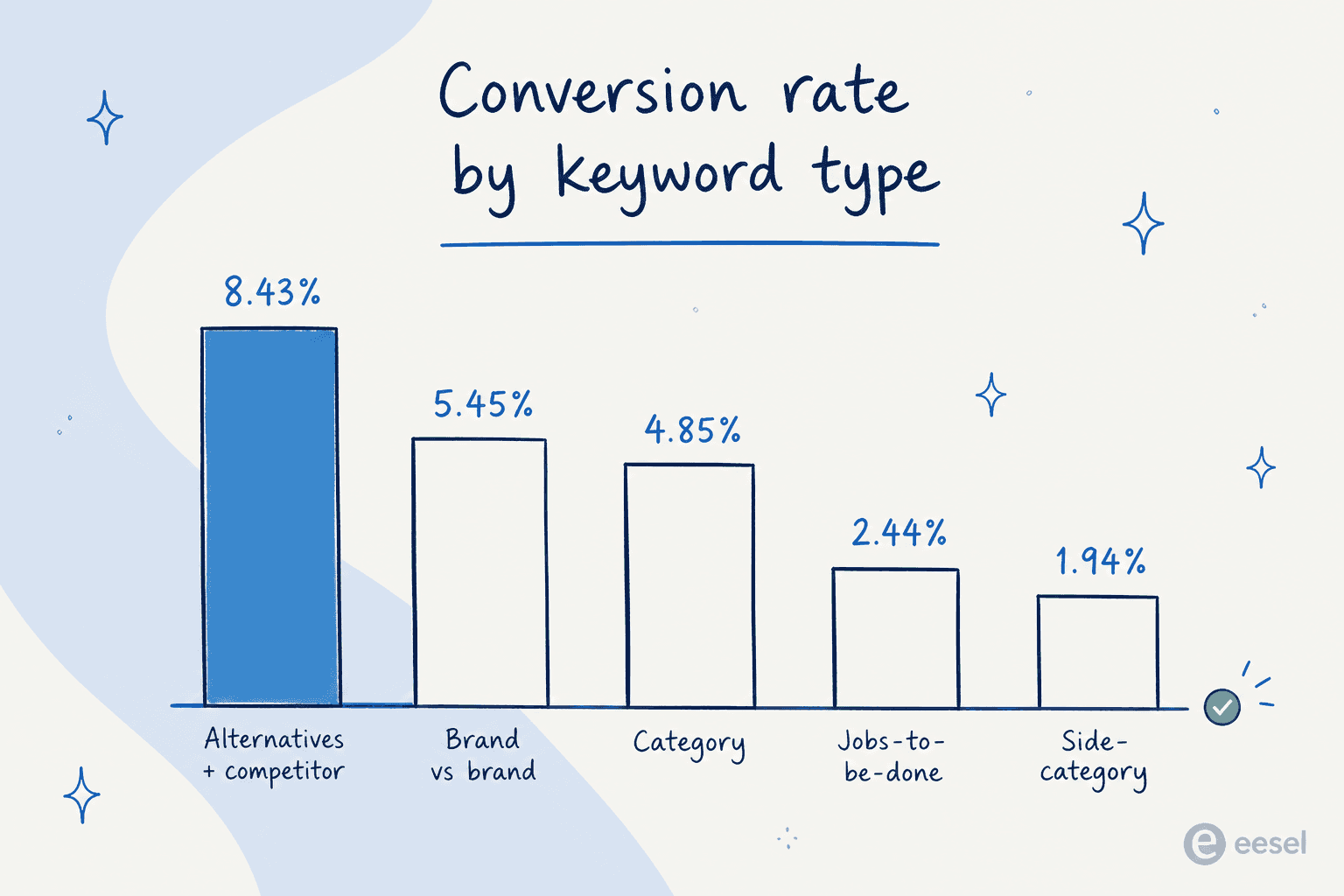
Alternatives keywords landed at 8.43% and "vs" keywords at 5.45%, both beating even the big category terms like "best accounting software" (4.85%). And these pages punch above their reported search volume: Grow and Convert found six comparison articles, each with under 20 monthly searches, that collectively drove 149 signups for one client.
Practitioners see the same thing. A SaaS founder who built comparison pages for five competitors reported the gap plainly:
"Conversion rate: 8.2% (vs 3.4% for general traffic). Why comparison pages convert well: Visitors are already in buying mode. They know the category, they're evaluating options."

There is a newer reason to care, too. The pages that get cited in AI search answers are disproportionately comparison and review content, not the brands being compared. When someone asks ChatGPT or Claude "what's the best Help Scout alternative", a good comparison article is the thing the model pulls from. That is the whole game now, and it is why I keep nudging teams toward comparison blog writing before almost any other format.
So why does most AI comparison content fall flat?
Here is where it gets uncomfortable. The exact format that converts best is also the easiest to mass-produce badly with AI, and the internet is now flooded with the bad version.
I spend a lot of my time on search intent and rankings, and the failure mode I see most is what I'd call the "ranks but nobody cares" trap. One operator ran a clean experiment publishing AI-generated app and comparison pages, then posted the data:
"Ranking turned out to be the easy part. The click is where everything dies... 28 articles, 215 impressions, 0 clicks. Zero. App pages converted at 0.6%. And 80% of all clicks on the site came from people typing the brand name."
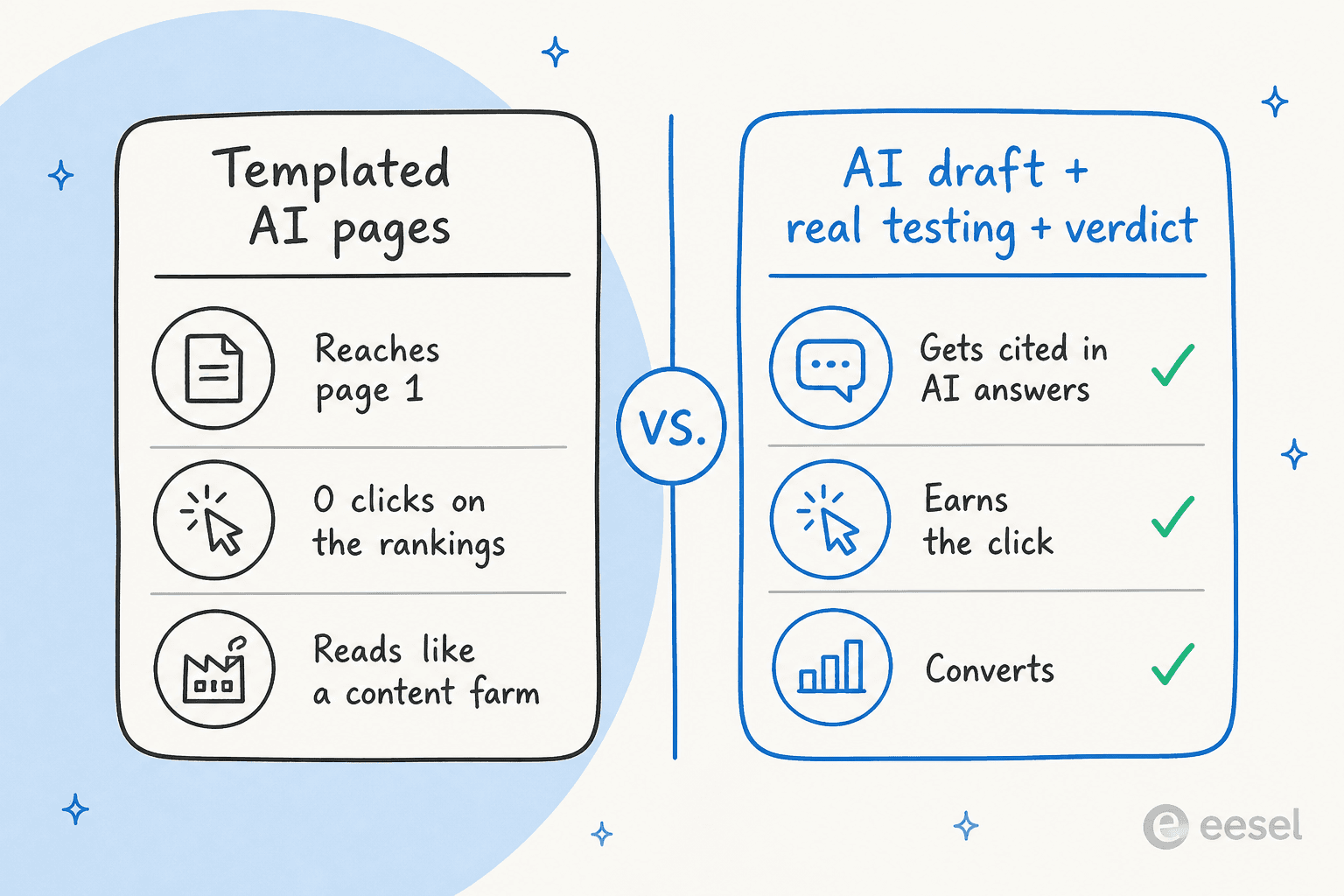
Ranking is the easy part. The click and the trust are where templated AI content dies. The searcher reads your title, sees the same generic phrasing the AI overview already gave them, and clicks the result that promises an actual opinion.
There is a real Google risk on top of the conversion problem. Google's scaled content abuse policy names this directly:
"Scaled content abuse is when many pages are generated for the primary purpose of manipulating search rankings and not helping users... no matter how it's created."
The phrase "no matter how it's created" is the one to internalize. AI authorship is not the violation. Spinning up hundreds of near-identical "X vs Y" tables with no original analysis is. The smartest diagnosis I've read of why bulk AI sites get hurt came from an r/SEO thread:
"what kills sites is the by-products of bulk AI publishing, not the AI itself... no entity grounding (no quotes, no proprietary data, no first-person experience), templated structure (every post has the same H2 stack so the site looks like a content farm)... if the AI drafts go through a real editor who adds something the model couldn't have written, you're usually fine."
That last line is the whole strategy in one sentence. If you want to go deeper on the mechanics, we wrote up how to scale SEO content safely and the question of whether AI content is good enough for B2B.
What an AI comparison article writer should actually do for you
Once you accept that the human adds the trust layer, the job of the AI gets clearer. It should take everything tedious off your plate so your time goes to testing and judgment, not formatting.
A good AI content writer for comparisons should:
- Do the research, with sources. Pull pricing, features, and limits from each tool's own pages, and cite them, so you are not fact-checking from scratch.
- Build the comparison table. The single most-skimmed element on the page. Get the structure right and populate it from real data.
- Write in your brand voice. Not a generic register that screams "AI wrote this." The eesel writer claims a 94% voice match after analyzing your past articles.
- Handle internal linking. Comparison articles should link densely to your other content and product pages. Doing this by hand across dozens of posts is brutal, which is why automated internal linking matters.
- Iterate on command. You should be able to say "make the verdict sharper" or "the competitor's pricing changed" and have it adjust, instead of regenerating from zero.

This is exactly the kind of work eesel's blog writer was built for, and it is run in anger: one SEO content lead uses it to scale to 360+ posts a month from a keyword-to-publish pipeline, and a German e-commerce brand runs it to produce 2,000 to 2,900-word researched posts with infographics and FAQs in roughly 12 to 20 minutes each. The point is not "AI writes the whole thing alone." It is that the drafting, research, and formatting stop being the bottleneck.
The anatomy of a comparison article that ranks and converts
Whatever tool drafts it, a comparison article needs the same bones. Ahrefs' anatomy of an optimized page and Grow and Convert's structural findings line up closely here. The format that wins is a long-form blog post, not a thin landing page, because a "vs" SERP full of blog posts is Google telling you searchers want depth.
The elements that earn their place:
- A keyword-bearing H1 and URL that say exactly what is being compared.
- The comparison table, high up. Buyers skim before they read. As one r/b2bmarketing reply put it, short comparison content wins when it is "skimmable, concrete and decisive."
- A "who should pick which" section. The best comparisons tell a story about which reader each tool fits, not just which has more checkmarks.
- Pricing, spelled out. Omitting it makes readers bounce. Define the billable unit, because per-seat and per-resolution are not the same cost.
- A real FAQ section to catch related question keywords (you'll notice this post has one).
- A clear, named verdict at the end.
Make the table dense. A four-column "name / price / rating / link" grid reads like a fluff piece; a table with security certifications, integration counts, free-tier availability, and support channels reads like research, and it is the artefact buyers screenshot and share. For the broader workflow of turning a keyword into a structured draft, our notes on AI-built blog outlines and SEO content writing examples cover the supporting steps.
How to write a comparison article with AI, responsibly
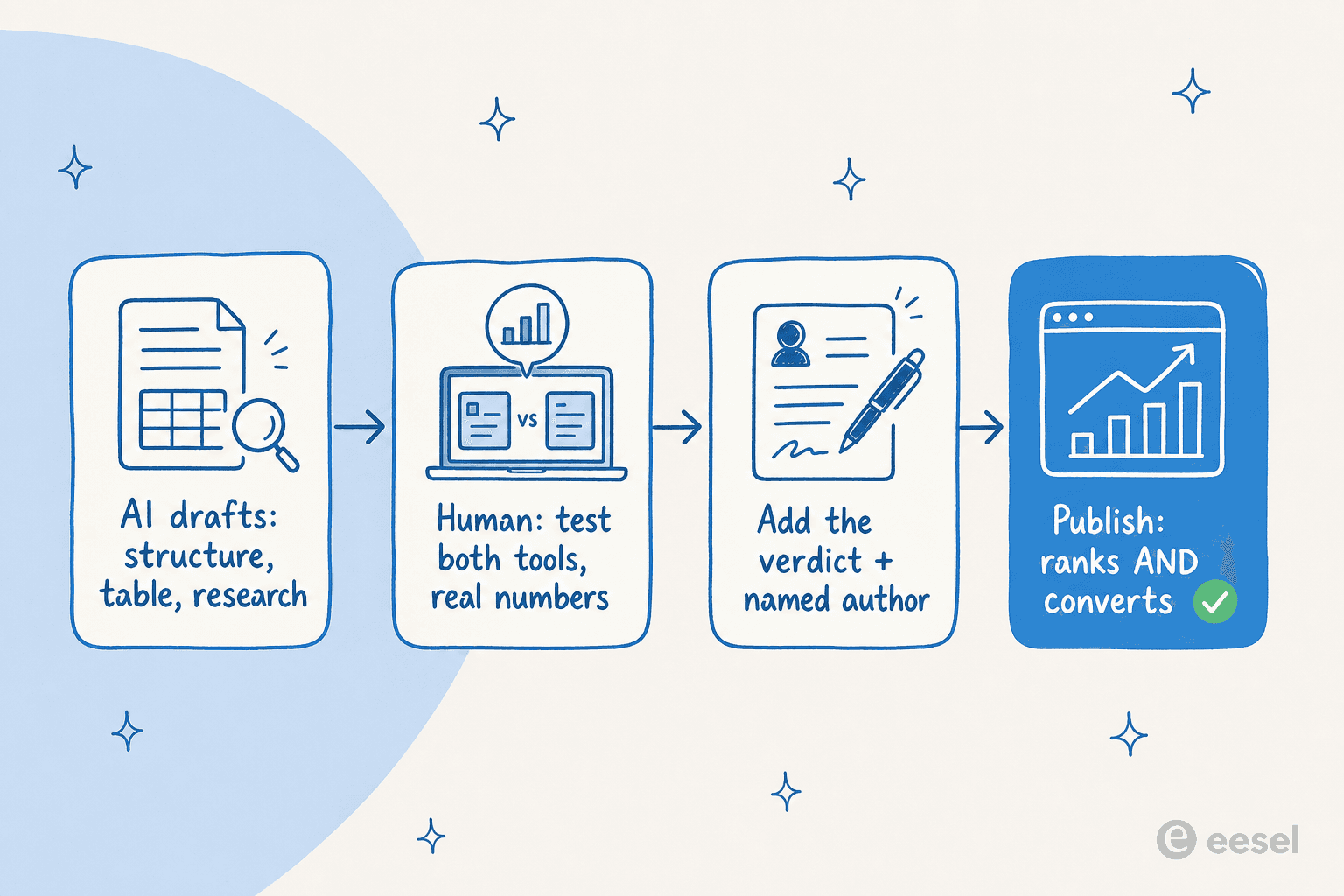
Here is the workflow I'd actually run, and the part where the AI hands back to you.
- Pick the right keyword. "Brand vs brand", "competitor alternatives", and even "competitor vs competitor" all convert. A three-way page once let a low-awareness brand rank #1 for "postmates vs onfleet" and insert itself into a buying conversation it had no demand for. Cluster these with a keyword clustering tool so you cover the whole intent.
- Let the AI draft structure and research. The table, the headings, the pricing pulled from source, a first pass at pros and cons. This is the 80% that used to eat your afternoon.
- Actually use both tools. This is non-negotiable. Open the products, click around, screenshot the real UI. Google's quality guidance rewards content that shows first-hand expertise from having actually used the thing.
- Add the numbers and the verdict. Replace soft claims with real figures. Then take a position. Buyers reading "X vs Y" are not looking for neutrality, they want an answer.
- Put a real name on it. A named author with a linked background is a trust signal Google looks for, and it matters most when you are comparing your own product to a rival.
If you want this as a repeatable system rather than a one-off, that is what an AI content pipeline is for: keyword in, researched and brand-voiced draft out, human edit, publish.
The one thing AI can't fake: a fair, opinionated verdict
This is the part I care about most, because it is where comparison content lives or dies. The single best predictor of whether a comparison article works is whether the reader believes it.
The same founder from earlier was blunt about what separates the winners:
"Honest comparisons. Don't trash competitors. Acknowledge their strengths... What doesn't work: Overly biased content. Readers can tell when you're not being fair. Generic comparisons. 'We're better at everything' isn't credible."
There is a real tension to manage. Be genuinely fair, but do not hide behind neutrality, because a BOFU checklist on LinkedIn nails the failure of trying to stay perfectly balanced: buyers reading "X vs Y" are not looking for neutrality, they are looking for a clear answer. The resolution practitioners keep landing on is simple: do a fair, detailed comparison, name where the other tool genuinely wins, and then introduce your brand as the better alternative to both.
Google frames the same idea as E-E-A-T, where trust is the most important component and everything else feeds it. An AI comparison article writer can give you a flawless table and zero trust. You supply the trust by having opinions you can defend, sourced from real use. If you want the deeper version, our E-E-A-T guide and notes on making AI content sound human go further.
Try the eesel AI blog writer for comparison content
If you are writing comparison articles at any volume, the bottleneck is rarely the verdict, it is everything around it: the research, the table, the brand voice, the internal links. That is the exact stretch the eesel AI blog writer handles. It finds topics through competitor gap analysis, does real research with every claim cited from primary sources, matches your brand voice from day one, and lets you iterate by chatting with it, so your time goes to the testing and the take.
It is usage-based, with $50 of free credit and two free blog generations, so you can draft a real comparison article and judge the output before you pay anything. Bring the keyword and the willingness to actually test the tools. Let the writer handle the rest.
Frequently Asked Questions
What is an AI comparison article writer?
Does Google penalize AI comparison content?
Why do my AI comparison articles rank but get no clicks?
How much does an AI comparison article writer cost?
Can AI write a fair comparison of my own product versus a competitor?
What is the best format for an AI comparison article?
Can an AI comparison article writer handle internal linking?


Article by
Kurnia Kharisma Agung Samiadjie
Kurnia is a software engineer and writer at eesel AI with two years of SEO experience, writing about AI tools, helpdesk software, and customer support. He pairs a developer's understanding of how these products are built with search-driven research into what actually ranks and resonates with the people searching for them.