Many teams use AI to increase content production, but find their articles are not ranking on Google. This can be frustrating, especially when publishing volume is high but traffic remains low.
A common misconception is that Google penalizes AI-generated content. However, the issue is not about the tool used for writing. Google's own guidance on AI content clarifies that quality and helpfulness are the primary ranking factors, regardless of how the content is created.
This article will break down the real reasons your content is falling flat. We’ll get past the myths and give you a clear, practical plan for using AI to create blogs that Google and your readers will actually value.
We'll also look at how modern tools are designed to avoid these issues from the get-go. Using our own eesel AI blog writer, we grew our daily impressions from 700 to over 750,000 in a few months by focusing on quality, not just cranking out posts. Let's get into how you can do the same.
What Google actually says about AI content
Before we dive into the fixes, it helps to know what Google's official stance is. This isn't about guessing; it's about lining up your strategy with what the world's biggest search engine has said out loud.
That's not true, Google has repeatedly said that it doesn’t care whether a text was written by a human or AI, as long as the content is useful and high-quality for the audience. So if you’re writing blogs with the help of ChatGPT, don’t worry that they won’t be ranked just because of that, focus instead on making sure those blogs actually help someone.

Google's core message is that it rewards high-quality content that helps people, no matter how it was made. Their systems are built to promote content created for people, not content made just to game the search rankings. If you’re using AI as a tool to help create original, useful stuff, you’re fine. But if you're just churning out low-value text to rank for keywords, you're breaking Google's spam policies.
The bar for "high-quality" is laid out in Google's guide on creating "people-first content." This guide focuses on originality, deep information, and showing expertise. It’s not about who wrote it (human or AI), but about the value it gives the reader.
Google looks for E-A-T signals, so if your AI-generated content lacks clear expertise or authority on a topic, it might struggle to rank.
To measure that value, Google uses its E-E-A-T framework: Experience, Expertise, Authoritativeness, and Trustworthiness. This is the real test for your content. For any article to rank well, it has to show these qualities. The newest part, "Experience," is a big one. It gives a boost to content that shows it was made with some first-hand knowledge or real-world use. This is where most basic AI-generated content stumbles right out of the gate.
Common reasons AI-written blogs don't rank
If Google doesn't automatically ding AI content, why are so many AI-written blogs failing? The answer is in the gap between what a generic AI can produce and what Google's E-E-A-T guidelines require. Here are the usual suspects.
Lack of first-hand experience
AI models are trained on huge amounts of text from the internet. They're great at summarizing what’s already out there, but they can't create anything truly new. They haven’t used your product, talked to an expert, or run an experiment. That means they can't offer first-hand experience, original case studies, or fresh insights.
This goes directly against the "Experience" and "Expertise" parts of E-E-A-T. Content that feels like a generic book report without any real-world perspective often gets pushed down during Google's core updates. These updates are basically re-checks of content quality, not penalties, and they tend to filter out shallow content.
On top of that, basic AI drafts usually don't have the signs of authority and trust that search engines look for. Both Google and AI answer engines depend on strong third-party citations and trust-building content (like clear policies, author bios, or good sourcing) to check information. A simple block of AI text has none of that, making it seem less credible.
Generic tone and brand voice
Ask a generic AI to write a blog post, and that's exactly what you'll get. The text often sounds robotic, uses the same old sentence structures, and has no real point of view. It doesn't build a consistent brand identity, which is something search systems use to figure out who you are and what you're about.
This bland tone directly affects how users behave. Readers can spot it a mile away. When content feels impersonal and unhelpful, they click away. That leads to higher bounce rates and less time on the page, which tells Google your content isn't giving users what they want.
Another small but important issue is a "vocabulary mismatch." An AI might use technical terms or formal language that doesn't match how your audience actually talks about their problems and searches for answers. If your content doesn't speak your audience's language, it's less likely to connect with them or even show up in their search results.
Poor structure and linking
Many AI writing tools just give you a wall of text. They might throw in a few headings, but they often don't create a logical structure (H2s, H3s) that breaks the content into easy-to-read sections. This formatting is important not just for readability but also for helping search crawlers understand the structure and main topics of your content.
More importantly, raw AI drafts are made in a bubble. They usually miss the key elements needed to build topical authority on your site:
- Strategic internal linking: Connecting your new post to other relevant articles on your blog helps users find more of your content and shows Google you have a lot of expertise on a certain topic.
- External linking: Citing trustworthy, high-quality sources builds credibility and shows your content is well-researched.
- Media-rich assets: A blog post with just text is boring compared to one with relevant images, tables, infographics, or videos. These things improve the user experience and can keep people on your page longer.
Without these pieces, your blog post is just an island, cut off from the rest of your content and the internet.
Thin content that misses search intent
One of the most common problems with AI content is that it's "thin." This doesn't just mean it's short. A 2,000-word article can still be thin if it has low information density, meaning it's full of fluff and repeated sentences but doesn't offer any real substance or useful advice.
Search intent is another huge piece of the puzzle. What a user wants when they type something into Google can change over time. A simple "what is" article might have ranked well last year, but today, users might want a detailed comparison, a step-by-step guide, or a video. Generic AI tools can’t look at the current search results to understand these details; they just write based on your prompt.
In the end, Google’s goal is to give the single best answer to a user's question. If your AI-generated post doesn't offer more depth, a better experience, or a more unique angle than the pages already on page one, Google has no reason to put it there.
How to create AI-assisted content that ranks
Knowing the problems is the first step. Now, let’s talk about the solution. The idea isn’t to ditch AI but to use it in a smarter way. Here’s how you can create high-quality, AI-assisted content that actually deserves to rank.
Start with a context-aware AI blog writer
The quality of your final article really depends on the quality of your first draft. Using a generic chatbot for specialized SEO content may not be the most effective approach, as it's not designed for that specific task. A specialized AI blog writer made for SEO content gives you a much better starting point.
The eesel AI blog writer, for example, was built to solve these exact ranking issues. It goes beyond simple text generation to create a complete, publish-ready blog post by truly understanding the context.
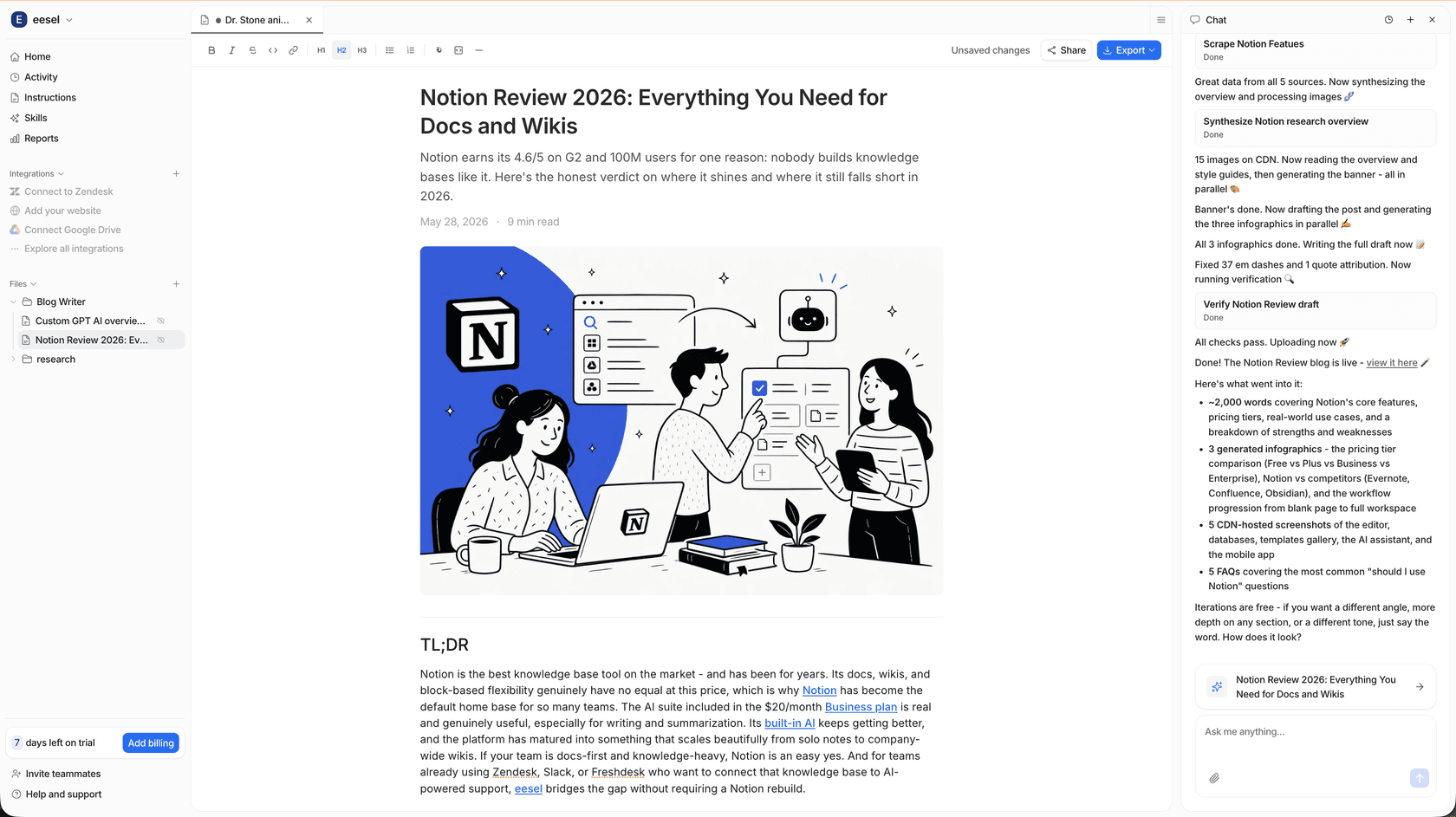
Here are a few key features that tackle the problems we've talked about:
- Automatic Assets: It doesn't just write text; it creates relevant images, tables, and infographics. This immediately fixes the "wall of text" and "thin content" problems by making the article more engaging and packed with information.
- Authentic Social Proof: It pulls in real, relevant Reddit quotes and YouTube videos. This adds genuine human experience and different viewpoints, directly addressing the "E" (Experience) in E-E-A-T.
- Deep Research with Citations: It automatically builds a network of links by adding internal links to your other pages and external links to good sources. This helps build topical authority and trust right from the first draft.
- SEO & AEO Structure: The whole post is formatted with a proper heading structure that's optimized not just for search engines but also for AI Answer Engines like Google AI Overviews and Perplexity.
Using a tool that handles the structure and research lets you spend your time on what really matters: adding your unique human expertise.
Layer in human expertise
This is the most important part of the whole process. AI should be seen as a powerful research assistant and a super-fast first-drafter, not a replacement for a human expert. The AI builds the foundation; you add the unique value that makes the content special.
AI can be a useful tool for creating blog content, but how you use it makes all the difference. Google doesn’t penalize AI-written posts as long as the content is original, helpful, and genuinely valuable to readers. What tends to hurt SEO are low-effort articles: stuff that’s too generic, stuffed with keywords, or doesn’t answer what users are actually searching for. The most effective brands I work with treat AI as a starting point. They draft quickly, then refine, fact-check, and optimize before publishing and they’re seeing real SEO gains from it.
Here are some practical ways for editors and subject matter experts to improve an AI draft:
- Add personal stories: Share a quick story about a time you faced the problem you’re writing about. This creates an instant connection with the reader.
- Include original data: Do you have internal numbers, survey results, or a great client success story? Adding original data makes your content one-of-a-kind.
- Inject your brand's view: What’s your company’s specific take on this topic? Don’t be afraid to have an opinion. This is how you build a memorable brand voice.
- Fact-check everything: Never trust an AI’s claims, stats, or technical details without checking them yourself. Your credibility is at stake.
This human layer is your secret weapon. It’s what turns a generic article into a truly valuable resource.
Finalize on-page SEO and formatting
Even with a great AI-generated draft, a final human review is key for polish and optimization.
- Read through the whole article to make sure it flows well and the language sounds like your brand.
- Look for chances to add more strategic internal links to guide readers to other relevant content and spread link equity across your site.
- Make sure every image has descriptive alt text. This is important for accessibility and for helping search engines understand what your images are about.
A practical workflow for AI content creation
Putting it all together, here is a simple, four-step process you can start using right away. This is the same basic workflow that helped our team see a jump of over 3,000 keywords in our rankings.
- Define Keyword & Context (Human-Led): Your process starts with human strategy. Pick a target keyword and gather the context, including your target audience, your unique angle, and your website URL.
- Generate a Complete Draft (AI-Led): Use a context-aware tool like the eesel AI blog writer to analyze the search results and generate a fully structured article. In just a few minutes, you’ll have a draft with headings, images, links, and social proof.
- Refine and Personalize (Human-Led): This is where the magic happens. An editor or subject matter expert reviews the draft. They add unique insights, inject the brand's voice, fact-check everything, and add personal experiences or original data.
- Publish and Promote (Human-Led): After a final on-page SEO check, the post is ready. Publish it and share it across your social media, email newsletters, and other channels.
This workflow uses the speed of AI for the heavy lifting and the expertise of humans for the high-value touches, giving you the best of both worlds.
Using AI writers effectively for SEO
If your AI-generated blogs aren't ranking, it’s almost certainly a strategy problem, not a tool problem. Publishing low-effort, generic content at scale is a recipe for failure, whether a human or an AI wrote it. Google’s algorithms are made to reward value, and a simple copy-paste from an AI tool doesn't cut it.
To see how this human-AI partnership works in practice, this video offers a great breakdown of how to publish AI-assisted content safely and effectively to gain traffic.
The winning formula is a human-AI partnership. It’s about using AI to build a strong, well-researched foundation, and then letting your human experts add their unique insights, experiences, and brand voice on top. This approach lets you scale content production without giving up the quality that's needed to rank.
Stop thinking of AI as a content vending machine and start treating it as a powerful teammate. When you combine the speed of AI with the irreplaceable value of human expertise, you create content that doesn’t just get published—it gets seen.
Ready to see what high-quality AI content looks like? Try the eesel AI blog writer for free and generate your first publish-ready article in under five minutes.