

For marketers, the content creation process can be demanding. The cycle of researching, outlining, writing, and sourcing images is often time-consuming. While AI blog writers are designed to help, many produce generic content that requires significant editing, making it difficult to identify tools that genuinely improve SEO performance.
don't use AI for writing entire blog, It's easier to spot these soulless blog writings filled with geeneric examples that are common across hundreds of different AI written blogs.

One example of a specialized tool is the eesel AI blog writer, which was developed to address these challenges. Using it for our own content, we were able to increase our daily impressions from 700 to over 750,000 in just three months.
To help you navigate the options, I tested seven of the top AI blog writers for SEO to see how they perform.
What is an AI blog writer for SEO?
An AI blog writer is a tool that uses artificial intelligence to help create long-form content like blog posts. These are not general chatbots like ChatGPT; they are specialized assistants for content creation.
They're designed to manage the entire blogging process. They can research topics, build a solid outline with headings, draft the intro and conclusion, and weave in your target keywords for SEO.
The best ones do more than just generate text. They can automatically create and add images and data tables, find relevant YouTube videos, and even pull quotes from Reddit to make your content feel more real and trustworthy. Plus, they are improving at optimizing for new formats like Google's AI Overviews.
How we chose the best AI blog writers for SEO
To make this list useful, I used each tool to create an SEO-focused blog post from a single keyword. I rated them on five main criteria, which are summarized in the graphic below:
- Real SEO features: I looked for tools that understand SEO beyond just keywords. This includes proper heading structures, meta descriptions, and suggestions for internal and external links. I gave extra points for tools optimized for Answer Engine Optimization (AEO).
- Content quality: I looked for engaging, well-researched content that sounded like it was written by a human, not robotic text.
- Draft completeness: A great AI blog writer should deliver something that's nearly ready to publish. Tools that included images, tables, and video embeds from the start scored higher.
- Ease of use: The tool had to be straightforward. I wanted a simple process: input a keyword and get a full article without a complicated setup.
- Value for money: I weighed the quality of the content against the time it saved. I also noted platforms with free trials.
Comparing the top AI blog writing tools for SEO in 2026
Before we get into the details, here’s a quick look at how the top 7 AI blog writers compare. This table should give you a fast way to see which tool might be the right fit for you, whether you’re a solo blogger or part of a bigger content team.
| Tool | Best For | Key SEO Feature | Starting Price (Annual) | Free Trial |
|---|---|---|---|---|
| eesel AI blog writer | Automating the entire blog creation workflow | AEO & Automatic Asset Generation | $99 for 50 posts | Yes, free to try |
| Jasper AI | Content teams needing versatile marketing copy | Brand Voice & Knowledge Base | $59/month per seat | Yes, 7-day trial |
| Surfer AI | Data-driven SEOs focused on on-page optimization | Real-time Content Score | $79/month | No, 7-day money-back |
| Koala AI | Affiliate marketers needing real-time data | Live Amazon Data Integration & SERP Analysis | $9/month | Yes, 5,000 words |
| Copy.ai | GTM teams automating structured content workflows | Pre-built GTM AI Workflows | $24/month per seat | Yes, free plan available |
| Writesonic | Marketers tracking visibility in AI search engines | Generative Engine Optimization (GEO) Tracking | $39/month | Yes, free trial |
| Rytr | Budget-conscious users and short-form content creation | Simplicity & Affordability | $9/month | Yes, free plan |
The 7 best AI blog writers for SEO in 2026
Alright, let's dive into the detailed reviews for each tool, based on my hands-on experience.
1. eesel AI blog writer
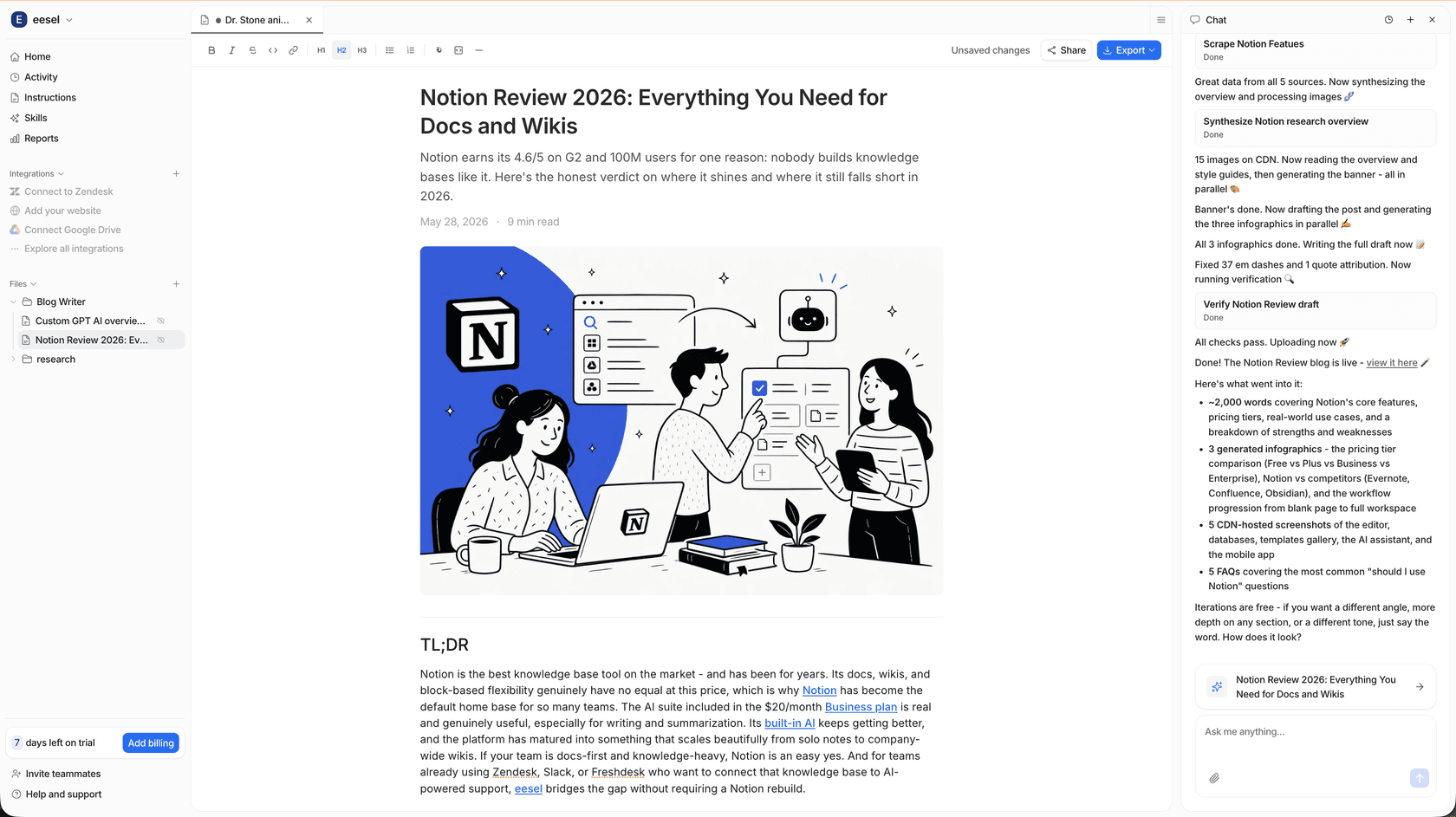
The eesel AI blog writer is designed to generate a complete, publish-ready blog post from a single keyword. Instead of a simple text document, it produces a fully-formed article that includes AI-generated images, data tables, relevant YouTube videos, and quotes from Reddit. This is the tool we used to increase our organic traffic from 700 to over 750,000 daily impressions. Its research is context-aware, meaning it automatically pulls relevant information based on the content type, such as pricing data for comparison posts or instructions for how-to guides.
-
Pros: The output is designed to be complete, providing a formatted article with visuals and social proof, which can save a significant amount of time. The tool is built for Answer Engine Optimization (AEO) to prepare content for Google's AI Overviews. The process involves entering a keyword and website URL for context to generate a post.
-
Cons: As a specialized tool, it focuses primarily on creating SEO blog content. It does not include templates for other marketing copy, such as advertisements or social media captions.
-
Pricing:
- Completely free to try your first post.
- Early Bird plan: $99 for 50 blog post credits.
2. Jasper AI
Jasper AI is a well-known name in the AI space and has positioned itself as a broad content platform for marketing teams. Its biggest strength is its versatility. It offers tools for various purposes, from blog posts to full ad campaigns. The platform is powered by Jasper IQ, which uses your brand voice, style guide, and a knowledge base to keep all your content consistent.
Yeah idk I still rely on my copywriting skills and use GPT to help me out
-
Pros: Jasper is a solid all-in-one option for teams that need more than just a blog writer. The interface is clean and polished, and the collaboration tools are great for working with others. The "Brand Voice" and "Knowledge Base" features are useful for maintaining consistency.
-
Cons: While Jasper is capable of writing long articles, the content may require human editing to add the depth and unique angles needed to rank for competitive keywords. It does not automatically generate assets like images or tables, so users must source visuals separately.
-
Pricing:
- Pro Plan: $59/month per seat (billed annually).
- Business Plan: Custom pricing for teams that need more advanced features.
3. Surfer AI
Surfer AI is integrated into the Surfer SEO platform and is focused on data. Its main goal is to help you create optimized content by analyzing what's already ranking at the top of Google. The workflow is built around its real-time "Content Score," which provides a detailed brief with recommended keywords, word count, and article structure.
SERP research & briefs: Frase, Surfer pull top-page headings, questions, entities, and gaps to build a brief fast.
-
Pros: If you rely on data, Surfer is a strong choice. It helps reduce the guesswork in on-page SEO. Its keyword suggestions are useful for ensuring thorough topic coverage. The platform has also added an AI Tracker to monitor visibility in AI search results and a Topical Map to help identify content gaps.
-
Cons: The AI's focus on data points can sometimes result in a draft that requires adjustments to sound more natural and improve its flow. It functions primarily as an optimization tool rather than a comprehensive content creator and does not generate visual assets.
-
Pricing:
- Essential Plan: $79/month (billed annually).
- Scale Plan: $175/month (billed annually) for more credits and access to the AI Tracker.
4. Koala AI
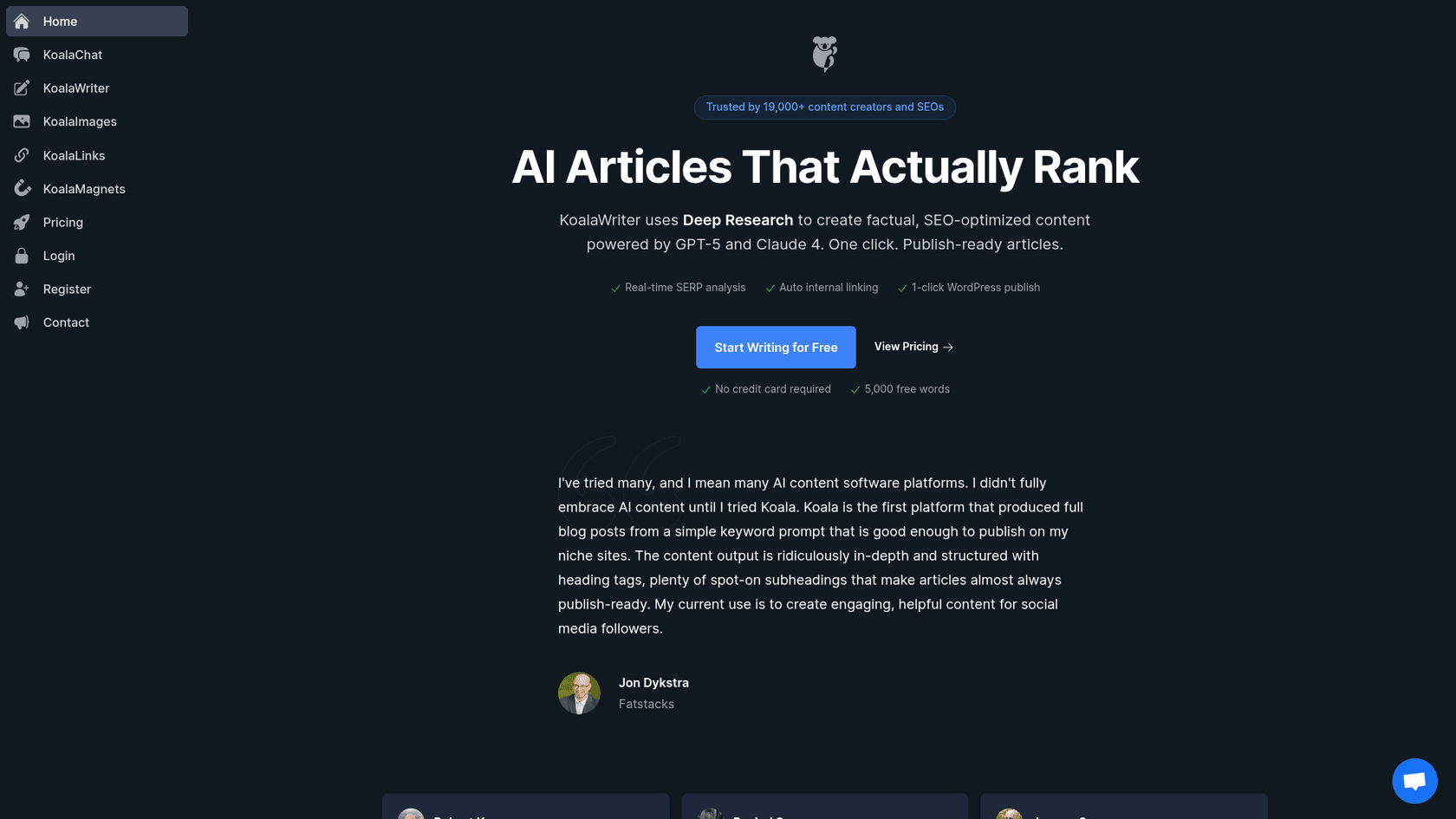
Koala AI is popular with affiliate marketers and bloggers. Its standout feature is the ability to pull in real-time data from Google and live product information directly from Amazon. This allows it to create up-to-date product roundups with current pricing and real customer reviews.
-
Pros: The real-time data feature is valuable for affiliate content, ensuring articles are accurate. It has special article types like "Amazon Product Roundup" and can convert a YouTube video into a blog post. It also has built-in SEO optimization and an automatic internal linking tool.
-
Cons: The content produced can be formulaic and may require significant editing to align with a specific brand voice or add personality. The user interface is functional but less polished than some other tools on this list.
-
Pricing:
- Free Trial: 5,000 words.
- Essentials Plan: Starts at $9/month for 15,000 words.
5. Copy.ai
Copy.ai has shifted its focus to become a Go-to-Market (GTM) AI Platform for sales and marketing teams. Its main strength is its workflow automation. Instead of just writing an article, it lets you build multi-step processes for tasks like sales prospecting, content creation, and lead engagement.
-
Pros: The "Workflows" feature is powerful for automating repetitive marketing and sales tasks at scale. It has a large library of templates for different channels, making it a handy all-around tool.
-
Cons: Since the platform is now focused on Go-to-Market workflows, its features for SEO blog writing are less advanced compared to more specialized tools. The output may require additional work to incorporate the unique insights needed for top-ranking content.
-
Pricing:
- Free Plan: Available with some limitations.
- Chat Plan: Starts at $24/month per seat (billed annually).
- Growth and Expansion plans are available for larger teams.
6. Writesonic
Writesonic has positioned itself as a platform for AI search. Its most notable feature is its Generative Engine Optimization (GEO) platform, which tracks brand visibility in places like ChatGPT and Google AI Overviews. Its article writer uses real-time data to create SEO-optimized content.
-
Pros: The platform is easy to use, and the GEO features provide interesting data for those focused on AI search visibility. It also offers different AI quality levels for more control over costs. The built-in SEO checker is a nice addition.
-
Cons: The quality of the generated content can be inconsistent. Drafts may require considerable editing and fact-checking before they are ready for publication.
-
Pricing:
- Free Trial: Available.
- Lite Plan: Starts at $39/month (billed annually).
- You'll need the Professional plan to access the GEO features.
7. Rytr
Rytr is an entry-level AI writing tool that is simple and affordable. While it can be used for blog writing, it excels at short-form content like emails, social media posts, and product descriptions. It has a clean, straightforward interface and numerous "use cases" to help users get started quickly.
-
Pros: The price point is very competitive, and the free plan is generous enough for casual users or those on a tight budget. It is fast and easy to use for brainstorming ideas or writing short paragraphs, making it a useful tool for overcoming writer's block.
-
Cons: Rytr is not designed for creating in-depth, long-form SEO articles. The content is generated section by section, which can be inefficient for a full blog post. It lacks the advanced research, optimization, and asset-generation features found in more comprehensive SEO writing tools.
-
Pricing:
- Free Plan: 10,000 characters per month.
- Saver Plan: $9/month.
- Unlimited Plan: $29/month.
Watching a hands-on review can provide a different perspective on how these tools perform in real-world scenarios. The video below tests several popular AI writers, offering a side-by-side comparison that can help you see their strengths and weaknesses in action.
Tips for choosing an AI blog writer for SEO
Picking the right tool can feel overwhelming, but it doesn't have to be. Here are a few tips to help you decide:
- Focus on your primary goal. If your main objective is to rank blog posts on Google, consider a tool built specifically for that purpose. Evaluate whether a specialized tool or an all-in-one platform with broader features better suits your overall content strategy.
- Test the free trials. Every tool on this list has a free plan or trial. Use them. Pick a topic and generate an article with your top 2-3 choices. Compare the results and see which one gives you a draft that’s closest to being publish-ready.
- Prioritize output quality over feature lists. A long list of features doesn't mean much if the content it creates is robotic and boring. The best AI blog writer is the one that saves you the most editing time.
- Look for complete solutions. The future of AI writing isn't just about text; it's about creating complete content. Tools that automatically include images, data, and social proof can provide a significant advantage and save hours of manual work.
Finding the right AI blog writer for your workflow
The purpose of using an AI blog writer is not just to write faster, it is about gaining leverage. Effective tools automate the more repetitive parts of content creation, such as initial research and asset sourcing. This allows content teams to focus on strategy and adding their unique expertise. Each tool on this list offers different strengths. By evaluating them based on your specific goals, from on-page data analysis to creating complete, publish-ready articles, you can find a solution that helps scale your content efforts effectively.