

The honest answer, from someone who ships AI content for a living
I'll skip the suspense. After three-plus years putting AI to work, on the support side across live customer queues and on the content side through the AI writing tools we build at eesel, my answer is: AI content is good enough for B2B marketing when a person is steering it, and a liability when it's on autopilot.
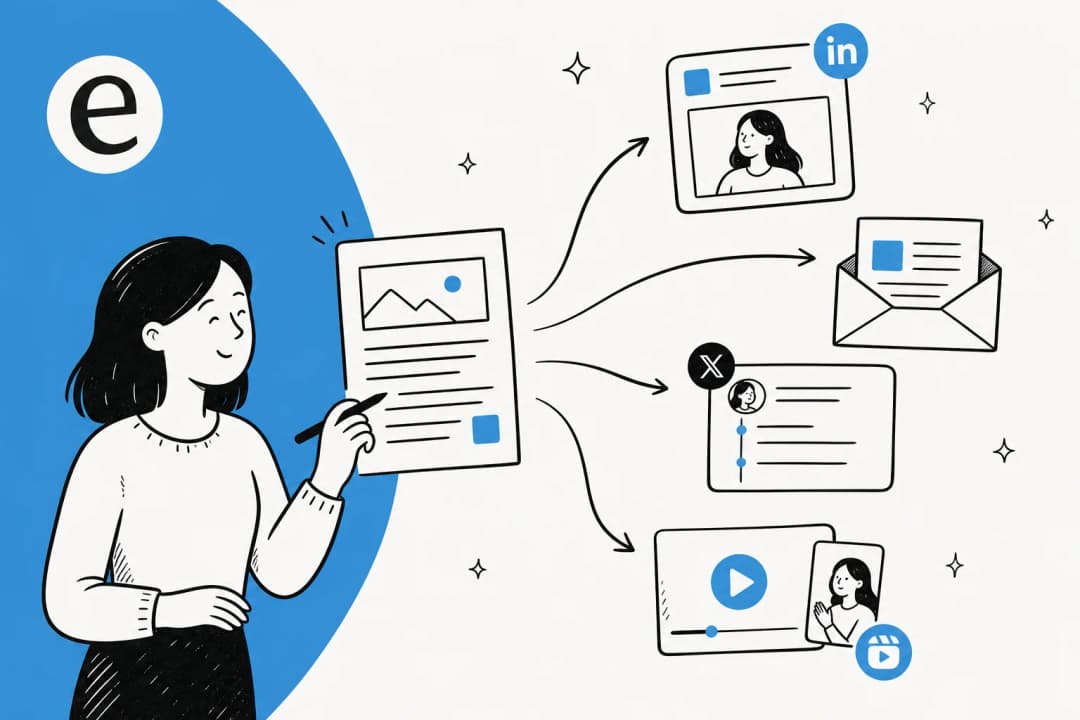
That's not a fence-sit. It's the whole game. I've watched our Blog Writer help one SEO content lead scale a Webflow operation to 360 published posts a month, twelve a day, with a consistent brand voice across all of them. I've also read the kind of raw, unedited AI output that reads fine to a search crawler and makes a real buyer quietly close the tab. Same underlying model. Completely different outcome. The difference is entirely in how it's used.
And I come at this with scars. On the support side, we've watched a confident-sounding bot give a confidently wrong answer to a real customer, which is why we now simulate every AI rollout against thousands of historical tickets before it goes anywhere near a live queue. That experience taught me the thing that matters here too: "sounds plausible" and "is actually good" are two completely different bars, and AI clears the first one effortlessly while the second one still takes a human.
What "good enough" means to Google (it's not what you think)
The fear underneath this question is usually "will Google punish me for using AI." So let's kill that one first, because the answer changes how you should think about everything else.
Google does not ban or penalize AI content. Its spam policies target a behavior called scaled content abuse, which it defines as creating "large amounts of unoriginal content that provides little to no value to users, no matter how it's created." When Google rewrote this policy in its March 2024 update, it was explicit: the focus is "producing content at scale to boost search ranking, whether automation, humans or a combination are involved." The same update was designed to surface 45% less low-quality, unoriginal content in results.
Read that twice. The line isn't human-versus-AI. It's value-adding versus scaled spam. A human cranking out forty thin pages to game a keyword is breaking the rule; an AI-assisted post that actually helps the reader, the kind of E-E-A-T-compliant content Google wants, is not.
The ranking data backs this up. Ahrefs analyzed 600,000 top-ranking pages and found 86.5% of them contain at least some AI-generated content, while the correlation between how much AI a page used and where it ranked was 0.011, which is statistically nothing. AI content already won the search results, which is exactly why the latest AI SEO tools assume you'll use it. Google neither rewards nor punishes you for using it.
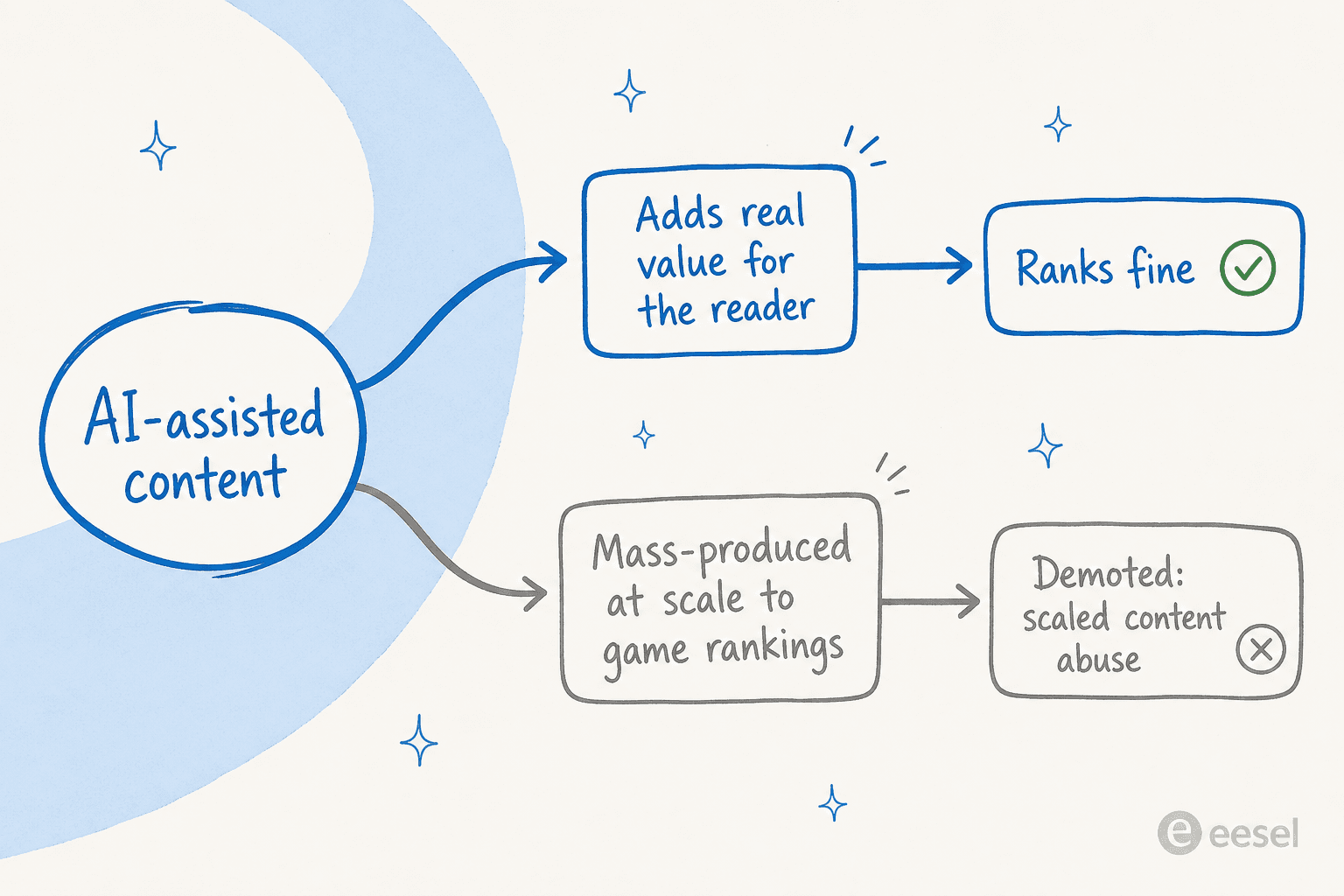
There's one quiet caveat in that same study, and it's the whole point of this post: only 4.6% of those ranking pages were pure AI, and the #1 spots skewed toward pages with less AI content. Ahrefs' own conclusion was blunt: "it's difficult to make truly high-quality content from AI alone." A companion study of 900,000 new pages found the same shape, 74% of new pages are AI-touched but only 2.5% are pure AI. The market has already voted, and it voted for AI as an assist, not AI as an autopilot.
The data: AI makes content faster, not automatically better
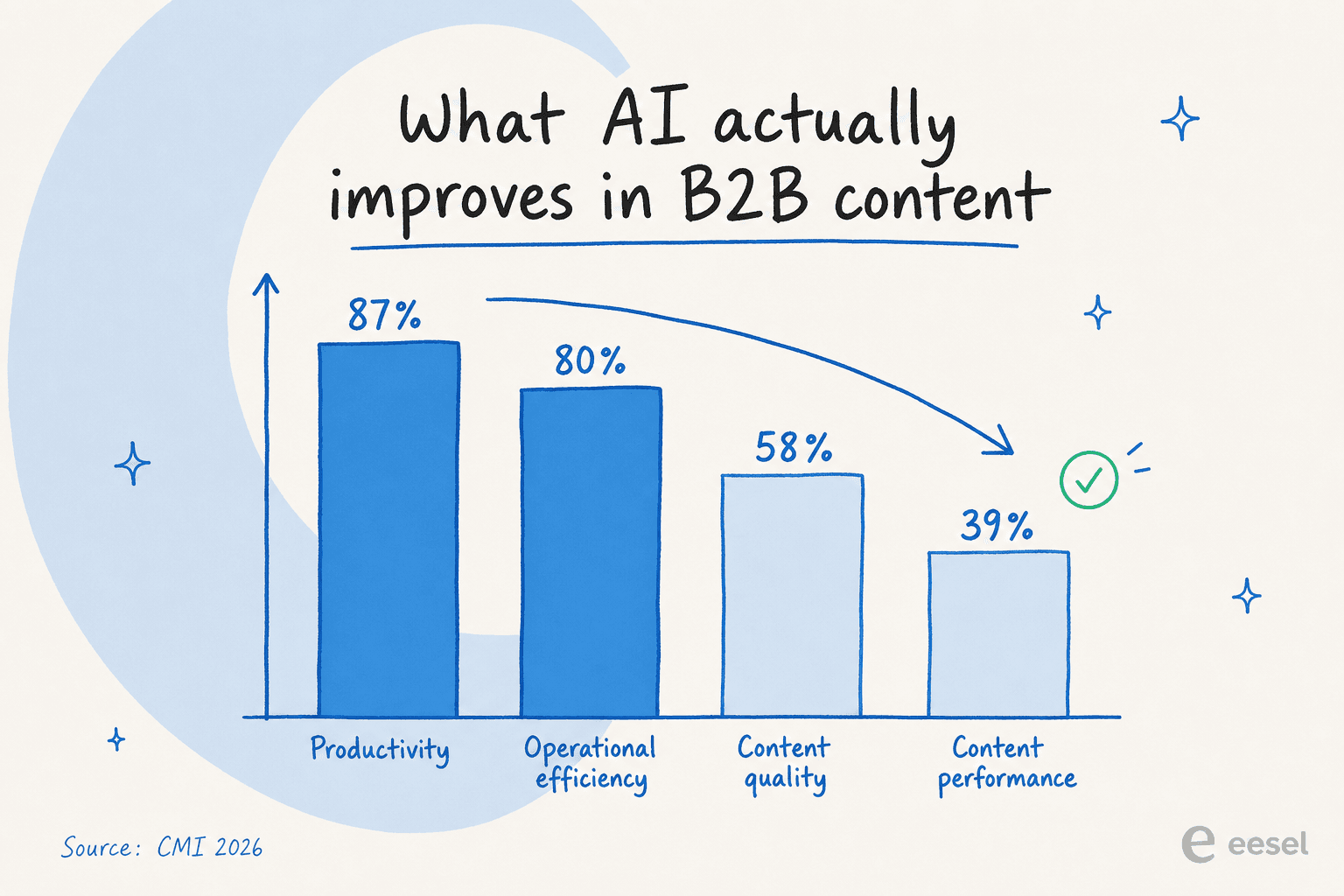
Here's the stat I'd tattoo on every content team's wall. In CMI's 2026 B2B Content and Marketing Trends report, among marketers using AI for content creation:
| What AI changed | % who said it improved |
|---|---|
| Productivity | 87% |
| Operational efficiency | 80% |
| Creative capabilities | 65% |
| Content quality | 58% (12% said it got worse) |
| Content performance | 39% (34% saw no change) |
Look at the shape of that. The gains fall off a cliff exactly where they start to matter. AI is a near-guaranteed win on speed and cost, a coin-flip on quality, and a minority report on actual performance. CMI's own one-line summary: "AI is making marketing faster. But is it better or just weirder?"
And here's the part that should reframe your whole strategy. When CMI looked at what actually made content teams effective, the top driver wasn't technology at all, it was strategy refinement, cited by 74% of teams, ahead of new tools at 51%. Their verdict: "AI won't magically fix a lack of capability. If anything, it makes capability gaps more obvious." If your content was generic before AI, AI will help you produce generic content faster, and the broader AI content creation trends bear that out. The tool amplifies whatever judgment you bring to it. This is the same reason choosing the right AI content generator matters less than what you feed it.
What your buyers actually think (this is the part that costs you money)
Search rankings are one audience. The human reading your blog before they book a demo is the audience that pays you, and they have gotten frighteningly good at spotting AI slop.
The most expensive version of this I've seen comes from B2B content marketer Garrett Oden, whose LinkedIn post on the topic picked up nearly a thousand reactions:
"Last year I decided against using a software vendor I was ready to pay ~$3K/year because their blog was filled with generic AI content. It was all-around unhelpful, a bad omen... AI content is cheap, then it's expensive. P.S. I use ChatGPT daily. Just not to write boring articles."
That's a real buyer walking away from a real three-thousand-dollar contract because the blog read like autopilot. The content didn't just fail to convert, it actively disqualified the vendor. Generic AI content isn't neutral-but-cheap; to a careful buyer it's a negative signal about whether you know your own product.
It gets worse at scale, because everyone is running the same playbook. Freelance B2B writer Kaleigh Moore calls it the content monoculture: "What happens when the AI is choosing between ten pieces of content that are tonally, structurally, and topically identical?" When every company in your category feeds the same prompts to the same models, you don't get a competitive edge, you get camouflage. Her prescription is the one that actually works, and we'll come back to it.
The candid version lives on Reddit, where one practitioner described a year of daily AI use like this:
"I've fed it examples, data, information, what to do and what to avoid, and 9 times out of 10 the content is SEO sound from afar, but reading it as a user (as a human) makes me feel like the final product is absolute garbage."
"SEO sound from afar, garbage up close" is the most accurate four-word summary of unedited AI content I've found. It's also why I don't trust ranking data alone to answer "is it good enough." Ranking is the far view. Conversion is the up close view, and that's where raw AI content quietly bleeds you.
The detector trap: please don't try to police this with software
A natural reaction to all of this is "fine, I'll just run everything through an AI detector and block the bad stuff." Don't. This is a trap, and it's worth one short section to explain why.
A 2026 peer-reviewed study in the International Journal for Educational Integrity tested the two leading commercial detectors and found Originality scored just 0.69 overall accuracy and Turnitin 0.61. Worse, both performed poorly on hybrid human-plus-AI text, which, per the Ahrefs data above, is now the majority of real content. Even Ahrefs, which sells a detector, says plainly that these are "statistical models" that "deal in probabilities, not certainty" and "should not be used in isolation."
So a detector will both miss real AI content and flag your human writer's work, and it tells you nothing about whether the piece is any good. The thing you actually care about, "is this valuable to a reader," is not something a detector can measure. Spend that energy on editing instead. (If you want the deeper version, we've written about how AI content detectors work and the broader category of AI writing detection tools.)
The cautionary tale of pure autopilot, by the way, is real and measurable. NewsGuard now tracks 3,006 AI content-farm sites, up from 49 in May 2023, churning out dozens of articles a day with no human oversight, sometimes with the chatbot's own error messages left in the text. That's what "good enough to publish, with nobody steering" looks like at scale. It's exactly the content scaling failure you don't want your brand anywhere near.
So how do you make AI content that's actually good enough?
Here's where the practitioners, the data, and my own experience all converge on the same answer. It's not abstinence, and it's not autopilot. It's human-led, AI-assisted, and fed proprietary inputs the model can't get anywhere else.
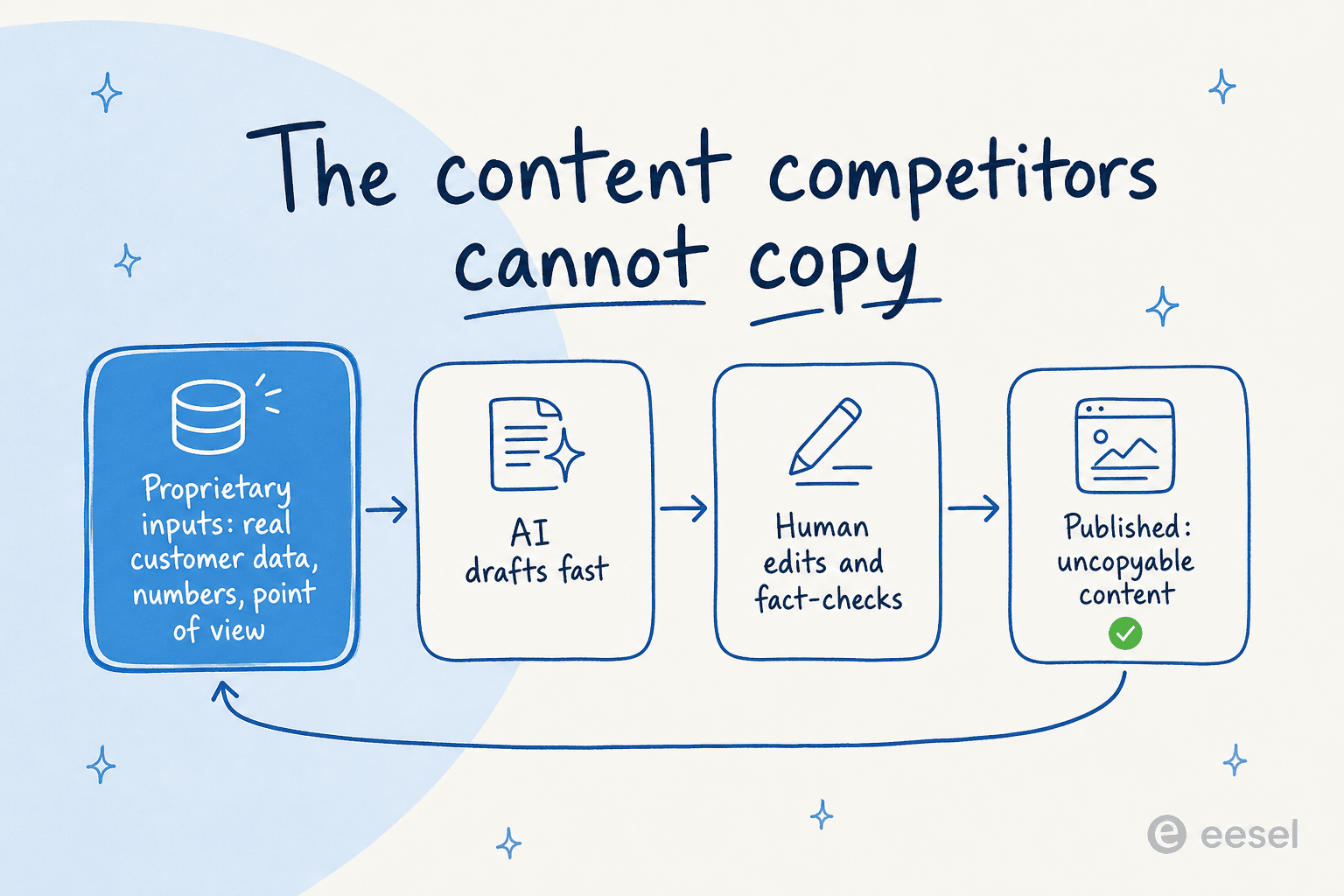
Three things separate AI content that converts from AI content that camouflages:
- Feed it what nobody else has. Kaleigh Moore's point is that large language models reward content that's "unique and insightful enough to be uncopyable": original data, your own research, specific numbers nobody else has, real points of view from real experts. A model trained on the public web cannot invent your customer's actual results. The moment your post contains a real figure, a real war story, or a real opinion, it stops sounding like everyone else's. This is the single highest-leverage move in AI copywriting.
- Keep a human in the editing seat. Use AI for the draft, the research scaffolding, the first pass, then edit it like you mean it. The most-upvoted advice across every thread I read was some version of "write the first draft yourself, then let AI clean it up, not the other way around." Whichever order you prefer, the editing pass is non-negotiable.
- Train it on your brand voice. Generic is the default failure mode; a defined voice is the antidote. Tools that support brand voice training are what let you scale to dozens of posts without all of them sounding like the same beige template. This is what made that 360-posts-a-month operation work, the voice held across all of them.
Do those three things and AI content isn't just "good enough," it's better than what most teams shipped by hand, and several times faster. Skip them and you've automated the production of content that costs you deals. The tool is identical. The discipline is everything. That's true whether you're writing business blogs, running an AI content pipeline, or scaling SEO across a whole agency's clients.
Try eesel for AI content that doesn't read like AI
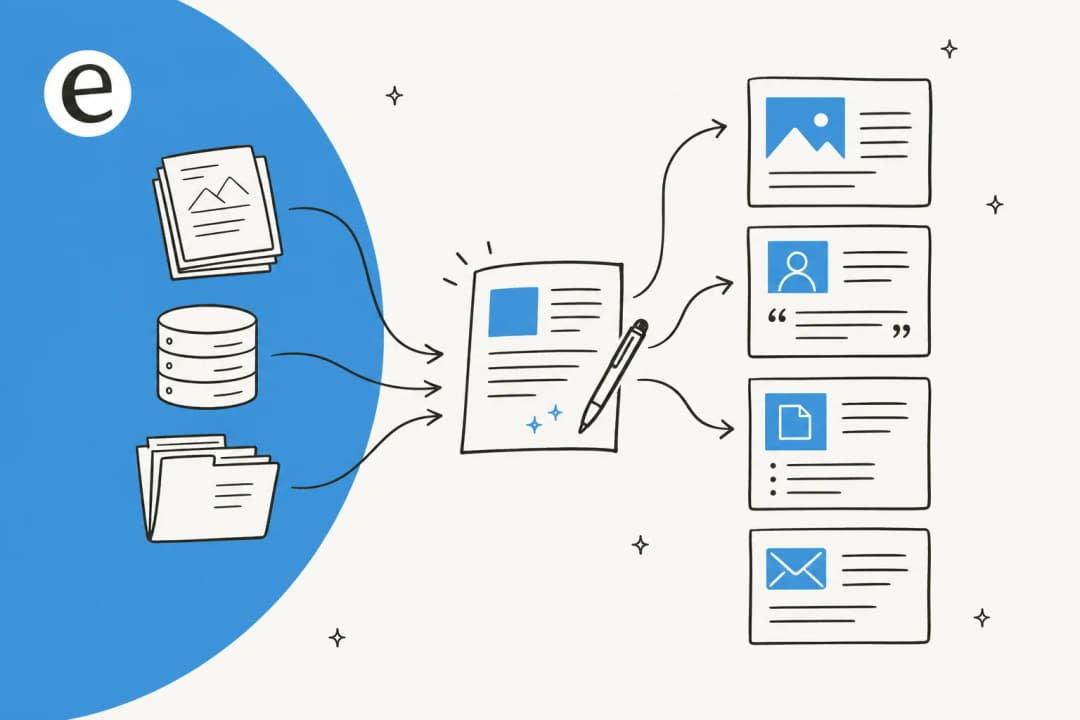
This is the exact problem we built eesel's AI Blog Writer to solve. Instead of a blank prompt box, it runs a research-based workflow: it pulls primary sources, real numbers, and your own brand context into every draft, then produces a full post, hero banner, brand-colored infographics, FAQs, and internal links in roughly 12 to 20 minutes. That's the "fed proprietary inputs, human in the loop" model turned into a pipeline, which is why one content team used it to ship 360 SEO posts a month without the output collapsing into monoculture.
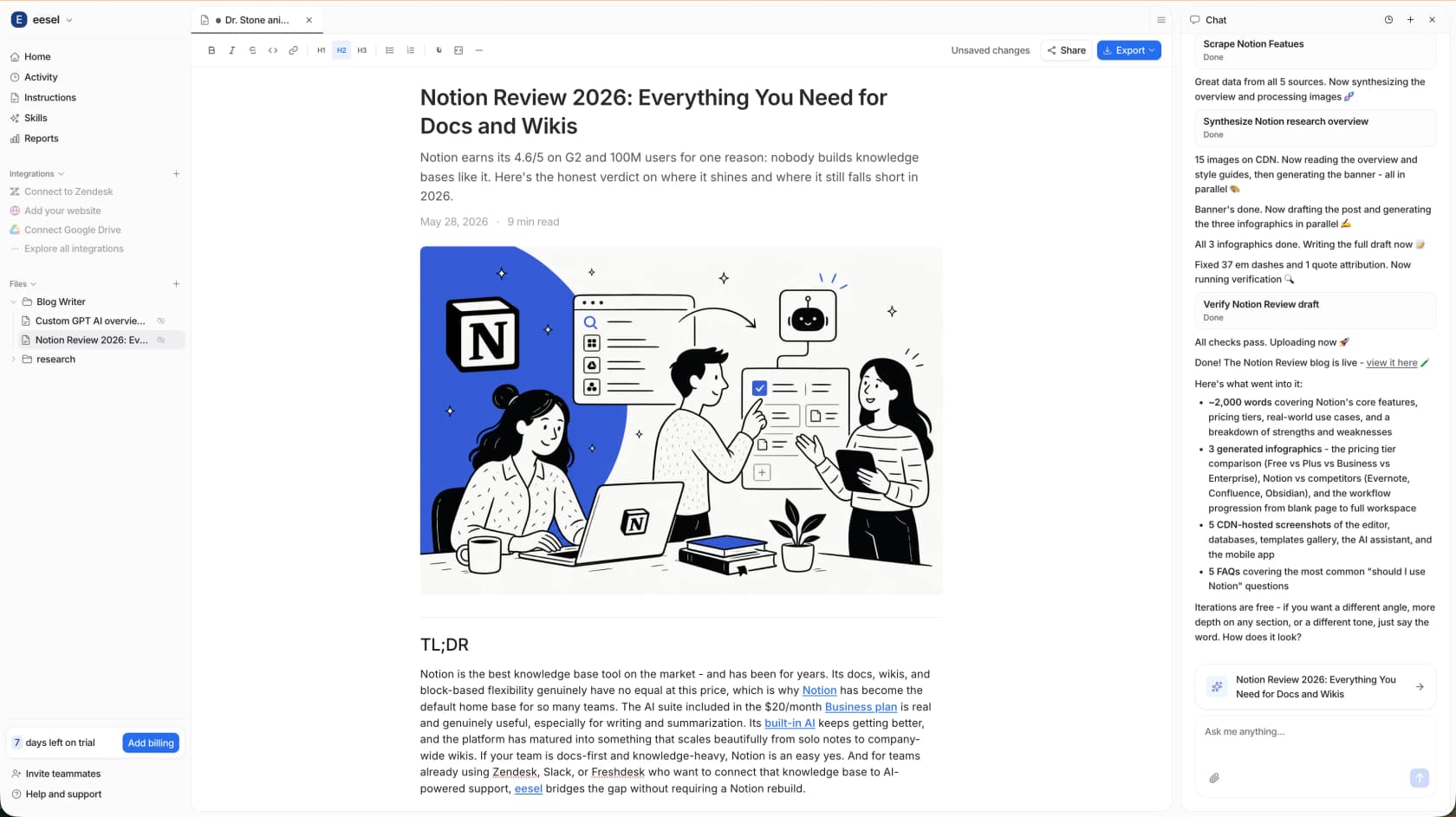
It's usage-based, so a generated blog post runs $4.00 with no platform fee, and you get two free generations to test the quality before you commit, no credit card. If you're still assembling a stack, our roundup of free AI marketing tools is a sensible starting point. One honest caveat: eesel writes its best work when you give it real inputs to work from, your data, your docs, your point of view, because that's the whole thesis of this post. Point it at a blank brief and you'll get the same generic output as anything else. Feed it what only you have, and it produces content that's actually good enough for B2B marketing. Try eesel and judge the first draft yourself.
Frequently Asked Questions
Is AI content good enough for B2B marketing?
Does Google penalize AI-generated content?
Can AI-written content actually rank in search?
How much does AI content cost compared to a writer?
What happens if I publish AI content with no human editing?


Article by
Riellvriany Indriawan
Riell is a designer and writer at eesel AI with about two years of experience researching CX platforms, AI chatbots, and helpdesk software. She combines her design background with a sharp eye for how these tools actually look and feel in practice — making her comparisons unusually visual and user-focused.