The model isn't your problem, your brief is
I've spent the better part of two years watching people put AI to work on actual content calendars, not demos. Some teams generate posts that read like a human expert wrote them. Others get bland mush and conclude "AI content just isn't there yet." The model under the hood is frequently the same one. The difference is the brief.
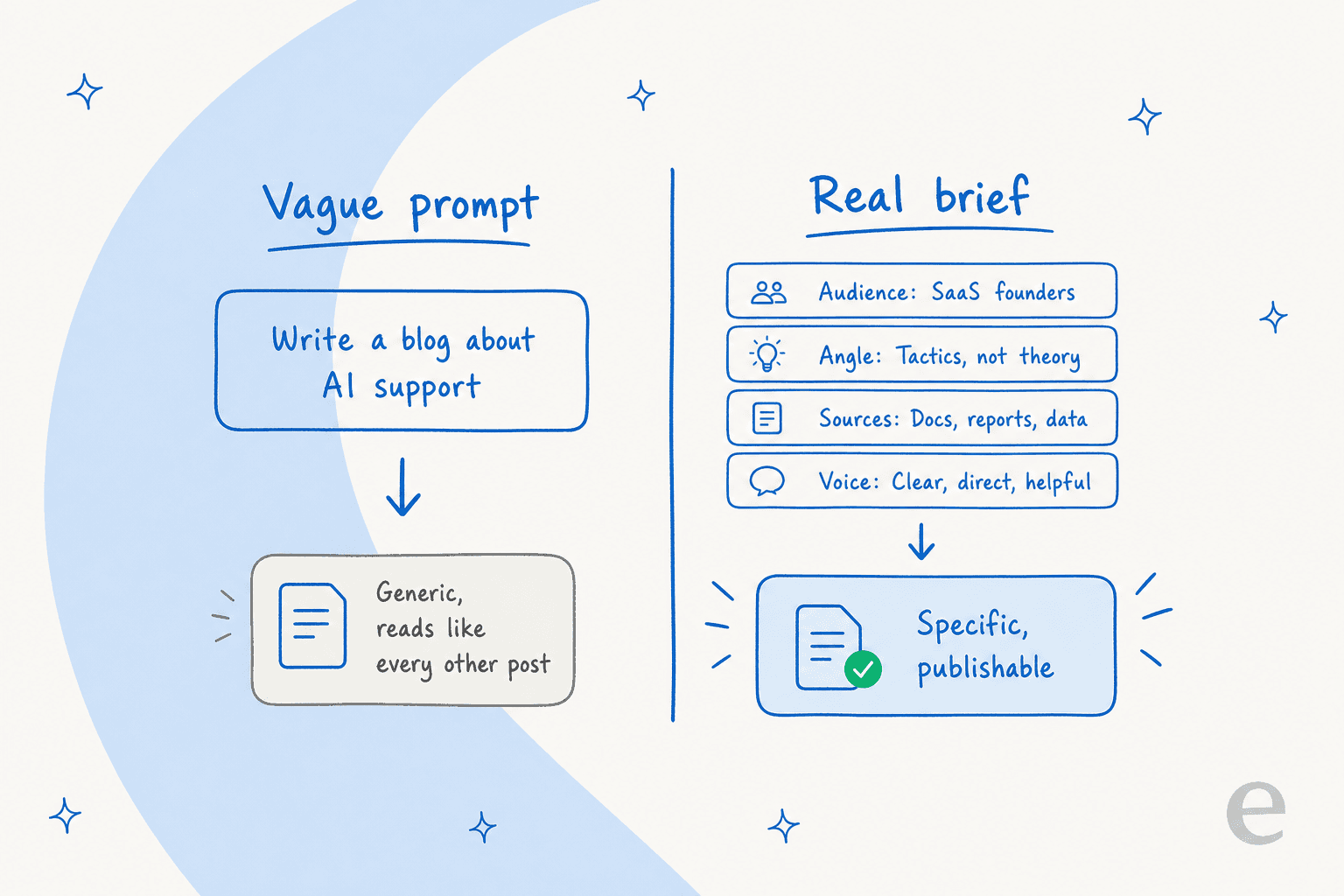
Here's the pattern I see constantly. Someone opens the tool, types "write a blog about AI customer support," and gets back exactly what you'd expect: 1,500 competent, forgettable words that could have come from any of the ten thousand other posts on the topic. They blame the AI. But that one-line prompt is the equivalent of telling a new writer "go write something about our industry" and walking away. No freelancer on earth produces good work from that.
When I dig into the chat logs from our own blog writer, the gap is obvious. One marketer at a staffing agency came in and said, more or less, "I don't need your chat and ticket stuff, I need help with the SEO content writing for our website." Fair enough. The people who then took twenty minutes to spell out their audience, their angle, and what they were trying to rank for walked away with posts they shipped. The people who fired off a keyword and hoped for magic churned within the week, frustrated. Same product. Wildly different briefs.
So before you go shopping for a better AI content tool, it's worth fixing the input. A great brief on a decent model beats a lazy brief on the best model every time.
What a good brief actually contains
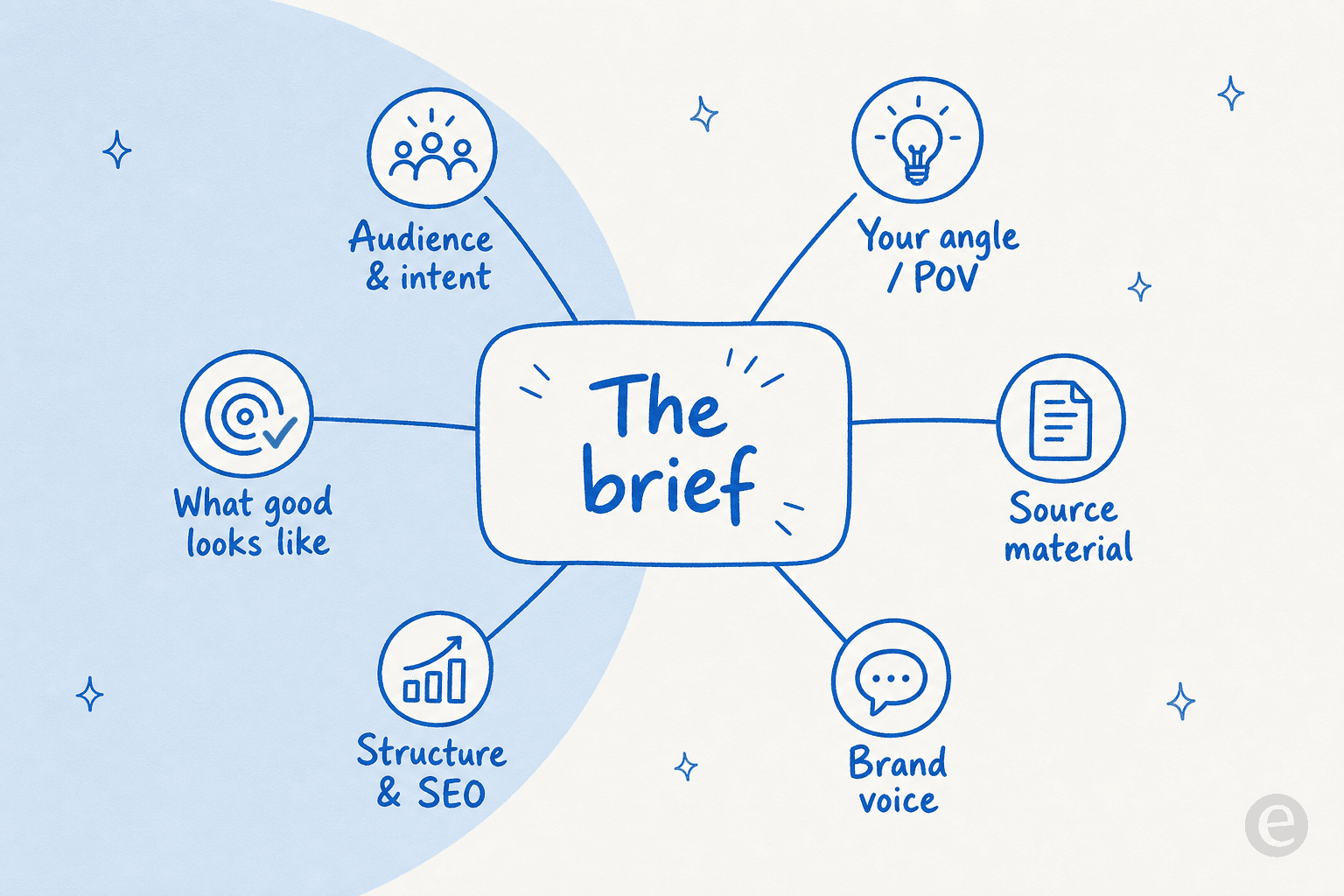
A brief isn't a paragraph of vibes, it's a short, structured set of decisions you make once. After running this thousands of times, I've landed on six parts that, when present, almost always produce something usable. When one is missing, you can usually point to it in the bad draft.
| Part of the brief | What it answers | What happens when you skip it |
|---|---|---|
| Audience and intent | Who's reading, and what are they trying to do? | The post talks to everyone and lands with no one |
| Your angle / POV | What's the one thing this post argues? | A neutral, listy summary with no spine |
| Source material | What facts and docs can it pull from? | Generic claims, and the occasional hallucination |
| Brand voice | How should it sound? | Reads like a press release, not like you |
| Structure and SEO | What's the shape and target keyword? | A wall of prose that doesn't rank or skim |
| What good looks like | How will you know it worked? | Endless "make it better" loops with no target |
You don't need to write an essay for each. A line or two per part is plenty. The point is that the decisions are made before the AI starts writing, not discovered halfway through your fourth regeneration.
Step by step: how to brief AI for better content
1. Start with the reader, not the keyword
Keywords matter, but they're not who you're writing for. Lead your brief with a real person: "B2B SaaS founders evaluating their first AI tool, mildly skeptical, short on time." That one sentence does more to de-generic-ify a draft than any amount of prompt engineering tricks, because it forces the model to pick a register, a depth, and a set of assumptions instead of averaging across all of them.
The cheapest test of a thin brief: if you could swap your company name for a competitor's and the draft would still be true, the reader was never specific enough.
2. Give it a real angle
Most AI content is boring because nobody gave it a point of view. "The 5 benefits of AI support" is a topic, not an angle. "Most AI support rollouts fail because teams automate before they simulate" is an angle, something the post can actually argue and defend.
This is the part people are most tempted to skip, and it's the one that separates content that gets cited from content that gets skimmed. Decide what you believe before you ask the AI to write it. If you're not sure what your angle is, that's a signal to do a little more research first, not to let the model invent a take for you.
3. Hand it your source material
This is where hallucinations go to die. A model asked to write about your product with no access to your product will confidently make things up, because that's what "write about X" with no X looks like from the inside. The fix is mundane: give it the raw material. Your help docs, your pricing page, a research doc, last quarter's webinar transcript.
The strongest version of this is a tool that pulls from your own knowledge base automatically using retrieval, so every claim is grounded in something real rather than something plausible. Either way, the rule holds: brief it to write from your sources, then fact-check the output before anything goes live. Briefing well reduces hallucination, it doesn't abolish the need to check.
4. Define the voice with examples, not adjectives
"Write in a friendly, professional tone" is noise. Every brand on earth describes itself that way, and the model has no idea what your friendly-professional sounds like. Adjectives don't transfer. Examples do.
The best move I've seen came from a power user running a wellness brand through our writer. Rather than describe their voice, they picked one finished post they loved, called it their "North Star," and told the AI: match this, every time. From then on, every brief referenced that one reference piece. Their output got dramatically more consistent overnight, because the AI finally had a concrete target instead of a vibe. If you want a tighter checklist for this, our content writing skills checklist is a decent starting point for what to encode.
5. Specify structure and SEO up front
Tell the model the shape you want: a how-to with numbered steps, a comparison with a table, an outline you've already approved. Name the target keyword and where it should appear. If you care about ranking in AI search as well as Google, ask for a TL;DR at the top and a real FAQ section, the things semantic SEO content leans on. A model that knows the destination writes a much straighter path to it.
6. Tell it what good looks like
Close the brief with your acceptance criteria. "Done means: under 1,800 words, every stat cited, no fluffy intro, passes as something a practitioner wrote." Without a finish line, you end up in the "make it better, no, better than that" loop that wastes more time than writing it yourself would have. With one, both you and the AI know when you're done.
Briefing for brand voice and brand safety
Voice is where briefs quietly earn their keep, and it's not only about tone. It's also about the rules that keep a draft on-brand and out of trouble.
One marketer I watched, working at a tour-operator software company, briefed her writer to crawl her site and write posts, and then added a hard rule: never promote a particular review platform, because it's owned by a competitor. That's a brand-safety instruction, and it's exactly the kind of thing a one-line prompt can't carry. The same goes for inclusive imagery, banned phrases, claims you're legally not allowed to make. Good briefs encode the guardrails, not just the goals.
The most reliable way to get your voice is to point the AI at content you've already published and let it learn the patterns, rather than describing them. When the writer is reading your real Google Docs and past posts, voice stops being something you have to explain.
The brief is only half the job: iterate
Even a perfect brief produces a first draft, not a finished post. The teams that get the most out of AI treat the brief as the start of a short loop, not a one-shot vending machine.
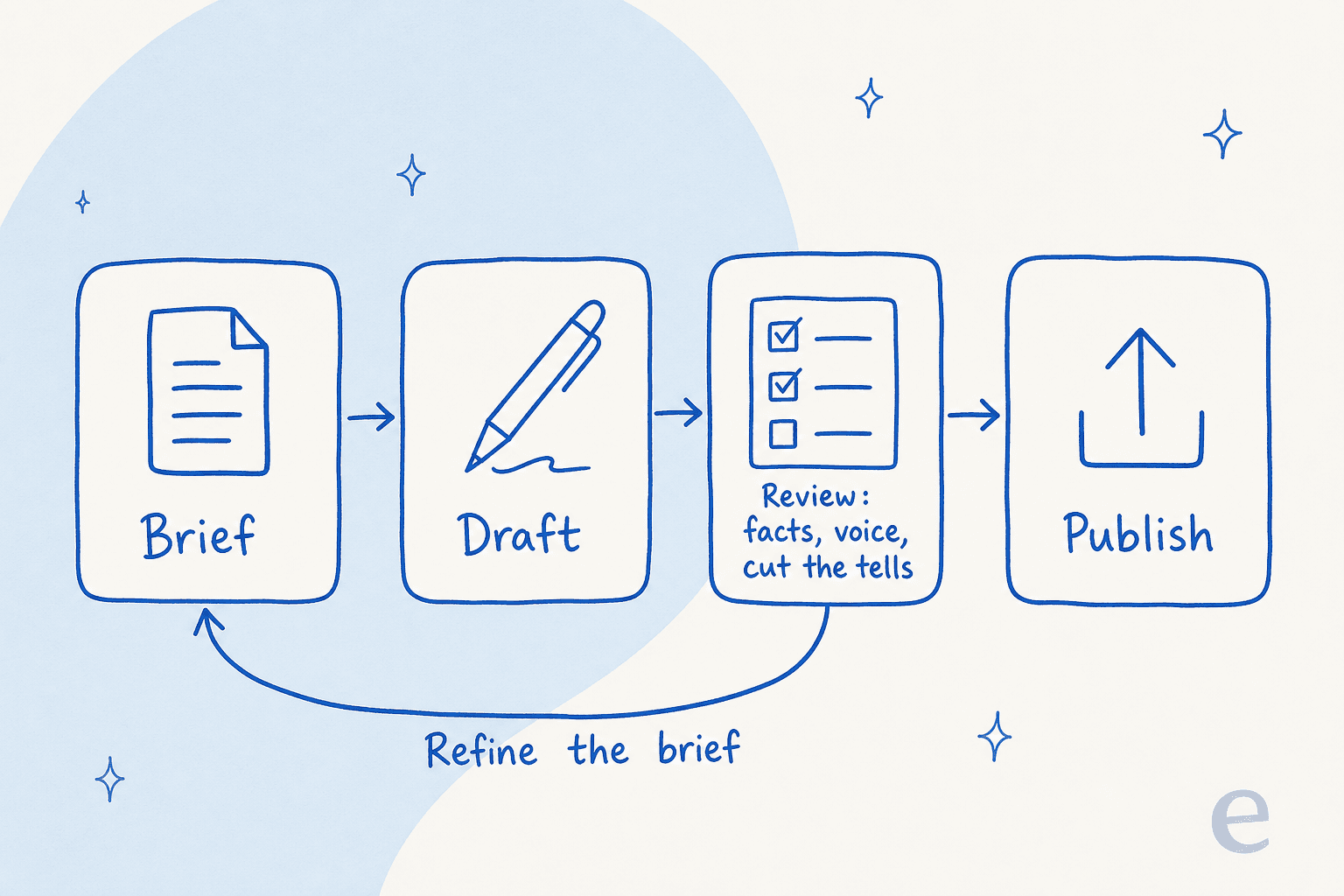
The good iterations are specific. I once watched a marketer take a draft and ask the AI to compare it against a sibling article and rewrite any phrase longer than four or five words that was identical, a real plagiarism and self-duplication fix, done in one pass. That's a world away from "make it punchier." The more concrete your edit, the better the result, same as the brief itself.
A useful habit: when an edit instruction works, fold it back into the brief so you never have to give it again. Over a few posts your brief quietly absorbs every lesson, and the editing pass gets shorter each time. That's how you go from one good post to a repeatable content pipeline.
Where briefing breaks down (and what to do about it)
Briefing well solves the quality problem. It doesn't solve everything, and it's worth being honest about the limits.
- Facts still need checking. A grounded brief cuts hallucination sharply, but "sharply" isn't "entirely." Keep a human verification step for any stat, quote, or claim. This is non-negotiable for YMYL topics like health or finance.
- Publishing is its own headache. A beautifully briefed post is worthless if you can't get it into your CMS with formatting intact. I've seen great drafts die on the way into restrictive platforms that won't take Markdown or FAQ schema. Pick a workflow that exports cleanly, or publishes straight to WordPress and other CMSes, so the last mile doesn't undo the work.
- Scale changes the math. Re-briefing from scratch every time is fine for one post. If you're producing dozens, you want the brief to persist, which is the whole argument for a dedicated AI blog writer over a general chatbot you re-explain yourself to daily.
None of these are reasons not to use AI for content. They're reasons to be deliberate about the brief and the tooling around it. Helpful, honest, and grounded beats fast and generic every time, and a sharp brief is the cheapest way to get there.
Try eesel AI for content
I'm clearly not neutral here, I work on it. But the reason eesel's AI Blog Writer exists is exactly the lesson above: it's built to make the brief stick. You point it at your own docs and past posts so it learns your voice and pulls from real source material, you give it a keyword and an angle, and it returns a research-grade, SEO-ready post with a TL;DR, FAQs, internal links, and images, in minutes rather than days.
One SEO lead on Webflow used exactly this keyword-to-publish setup to scale to over 360 posts a month while holding brand context across every one. The brief is what made that possible at that volume.
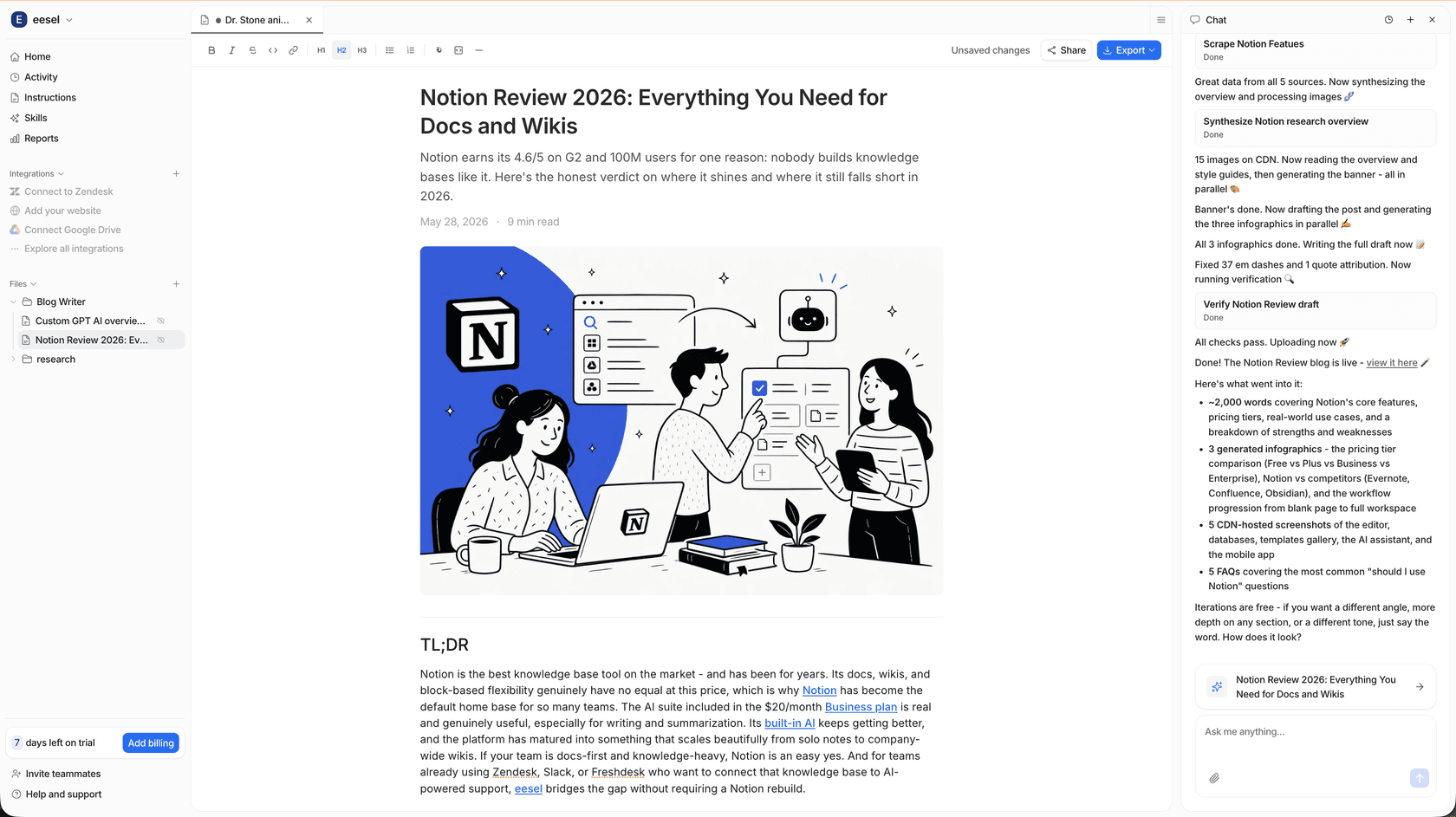
You get $50 in free usage and two free blog generations to test it on your own brief, no credit card, so you can see the difference a real brief makes on your own content. Pricing is pay-as-you-go after that. Try eesel and see what it does with a proper brief instead of a one-liner.
Frequently Asked Questions
What is an AI content brief?
How do I brief AI for better content without becoming a prompt expert?
Why does my AI-generated content still sound generic?
How do I stop AI from making things up in my content?
Is it worth using a dedicated AI writer instead of just ChatGPT?
How do I write a brief that captures my brand voice?
How much does an AI blog writer cost?
Can a well-briefed AI post actually rank in Google and AI search?


Article by
Alicia Kirana Utomo
Kira is a writer at eesel AI with a Computer Science background and over a year of hands-on experience evaluating AI-powered customer service tools. She focuses on breaking down how helpdesk platforms and AI agents actually work so that support teams can make better buying decisions.