


Content marketing today is a lot more than just writing. It's a full-cycle operation that covers research, planning, writing, creating visuals, SEO, distribution, and performance analysis. Trying to manage all of that by hand is a fast track to burnout and inconsistent results. The answer is to build a solid toolkit that streamlines your workflow, automates the tedious parts, and gives you the data you need to make better decisions.
But here's the catch: the market is packed with tools, especially with new AI platforms popping up every week. It's hard to tell what's genuinely useful and what's just hype.
That’s why we tested the most popular options to find the six essential tools you actually need in 2026. This guide is a practical look at the platforms that deliver real results, from all-in-one SEO suites to powerful AI blog generators like the eesel AI blog writer, which can turn a single keyword into a complete, publish-ready article.
What are content marketing tools?
Content marketing tools are software and platforms built to help you manage every stage of the content lifecycle, from brainstorming ideas to analyzing the results. Think of it less like finding one magic tool and more like building a specialized toolkit. A great content strategy relies on a stack of tools that work together, each handling a specific job.
They usually fall into a few main categories:
- SEO & Research: These tools are for finding keywords, coming up with topics, and analyzing competitors. They help you figure out what your audience is searching for so you can create content that actually helps them (e.g., Semrush).
- Content Creation & Optimization: This category includes everything from writing assistants to platforms that optimize your content for search, often with the help of AI.
- Visual Content Creation: These platforms let you create professional-looking images, infographics, and videos without needing a design degree (e.g., Canva).
- Distribution & Promotion: Once your content is ready, these tools help you share it with the right people through social media scheduling and email marketing (e.g., Hootsuite).
- Project Management & Collaboration: These are the tools that keep everything organized, from content calendars to team feedback on drafts and briefs (e.g., Notion).
An infographic showing the five essential categories of content marketing tools: SEO, content creation, visual creation, distribution, and project management.
The real value here isn't just about saving time. These tools provide the structure and insights you need to scale a content strategy from a few articles into a predictable growth engine.
How we picked the best content marketing tools
We didn't just look for the tools with the longest feature lists. We focused on platforms that offer a clear return on investment, whether that’s through saving a massive amount of time, a measurable traffic increase, or a big jump in content quality.
Our practical criteria for this list were:
- Core Functionality: The tool has to be excellent at its main job.
- Ease of Use: It needs a straightforward interface your team can start using quickly without weeks of training.
- Real-World Impact: We looked for tools with a proven track record of delivering actual results.
- Value for Money: The features have to justify the price. A strong free plan is a huge plus.
A quick comparison of the top content marketing tools
| Tool | Best For | Standout Feature | Starting Price |
|---|---|---|---|
| eesel AI blog writer | AI Blog Generation | Turns a keyword into a complete, media-rich article | Free to try; $99/month for 50 blogs |
| Semrush | All-in-One SEO | 25B+ keywords and 43T+ backlinks database | Starts at $165.17/month (billed annually) |
| Jasper | AI Copywriting Assistance | Jasper IQ for maintaining brand voice and knowledge | Starts at $59/month (billed annually) |
| Hootsuite | Social Media Management | OwlyGPT AI assistant trained on real-time social data | Starts at $99/month |
| Canva | Visual Content Creation | Magic Studio™ with a suite of AI-powered design tools | Free plan available; Pro from $120/year |
| Notion | Content Planning & Docs | Notion AI for search, summaries, and task automation | Free plan available; Plus from $10/seat/month |
The 6 best content marketing tools in 2026
Here’s a detailed look at the tools that made our list, why we chose them, and what makes them stand out.
1. eesel AI blog writer
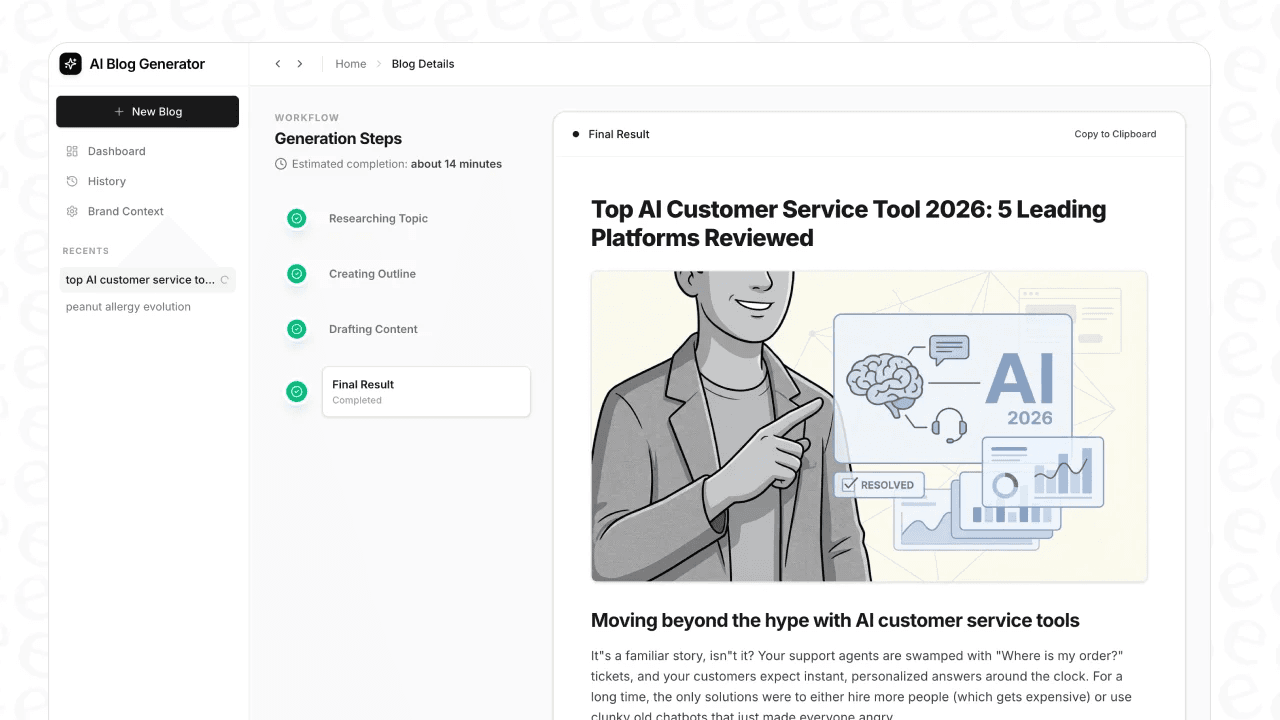
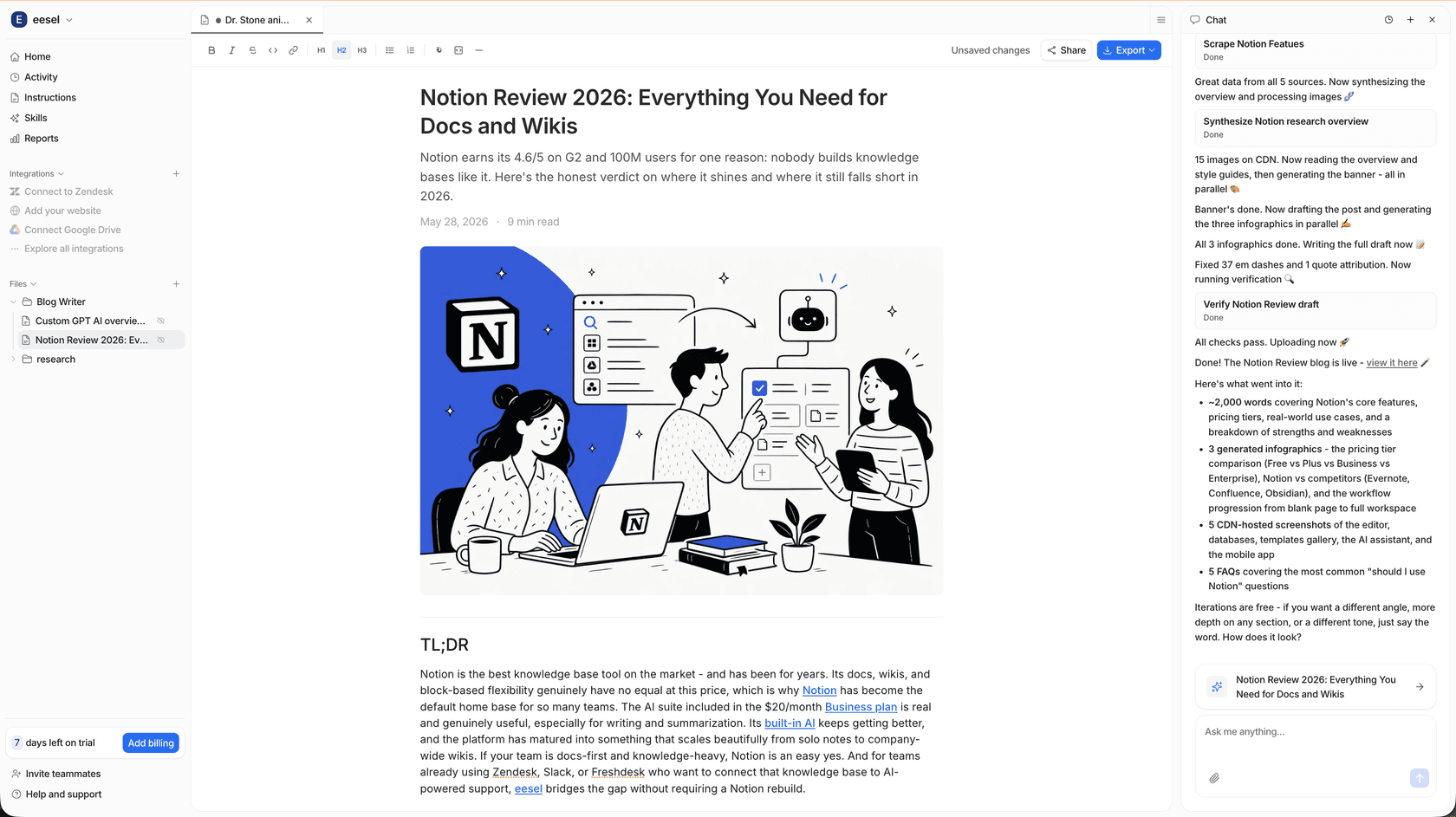
What really sets it apart is its focus on creating a finished asset. Give it a topic, and it doesn't just write. It researches, automatically generates and embeds AI images and infographics, finds relevant YouTube videos, and even pulls authentic quotes from Reddit to add social proof. We used this exact tool at eesel to grow our [daily search impressions](https://www.eesel.ai/product/ai-blog-writer) from 700 to over 750,000 in just three months by publishing over 1,000 optimized articles.The issue isn't really the AI tool, it's your content production workflow. I've been scaling content for my SaaS with Claude and it keeps performing the best but only if you break longer pieces into 3-4 separate prompts instead of trying to get 2000+ words in one shot.

- Pros: The main advantage is pure efficiency. You get a fully-formed, media-rich article optimized for both traditional SEO and new Answer Engines (AEO) in minutes. The automatic inclusion of internal and external links, plus natural mentions of your product based on your website's context, makes the content useful right out of the box.
- Cons: Like any AI tool, the final output still benefits from a quick human review to add a unique perspective and ensure it perfectly captures your brand's specific nuances.
- Pricing: You can try it completely free. The paid Early Bird plan costs $99 per month for 50 blog generations.
2. Semrush
You can't have a good content strategy without understanding the search landscape, and Semrush is the industry standard for getting that visibility. It’s an all-in-one marketing platform with one of the world's largest databases, holding over 25 billion keywords and 43 trillion backlinks.
We use Semrush for everything from finding content gaps and discovering new keywords to running technical site audits. Its modular structure is great because you can subscribe to specific toolkits, like the SEO Toolkit or Content Toolkit, without paying for features you don't need. They even have a new AI Visibility Toolkit to help you track how your brand appears in AI-generated search results.
- Pros: The sheer amount of data is unmatched. You can manage almost your entire SEO and market research workflow from a single dashboard, which gives you the insights needed for data-driven decisions.
- Cons: The price can be a big investment, especially for freelancers or small businesses. The huge number of features can also feel overwhelming for beginners.
- Pricing: The Semrush One Starter plan begins at $165.17 per month when billed annually.
3. Jasper
Jasper is an AI content platform built for marketing teams that need to keep a consistent brand voice across every channel. While the eesel AI blog writer is best for producing complete, long-form articles, Jasper shines as a versatile AI assistant for a huge range of marketing tasks.
Jasper used to be my go-to but it’s bloated now. Koala has been smoother lately for quick SEO pieces.
Its standout feature is Jasper IQ, which acts as a central brain for your brand's knowledge. You can feed it your style guides, company facts, and tone of voice, and the AI uses that context to generate on-brand copy for everything from ad campaigns to social media posts. With features like Content Pipelines, teams can automate the entire creation process.
- Pros: Jasper's biggest strength is its ability to maintain brand consistency at scale, making it perfect for marketing teams. Its tools are intuitive enough that anyone on the team can create on-brand assets without needing to become a prompt engineering expert.
- Cons: It generally requires more human guidance to turn its output into a polished, long-form article. It focuses on generating text and does not automatically create or embed visual assets like images or videos.
- Pricing: The Pro plan starts at $59 per seat per month when billed annually.
4. Canva
Visuals are a must-have for modern content marketing, but not every team has a dedicated graphic designer. Canva solves this by making design accessible to everyone through its simple drag-and-drop interface.
With Magic Studio™, Canva has integrated a powerful suite of AI tools that can generate images from a text prompt, transform entire designs, and remove photo backgrounds with a single click. For teams, its Brand Kit and collaboration features make it easy to keep all marketing materials visually consistent.
- Pros: Canva’s main advantage is its simplicity and speed. It empowers anyone to create professional-looking visuals without a steep learning curve. Its free plan is also incredibly generous.
- Cons: Professional designers might find its customization options a bit limited compared to more advanced software like Adobe Photoshop.
- Pricing: Canva offers a robust free plan. The Pro plan, which unlocks more advanced features and higher AI usage limits, starts at $120 per year for one person.
5. Hootsuite
Once you've created great content, you need to get it in front of people. Hootsuite is a comprehensive social media management platform that lets you manage all your channels from one central dashboard.
Hootsuite supports all the major networks, including Instagram, Facebook, X, LinkedIn, and TikTok. Its AI assistant, OwlyGPT, is trained on real-time social data, helping you generate captions, brainstorm post ideas, and repurpose your blog content for social media based on what's currently trending. It also has powerful social listening tools, boosted by its acquisition of Talkwalker, to monitor brand mentions and audience sentiment.
- Pros: Hootsuite's ability to centralize your entire social media workflow is a massive time-saver. Its analytics and social listening features are powerful for tracking ROI and understanding what people are saying about your brand.
- Cons: It's one of the more expensive tools on this list, and its feature-packed interface can be a little complex for beginners.
- Pricing: The Standard plan starts at $99 per month.
6. Notion
A good content program runs on clear organization. Notion has become the go-to workspace for countless content teams because of its incredible flexibility. It’s a single, connected space where you can build content calendars, create briefs, store research, and manage your entire production workflow.
Something like Notion or ClickUp can make a huge difference when it comes to organizing calendars, briefs, and content ideas - especially if you're the bridge between writers, designers, and leadership.
The integration of Notion AI makes it even more powerful. You can use AI to summarize research notes, brainstorm topic ideas, or draft outlines without ever leaving your workspace. It can also act as an enterprise search tool, pulling answers from across your workspace and connected apps like Slack and Google Drive.
- Pros: Notion's key strength is its flexibility. You can build almost any workflow you can imagine. Its collaborative features are also excellent for keeping teams aligned.
- Cons: That same flexibility can lead to a steep learning curve. Setting up the perfect workspace can take some time and effort.
- Pricing: Notion offers a generous free plan for individuals. The Plus plan for teams starts at $10 per seat per month.
How to choose the right content marketing tools for your needs
- Identify your biggest bottleneck: Where does your team struggle the most? If it's the time it takes to write high-quality blog posts, an AI generator like the eesel AI blog writer could be your best investment. If you're flying blind on SEO, a platform like Semrush is essential.
- Consider your team size and skills: A solo creator or a small team might prioritize free or low-cost tools like Canva and Notion. A larger team might need the advanced collaboration and brand management features of a tool like Hootsuite or Jasper.
- Start with free trials: Almost every tool on this list offers a free plan or a trial period. Use them. Get a feel for the interface and see if it genuinely solves a problem for you before you commit to a paid subscription.
- Prioritize integration: Your tools should work together. A project management tool that integrates with your content creation and distribution platforms will create a much smoother workflow.
To see some of these tools in action and discover other AI-powered options, this video from HubSpot provides a great overview of platforms that can streamline your workflow.
Putting it all together with the right content marketing tools
The right tools can transform your content strategy from a series of disconnected tasks into a streamlined, data-driven engine for growth. While no single tool does everything, a well-chosen stack covering SEO, content generation, visuals, and project management provides a powerful competitive edge.
If your main goal is to scale your blog content without sacrificing quality, the most impactful place to start is with an AI generator that produces complete, publish-ready posts. Give the eesel AI blog writer a try for free and see how quickly you can turn a keyword into a fully optimized article that's ready to attract organic traffic.