AI blog writer
A software tool that uses generative AI to research a topic and draft a complete, structured blog post from a brief or keyword.
What an AI blog writer means
An AI blog writer is a software tool that uses generative AI to research a topic and draft a complete, structured blog post from a brief or keyword. Rather than producing a single paragraph on request, it assembles a full article: an introduction, sectioned body with headings, supporting points, and often the on-page elements a post needs to publish. It sits at the long-form end of AI content generation, where the unit of output is a whole article rather than a snippet.
For content marketing and SEO teams, an AI blog writer is the tool that turns a keyword and a brief into a publishable-shaped first draft. It collapses research and first-draft writing into one step, which is where most of the time on a post actually goes. The strongest tools ground each claim in real source material, so the draft reads as research rather than a confident guess.
What makes an AI blog writer different
A general chat model can write prose, but a purpose-built AI blog writer adds the things a long-form SEO post actually needs:
- It researches before it writes, pulling real sources on the topic so the draft is grounded rather than generated from the model's memory alone.
- It produces a full structure, with headings, sections, and a logical flow that matches search intent instead of a single block of text.
- It handles on-page elements, drafting internal linking, metadata, and headings as part of the post.
- It works from a brief, taking target keywords, tone, and audience as input rather than guessing the angle.
- It scales output, letting a small team build topical authority across many posts without proportionally more writing hours.
One way to see the category is as a quality ladder, where each rung adds something the rung below it lacks.
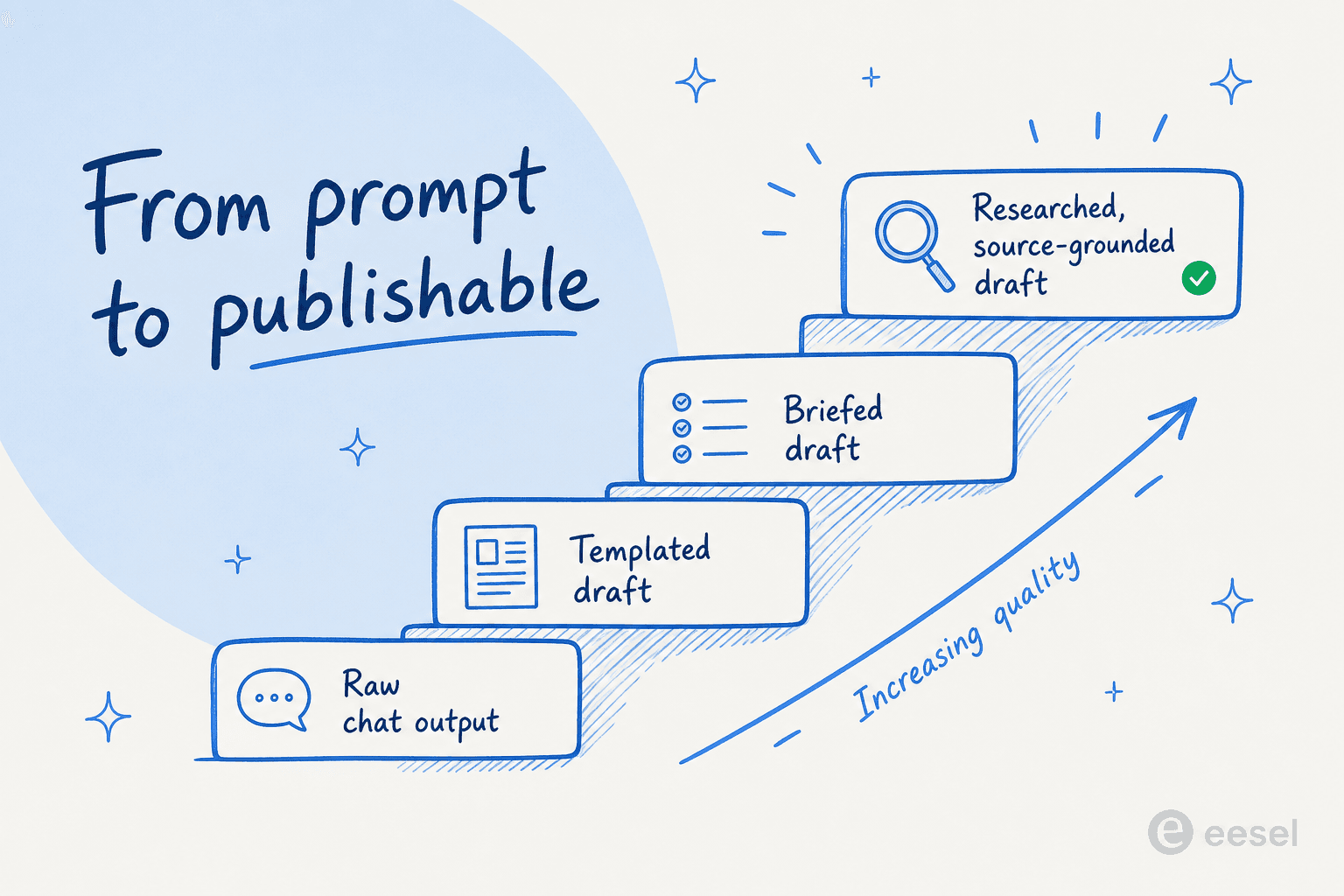
A raw chat reply sits at the bottom; a templated draft adds structure; a briefed draft adds intent and keywords; and only a researched, source-grounded draft is something an editor refines rather than rebuilds. The eesel AI blog writer is built to land on that top rung.
How an AI blog writer works
Most AI blog writers run a version of the same flow:
- Take the brief. A topic, target keyword, audience, and structure go in.
- Research the topic. It gathers and synthesizes real sources so the draft has facts to work from.
- Draft the post. It writes section by section, following the brief and weaving in internal links and metadata.
- Hand off for editing. A human verifies claims, adjusts voice, and adds first-hand experience before publishing.
The eesel AI blog writer is built on exactly this pattern: it researches a topic, drafts a long-form SEO-oriented post grounded in real sources rather than memory, and gives an editor a finished first draft rather than raw output to rebuild. The research-and-grounding step is what makes the result something a team edits, not something it rewrites from scratch.
AI blog writer in practice
The value of an AI blog writer lives in what feeds it. A vague prompt produces generic text that reads like every other AI post; a specific brief with real source grounding produces a draft worth editing. Teams that get results treat it as the draft engine inside an editorial process: a tight brief in, a researched draft out, then a human pass for accuracy, voice, and the kind of experience a model cannot fake. Used that way, it lifts how many strong posts a small team can ship without turning the blog into undifferentiated filler.
We go deeper on this in how AI blog writers work.
Draft long-form posts from a topic
eesel AI researches a topic, drafts a structured SEO post grounded in real sources, and hands an editor a finished first draft.