

Marketing teams are under constant pressure to create great content that people actually see. You have to publish regularly, rank for tough keywords, and keep readers engaged, all while juggling a dozen other tasks. It’s a lot.
AI blog writers have popped up as a way to scale content creation, but they come with a huge risk: churning out generic, soulless "AI slop" that doesn't connect with readers or rank on search engines. We’ve all seen it, and nobody wants their name on it.
What is an AI blog writer?
An AI blog writer is a tool that uses large language models (LLMs) to generate a full blog article from a simple prompt. Think of it as a collaborator that can handle the heavy lifting of writing.
This is a big step up from older tools like basic text expanders or grammar checkers. Modern AI blog writers are built to manage a lot of the pre-publishing work. They can help brainstorm ideas, structure an article with logical headings, write full drafts, and even optimize the post for search engines.
The core functions usually include:
- Idea generation: Finding relevant topics your audience is interested in.
- Outlining and structuring: Creating a logical flow with an intro, headings, and a conclusion.
- Drafting: Writing the actual body content.
- SEO optimization: Adding keywords and formatting the content to rank well.
But not all of these tools are created equal. A basic generator will give you generic text that needs a ton of editing. A more advanced platform can deliver a well-researched, structured, and engaging article that’s almost ready to go live.
How an AI blog writer turns a prompt into a post
Step 1: User input and context
It all starts with what you give it. This can be as simple as a target keyword like "customer service automation" or as detailed as a full outline with brand guidelines.
The quality of this input has a direct impact on the final output. The more context you provide, the better the result. Good AI writers let you add your company website, target audience, and desired tone of voice. This helps the AI produce content that’s relevant, on-brand, and tailored to your goals. Think of it less as prompting and more as briefing a teammate.
Step 2: Research and data analysis
Once the AI understands your request, it starts researching. Depending on the tool, it might analyze its training dataset or actively search the internet for real-time information on your topic.
This is where many tools fall short. If an AI only relies on static, outdated data, it can lead to inaccurate information or "AI hallucinations," where the model just makes things up. Access to live, current data is essential for creating content that's factual and trustworthy.
Step 3: Content generation and structuring
With the research done, the LLM starts writing. It generates sentences and paragraphs based on the patterns and information it has learned.
But it doesn't just produce a wall of text. A good AI blog writer organizes the content into a logical structure. It creates an introduction to hook the reader, uses H2s and H3s to break up sections, and adds lists or tables to make the information easy to digest. This structure is important for both people and search engines.
Step 4: SEO and optimization
Finally, the AI optimizes the content for search engines. This includes placing keywords in headings and the body text, generating a meta description, and making sure the content is readable.
There’s a big difference between basic and advanced optimization, though. Older tools often just stuff keywords everywhere, which can hurt your rankings. More sophisticated platforms focus on search intent. They create helpful content that actually answers the user's question and optimize for newer standards like Answer Engine Optimization (AEO), helping your content show up in AI-powered search results.
Common pitfalls of AI-generated content
Inaccuracy and outdated information
One of the biggest risks is getting facts wrong. An AI might pull an incorrect statistic, reference an old study, or describe a product feature that doesn't exist anymore, especially if it can't access the live internet. This kills trust with your audience and can damage your brand.
Solution: Always fact-check AI-generated content. Or, even better, choose a tool with built-in research capabilities that pulls from live, up-to-date sources.
Generic and soulless writing
This is the most common complaint about AI content. It often lacks personality, a unique point of view, and a human touch. The writing can feel robotic and repetitive. It might be grammatically correct, but it’s just plain boring to read.
Solution: You could spend hours editing every draft to inject your brand's voice. Or, you can use a tool that has been trained to produce a more natural, human-like tone from the start.
A lack of supporting assets
A good blog post is more than just text. It has images, infographics, tables, and videos to break up the content and explain key points. Most AI writers just generate text, leaving you to find or create all the visuals yourself. This approach often fails for longer articles.
If you ask for a 2000 word article in one go, the AI just tends to repeat itself or lose focus.

Solution: You can manually create all your visual assets, which takes hours per post. The better option is to use a platform that automatically generates relevant images, charts, and tables as part of the process.
Poor alignment with brand voice
Without specific instructions, an AI can’t capture your company's unique tone and style. The output might be well-written, but it won't sound like you. It won't know how to position your products naturally or which features to highlight for a certain audience.
Solution: You can set aside a lot of time to edit every draft to match your brand. A more efficient way is to use a tool that can learn your brand context from your website, making sure the content is consistent from the first draft.
Choosing the right tool: Key differentiators
The difference between a basic tool and a comprehensive one is its ability to solve the problems we just covered. A simple text generator gives you a starting point; a true content platform gives you a finished product.
Draft vs. publish-ready content
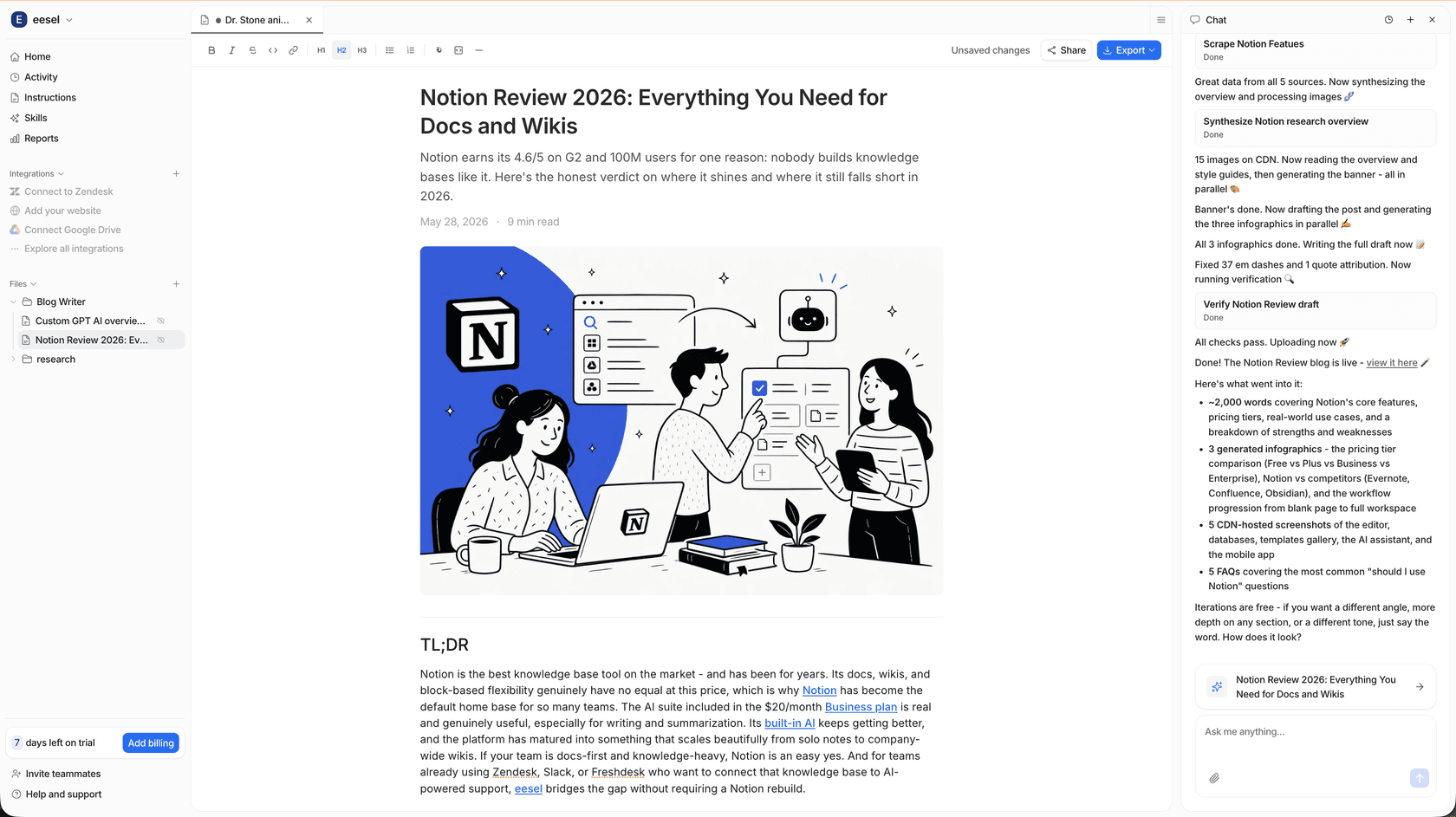
The eesel AI blog writer is an end-to-end content platform that automates the workflow from keyword to a publish-ready post. This approach addresses common issues with AI content. At eesel AI, we used this tool to grow our daily impressions from 700 to 750,000 in three months.
Here’s what makes a platform approach different:
- It produces publish-ready posts, not drafts. Instead of a rough article that needs hours of editing, eesel AI delivers a complete post with a proper structure, intro, conclusion, and FAQs.
- It includes automatic asset generation. The "wall of text" problem is gone because it automatically creates relevant, AI-generated images, infographics, and tables. It even finds and embeds relevant YouTube videos.
- It uses context-aware live research. To make sure everything is accurate, eesel AI performs real-time, topic-specific research. If you’re writing a comparison post, it finds current pricing. For a technical topic, it finds specs. Your content is always fresh and factual.
- It adds authentic social proof. To make content more human and credible, the AI automatically finds and integrates relevant quotes from Reddit and other forums, adding a layer of real-world experience.
- It’s optimized for AEO (Answer Engine Optimization). Beyond standard SEO, eesel structures content to be easily understood by AI answer engines, helping you rank in Google’s AI Overviews and other new search formats.
How different AI writers approach content creation
| Feature | eesel AI blog writer | Jasper |
|---|---|---|
| Primary Output | Publish-ready blog post | First draft for editing |
| Asset Generation | Automatic (images, infographics, tables) | Manual creation required |
| Research | Live internet access for current data | Pulls from Google search results |
| Social Proof | Automatic Reddit quote integration | Not available |
| Optimization | SEO & AEO (for AI Overviews) | SEO-focused |
| Pricing Model | $99 for 50 blog posts | Subscription-based (Pro plan is $59/mo billed yearly) |
Each tool is designed for a different workflow. Tools like Jasper are versatile for generating text and assisting writers across various formats, providing a first draft that requires further manual work like research, asset creation, and final formatting. In contrast, the eesel AI blog writer is built to automate the end-to-end process for blog posts, handling research, asset generation, and formatting within a single workflow.
The role of AI in a content strategy
AI blog writers are becoming a key part of any modern content strategy. They offer a clear way to scale up content production without burning out your team. But their real value comes from choosing a platform over a simple generator.
The goal isn't just to write faster; it's to consistently create content that is accurate, engaging, and full of helpful assets. You need articles that are optimized not just for old search algorithms, but for the AI-driven answer engines of tomorrow. A great AI tool understands the entire content process, from research to publishing, and acts as a real partner in your growth.
To see how these concepts come together in a real workflow, the following video demonstrates how to build an automated system for generating high-quality blog posts, from research and drafting to final review.
Start creating publish-ready content today
Why settle for generic drafts that just create more work? You can see the difference of an end-to-end content platform for yourself.
Try the eesel AI blog writer for free and generate your first complete, SEO-optimized, and publish-ready blog post in minutes. See how quickly you can go from a single keyword to a finished article that's ready to drive traffic.