
That blinking cursor on a blank page is probably one of the most intimidating things in content marketing. You know you need to publish consistently to keep your SEO strong, but coming up with fresh ideas that actually get results can feel like a full-time job.
It’s not about writing more, it’s about writing smarter. The real challenge is creating content that answers questions people are actually searching for, builds your brand's authority, keeps readers hooked, and, most importantly, climbs the search rankings.
Here at eesel AI, we've been there. A while back, we were stuck. So we decided to stop guessing and started systemizing our content around a few high-impact formats. The result? We scaled our daily impressions from a modest 700 to over 750,000 in just three months.
This guide shares the exact blog writing ideas we used to make that happen. Your brainstorming session is officially over. We'll also show you how tools like the eesel AI blog writer can take these ideas and spin them into publish-ready posts in minutes.
What makes for great SEO blog writing ideas?
It all starts with understanding search intent. You have to figure out why someone is typing a specific phrase into Google. Are they looking for information ("what is AEO?"), comparing options ("eesel vs. jasper"), or ready to buy ("best AI blog writer")? Your content format has to line up with that intent.
And it’s not just about Google anymore. We're now optimizing for traditional search (SEO) and for AI answer engines (AEO). The goal is to appear in places like Google's AI Overviews, where AI summarizes the best answer directly for the user.
This all connects to Google’s E-E-A-T principle, which stands for Experience, Expertise, Authoritativeness, and Trust. At the end of the day, Google wants to reward helpful, credible content written by people who know their stuff. A great idea is simply a topic where you can prove you’re one of them.
Our criteria for choosing these blog ideas
We didn't just pull these formats out of a hat. We picked them because they have a history of delivering real SEO results and helping build a genuine connection with an audience.
Here’s what made the cut:
- High SEO potential: These formats are keyword magnets. They naturally target a wide range of terms and attract the kind of backlinks that search engines love.
- Builds authority and trust: Each of these ideas is perfect for showing your expertise and proving to Google (and your readers) that you’re a credible source, ticking all the E-E-A-T boxes.
- Audience engagement: They’re designed to be genuinely useful and shareable. That means more time on page, more social shares, and all the other positive signals that tell Google your content is worth ranking.
- Versatility: It doesn't matter if you're in B2B SaaS, e-commerce, or a local service business. You can adapt these formats to fit just about any industry or niche.
A quick comparison of top SEO blog writing ideas
To give you a head start, here’s a quick look at each format. They all have different strengths, so you can pick the one that best fits your goals and the time you have.
| Blog Idea Type | Primary Search Intent | SEO Strength | Effort to Create | Best For |
|---|---|---|---|---|
| Thought Leadership | Informational | Backlinks, Authority | High | Building brand credibility & earning media |
| How-To Guides | Informational, Transactional | Long-tail keywords, Featured Snippets | Medium | Solving specific user problems & showing expertise |
| Product Comparisons | Commercial, Transactional | High-intent traffic, Conversions | Medium | Capturing bottom-of-funnel users |
| Case Studies | Commercial, Informational | Building trust, Social proof | High | Converting leads into customers |
| Resource Listicles | Informational | Shareability, Backlinks | Low-Medium | Attracting a broad audience & top-of-funnel traffic |
| Myth-Debunking / FAQs | Informational | Voice search, "People Also Ask" | Low | Answering common questions quickly |
6 powerful SEO blog writing ideas
Ready to dive in? Here are six formats you can steal and start using today to create content that consistently drives organic traffic.
1. Thought leadership and trend analysis
This is where you stop reporting the news and start making it. Thought leadership content positions you as an expert by offering unique insights, bold predictions, or sharp analysis of industry trends. The whole point is to add your own perspective, not just repeat what everyone else is saying.
An 'AI' writers will simply take a search query you specify. Download the text of the top 10 results. Text mine the results and find common words. Use the most popular semantic linking profile. Write the first iteration of text and then paraphrase. There is one major flaw with all 'AI' writers however. The semantic linking profile that it uses is the same across most 'AI' articles. Google can determine this by looking at the top results for your search query and look at how each article is written.
This kind of content is a magnet for high-quality backlinks from other industry players and journalists. It builds massive authority and sends a powerful signal to Google that your brand is a leader in its field.
So how do you do it right? Follow a simple formula: state a common problem, back it up with data or observations, offer your unique solution (with personal examples), and then wrap it up. The key is to give away your best knowledge freely. Don’t hold back. When you teach people something valuable, they remember you and trust you.
2. In-depth how-to guides
Every day, millions of people type "how to..." into Google. Creating a step-by-step guide that solves a specific problem for your audience is one of the most reliable ways to capture that traffic.
These guides are fantastic for targeting long-tail keywords, which are less competitive and often have higher conversion rates. A well-structured tutorial with clear steps and helpful visuals is also more likely to be featured in Google's "featured snippets," that little answer box at the top of the search results.
To make your guide stand out, you have to be incredibly thorough. Don't assume your reader knows anything. Break the process down into the smallest, most actionable steps you can. And please, use visuals. A huge wall of text is a surefire way to get someone to click the "back" button. Screenshots, short videos, or simple diagrams for each step are non-negotiable.
Pro tip
Manually formatting a detailed guide can be a huge time sink. An AI tool like the eesel AI blog writer can automatically structure a how-to post with clear headings and even generate AI images or infographics to illustrate each step, turning hours of work into minutes.
3. Product reviews and comparisons
This format is for people who are already deep in the buying cycle. They know they have a problem, and they’re actively comparing solutions. An "X vs. Y" article or a "Best [Product Category] in 2026" post can capture this high-intent traffic.
From an SEO perspective, this is gold. You're ranking for valuable, bottom-of-funnel keywords like "[competitor] alternative" or "best tools for [job]," which drives highly qualified leads directly to your site.
The secret to a great comparison post is honesty. Don't just trash your competitors and sing your own praises. Your readers are smart, and they'll see right through it. Instead, be objective. Explain the real pros and cons of each option and clearly state who each product is best for. Using a clean, side-by-side comparison table is a must-have for making the information easy to scan and digest.
4. Experience-driven stories and case studies
Nothing builds trust like real-world proof. A case study is a story that shows exactly how you helped a customer solve a problem and achieve measurable results. It’s the ultimate form of "show, don't tell."
For SEO, this is powerful because it’s 100% unique, original content that can't be easily copied. It’s a direct demonstration of your Experience, Expertise, Authoritativeness, and Trust (E-E-A-T). A compelling case study can be the final nudge someone needs to go from a curious lead to a paying customer.
The best case studies are structured like a classic story: introduce the hero (your customer) and their problem, explain the solution you provided, and end with the triumphant results. Use hard numbers and direct quotes from the customer whenever possible to make your claims concrete and believable.
5. Helpful resource lists and roundups
Everyone loves a good listicle. These are articles that gather the "best" of something, like tools, podcasts, books, or blogs, all in one easy-to-read post.
These posts are content marketing workhorses. They’re great for attracting top-of-funnel traffic from people who are just starting to explore a topic. Because they're so shareable and genuinely helpful, they're also fantastic for earning backlinks from others in your industry.
The trick to a successful listicle is to add your own value. Don't just list 20 tools with a link. For each item, provide a short, insightful blurb that explains why it's on the list and who it’s the best fit for. This extra layer of curation is what separates a truly helpful resource from lazy content filler.
6. Myth-debunking posts and FAQs
This type of content directly tackles common misconceptions in your industry or answers a group of frequently asked questions about a topic. Think of it as a preemptive strike against confusion.
From an SEO standpoint, this format is perfect for grabbing visibility in the "People Also Ask" (PAA) boxes on Google's search results pages. It's also incredibly effective for optimizing for voice search queries, as people often ask their smart speakers full questions.
To do this well, keep your answers clear, direct, and concise. Use the questions themselves as your subheadings (H3s). This makes it super easy for Google's crawlers to understand the structure of your content and for readers to quickly find the exact answer they're looking for.
How to turn blog ideas into articles with eesel AI
Having a list of great ideas is a solid start, but the real bottleneck is execution. Turning an idea into a 2,000-word, well-researched, and properly formatted blog post takes time. A lot of it. Basic tools like ChatGPT can give you a rough draft, but you’re still left with the heavy lifting of research, formatting, and finding assets.
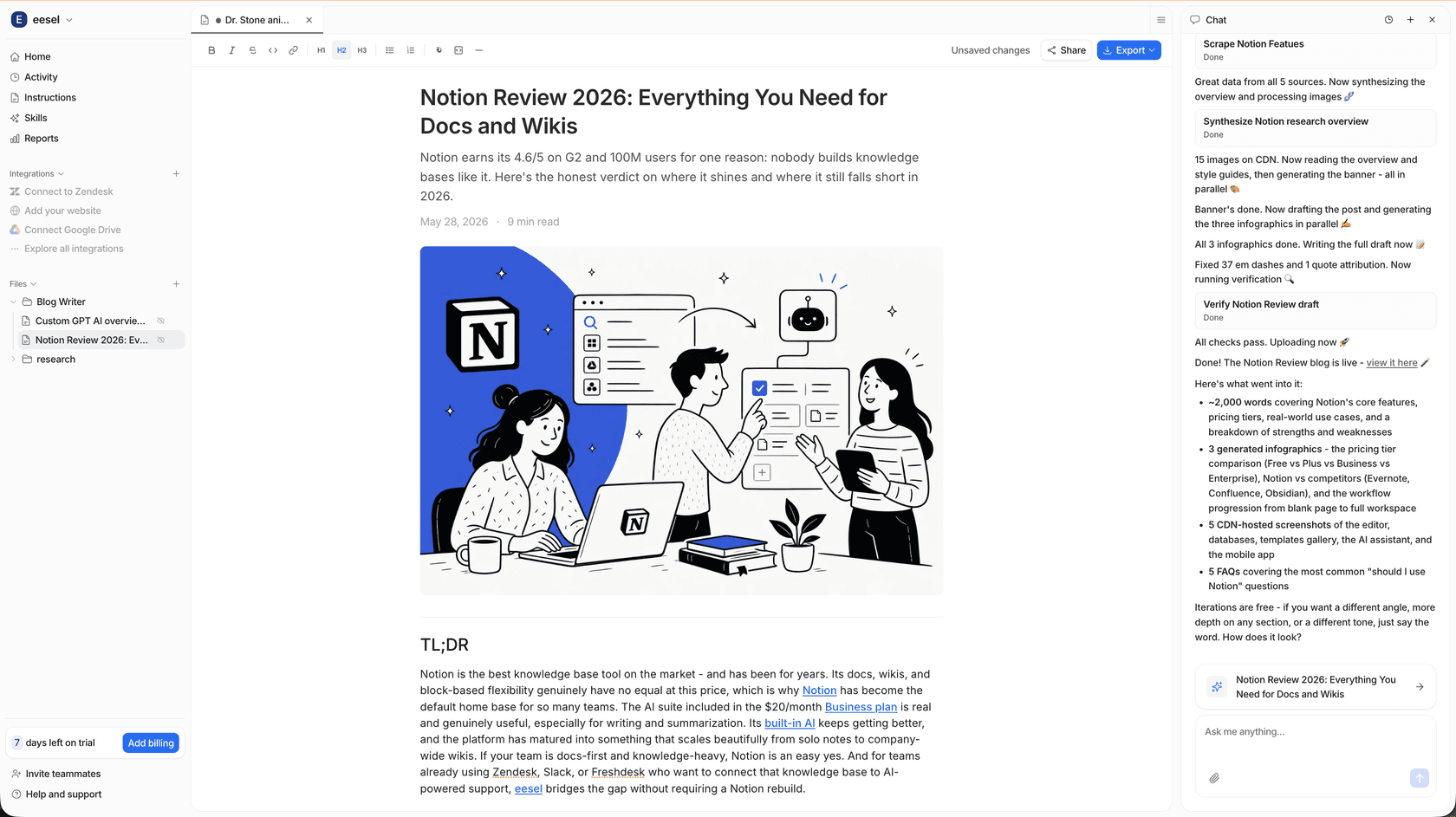
Here’s what makes it different:
- Deep Research with Citations: It goes way beyond surface-level AI filler. It researches the topic and automatically adds external source links to back up claims, boosting your content's authority.
- Automatic Assets: It creates and inserts relevant visuals like AI-powered images, infographics, and data tables right into the post, saving you from hunting for stock photos or firing up Canva.
- Authentic Social Proof: It scours the web to find and embed real quotes from Reddit threads and relevant YouTube videos, adding a layer of human experience and credibility that pure AI content lacks.
- Context-Aware Content: You can add your website URL, and it learns your brand's context to weave in natural, non-salesy mentions of your product or service.
- AEO Optimized: The content is automatically structured to not just rank on Google, but to be the source for AI answer engines like Google AI Overviews and Perplexity.
You're not wrong about how a lot of the early AI writers worked, basically just fancy spinners mashing up the top 10 results. That approach is definitely getting easier for Google to spot and penalize. The game is shifting pretty fast though. I work at eesel AI, and our whole approach with our AI blog writer is to avoid that exact problem. Instead of just scraping the SERPs, it can pull context from a specific URL you give it. This means it can learn a company's actual brand voice, product details, and unique perspective, rather than just regurgitating what's already out there.
 Reddit
Visual learners might find it helpful to see these brainstorming techniques in action. The video below offers practical strategies for generating a steady stream of blog content ideas that align with your SEO goals.
Wrapping up these SEO blog writing ideas
Writer's block doesn't have to be a part of your content workflow. By building your strategy around these six proven SEO blog writing ideas, you can create a content calendar that consistently brings in organic traffic, builds your brand's authority, and actually connects with your audience.
The simple secret is to match your format to your audience's search intent and to pour genuine value into every single post you publish.
And you don't have to let the execution slow you down. Try the eesel AI blog writer for free and see for yourself how easy it is to turn a single keyword into a complete, SEO-optimized article that's ready to go live and start ranking.