A practical guide to fresh blog writing: How to never run out of ideas

Stevia Putri
Last edited January 20, 2026
Staring at a blank content calendar can be daunting. There's this constant pressure to pump out interesting blog posts that keep your audience hooked, please the search engines, and actually help your business grow. It’s easy to hit a point where you feel like you’ve run out of things to say.
But the good news is: you haven't. Keeping your content 'fresh' is the key to holding your audience's attention and boosting your SEO, and it's not as hard as it sounds. It tells search engines that you’re still in the game and a relevant voice in your field. With the right workflow, you can stop dreading content creation. For instance, we used our own eesel AI blog writer to ramp up our content game and watched our daily impressions shoot up from 700 to over 750,000 in just three months.
This guide will give you some real, practical strategies to make sure your idea well never runs dry.
What is fresh blog writing (and why does it matter)?
First off, what does "fresh blog writing" actually mean? It’s not just about hammering out new posts every week. A big piece of the puzzle is breathing new life into the content you already have. This could mean updating old articles with new stats, swapping out dated screenshots, cutting sections that don't make sense anymore, and just making sure the whole thing is still relevant to what people are looking for.
Your blog should feel more like a living library than a dusty old archive.
This is important for a couple of reasons. The first is your readers. People trust sources that are accurate and current. If they find a post with stats from five years ago, they're going to leave. The second is search engines. Google has this thing called Query Deserves Freshness (QDF), which is a way of saying it rewards new or recently updated content for certain topics. If you're blogging about social media trends, last year's news isn't going to fly.
The alternative is content decay, which is the slow, painful drop in traffic when a post gets old and irrelevant. Keeping things fresh is how you fight it.
Finding inspiration for fresh blog writing from your audience and industry
You don't need to be a genius to come up with great ideas. The best ones are usually hiding in plain sight. Your audience, your competitors, and even a simple Google search are packed with inspiration. You just need to know where to look.
Tap into your audience's questions
Your customers and community are your best source for content ideas, period. They're telling you exactly what they want to know; you just have to listen.
I run a cooking blog. I blog what I cook, and cooking is something I do regularly. There’s more potential material than I have time to turn into blog posts. I guess if you blog about something that’s part of your life, you’ll never run out of ideas!

A few simple ways to tune in:
- Dig through support tickets: What are the most common questions your support team answers? Every single one could be a blog post that solves a real problem for someone.
- Chat with your sales team: Sales reps hear every objection, question, and pain point from potential customers. Ask them what topics keep coming up on their calls.
- Keep an eye on social media: Look at the comments and DMs you get. What are people asking? What's confusing them?
- Lurk in industry forums: Go where your audience hangs out. Subreddits, Quora, and niche forums are goldmines for unfiltered conversations about the challenges people are facing.
When you use these channels, you stop guessing what people want to read and start creating content that helps them.
Analyze competitor content for gaps
Looking at what your competitors are up to isn't about stealing their ideas. It's about finding the gaps they've left open. A quick look at their content can show you where you have a chance to shine.
Here’s a simple way to do it:
- Pick 3-5 of the top blogs in your space.
- See what their most popular posts are. You can use tools like Ahrefs or Semrush, or just browse their blog to get a feel for it.
- Then ask yourself: What did they miss?
Maybe all their posts are just walls of text, which means you could create a video tutorial on the same subject. Or maybe they covered a big topic but didn't go very deep, leaving room for you to write the ultimate guide. Find the angles they didn't see or the formats they didn't use. That's your opening.
Use keyword research to uncover new ideas
Keyword research sounds technical, but it’s really just a way to peek inside your audience's head. It shows you the exact phrases people use when they're looking for answers.
A great tool for this is AnswerThePublic. You pop in a keyword, and it shows you a web of all the related questions people are asking. It breaks them down into helpful groups:
- Questions: Who, what, why, where, how (like, "how does content marketing work?")
- Prepositions: For, with, without, to (like, "content marketing for small business")
- Comparisons: Vs, and, or (like, "content marketing vs social media marketing")
Playing around with these visuals can help you find long-tail keywords and angles you wouldn't have found otherwise. It's less about hunting for one perfect keyword and more about getting the vibe of the whole conversation around your topic.
Repurposing and refreshing existing content
You don't always have to start from scratch. Your existing blog posts are a goldmine. Giving some of your older content a little love can bring in big results without all the work of writing a brand-new piece.
How to find content worth refreshing
Not every old post deserves a makeover. You want to focus on the ones that have the most potential. The easiest wins are usually buried in your Google Search Console data.
Pro tip
Hunt for pages that get tons of impressions but have a low click-through rate (CTR). A discussion on Google Search Central points out that this usually means Google thinks your page is relevant, but your title or description isn't convincing enough for people to actually click. A quick update could be all you need to turn those eyeballs into visitors.
The content refresh pyramid: 3 ways to update old posts
The Content Refresh Pyramid is a handy way to think about this, breaking down updates into three levels, as shown in the graphic below.
- Level 1: Update the content itself. This is the easy stuff. Go through the post and update old stats, swap out screenshots, fix broken links, and maybe add a new section to cover recent changes on the topic.
- Level 2: Target new keywords. Your post might already be getting traffic for keywords you didn't even aim for. Check Google Search Console to see what queries are leading people to the page. If you find a relevant keyword you only briefly mentioned, add a new paragraph to tackle it head-on. This can help you pull in even more search traffic.
- Level 3: Merge and repurpose content. Sometimes you have a few shorter posts on a similar topic. You can combine them into one massive, in-depth guide. These "pillar pages" are great for readers and also tend to attract more backlinks, which is great for your SEO.
And remember, one piece of content can be sliced and diced in a bunch of different ways.
| Original Format | New Format Ideas |
|---|---|
| Long-form blog post | YouTube video, Infographic, Twitter thread, Short clips |
| Webinar or video | Series of blog posts, Downloadable guide (PDF), Podcast episode |
| Internal data/report | Public case study, "State of the Industry" blog post |
| Customer interview | Success story blog post, Series of quote graphics for social |
Leveraging systems and tools for consistent content creation
Inspiration is awesome, but it's a system that actually gets content published. Having a process for grabbing, organizing, and acting on your ideas is the difference between blogging whenever you feel like it and running a real content machine. The right tools can help you kick that machine into high gear.
Build a central ideation system
Ideas pop up at the weirdest times. In the shower, during a walk, in the middle of a meeting. If you don't write them down, they're gone. That's why you need a central "idea bank."
I created a spreadsheet in Google Sheets. Whenever I get an idea, I’ll add it to my spreadsheet. I have a column for Purpose/Problem. Then I do keyword research using Keywords Everywhere. I then do an outline in Google Docs and start writing.
It doesn't need to be fancy. A Trello board, a Notion page, or a simple Google Sheet works perfectly. The point is to have one spot where every single blog post idea goes.
Once that's set up, your workflow can be pretty simple:
- Capture: The second an idea hits, toss it in the bank.
- Review: Once a month, look through the ideas and pick the best ones.
- Assign: Slot the chosen ideas into your content calendar with due dates.
- Execute: Write and publish the post.
This keeps good ideas from slipping through the cracks and gives you a clear plan.
How the eesel AI blog writer supports content creation
A list of great ideas is a good start, but turning them into well-researched, engaging, SEO-friendly blog posts is the hard part. This is where a lot of us get stuck, and it's where AI can make a huge difference.
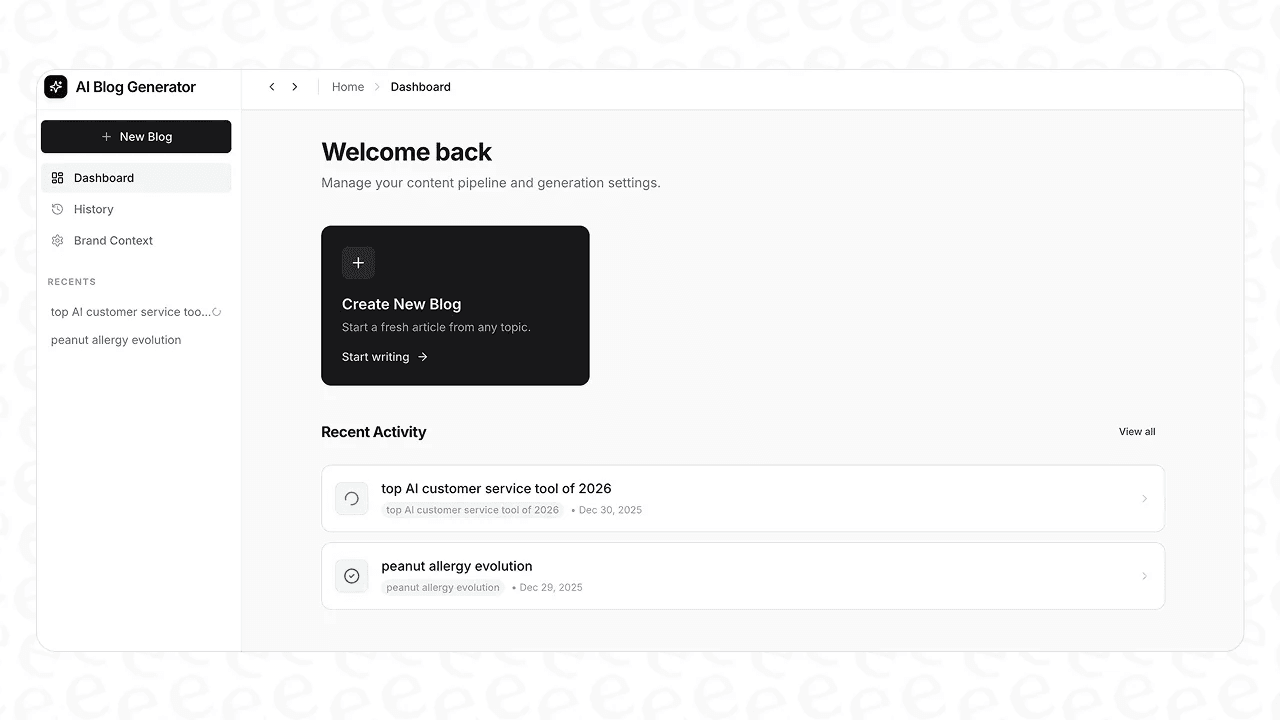
The eesel AI blog writer is a tool built to take you from a simple idea to a finished article. It generates complete, publish-ready posts that are structured to rank and written in a human-like tone.
Here’s how it keeps your content pipeline flowing:
- It does the research for you: Instead of you spending hours looking for stats, eesel AI pulls in current, relevant info so your posts are well-researched from the start.
- It adds social proof: The tool can automatically find relevant social content. This brings in real voices and makes your content more trustworthy.
- It creates visuals for you: Every post needs images. The eesel AI blog writer generates unique images, tables, and infographics, so your articles look professional without you having to do any design work.
On top of that, the content is optimized for Answer Engine Optimization (AEO), which means it's set up to do well in new AI search results like Google AI Overviews.
The power of batch blogging
Batching your work is a total productivity hack. Instead of trying to brainstorm, outline, write, and edit one post from start to finish, you group similar tasks. You could spend one morning just brainstorming 20 topics, and another afternoon just outlining five of them.
This is where a tool like the eesel AI blog writer can be particularly useful. You can feed it a list of 10 keywords from your idea bank and get back 10 complete, ready-to-publish drafts. In a few hours, you could have a whole month's worth of content ready to go, which leaves you more time to think about the big picture and promote your work.
For more strategies on keeping your blog content engaging and effective, check out this video from Neil Patel, where he shares some of his proven secrets for successful blogging.
Never run out of blog ideas again
That fear of the blank page is real, but it doesn't have to be your default setting. Keeping a steady flow of fresh content is totally possible once you have the right systems.
By listening to your audience, peeking at your competitors, updating your old stuff, and organizing your workflow, you can build a content machine that never sputters out.
The hardest part is usually just getting started. Execution is what matters, and AI can help turn that slow grind into a much faster process.
Why not take one of the ideas you've had while reading this and give it a shot? You can generate your first post free and see how quickly you can turn that idea into a finished article.

Frequently Asked Questions
Share this article

Article by
Stevia Putri
Stevia Putri is a marketing generalist at eesel AI, where she helps turn powerful AI tools into stories that resonate. She’s driven by curiosity, clarity, and the human side of technology.