A complete guide to SEO-optimized blog writing

Stevia Putri

Katelin Teen
Last edited January 20, 2026
Ever feel like you're creating blog content that just disappears into the internet void? You spend hours, maybe even days, putting together what feels like a masterpiece, only to publish it and hear nothing back. The competition is fierce, and it often feels like you're just shouting into an empty room.
The tough reality is that many businesses publish post after post that never gets seen, wasting time and money with little to show for it. The gap between just writing a blog and writing a blog that actually ranks on Google is where most content strategies stumble.
This is where SEO-optimized blog writing comes into play. It’s a strategy for creating content designed from the start to appeal to both curious readers and search engine algorithms. The good news is, you don't have to do it all by hand anymore. Modern AI tools, like the eesel AI blog writer, are built to handle the heavy lifting, turning a single idea into a fully optimized, publish-ready post in minutes.
What is SEO-optimized blog writing?
At its heart, SEO-optimized blog writing is the process of creating content with the main goal of landing a top spot on search engine results pages (SERPs). Think of it as building a direct bridge between a question someone types into Google and your article that provides the perfect answer.
But it's more than just sprinkling a keyword into your text a few times. That old-school tactic doesn't cut it anymore. Real SEO writing involves understanding what your audience actually wants (user intent), structuring your content so it's easy to read, and checking all the technical on-page SEO boxes.
You're essentially writing for two audiences at once:
- Your human readers: They're looking for clear, valuable, and engaging information that solves their problem. If your content is boring or confusing, they'll leave in a heartbeat.
- Search engine crawlers: These are the bots from Google and other search engines that scan your content to figure out what it's about. They need clean, logical signals to understand and index your page correctly.
When you get both right, the benefits are significant. You get more visibility from a steady stream of organic traffic, build authority by becoming a go-to source, and can guide readers toward taking an action, like signing up for a trial or buying a product.
Foundational components of SEO-optimized blog writing
Alright, let's get into the essential building blocks you need to create content that has a real shot at ranking.
Strategic keyword research
This is where it all begins. Keyword research isn't just about finding popular search terms; it’s about understanding the question behind the query. Matching your content to a user's search intent is the key to keeping them on your page and showing Google that you’re a relevant result.
There are a few main types of search intent to consider:
- Informational: The user wants to learn something (e.g., "how to write an seo blog post").
- Commercial: The user is researching before a purchase (e.g., "best tools for...").
- Navigational: The user is trying to find a specific website (e.g., "eesel ai login").
- Transactional: The user is ready to buy (e.g., "eesel ai pricing").
A "how-to" guide is perfect for informational intent, while a "best tools for..." list targets commercial intent. Nailing this is half the battle.
Structuring your content for readers and search engines
A massive wall of text will send readers running. A logical structure makes your content easy to scan for both people and search engine bots.
Headings (H2, H3) are your best friends here. They create a clear hierarchy and break your content into manageable chunks. Your main title should be the H1, main sections should be H2s, and sub-points within those sections can be H3s.
Here are a few other readability tips that make a big difference:
- Keep paragraphs short. Try to stick to 2-3 sentences. This is much easier on the eyes, especially for mobile readers.
- Use bullet points and numbered lists. They're great for breaking down steps, features, or key takeaways in a format that's easy to skim.
- Use bold and italics. Highlight the most important phrases and ideas to guide your reader through the text.
Break up the text with subheadings and bullet points. We’ve found that segmenting our content like this makes it easier for readers to scan and find the info they need, and it gives it a better chance of ranking.

Essential on-page elements
These are the technical details that send strong signals to search engines about your content.
- Compelling title tags: The title tag is what appears as the blue link in Google search results. According to Rank Math's guidelines, it's a major ranking signal and should always include your main keyword. Keep it between 50-60 characters so it doesn’t get cut off.
- Click-worthy meta descriptions: This is the short description under your title tag in the search results. While not a direct ranking factor, a good meta description acts like an ad for your article and can seriously improve your click-through rate (CTR). Aim for under 160 characters and make it interesting.
- Clean and descriptive URLs: A simple, readable URL like
yourdomain.com/blog/seo-optimized-writingis much better than a jumble of numbers and symbols. It should ideally include your target keyword. - Optimized image alt text: Alt text is a brief description of an image that helps search engines understand its content. It also improves accessibility for people using screen readers. This is another good spot to naturally include your keyword.
Leveraging AI for SEO-optimized blog writing
The basics of SEO haven't changed much, but the tools we use to create content have. AI has completely changed the game, making it possible to produce high-quality content at a scale that was once unimaginable. Let's look at the tools that are making a difference in SEO-optimized blog writing.
Automating SEO writing with the eesel AI blog writer
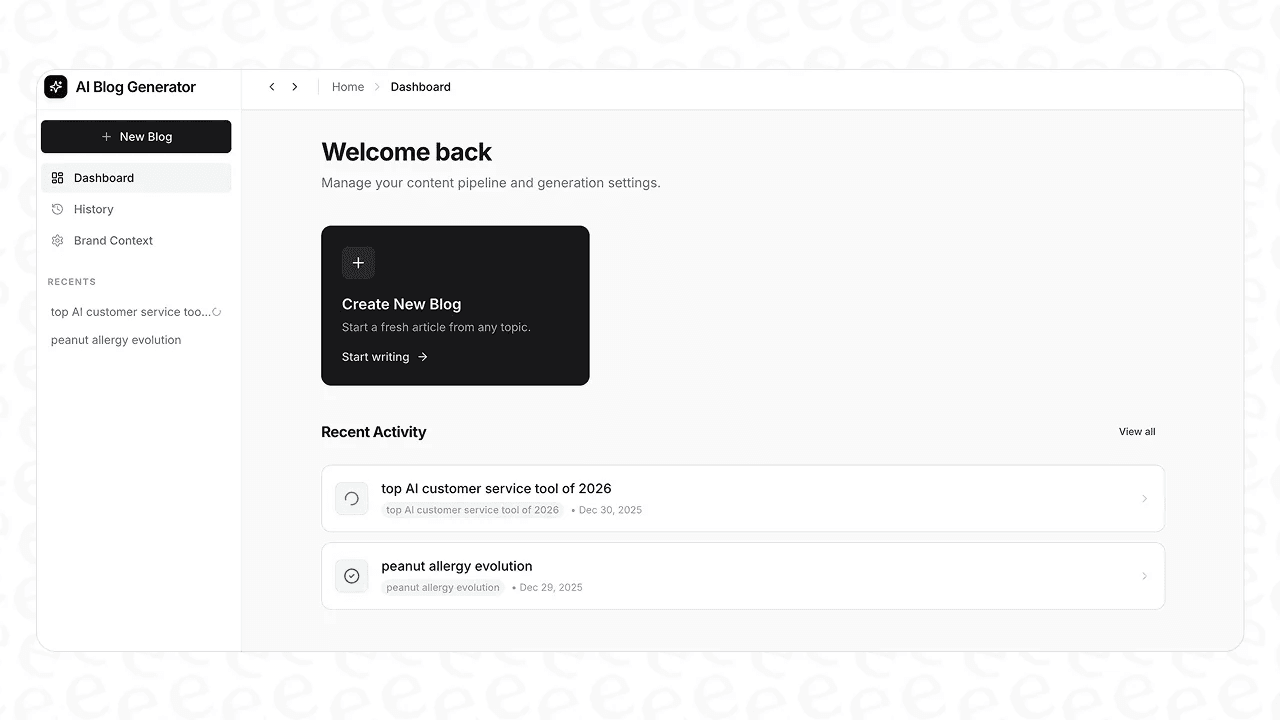
Many AI writing tools assist with specific parts of the content creation process. This can require users to do their own research, create an outline, generate each section separately, find images, and then stitch it all together.
The eesel AI blog writer is different. It is designed to streamline this workflow by automating the entire process from a single topic or keyword. You give it a starting point, and it delivers a complete, publish-ready blog post.
Here’s how it works:
- Context-aware research: Before writing anything, it analyzes the top-ranking content for your topic to build an outline structured to compete and match search intent.
- Automatic assets: Instead of just giving you text, eesel generates and embeds relevant AI images, infographics, and tables directly into the draft.
- Social proof and media integration: To make the content feel more authentic, it pulls in relevant quotes from Reddit and embeds related YouTube videos. Search engines favor content with rich media elements.
We use this exact tool ourselves. It helped us grow our own blog from 700 to 750,000 impressions per day in just three months by publishing over 1,000 fully optimized posts, something that would have been difficult to do manually.
Other tools in the SEO writing ecosystem
To understand the different approaches, it helps to see where other tools fit in. Most are designed for one specific part of the job, which is a workflow that an all-in-one solution like eesel aims to consolidate.
On-page SEO checkers (post-writing)
- Tools: Yoast and Rank Math.
- Function: These are WordPress plugins that give you real-time feedback on your on-page SEO after you’ve written everything. They act like a final checklist, grading you on keyword usage and readability right inside your editor.
- Limitation: They're editors, not content generators. An analysis by OnlineMediaMasters notes that Rank Math’s free version offers more features like redirects and multi-keyword analysis. But with either tool, you still have to do all the upfront research, writing, and asset creation yourself.
Deep research tools (pre-writing)
- Tools: Ahrefs and Semrush.
- Function: These are comprehensive SEO platforms fantastic for deep keyword research, competitor analysis, and tracking backlinks. A detailed comparison mentions that Ahrefs is often praised for its backlink data, while Semrush offers a broader digital marketing toolkit.
- Limitation: They provide a ton of raw data, but it's up to you to spend hours analyzing it and figuring out how to turn those numbers into a blog post. This research phase is what advanced AI blog generators now automate.
Basic text generators vs. complete SEO writing
- Tools: Jasper and Copy.ai.
- Function: These are general AI assistants that are good for brainstorming ideas or writing short pieces of copy.
- Limitation: They don't typically produce a finished, publish-ready article. As noted in user discussions, the output often requires manual work to structure the article, analyze SERPs, find visuals, and handle the on-page SEO. This multi-tool juggle is what a specialized platform like the eesel AI blog writer is designed to eliminate.
I work at eesel AI, and our whole approach with our AI blog writer is to avoid that exact problem. Instead of just scraping the SERPs, it can pull context from a specific URL you give it. This means it can learn a company's actual brand voice, product details, and unique perspective, rather than just regurgitating what's already out there. The goal is a solid, on-brand first draft that a human can then quickly polish.
Measuring the success of your SEO writing
Hitting "publish" is only the first step. The real work begins when you start tracking your content's performance and keeping it up-to-date.
Key metrics in Google Search Console
Google Search Console is a free tool that gives you direct insights from Google. According to Google's own documentation, these are the core metrics to watch:
- Impressions: How many times a link to your site appeared in search results. This tells you if you're visible.
- Clicks: How many times someone clicked that link to visit your site.
- Click-through rate (CTR): The percentage of impressions that resulted in a click. A good CTR means your title and meta description are effective.
- Average position: Your average ranking for the keywords your page appears for. The goal is to get this number closer to 1.
The most critical thing that I thought of is vacant from this thread: what was the performance of the 20 blog posts? Are they all ranking? ... I never post a second blog post until the first one is ranking.
The importance of updating old content
Content isn't something you can just set and forget. Even your best-performing posts can lose traction over time as information becomes outdated or competitors publish something better. This is often called content decay.
The solution is a content refresh strategy. Go back to your older posts and give them an update. Add new information, refresh old statistics, embed new media, and improve your internal linking. This tells Google that your content is still relevant and valuable, which can often lead to a quick ranking boost.
Seeing these concepts in action can make them easier to grasp. For a visual walkthrough of how to combine AI tools with SEO best practices to create content that ranks, check out this helpful guide:
Ultimately, SEO-optimized blog writing is a strategy that combines high-quality, helpful content with smart technical optimization. It’s all about creating something genuinely useful for your readers in a way that search engines can easily understand and reward.
While the core principles haven't changed, the tools we use have. AI-powered platforms have made it possible for any team to scale up content production without sacrificing quality or SEO performance.
Stop the manual grind of research, writing, and formatting. See for yourself how quickly you can go from a single idea to a complete, rank-ready article. Try the eesel AI blog writer for free and generate your first optimized post today.

Frequently Asked Questions
Share this article

Article by
Stevia Putri
Stevia Putri is a marketing generalist at eesel AI, where she helps turn powerful AI tools into stories that resonate. She’s driven by curiosity, clarity, and the human side of technology.