
The challenge for content teams today is not just about producing more articles. It is about creating high-quality, SEO-optimized content at scale that improves search engine rankings. Many AI tools promise a quick solution, but the output often requires significant editing. The goal is to find a tool that creates a publish-ready post, not just a first draft that needs to be completely reworked.
We faced this exact problem at eesel AI. To grow our blog while maintaining quality, we developed our own solution: the eesel AI blog writer. Using our own tool, we grew our daily impressions from 700 to over 750,000 in three months. This post shares what we learned from testing the top tools on the market.
There’s no single best tool. AI works best when each tool has a job. ChatGPT or Claude for outlines and drafts. Surfer or Clearscope for on-page coverage. Frase for FAQs and question targeting. The real lift comes from editing hard and tightening answers.

What is an AI article writer?
An AI article writer is a tool that uses artificial intelligence to generate long-form content, like blog posts, from a simple prompt such as a keyword or a title. It is a specialist tool, not a general-purpose one.
Unlike general AI chatbots like ChatGPT, these tools are built specifically for content creation. They are designed to handle research, outlining, and drafting, and they usually come with features to assist with search engine optimization (SEO).
How we chose the best AI article writers
To create this list, we went beyond feature pages and generated articles with each tool to assess their capabilities. Our evaluation focused on what is most important for content teams trying to grow their organic traffic.
Here are some tools to consider: SERP research & briefs: Frase, Surfer pull top-page headings, questions, entities, and gaps to build a brief fast. Outlines & drafting: ChatGPT, Claude, Gemini great for reverse-outlines, first drafts, and variant angles. Editing, tone & style guardrails: Grammarly, Hemingway for readability. Facts & citations (hallucination control): Perplexity (with sources), ChatGPT w/ browsing for cite-and-summarize.
- Content quality & human tone: Does the output sound like something a person would write and read? We prioritized tools that produce engaging, well-researched content that does not have a robotic tone.
- SEO & AEO features: How well is the content configured for search engines (SEO) and AI answer engines (AEO)? This includes keyword placement, proper structure, metadata, and whether it directly answers the types of questions people ask.
- Inclusion of assets: A good blog post is more than just text. We looked for tools that automatically include images, tables, infographics, and social proof like quotes from Reddit threads.
- Ease of use: How quickly can you move from an idea to a complete, publish-ready draft? We favored tools with a simple workflow that do not require extensive prompt engineering.
- Value for money: We compared the price against the quality and completeness of the final article to determine which tools offer the best return on investment.
An infographic showing the five criteria for choosing the best AI article writer: content quality, SEO features, asset inclusion, ease of use, and value.
A comparison of top AI article writers
Here is a quick look at the top tools we tested. This table provides a high-level comparison to see how they stack up against each other.
| Tool | Best For | Includes Assets? | Starts At | Free Trial? |
|---|---|---|---|---|
| eesel AI blog writer | Publish-ready SEO blogs in one click | Yes | $99/month | Yes, free to try |
| Jasper | Marketing teams needing brand control & automation | No | $69/month | Yes, 7-day trial |
| Writesonic | Fact-checked articles with SEO & GEO features | Yes | $49/month | Yes |
| Copy.ai | Automating go-to-market workflows | No | $29/month | Yes, free plan available |
| Rytr | Affordable short-form copywriting | No | $9/month | Yes, free plan available |
| ChatGPT (Plus) | General-purpose writing with manual prompting | No | $20/month | Yes, free version available |
A review of 6 top AI article writers for 2026
Let's dive into the details. Here is our full breakdown of each tool after putting them to the test.
1. eesel AI blog writer
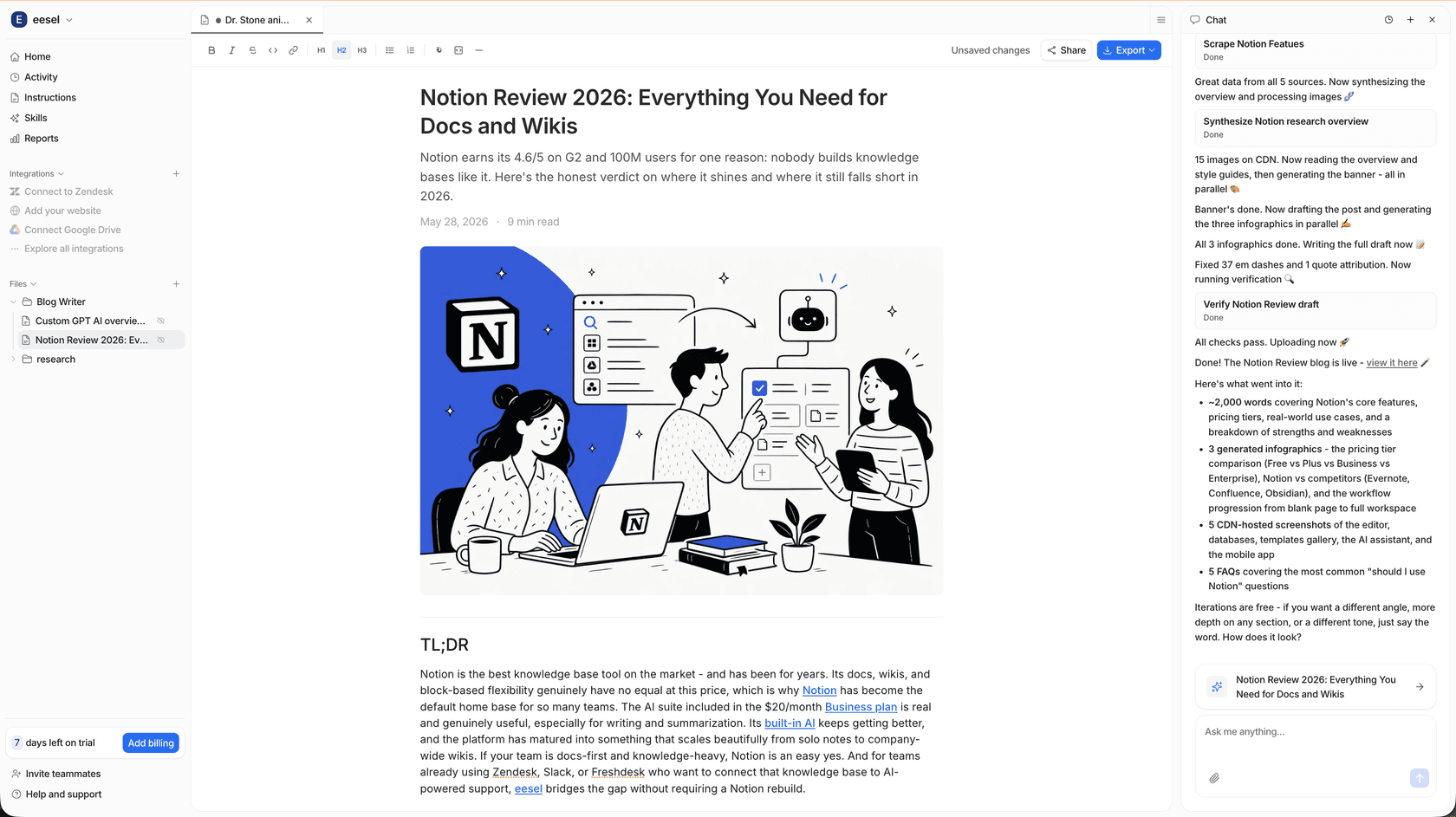
The eesel AI blog writer is designed to handle the entire content process, not just the writing part. You provide a single keyword, and it returns a complete, SEO-optimized, and media-rich blog post. We built it to scale our own content strategy.
Pros: Its main advantage is that it produces a finished article. The context-aware research pulls in relevant data automatically, and it generates a tone that sounds human. It comes with a full set of assets like AI-generated images, infographics, and embeds from YouTube and Reddit. It is also optimized for AI Answer Engines (AEO), which helps future-proof your content for platforms like Perplexity and Claude. Additionally, you can translate full posts to expand your reach.
Cons: The tool is specialized for long-form blog content. Users seeking to generate short-form copy for ads or social media may find it has more features than they require for those specific tasks.
Pricing:
- Early Bird Plan: $99/month for 50 blog generations.
- Free Trial: You can generate your first few articles completely free to see the quality for yourself.
Why we included it: It addresses a common challenge with AI writers: the gap between a first draft and a published article. By bundling research, writing, asset creation, and optimization into a single step, it reduces manual work on each post.
2. Jasper
Jasper is a well-known AI content platform built for marketers. It is a versatile tool that helps marketing teams create various types of content, from blog posts to ad campaigns, while maintaining brand consistency.
Pros: Jasper excels at brand control. Its Jasper IQ context layer learns your brand voice, style guides, and company information to apply across all generated content. It is a comprehensive platform for marketing departments with diverse content needs. It also offers security features like SOC 2 compliance, which is important for larger companies.
Cons: Blog posts generated by Jasper serve as a strong starting point but typically require additional editing and SEO optimization to be publish-ready. The platform's extensive features may present a learning curve for new users, and achieving a specific brand voice can require detailed prompting.
Pricing:
- Pro: Starts at $69 per user/month when billed monthly ($59/mo if you pay annually).
- Business: Custom pricing for teams that need advanced features like API access.
Why we included it: Jasper is a solid choice for larger marketing teams that want a single platform for all their copywriting and content automation needs, not just article writing.
3. Writesonic
Writesonic is an AI tool for creating factual, current, and SEO-ready content. It includes features like real-time data integration, competitor analysis, and automatic citation generation.
Pros: The platform’s deep web research and competitor analysis features are advantageous for creating comprehensive articles. Features like automated internal linking and a built-in fact-checker help improve SEO and credibility. A key feature is its focus on Generative Engine Optimization (GEO), which is designed to improve content visibility in AI search results.
Cons: Some of its advanced features, such as AI search visibility tracking, are reserved for higher-tier plans. Users on entry-level plans will have a more limited feature set.
Pricing:
- Lite: Starts at $49 per month for 15 articles.
- Professional: Starts at $249 per month and includes the GEO features.
- Enterprise: Custom plans for bigger organizations.
Why we included it: Writesonic is a strong contender for businesses that prioritize factual accuracy and want to create data-driven articles with research, citations, and an approach geared toward AI search.
4. Copy.ai
Copy.ai is a Go-To-Market (GTM) AI Platform. While it can generate blog posts, its primary strength is in automating sequences of marketing and sales content, such as email campaigns and sales outreach.
Pros: The extensive library of pre-built workflows is a key feature of Copy.ai. It is powerful for teams that want to streamline repetitive tasks at scale, like converting a sales call transcript into a blog post. It is also LLM agnostic, meaning it can use the most suitable AI model for a given task.
Cons: The process for generating a full blog post differs from that of more specialized article writers. As the tool often summarizes existing top-ranking content, drafts may require significant editing to add a unique perspective and stand out.
Pricing:
- Free Plan: Gives you a limited number of words to use each month.
- Chat Plan: Starts at $29 per month for 5 seats.
- Growth & Enterprise: Custom pricing for larger teams that need more workflow credits.
Why we included it: Copy.ai is a good fit for teams that want to use AI to automate a range of go-to-market activities. It functions as a workflow engine first and an article writer second.
5. Rytr
Rytr is an entry-level AI writing tool known for its simplicity and affordability. It is suitable for individuals, freelancers, and small teams who need a quick way to generate short-form content and overcome writer's block.
Pros: Rytr is easy to use and has a generous free plan with 10,000 characters per month. Its "MyVoice" feature helps it learn and mimic your unique writing style, and the handy browser extension lets you use Rytr in various online writing environments.
Cons: Rytr is primarily optimized for short-form content. For long-form articles, the output may lack the coherence of more specialized tools and require substantial editing. It functions well as a writing assistant for generating sections of an article.
Pricing:
- Free Plan: Offers 10,000 characters per month.
- Saver Plan: Starts at $9 per month for 100,000 characters.
- Unlimited Plan: Around $29 per month for unlimited character generation.
Why we included it: Rytr is a suitable choice for those on a tight budget or new to AI writers. Its simplicity and free plan make it a risk-free way to experiment with AI in your writing process.
6. ChatGPT (Plus)
No list of AI writers is complete without mentioning ChatGPT. The paid "Plus" subscription provides access to more powerful models like GPT-5.2, making it a versatile and capable writing assistant.
Pros: ChatGPT's main strength is its flexibility. With the right prompts, it can perform almost any writing task. The "Custom Instructions" feature allows you to provide information about your brand and tone, and its ability to browse the web makes it a solid research tool.
Cons: As a general-purpose tool, ChatGPT requires users to have strong prompt engineering skills to produce a high-quality, SEO-optimized blog post. It does not automatically add assets, optimize for keywords, or apply a specific structure without detailed, step-by-step instructions from the user.
Pricing:
- Free Version: Uses an older model and has some limitations.
- ChatGPT Plus: Costs $20 per month for access to the more advanced models and features.
Why we included it: ChatGPT is a benchmark for AI text generation. For writers who are comfortable with hands-on, detailed prompting, it remains one of the most powerful AI assistants available.
For a hands-on comparison of different AI writing tools and their output, this video offers a great overview of what to expect when you start generating content.
Tips for using an AI article writer
No matter which tool you choose, your results depend on your process. AI is a powerful assistant, but it still requires a human touch to create content that connects with readers.
- Provide rich context: Do not just give the AI a keyword. Provide information about your audience, the article's goal, specific points to cover, and the desired tone of voice. For tools like the eesel AI blog writer, this can be as simple as adding your website URL for automatic context.
- Always edit and humanize: Never copy and paste an AI draft and publish it directly. Always read it through. Add your own personal stories, unique insights, and expert opinions. This human layer is what distinguishes great content from generic AI text.
- Fact-check everything: This is non-negotiable. AI models can sometimes produce inaccurate information or "hallucinate." Always double-check any data, statistics, or claims before publishing. Your credibility is important.
- Use AI for the entire workflow: Think beyond drafting. Use AI to help brainstorm topics, create outlines, develop catchy titles, write meta descriptions, and even generate social media posts to promote your new article.
A four-step workflow for using an AI article writer, including providing context, editing, fact-checking, and using AI for the full workflow.
Choosing the right AI article writer
The market for AI writers offers a range of tools, each with different strengths. Some are designed to produce a solid first draft that requires further editing and optimization, while others aim to generate a more complete article with assets included. The best choice depends on your team's workflow, resources, and content goals.
These top-tier tools recognize that modern content needs more than just words; it requires good structure, SEO, visuals, and a human touch. They are built to manage the entire workflow, allowing you to scale your content strategy without sacrificing quality.
If you are looking for a tool that generates articles with assets included, you can try the eesel AI blog writer. It is free to start, so you can see for yourself how quickly you can create high-quality, SEO-optimized content.