

Trying to keep up with the demand for great content feels like a never-ending battle, right? You're juggling research, writing, editing, finding images, and optimizing every post. It's easy to get burned out. That's where AI writing tools can really help. They can scale up your content creation, boost its quality, and give you back some much-needed time.
The problem is, there are a ton of them out there, and it can be hard to figure out which one is the right fit. To help you sort through the noise, I've tested a bunch of these platforms myself. At eesel AI, we even used our own tool to grow our blog from 700 to over 750,000 daily impressions in just three months. This guide will break down the top options so you can find the right tool for the job.
Understanding the different types of AI writing tools
AI writing tools are software programs that use large language models (LLMs) and Natural Language Processing (NLP) to help you create, edit, and fine-tune text. They aren't all created equal, and there's no single "AI writer" that does it all. They usually fall into a few main categories:
-
AI Text Generators: These are the most common. You give them a prompt, and they generate content from scratch. This could be anything from articles and emails to ad copy. Most tools like Jasper and Copy.ai fit here, typically giving you a text-only output that you then have to format and polish.
-
AI Writing Assistants: These tools are more focused on improving text you’ve already written. Think of them as a spellchecker on steroids that also helps with grammar, style, tone, and clarity. Grammarly is a well-known example.
-
AI-Powered Optimization Platforms: These tools are built to help your content rank higher in search engines. They focus on optimizing for traditional search engines (SEO) or the new wave of AI Answer Engines (AEO). Writesonic and Surfer are big names in this space, analyzing top results to give you data-backed suggestions.
-
Complete Asset Generators: This is a newer type of tool that aims to produce a final, publish-ready piece of content, not just a block of text. Instead of a rough draft, you get a fully structured article complete with images, tables, quotes, and other media. The eesel AI blog writer is designed for this, saving you the headache of post-writing production.
How we chose the best AI writing tools
To make this list genuinely useful, I didn't just skim feature lists. I spent real time with each tool, judging them on a few key things that matter to content creators.
-
Quality of Output: First and foremost, does the content sound like a person wrote it? Or is it full of generic, repetitive AI fluff? I was looking for tools that could produce factually accurate, natural-sounding text that people would actually want to read.
-
Ease of Use: How fast can you get started? The best tools have a straightforward interface that lets you generate useful content right away, without making you watch hours of tutorials.
-
Key Features & Use Case: Is the tool a jack-of-all-trades, or does it have a specialty? Some tools are great for general writing, while others are laser-focused on a specific task like SEO, fiction writing, or creating complete blog posts.
-
Asset Generation: A huge amount of time in content creation is spent on everything that comes after the writing. I checked whether the tool could deliver a complete, publish-ready article with images, tables, and media, or if it just spat out unformatted text.
-
Value for Money: Is the price reasonable for what you're getting? I compared the cost of each tool against its features and output quality to see if it was a good investment.
A quick comparison of the best AI writing tools
If you're in a hurry, here's a quick rundown of how the top tools compare.
| Tool | Best For | Starting Price | Free Plan/Trial? | Includes Assets? |
|---|---|---|---|---|
| eesel AI blog writer | Complete, publish-ready blog posts | $99/mo for 50 blogs | Yes, free to try | Yes |
| Jasper | AI content automation for marketing teams | $59/month (billed annually) | 7-day free trial | Yes (images) |
| Copy.ai | Go-to-market (GTM) content and workflows | $24/month (billed annually) | Yes, 2,000 words/mo | No |
| Writesonic | AI search visibility and SEO tracking | $39/month (billed annually) | Yes, free trial | Yes (images) |
| Rytr | Budget-friendly text generation | $9/month | Yes, 10k characters/mo | No |
| Surfer | On-page SEO optimization | $79/month (billed annually) | No | No |
| Sudowrite | Creative and fiction writing | $10/month | Yes, free to try | Yes (images) |
A deep dive into the 7 best AI writing tools
Alright, let's get into the specifics. Here’s a closer look at each tool, what it's good at, and who it's for.
1. eesel AI blog writer
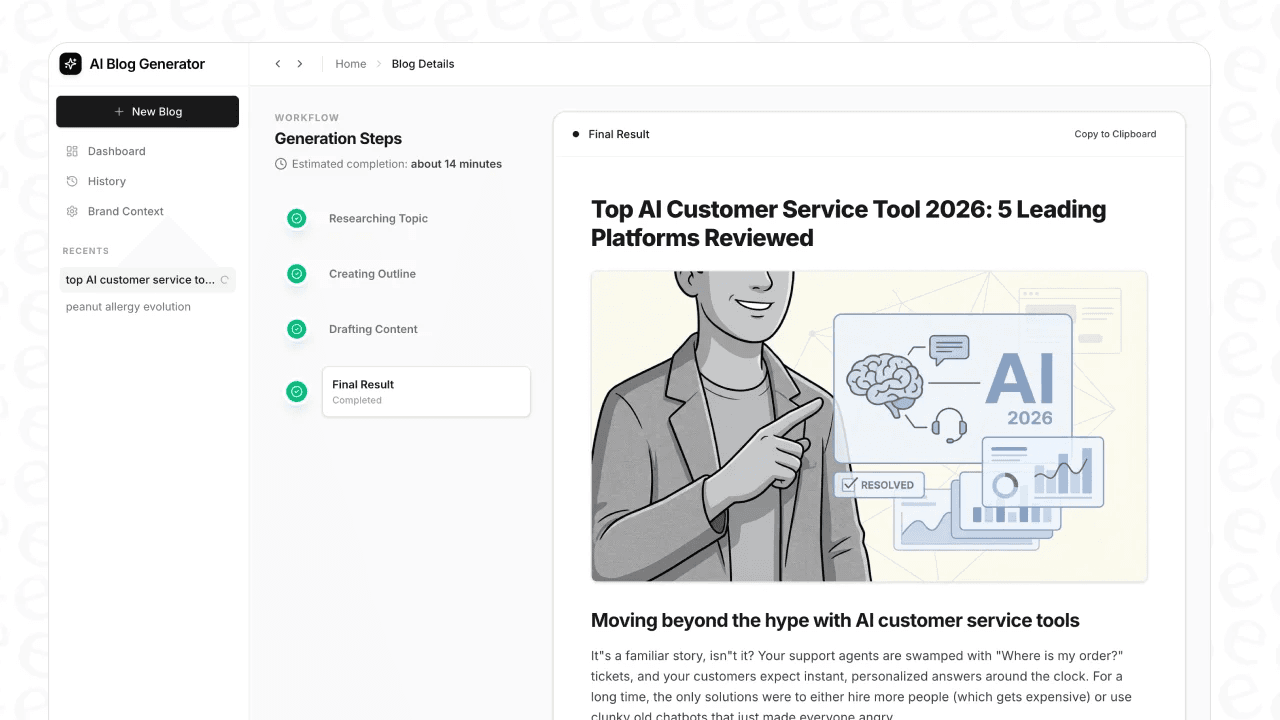
The main idea behind the eesel AI blog writer is simple: it’s built to take a single topic or keyword and produce a complete, SEO-optimized, and media-rich blog post, not just a first draft. This approach is a key differentiator from tools that focus on generating unformatted text, as it aims to produce a fully structured article ready for publication.
What makes it stand out are the features that add depth and authenticity. Its context-aware research pulls in relevant information based on the kind of post you're writing. It also automatically includes AI-generated images and tables, and even finds relevant YouTube videos and Reddit quotes to make the content more engaging. This saves a ton of time on editing, formatting, and finding visuals.
The primary benefit of the eesel AI blog writer is its focus on creating a final, publishable asset. It also optimizes for AI Answer Engines (AEO), which is increasingly important for modern search. A potential drawback is its specialization in blogging, which may not be suitable for users who need short-form ad copy or social media captions.
- Pricing:
- It's free to try.
- The Early Bird plan is $99 per month for 50 blog generations.
2. Jasper
Jasper has established itself as a go-to platform for marketing teams that want to automate their entire content process. It's made for scale and is used by over 100,000 businesses. It's more than a simple text generator; it's a full system for creating consistent, on-brand content.
Its key features include Jasper IQ, which learns your brand voice, knowledge base, and audience to apply them to every piece of content. It also has Content Pipelines that help connect your content strategy directly to your work. It’s a solid tool with everything from a no-code app builder to AI agents designed for different marketing jobs.
Jasper excels at producing consistent, on-brand content in various formats, making its toolset valuable for larger marketing teams. However, the platform may have a steeper learning curve than simpler tools, and its pricing is geared towards established teams with a budget.
- Pricing:
- Pro Plan: Starts at $59/month per seat (billed annually).
- Business Plan: Custom pricing for teams.
3. Copy.ai
Copy.ai calls itself a "GTM AI Platform" and is built to weave AI into your entire sales and marketing machine. Trusted by over 17 million users, it's less about writing a single blog post and more about automating the processes that help a business grow.
Its platform is based on things like Workflows, which let you automate repeatable processes, and Agents that can handle tasks like sales prospecting and lead follow-ups. With over 2,000 integrations, it's made to plug into your existing software. It's also SOC 2 Type II compliant, which is a big deal for enterprise-level security.
Copy.ai's strength lies in its focus on business goals like lead generation and account-based marketing. Its Chat plan offers good value with multiple seats. The main consideration is that its full value is realized through its complex workflows, which might be excessive for users seeking a simple text generator.
- Pricing:
- Free Plan: 2,000 words per month.
- Chat Plan: Starts at $24/month for 5 seats (billed annually).
- Enterprise: Custom pricing.
4. Writesonic
Writesonic is a platform built for the new age of search. While it can write content, its main purpose is to track and improve your brand's visibility in AI search results, a concept it calls Generative Engine Optimization (GEO). It helps you see how you're showing up on platforms like ChatGPT and Perplexity, not just Google.
Its main features are AI Visibility Tracking, which shows you where your brand ranks on over 10 AI platforms, and AI Visibility Actions, which give you specific advice to beat your competitors. It also includes traditional SEO tools and a content writer, making it a well-rounded platform for search-focused marketers.
Writesonic's forward-thinking approach to search is its biggest advantage. As AI answer engines grow, tracking and optimizing for them becomes crucial. The platform is also SOC 2 Type II compliant. However, this specialized focus makes it less of a general AI writer and more of an advanced SEO/GEO tool, which may not fit every content creator's needs.
- Pricing:
- A free trial is available.
- The Lite Plan starts at $39/month (billed annually).
5. Rytr
Rytr is one of the most popular and affordable general-purpose AI writers you can find. It’s a simple tool designed to help you create short-form content quickly and easily.
It provides over 40 "Use Cases" (templates) for everything from blog ideas and outlines to emails and social media posts. It supports over 30 languages and even has a plagiarism checker built in, making it a flexible tool for a lot of different tasks.
Rytr is highly flexible, and its pricing is very competitive, including a generous free plan. It serves as a great entry point for those new to AI writing. A potential drawback is its character-based limit, which can be less intuitive than a word count. The output quality is generally suitable for a first draft but often requires human editing for nuance and flow.
- Pricing:
- Free Plan: 10,000 characters per month.
- Saver Plan: $9/month.
- Unlimited Plan: $29/month.
6. Surfer
It's important to note that Surfer is primarily an AI-powered SEO tool, not a text generator. It helps you optimize the content you write (or get from another tool) to rank higher in search results. It's used by over 150,000+ customers who are serious about their on-page SEO.
Its main job is to analyze the top-ranking articles for your target keyword and give you a detailed checklist of what to include in your own content. This covers key terms, heading structures, word count, and more. As you write, its real-time Content Score gives you feedback, guiding you toward a perfectly optimized article.
Surfer excels at demystifying competitor analysis and providing a clear, data-driven path to improve on-page SEO. Its integrations with Google Docs and WordPress streamline content workflows. However, it is one of the more expensive tools on this list and does not offer a free plan, making it a significant investment best suited for SEO-focused teams.
- Pricing:
- The Essential Plan starts at $79/month (billed annually).
7. Sudowrite
Sudowrite is a unique tool made just for creative writers, novelists, and screenwriters, not for marketers. It's designed to be an "AI writing partner with unparalleled story smarts" helping you get past writer's block and make your storytelling richer.
It has a set of specialized features you won't find in other tools. Its Story Bible helps you plan your world and characters, the Write feature generates text in your own voice, and the Describe tool adds rich, sensory details to your scenes to make them come alive.
Sudowrite offers an impressive and unique set of tools tailored specifically to the needs of storytellers. Its user-friendly interface simplifies complex creative tasks. The primary limitation is that it is not designed for business or marketing content. Its credit-based pricing can also be unpredictable, as the cost varies depending on the AI model used.
- Pricing:
- The Hobby & Student Plan starts at $10/month for 225,000 credits.
How to choose the right AI writing tool for your needs
With so many good options, how do you pick the one that's right for you? Here are a few tips to help you decide.
-
Figure Out Your Main Goal: What are you really trying to accomplish? Are you writing long-form blogs, short ad copy, or the next great American novel? A specialized tool is often more effective for specific tasks than a general-purpose one. For example, if your main goal is to scale a blog with high-quality, SEO-ready content, a tool like the eesel AI blog writer is built specifically for that.
-
Think About Your Workflow: How much work do you want to do after the initial draft is done? If you're okay with getting a rough draft and then handling the editing, formatting, and image sourcing yourself, a simple text generator might be all you need. But if you want to cut down on that manual work, you should look for an all-in-one generator that creates complete, ready-to-publish assets.
-
Start with a Free Trial: This is the most important step. Nearly every tool on this list offers a free plan or a trial. Use it. Take the same prompt or topic and run it through your top two or three choices. This will give you a direct, side-by-side comparison of the output and show you which one best fits your style and needs.
Seeing these tools in action can also help you decide. For a quick overview of some top contenders and how they compare, check out this video.
Final thoughts on the best AI writing tools
The market for AI writing tools is incredibly varied, with great options for every need, niche, and budget. After trying all these platforms, it's clear that the "best" tool really comes down to the job you're trying to do.
Jasper is a powerful tool for large marketing teams that need to automate content at scale. Surfer is a valuable asset for SEO professionals who live and breathe on-page optimization. And Sudowrite is an excellent choice for fiction authors.
For businesses focused on driving organic traffic with high-quality, long-form content, the process extends beyond text generation to publishing complete, engaging articles. The eesel AI blog writer is designed for this specific workflow, aiming to turn a single keyword into a complete, media-rich post.
See the difference for yourself and generate your first blog for free.
Frequently asked questions
What are the best AI tools for writing blog posts specifically?
For creating complete, publish-ready blog posts, a specialized tool like the eesel AI blog writer is a strong option. It handles everything from research and writing to adding images and media, saving you a lot of post-production time. Other tools like Jasper are also good but may require more manual formatting.
Can the best AI tools for writing create content that sounds human?
Yes, the top-tier tools can produce content that is very natural and human-like. The quality often depends on the tool's underlying language model and how specific your prompts are. Tools like eesel AI and Jasper are known for generating high-quality, readable text.
Are there any free options among the best AI tools for writing?
Yes. Many of the best AI tools for writing offer free plans or trials. For instance, Rytr has a generous free plan with a monthly character limit, Copy.ai offers a free tier with a word limit, and the eesel AI blog writer lets you generate your first blog for free to test its capabilities.
How do I choose from the many best AI tools for writing available?
The best approach is to define your main goal. For example, if you need SEO-optimized blogs, you might consider eesel AI or Writesonic. For a wide variety of marketing copy, Jasper or Copy.ai could be suitable. For creative fiction, Sudowrite is a specialized option. Always use the free trials to compare the output quality for yourself.
Do the best AI tools for writing help with SEO?
Many of them do. Tools like Surfer are built specifically for on-page SEO optimization. Others, like the eesel AI blog writer and Writesonic, have SEO features built-in, helping you create content that is structured to rank well in search engines by including keywords, proper headings, and meta descriptions.