
AI-generated content is popping up everywhere. You can get an article draft faster than it takes to make a coffee, which is great. But there's a huge difference between that first draft and something you'd actually want to put your name on.
The biggest issue? Hitting "publish" on unedited AI content can do a number on your brand. It often sounds robotic, gets facts completely wrong (thanks, AI hallucinations), and has zero personality. It’s just filler, really.
Many think you need to only use AI-powered tools to create “new” media completely “from scratch” but I feel current post AI tools are better at tweaking media you already have part way to your goal - almost like what we’ve been doing with VFX for decades, it’s just another tool.

This is where a solid AI content editing process comes into play. It's the essential, human-led workflow that turns those generic drafts into quality articles that people want to read and rank in search engines.
Of course, starting with a better first draft from a tool like the eesel AI blog writer can cut your editing time way down. But even then, that final human touch is what really makes the difference.
What is the AI content editing process and why is it essential?
The AI content editing process is a complete workflow for whipping machine-generated text into shape. It's much more than just fixing typos. It involves checking facts, improving the structure, aligning it with your brand's voice, and optimizing it for search.
In an era where everyone is churning out AI content, authenticity and trust are what will make you stand out. Think about it: if your blog is full of generic, slightly-off content, why would anyone stick around?
According to a 2026 report from Accenture, nearly 60% of consumers doubt online authenticity because of the flood of AI-generated content. That's a huge number you can't just ignore.
The whole point of this process is to bridge the gap between AI's speed and the nuance, credibility, and personality that only a human editor can provide.
The 3 foundational steps of a successful AI content editing process
Okay, let's get into the nitty-gritty. This is the core, hands-on workflow that every content team should be using to ensure quality.
Step 1: Start with a strategic review for flow
Before you even think about changing a single word, do a high-level read-through. The goal is to get a feel for the overall structure, the main argument, and how the narrative flows (or doesn't).
You're looking for common AI slip-ups:
- Logical gaps: Does the argument jump from point A to C without explaining B?
- Awkward transitions: Does it feel like different sections were just pasted together?
- Repetitive points: Is the AI just rephrasing the same idea over and over?
Don't be afraid to move entire paragraphs or even whole sections around. You're trying to create a smooth, logical journey for the reader, and sometimes that requires a bit of a shuffle.
Step 2: Fact-check everything
This step is absolutely non-negotiable. AI models are known for "hallucinating," which is just a polite way of saying they make stuff up. They'll invent facts, stats, and even sources that sound real but are completely fake. As we mention in our guide to AI blog writing, verifying every single fact is vital.
Here's a quick checklist to run through:
- Check every statistic: Find the original source and make sure the number is correct.
- Verify names and dates: Double-check that all proper nouns are spelled correctly and dates are accurate.
- Attribute quotes properly: Make sure quotes are real and credited to the right person.
- Confirm sources: If the AI cites a study or report, make sure it actually exists and says what the article claims it does.
Your credibility is on the line. A single made-up statistic can undo all the trust you've built with your audience.
Step 3: Refine the tone and align with your brand voice
AI-generated text usually has a very neutral, almost bland, tone. It’s your job as the editor to inject your company's personality back into it. Are you conversational and friendly? Authoritative and expert? A little bit witty?
This is where your brand's style guide comes in handy. Pull it out and use it to check for things like preferred terms, sentence structure, and the overall tone. You’re turning a generic script into a conversation that sounds like it’s coming from you.
Here’s a look at how you can transform robotic phrases into something more human:
| Generic AI Phrase | Human & On-Brand Alternative |
|---|---|
| "In the realm of customer service..." | "For support teams on the frontline..." |
| "It is imperative to consider..." | "You need to think about..." |
| "This article will delve into the intricacies of..." | "Here’s how you can..." |
| "Leveraging this technology allows for..." | "Using this tool helps you..." |
Streamlining the process with eesel AI
The manual editing process is vital, but it can also be a massive time-drain. The best way to reduce editing time is to start with a much better first draft. That’s what the eesel AI blog writer is built for.
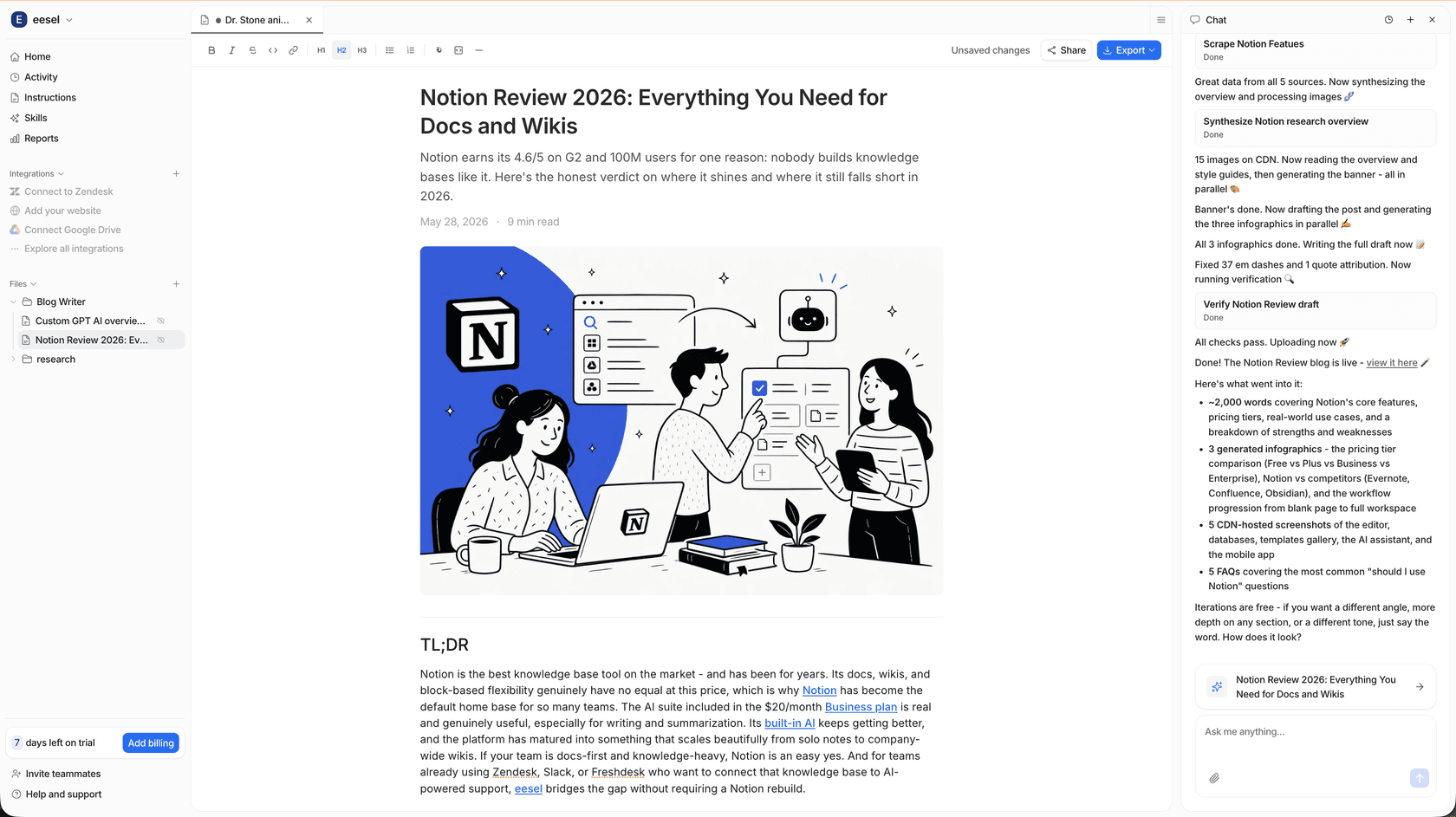
Instead of just giving you a wall of text, its features are designed to solve common editing headaches before the draft is even done. This means less manual work for you and your team.
Here’s how it helps:
- Context-aware research: eesel AI does deep research based on the type of blog you need. If you're writing a comparison post, it automatically pulls in pricing. For a product review, it finds the tech specs. This cuts down the time you have to spend on fact-checking.
- Automatic asset creation: It doesn't just write text. It generates a complete blog post with AI-generated images, custom infographics, and data tables already included. You don't have to waste time making visuals from scratch.
- Authentic social proof: It automatically finds and embeds relevant YouTube videos and pulls in real quotes from Reddit. This adds a layer of human perspective and credibility without you having to spend hours scrolling through forums.
- AI-assisted editing: Once the draft is generated, you’re not left on your own. You can highlight any section and use AI-powered "vibe edits" to quickly change the tone, shorten a paragraph, or simplify complex language, making targeted changes quick and easy.
Think of eesel AI as a partner in the process. It handles the heavy lifting and initial research, freeing you up to focus on the high-level strategy, creative polish, and final touches that make the content stand out.
Common pitfalls to avoid
Even with a solid workflow, there are a few common traps that editors can fall into. Here’s what to look out for.
Over-editing and sanitizing the content
It can be tempting to rewrite every single sentence, but be careful not to overdo it. If you edit too much, you can accidentally strip out any personality and end up with something that sounds just as generic as the original draft, just with different words.
The goal is to refine, not completely rebuild. Focus your energy on edits that improve clarity, fix errors, and align with your brand voice. If a sentence works, let it be.
Ignoring readability and sentence variety
One of the biggest giveaways of unedited AI content is a repetitive sentence structure. You'll see a lot of sentences that start with "This," "It," or "The." It's grammatically correct, but it’s incredibly dull to read.
As you edit, try to vary your sentence length. Mix short, punchy sentences with longer, more descriptive ones. Break up huge paragraphs into smaller, more digestible chunks. Use formatting like bullet points and bold text to guide the reader's eye and make the content scannable.
Forgetting about SEO and AEO
A great edit isn't just about the words; it's also about how the content performs. Your final pass should always include an SEO check. Are your target keywords integrated naturally in the headings and body? Are your internal links in place?
And don’t forget about AEO (Answer Engine Optimization). This is about structuring your content so it can be easily picked up and featured by AI answer engines like Google's AI Overviews and Perplexity. It involves using clear headings, concise answers, and structured data. This is a smart step to future-proof your content, and it's something the eesel AI blog writer handles automatically.
For a deeper dive into editing AI-generated articles to make them unique and effective, check out this helpful video guide. It covers everything from the initial setup to humanizing your content, ensuring your articles truly stand out.
Balancing AI speed with human quality
AI is an incredible tool for creating content at scale, but it’s not the whole story. The human editor is still the most important part of the equation when it comes to quality, authenticity, and creating content that actually gets results.
For me, I use AI as a refiner rather than a complete creator. For example, I’ll use it to help me research, flesh out an outline, or find data sources all before I ever start writing. If I get stuck or feel like something could sound better or more effective, I’ll put my draft in and have it give me feedback.
A well-defined AI content editing process is the framework that makes this human-AI collaboration work. It turns a potential problem into a powerful content engine. By starting with a better draft and applying a strategic human touch, you get the best of both worlds: speed and quality.
To see how a higher-quality first draft impacts the editing workflow, you can generate a blog post for free using the eesel AI blog writer.