What is generative engine optimization? Your guide to the new era of AI search

Kenneth Pangan

Stanley Nicholas
Last edited February 2, 2026
Expert Verified

It's pretty clear that search isn't what it used to be. We're not just scrolling through a list of blue links anymore. Instead, AI-generated answers, like Google's AI Overviews, are showing up in a huge 42.5% of search results. This isn't just a minor update; it's a fundamental change. The goal has shifted from getting clicks to getting cited.
This new reality requires a new approach: generative engine optimization (GEO). It’s all about making your content the primary source for AI models on platforms like Google, ChatGPT, and Perplexity. And the effect is massive. A Pew Research Center study recently found that people are half as likely to click a regular link when an AI summary is present. If you're not part of the AI's answer, you're practically invisible.
This article is your guide to navigating this change. We'll get into what generative engine optimization actually is, why you need to pay attention to it now, and share some practical, data-backed tips. It's a new game, and tools like the eesel AI blog writer are designed for it, helping you create optimized articles that earn those valuable citations.
What is generative engine optimization (GEO)?
Generative engine optimization (GEO) is the process of fine-tuning your content so AI models choose you as their source of truth. The goal isn't just to rank, but to be retrieved, synthesized, and cited directly in the AI's answer. It's a big switch from trying to drive traffic to trying to drive influence within the answer itself.
While it might sound brand new, GEO builds on the foundations of traditional SEO. The main difference is the mindset and the ultimate goal. To illustrate, here’s a quick comparison of traditional SEO and Generative Engine Optimization:
| Factor | Traditional SEO | Generative Engine Optimization (GEO) |
|---|---|---|
| Primary Goal | Rank a webpage high in a list of links | Be cited as a source in an AI-generated answer |
| Key Metric | Click-Through Rate (CTR) | Citation Frequency & Share of AI Voice |
| Content Focus | Keyword optimization | Answer-first, structured for machine readability |
| Core Tactic | Building backlinks for domain authority | Building topical authority with E-E-A-T signals |
You're no longer just writing for a person scanning for keywords. You're also writing for a machine that's hunting for the clearest, most trustworthy information to build a definitive answer. It’s less about gaming an algorithm and more about becoming an essential, easily digestible source of knowledge.
Why is generative engine optimization the new reality for content marketing?
If you're wondering if this is really a big deal, the data is pretty clear. This isn't some future trend; it's happening now and it's already disrupting the old way of doing things.
The rise of AI-generated answers is pouring fuel on the "zero-click" search fire. That same Pew Research study discovered that when an AI Overview is present, users click a traditional search link only 8% of the time, down from 15% when there isn't one. That's a huge drop. For some publishers, the impact has been so severe they're calling it an "extinction-level event" as their traffic disappears. If your brand isn't cited in the AI's answer, you’re invisible to a large and growing number of users.
On top of that, people are changing how they search. We're moving from short keywords to longer, more conversational questions. According to Pew, searches with 10 or more words are 53% likely to trigger an AI summary. That's compared to just 8% for one- or two-word searches. People are basically having conversations with their search engines, and they want a direct answer, not a list of links to sort through. GEO is how you join that conversation.
How does generative engine optimization work?
To get good at GEO, you need to understand how the technology works. The system behind most modern AI search is called Retrieval-Augmented Generation (RAG).
Simply put, RAG allows AI models like Google's Gemini or OpenAI's GPT-4 to do more than just rely on their training data. When you ask a question, the AI actively "retrieves" fresh information from the live web to create an "augmented," current answer. This is precisely why your content is so important. The AI is always on the lookout for the best sources.
Here's a simplified look at how it happens:
So, what makes an AI model choose your content over a competitor's? It usually comes down to a few things:
- Authority and Trust (E-E-A-T): AI models are trained to prioritize sources that demonstrate strong Experience, Expertise, Authoritativeness, and Trustworthiness. As Google notes in its own guidelines for creating helpful content, E-E-A-T signals are a big deal for their systems.
- Semantic Structure & Clarity: Content that is well-organized with clear headings, lists, and direct answers is a goldmine for an AI. It's easy to parse and understand. This is the "answer-first" principle at work, and it's why sites like Reddit and Wikipedia get cited so often. They don't waste time.
- Freshness: AI platforms want the most current information. One study found that content cited in AI answers is, on average, 25.7% fresher than content that just ranks in the top ten traditional organic spots.
Core strategies for effective generative engine optimization
Now for the practical part. Knowing how it works is one thing, but how do you actually do it? Here are the core strategies to focus on.
Build authority with E-E-A-T and digital PR
Being seen as an expert is more critical than ever. AI models are smart enough to recognize that a mention on a niche, high-authority site is a strong vote of confidence. In fact, AI models heavily favor specialized sources over general-interest ones.

The data supports this: brands in the top 25% for web mentions get over 10 times more AI Overview citations. So, how do you get there?
- Focus on digital PR: Get featured in industry publications and on expert roundups.
- Publish original research: Create unique data or insights that other people will want to cite.
- Be active where the conversation is: A strong presence on platforms like Reddit and Quora can be very valuable, as these are frequently cited in AI answers.
Create answer-first, structured, and data-rich content
It's time to shift your thinking from "how do I rank for this keyword?" to "how do I give the best possible answer to this question?" This means structuring your content for both people and machines.
Start using question-based headings (like "What is generative engine optimization?") and provide a direct, clear answer right below it. Don't bury the important stuff. And back up your claims with data. A study on optimizing for generative engines found that adding relevant quotes, statistics, and credible citations can increase your visibility by up to 40%.
Of course, the old rules haven't disappeared. Traditional SEO is still the foundation. Around 40.58% of AI citations come from pages that already rank in Google's top 10 organic results. You still need to get the basics right to even have a shot.
Optimize for technical accessibility
Finally, you have to make it incredibly simple for an AI to read and understand your content. This is all about "building for ingestion."
- Use structured data (schema markup): Things like "FAQPage" schema give AI models clear context about what's on your page, making it easier for them to pull out specific questions and answers.
- Embrace "content chunking": Break up long blocks of text. Use short paragraphs, bullet points, and numbered lists. This makes key facts and takeaways easy for an AI to extract when it's putting together an answer.
Scaling generative engine optimization with the eesel AI blog writer
Manually creating content that is deeply researched, perfectly structured, full of media, and optimized for AI engines is a lot of work. It can easily become a bottleneck for any content team.
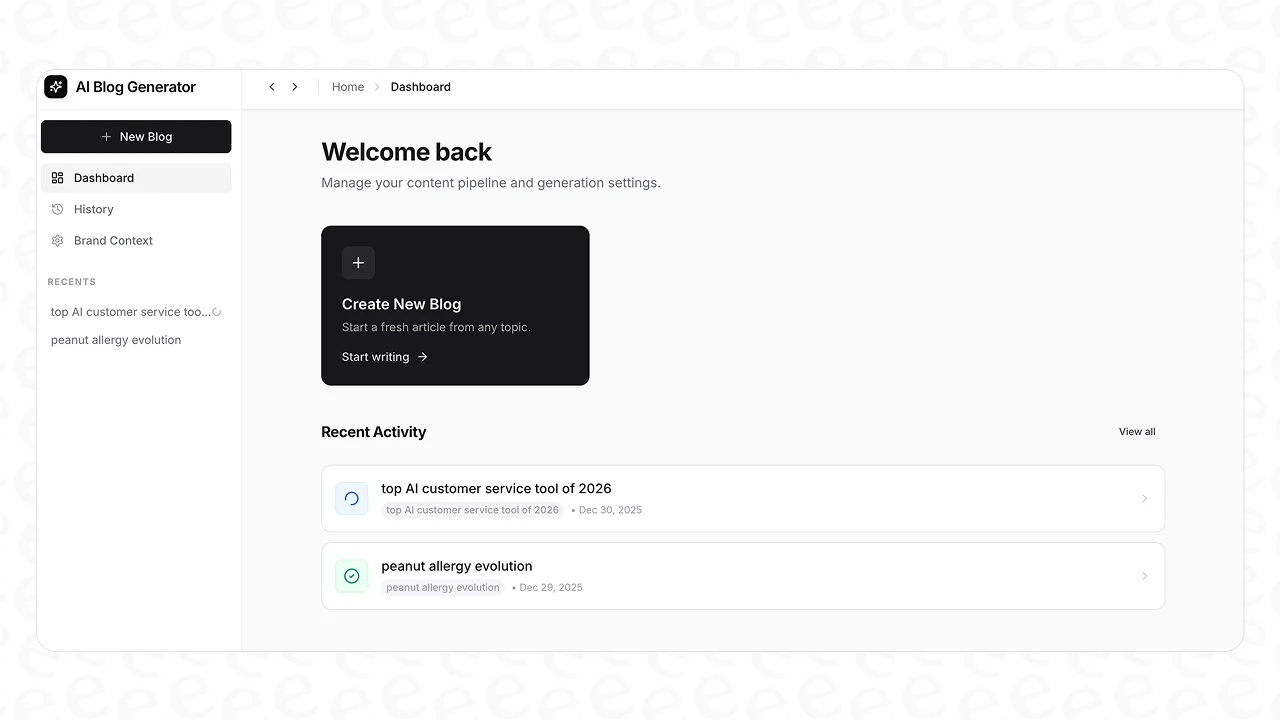
The eesel AI blog writer is a content platform designed for the GEO era. The goal isn't just to give you a first draft, but to produce a publish-ready article that's engineered to get cited.
Here’s how its features directly help with the GEO strategies we've discussed:
- Deep Research with Citations: Instead of generic text, it automatically pulls in relevant statistics and links to credible external sources, which is a key factor for gaining visibility and trust.
- Automatic Assets: It generates tables, infographics, and embeds relevant YouTube videos. This creates the kind of rich, varied, and structured content that AI engines like to feature.
- Authentic Social Proof: It searches the web to find and integrate real quotes from Reddit. Why? Because both Google AI Overviews and ChatGPT often use Reddit as a source for authentic, human perspectives.
- Optimized for LLMs: The entire output is built with the answer-first structure and clarity that AI models are designed to understand. It saves you the manual effort of "building for ingestion" because it's built-in from the start.
For a more detailed breakdown of what Generative Engine Optimization entails, the video below offers a great explanation.
A video from Vendasta explaining the basics of generative engine optimization and how it differs from traditional SEO.
Prepare for the future of search with generative engine optimization
Search is no longer just a directory of links; it's a conversation. Generative engine optimization is the strategy that ensures your brand is a trusted, authoritative voice in that conversation.
Success in this new era comes down to one thing: creating content that is so authoritative, well-structured, and genuinely helpful that an AI has no choice but to trust and reference it. It’s about being the source, not just another result.
Start preparing for the future of search. Generate your first blog for free with the eesel AI blog writer and create content that gets cited in this new era of AI.
Frequently Asked Questions

Share this post
Article by
Kenneth Pangan
Writer and marketer for over ten years, Kenneth Pangan splits his time between history, politics, and art with plenty of interruptions from his dogs demanding attention.