How to do generative engine optimization: A complete guide

Stevia Putri

Katelin Teen
Last edited January 27, 2026
Let's be honest, search is going through a massive shake-up. For years, we've all played the same game: find a keyword, write a blog post, and try to climb that ladder of blue links. But that's changing, and it's changing fast. Now, when someone asks a question, they often get a direct, AI-generated answer from platforms like Google's AI Overviews and Perplexity, not just a list of links.
This presents a new kind of challenge. Your old SEO playbook just isn't enough anymore. Visibility now depends on your content being so good, so trustworthy, and so clear that these AI engines choose to cite you as a source in their answers.
This is where Generative Engine Optimization (GEO) comes in. It’s all about creating content that AI models actually trust and use. It’s a completely new way of thinking about content, and it can feel a bit daunting. That’s why we built tools like the eesel AI blog writer. It's designed from the ground up to create content that’s ready for this new AI-driven world, helping you become a citable authority without all the manual guesswork.
What is generative engine optimization (GEO)?
What exactly is Generative Engine Optimization? Think of it this way: GEO is the practice of making your content the go-to source for AI answer engines. Instead of just trying to get a click from a search results page, your new goal is to get a citation or a direct mention inside an AI-generated response. You're not just writing for a human reader anymore; you're also writing for the AI that's summarizing the web for them.
The main difference between traditional SEO and GEO is the end goal. SEO is about traffic. GEO is about authority and influence. You want the AI to see your content as the definitive answer.
This shift is a big deal for businesses in 2026. We’re moving deeper into an era of "zero-click" searches, where users get what they need directly from Google's AI Overviews or chatbots like ChatGPT. If your content isn't being used as a source, you're pretty much invisible. Getting that direct citation is becoming more valuable than a simple click-through.
| Feature | Traditional SEO | Generative Engine Optimization (GEO) |
|---|---|---|
| Primary Goal | Drive clicks and achieve high rankings | Earn citations and mentions in AI answers |
| Content Focus | Keywords, on-page optimization, backlinks | Factual density, E-E-A-T, semantic structure |
| User Interaction | User clicks a link to visit a website | User gets a synthesized answer on the search page |
| Key Metric | Organic traffic, keyword position | Brand mentions, citation count, AI bot traffic |
Core strategies for generative engine optimization
Build around expertise, experience, authoritativeness, and trustworthiness (E-E-A-T)
If you've been in the content world for a while, you've probably heard of E-A-T (Expertise, Authoritativeness, Trustworthiness). Google recently added another "E" for Experience, making it E-E-A-T. For GEO, these principles are more important than ever. AI models are basically giant pattern-matching machines, trained to find and prioritize information from sources that are obviously credible.
A Stanford HAI report noted that many AI developers aren't very transparent about their training data. This means the models themselves have to rely on strong signals of credibility to figure out what's true and what's not.
Here’s how you can put E-E-A-T into practice:
- Detailed Author Bios: Don't just list a name. Include credentials, experience, and links to social profiles. Show the AI (and your readers) that a real expert wrote the content.
- Cite Your Sources: Link out to credible, primary sources. If you’re mentioning a statistic, link to the study it came from. This shows you've done your homework.
- Publish Original Research: Nothing says "authority" like publishing your own data or unique insights. It takes effort, but it’s a great way to become a primary source for AI engines.
Structure content for AI comprehension
AI models don't "read" a webpage like a person does. They break it down into chunks of information to understand the relationships between concepts. This is why a well-structured article is so valuable for GEO. You need to make it incredibly easy for an AI to parse your content.
Google is already leaning into this with its new "AI-organized results page," which groups information under AI-generated headings. This is a massive clue: structure is everything.
Here are some practical tips:
- Use a Clear Heading Hierarchy: Your H1 should be the main topic, H2s for major sub-topics, and H3s for the details within those. It's basic but often overlooked.
- Adopt an "Answer-First" Structure: When you introduce a topic in a heading, put the direct answer in the first paragraph. Then, you can elaborate. This makes it easy for an AI to grab that key piece of information.
- Use Lists and Tables: For complex information, break it down. Numbered lists, bullet points, and markdown tables are fantastic for organizing data in a way that's easy for both humans and machines to scan.
Prioritize fact-density and citations
Answer engines like Perplexity and Google's AI Mode don't just pull from one source. They synthesize information from multiple pages and present a summary with citations. Your goal is to be one of those cited sources.
How do you do that? By making your content dense with verifiable facts and data. Vague claims and fluffy writing won't cut it. Every major point you make should be backed up by a statistic, a study, or a credible source. The more fact-dense your content is, the more likely it is to be included in the AI's synthesis. Think of each sourced fact as another reason for the AI to trust you.
Platform-specific GEO tactics
While the core principles of GEO are universal, the big players: Google, ChatGPT, and Perplexity, all have their own quirks. Understanding these differences can give you an edge.
Optimizing for Google AI Overviews
Getting cited in Google's AI experiences is still closely linked to traditional SEO. Google has spent decades building its index and trust signals, and it's not throwing that away.
- Focus: Strong on-page SEO, structured data (schema), and a good user experience are non-negotiable. Google needs to see your site as a high-quality destination first.
- Tactics: Make sure your technical SEO is flawless. Use schema markup whenever possible to help Google understand the content on your page and become eligible for rich results. Things like FAQ schema, review schema, and how-to schema are especially powerful.
Pro tip
You can actually tell Google whether you want your content used for training its AI models. By adding the 'Google-Extended' user-agent token to your 'robots.txt' file, you can opt-out. This won't prevent your content from showing up in search, but it gives you control over how it's used for future model training.
Optimizing for ChatGPT
ChatGPT has a few different ways it accesses the web, and you can control each one through your "robots.txt" file. It’s worth getting familiar with them.
- Focus: Giving the right permissions to the right crawlers.
- Tactics: Here are the key bots to know, straight from OpenAI's documentation:
- "OAI-SearchBot": This is the bot that crawls the web for ChatGPT's search results. You'll definitely want to allow this one if you're hoping for citations.
- "GPTBot": This one is used to gather data to train future OpenAI models. Many publishers choose to block this bot to prevent their content from being used for training without compensation.
- "ChatGPT-User": This agent is used when a user specifically asks ChatGPT to access a page via a plugin or browsing feature. You should generally allow this one.
Optimizing for Perplexity
Perplexity markets itself as an "answer engine," and it's built to provide direct, well-sourced answers. It loves deep, factual content.
- Focus: Perplexity seems to value recency, depth, and community validation. Its "Deep Research" mode is a clear signal that it prioritizes comprehensive content.
- Tactics: Keep your content updated. An article from 2026 will almost always be preferred over one from 2023. Also, try to add a layer of human experience. Perplexity often pulls from forums like Reddit to add real-world context to its answers. Including authentic examples or referencing community discussions can make your content more appealing. Like with other crawlers, you can manage "PerplexityBot" and "Perplexity-User" in your "robots.txt".
Using the eesel AI blog writer for generative engine optimization
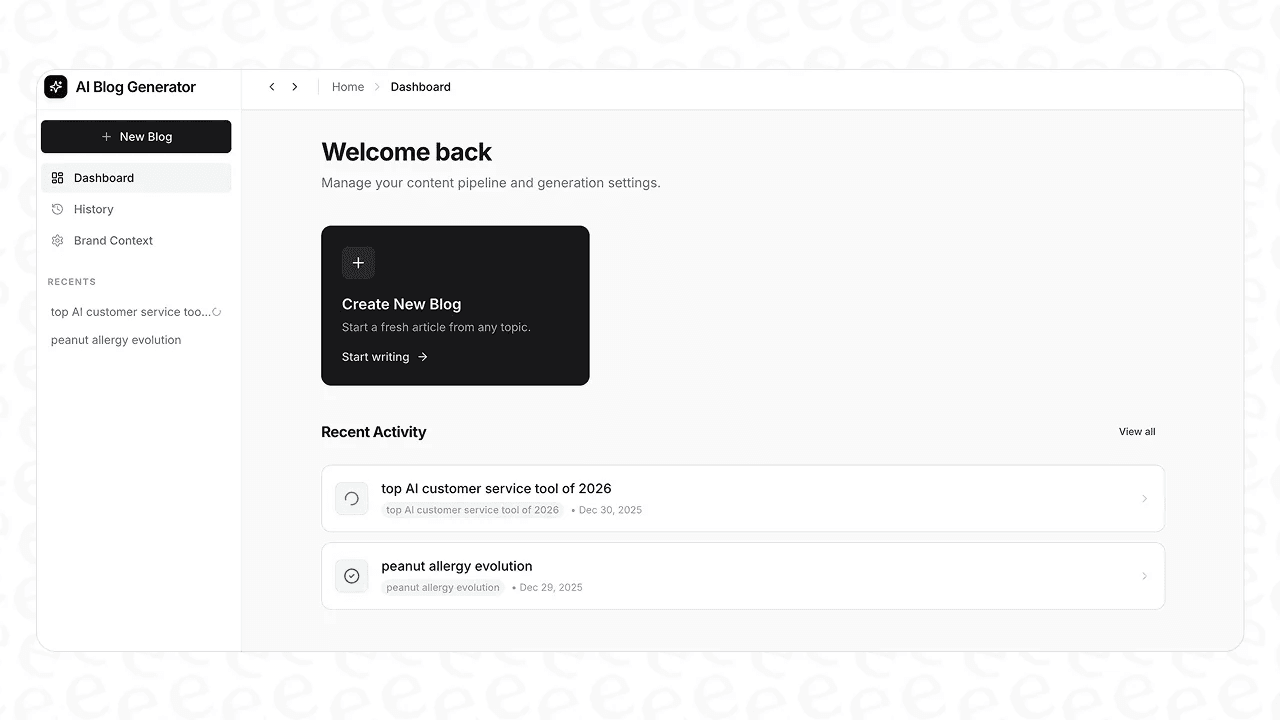
This is exactly why we built the eesel AI blog writer. It’s a tool designed to handle the heavy lifting of GEO, so you can focus on strategy instead of getting bogged down in the details.
It takes the core principles we just talked about and builds them directly into the content generation process:
- AEO (Answer Engine Optimization): The tool automatically creates content with the "answer-first" format and clean semantic structure that AI engines need. It organizes information into logical chunks, making it easy for crawlers to parse and pull into their answers.
- Deep research with citations: Instead of you spending hours digging for data, it automatically finds and integrates relevant statistics and facts from credible sources, boosting your content's fact-density and authority right out of the box.
- Automatic asset generation: Remember how important tables and lists are for structure? The eesel AI blog writer creates them for you, along with other visuals like infographics and charts. This makes your content more digestible for both people and AI.
- Authentic social proof: To capture that layer of human experience that engines like Perplexity love, the tool can pull in real, relevant quotes and insights from Reddit. This adds a level of authenticity that's hard to replicate manually.
Essentially, you give it a topic, and it gives you back a publish-ready, GEO-optimized article that’s built to earn citations.
Measuring GEO success
You've started creating GEO-optimized content. How do you know if it's working? Your old dashboards for keyword rankings and organic traffic won't tell the whole story. Success in GEO requires a new set of KPIs focused on visibility inside AI answers.
Here are a few ways to track your performance:
- Citation Tracking: This is a bit manual, but it's the most direct method. Regularly go to Google's AI Mode, ChatGPT, and Perplexity and enter prompts related to your core topics. See if your brand or website shows up as a cited source. Keep a log to track your progress over time.
- AI Bot Traffic Analysis: Your server logs are a goldmine of information. By monitoring traffic from known AI user agents, you can see how often these engines are visiting your site. According to research from SEO experts, these are some of the key agents to look for:
- "OAI-SearchBot" (OpenAI search indexing)
- "ChatGPT-User" (User-initiated fetches from ChatGPT)
- "ClaudeBot" (Anthropic's crawler)
- "PerplexityBot" (Perplexity's indexing crawler)
- Brand Mentions: Use brand monitoring tools (like Brand24 or Mention) to track mentions of your brand across the web. While this won't specifically tell you if the mention came from an AI answer, a rise in unlinked mentions can be an indicator that your content is being surfaced more frequently in synthesized responses.
For a deeper dive into the practical steps of implementing these strategies, this video offers a comprehensive walkthrough on how to get started with Generative Engine Optimization.
Generative engine optimization isn't just a buzzword; it's the next logical step in how we approach SEO. The game has changed from chasing clicks to earning trust. Winning in this new era of search means creating high-quality, deeply researched, and perfectly structured content that AI engines see as a credible source of truth.
It all comes down to focusing on E-E-A-T, building a clean semantic structure, and prioritizing fact-density in everything you publish. It's a higher bar for content quality, but the payoff is visibility where it matters most: right inside the answer.
Ready to see what GEO-optimized content looks like? Generate your first blog post for free and start earning citations in AI search.

Frequently Asked Questions
Share this article

Article by
Stevia Putri
Stevia Putri is a marketing generalist at eesel AI, where she helps turn powerful AI tools into stories that resonate. She’s driven by curiosity, clarity, and the human side of technology.