B2B content has a trust problem, and generic AI makes it worse
Here is the thing about B2B buyers: they are experts, they are skeptical, and they have read a hundred posts exactly like the one you're about to publish. They are not looking to be impressed by prose. They are looking for a reason to believe you actually know their problem.
That is a higher bar than most content clears, and it is exactly the bar generic AI fails at. When you ask a model to "write a blog post about reducing support costs," it writes from the average of everything it has ever seen, which is the average of everything every competitor has already published. The output is smooth, grammatical, and says nothing a buyer couldn't get from ten other tabs. It is the textbook generic AI tone, and a B2B reader spots it in one paragraph.
I have watched this play out on our own blog. AI does a huge amount of the drafting on posts like our GENERAL BYTES write-up and the Yellowdig case study, and it does it well. But the first time I let a draft lean on the open web instead of our own material, it read like a press release for a company that didn't exist. The difference was never the model. It was what I put in. That is the whole game with an AI B2B content writer, and most of this post is about getting that input right.
What an AI B2B content writer actually does (and what it can't)
Let me set the ceiling before the floor, because the marketing around these tools oversells the magic and undersells the work.
An AI B2B content writer is very good at the mechanical parts of writing. It turns a messy brief into a clean structure. It holds a consistent brand voice once you show it a few examples. It drafts fast, and it turns one finished asset into five formats without complaint. That last point is the one people underrate, and I'll come back to it.
What it does not do is supply the truth. It cannot know your customer cut onboarding time by 60% unless you tell it. It cannot quote a buyer accurately unless you paste the quote in. And if you ask it to fill those gaps anyway, it will, with confident, plausible, completely invented numbers. In B2B, that is not a small risk. A made-up stat in a white paper is the kind of thing a prospect's procurement team catches, and it torpedoes the credibility of every real claim around it.
So the honest division of labour looks like this.
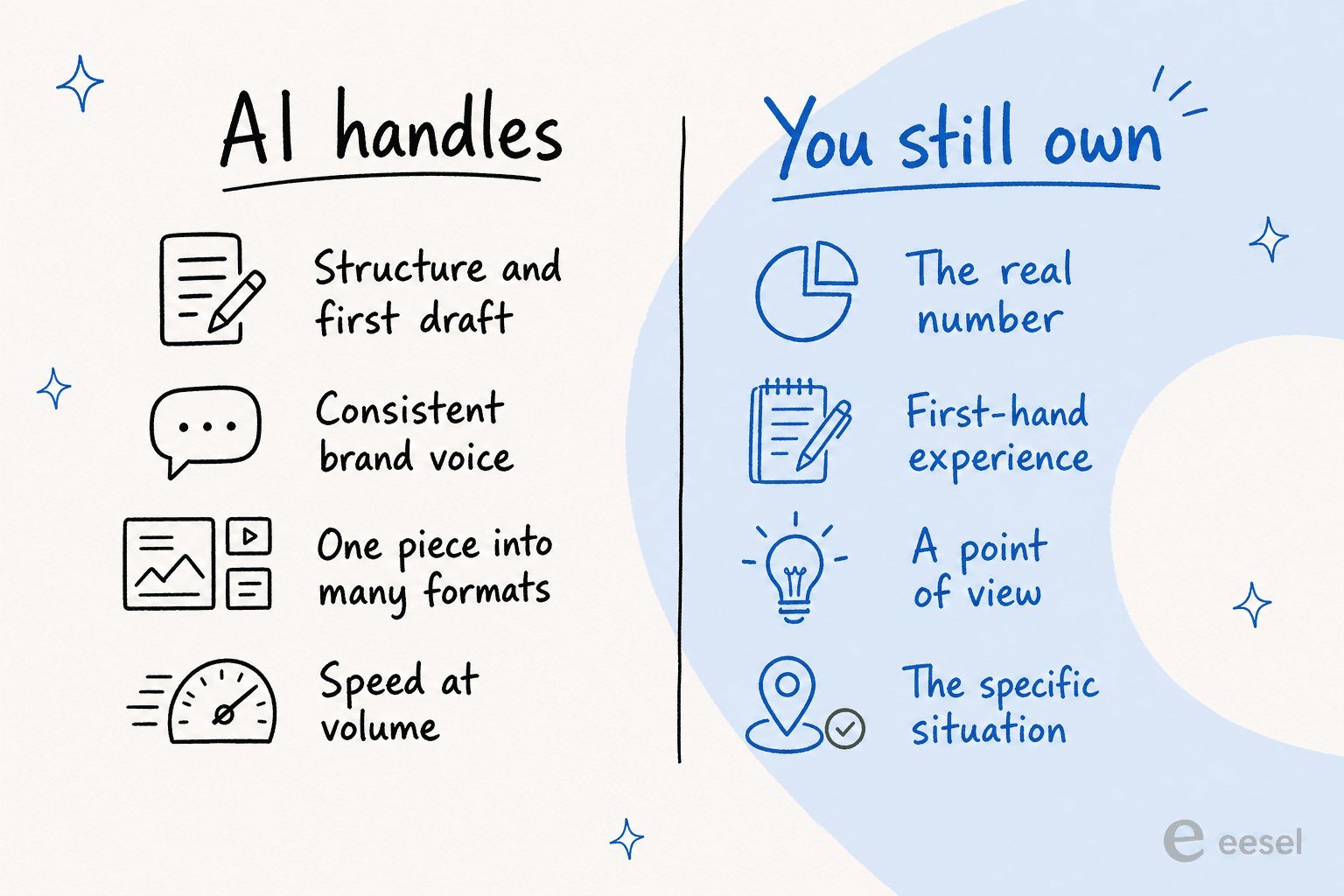
Keep that split in your head and the tool becomes a force multiplier. Forget it, and you're just generating filler faster. It is the same logic behind creating E-E-A-T content with AI: the parts that prove a real operator wrote this are precisely the parts you can't delegate.
The one variable that decides B2B output: grounding
If I could only tell you one thing about picking an AI B2B content writer, it would be this. The single biggest predictor of output quality is where the tool gets its information.
There are really two kinds of AI writing. One writes from the open web, the generic average I described above. The other writes from your own sources: your past posts, your product docs, your real customer data. The first gives you content that could be about any company. The second gives you content only your company could have written, which is the entire point of B2B content in the first place.
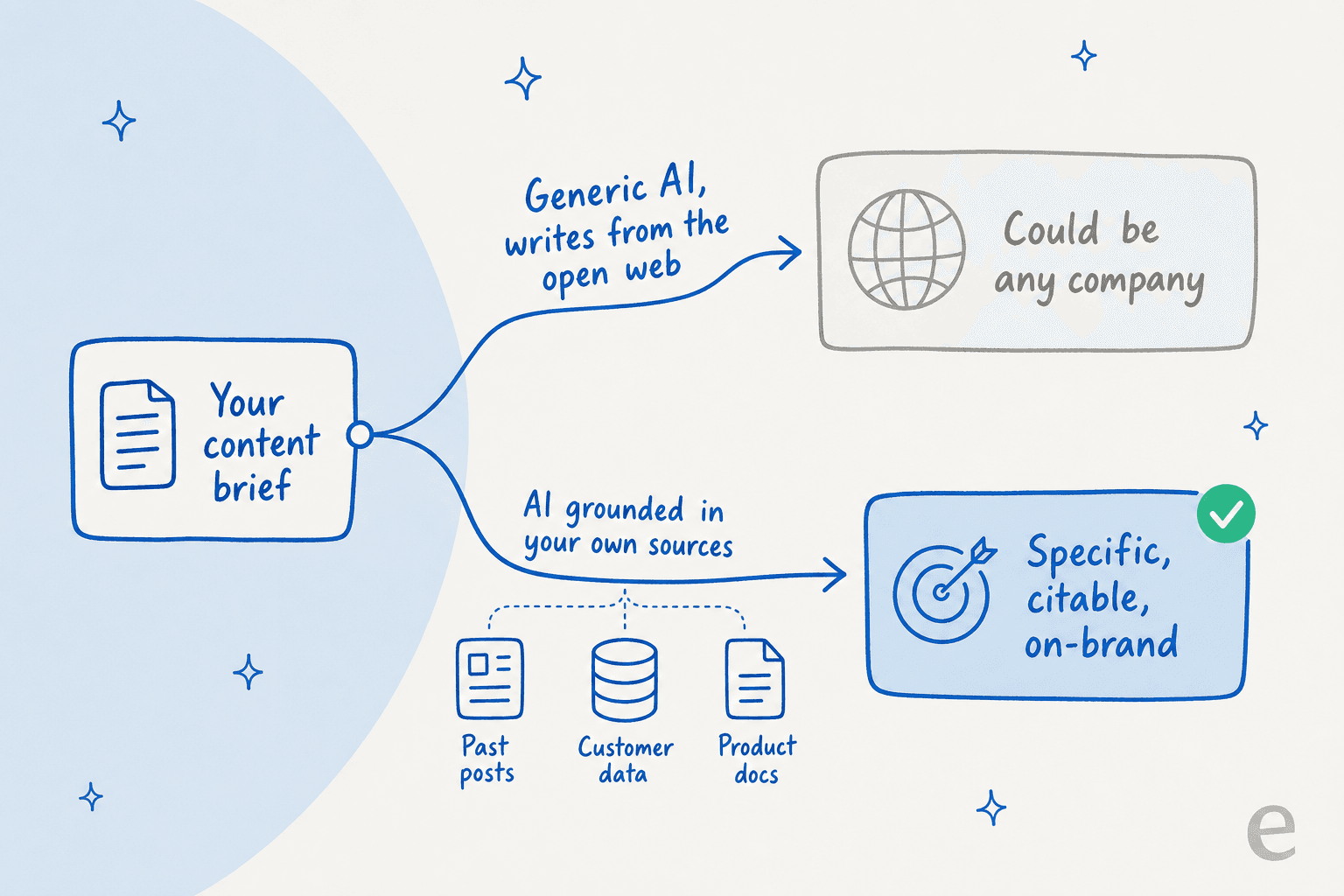
This is why I'm skeptical of any AI writer that doesn't connect to your knowledge base. A blank general model is starting every draft from zero, with no memory of your product, your voice, or your last fifty posts. A grounded writer starts with a head start a generic tool structurally cannot match. When you compare the best AI content writers, grounding is the column I'd weight above almost everything else.
The formats it's good at (and how good)
"B2B content" is a wide net, so it helps to be specific about which formats an AI writer actually handles well. The pattern is simple: the more predictable a format's structure, the better AI does with it, as long as you bring the proof.
| Format | What AI nails | What you have to supply |
|---|---|---|
| Blog posts and SEO articles | Structure, SEO formatting, internal links, FAQs, first draft | The angle, a real point of view, any hard numbers |
| Case studies | The challenge, solution, result arc; brand voice | The metric, the verbatim quote, the customer's situation |
| White papers | Outline, section drafting, executive summary | The original data, the argument, the citations |
| Landing-page and product copy | Variants, structure, tightening | Positioning, the differentiator, what's actually true |
| Email sequences and nurtures | Drafting at volume, tone consistency | The offer, the segmentation, the real use case |
The through-line: AI handles the shape, you handle the substance. A professional blog post and a white paper are both shapes AI fills competently. Where teams go wrong is treating the proof as optional, then wondering why the output reads like everyone else's.
How I'd actually run an AI B2B content writer
The mistake most people make is treating this as one prompt. It isn't. It's a content pipeline, and the order matters more than the model.
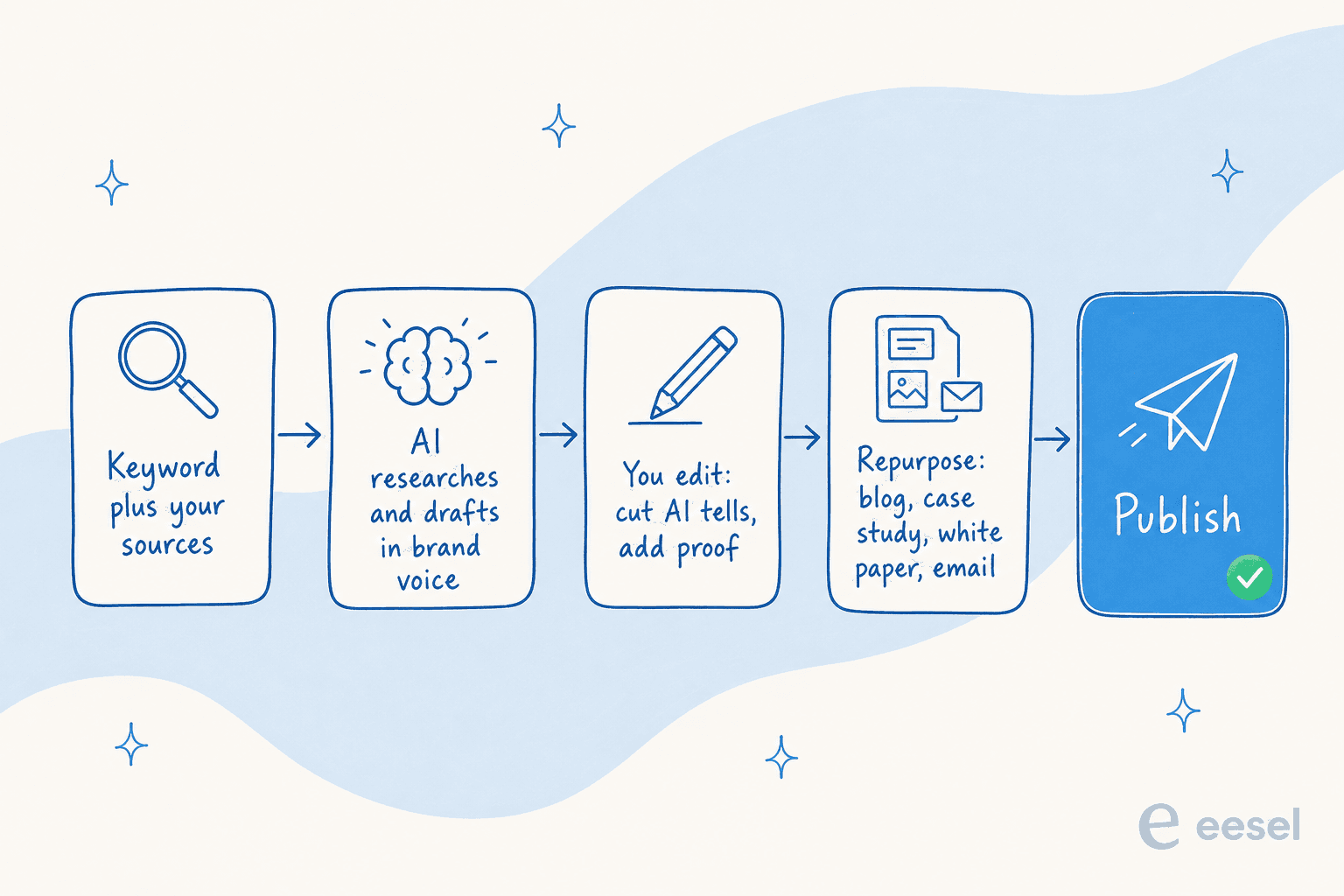
1. Gather the raw material first. Before you open any tool, pull the real inputs: the metric, two or three direct quotes, the source docs, the keyword. I keep this in a short content brief so the AI gets everything at once. Skip this and no tool will save you.
2. Brief the AI with the argument, not just the topic. Don't say "write about ticket deflection." Give it the claim you're making, the proof you're using, and the reader you're writing for. A sharp brief is the single biggest lever on quality, the same way it separates a strong draft from a generic one.
3. Generate, then edit hard for voice. The first draft gets you 80% there. The last 20% is where you cut the AI tells, the "in today's fast-paced world" openers and the rule-of-three filler, and pull your real phrasing back to the surface. This editing pass is the job, not an afterthought, and an AI writing detector is a fine gut check before you ship.
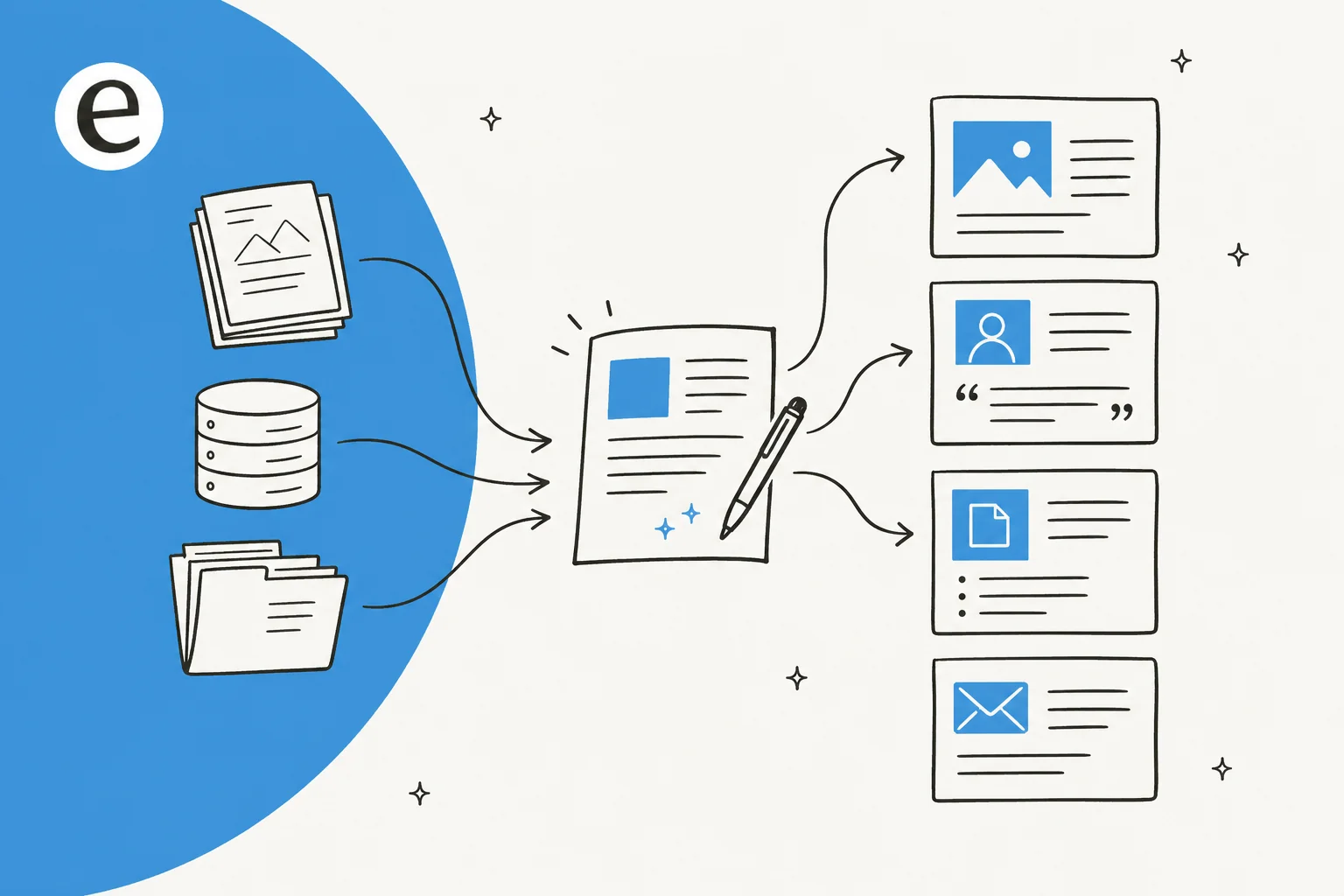
4. Repurpose one asset into many. This is where AI quietly pays for itself. One approved case study becomes a blog post, a white paper section, a sales one-pager, a nurture email, and a set of social posts, all in the same voice, in the time it used to take to format one. If you want to see how far this scales, I've written before about how I built a near-automated blog using AI. The principle is identical: do the hard thinking once, let AI handle the formats.
To put a real number on it: one SEO content lead I know of, running on Webflow CMS, pushes 360+ posts a month, roughly a dozen a day, off a keyword-to-publish pipeline with bulk review and publish. That's not a prompt. That's a machine, and it's the kind of throughput a grounded AI B2B content writer makes possible once the workflow is dialled in.
What it costs, and the build-versus-buy question
Pricing splits along the same line as everything else. General chatbots like ChatGPT or Claude are free to cheap and flexible, but they have no brand memory between sessions and no connection to your data. Dedicated AI copywriting tools run roughly $20 to $99 a month per seat and add templates and brand-voice settings, but most are still disconnected from your real material. Data-grounded writers cost more per unit of work but draft from your own sources, which is the column that matters for B2B.
eesel sits in that last column and prices by usage rather than per seat: a blog-post draft is billed as a heavier task, there's a free trial with two free blog generations, and there are no per-seat fees, so a small team isn't paying for ten logins to use one writer. For a steady content channel, that maths usually beats stacking seats on a per-seat tool, and I'd weigh it against production speed at volume before committing.
The other question I get is "why not just build our own on the OpenAI or Claude API?" It's a fair instinct, and sometimes it's right. But here's a customer who walked exactly that path and chose not to:
"We could try to write our own LLM application but we didn't want to invest our time into that. We wanted something that we would not have to maintain."
Karel, GENERAL BYTES, eesel case study
That's the honest trade-off. A homegrown writer is never "done", it's a thing you maintain forever, and the time you spend on plumbing is time you're not spending on content. For most teams, buying a tool that already handles research, brand voice, images, and CMS integration is the better use of a quarter.
Common mistakes to avoid
The failure modes are predictable, so they're easy to dodge once you've named them.
- Letting AI invent the numbers. If you didn't supply a figure, the AI shouldn't be stating one. Check every stat against the source before it ships, this matters double in B2B, where a wrong number is a credibility event.
- Writing from the open web instead of your data. Generic input, generic output. Ground the draft in your own sources or accept that it'll read like everyone else's.
- Shipping the first draft. The unedited draft is where the AI tells live. The human pass is what makes it sound like you.
- Treating it as one prompt. The value is the pipeline, brief, draft, edit, repurpose, not a single clever instruction.
- Forgetting the buyer is an expert. B2B readers can tell when you don't actually know their problem. First-hand specificity is the only thing that survives that scrutiny, the same reason a survey of the best tools for blog writing always rewards the ones grounded in real use.
Try eesel for B2B content at scale
I work at eesel, so take this with that grain of salt, but it's also why I can be specific. eesel started as an AI helpdesk agent that learns from a company's own tickets and docs, and that same "learn from your real material" engine powers its content writer. For B2B content, that's the whole point: it drafts from sources you connect, not from the generic web.
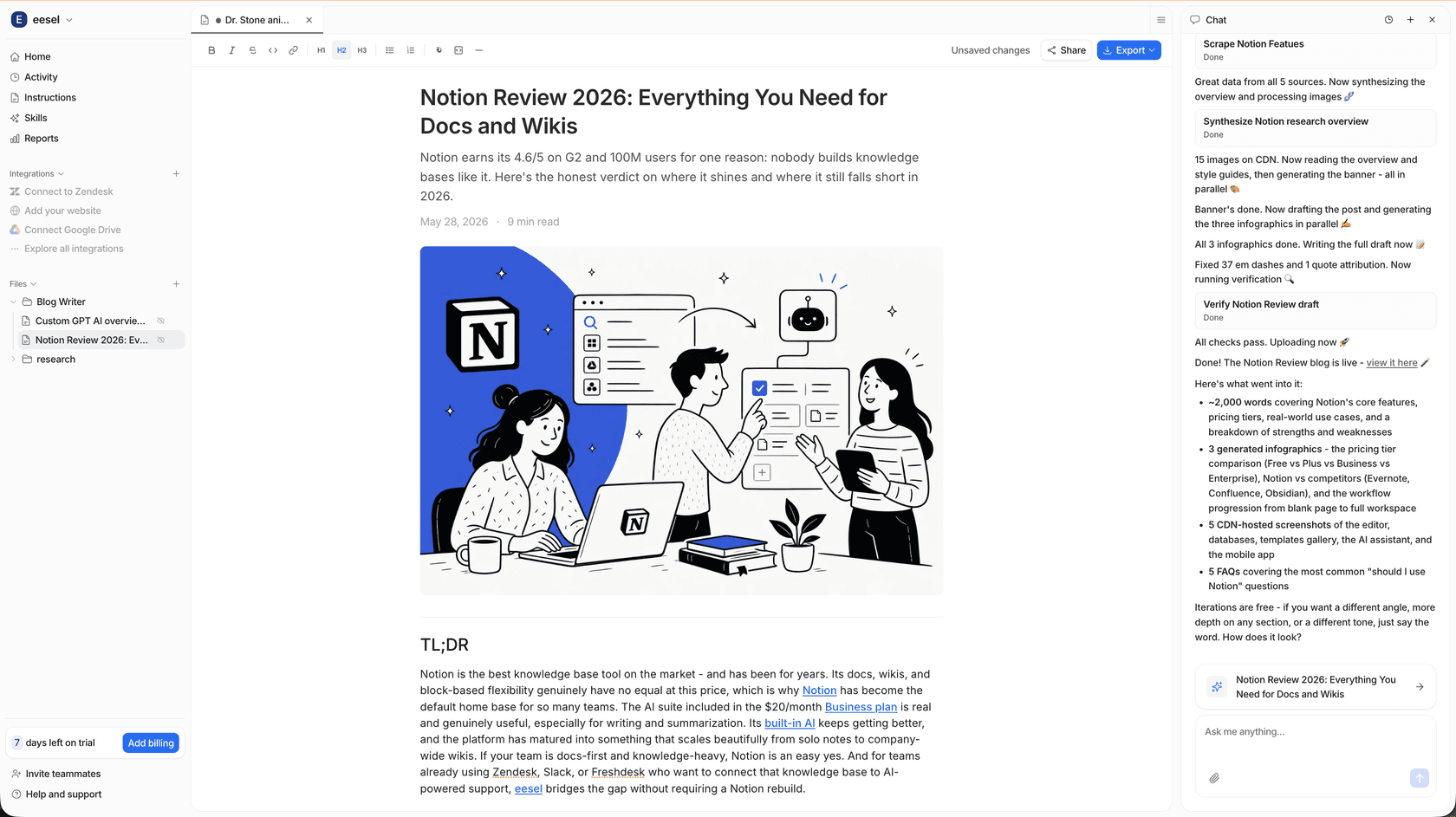
The differentiator is the keyword-to-publish workflow: give it a topic and your material, and it produces a fully formatted draft with images, internal links, and FAQs, ready to repurpose into the formats above. It runs on usage-based pricing with no per-seat fees and a free trial, so you can draft a post or two before deciding. It's also the column I'd pick for any team treating content as a real channel rather than a chore, the same case I make in my roundup of AI tools for content marketing. Start from the eesel homepage or go straight to the content writer.
Frequently Asked Questions
What is an AI B2B content writer?
Can AI write B2B content that actually converts?
How much does an AI B2B content writer cost?
What types of B2B content can AI write?
How do I stop my AI B2B content from sounding generic?
Should I use a general AI like ChatGPT or a dedicated B2B content writer?
Can one AI B2B content writer handle blog posts, case studies, and white papers?


Article by
Riellvriany Indriawan
Riell is a designer and writer at eesel AI with about two years of experience researching CX platforms, AI chatbots, and helpdesk software. She combines her design background with a sharp eye for how these tools actually look and feel in practice — making her comparisons unusually visual and user-focused.