
The Writer AI content detector is being shut down on December 22, 2026. If that was your go-to tool for checking content, you are probably now on the hunt for a replacement. It's a challenge for anyone, from content teams to teachers, who needs to know if they're looking at human or AI writing.
AI detectors are not always perfectly reliable and have the potential to flag human-written text as AI, which can create false positives. Because of this, some users prefer to focus on creating content that sounds human from the start. Tools like the eesel AI blog writer are designed for this purpose, helping you generate blog posts that are ready to publish and sound like a person wrote them.
false positives are the biggest issue with all these toolsI use gptzero because at least it shows sentence level breakdowns so i can explain to students why something got flagged but I've had legitimate work get flagged constantly, especially from ESL students or anyone writing formally. Any tool claiming 'highly accurate' is overselling to me. They all work on probability and formal academic writing trips them because that's how ai structures things too.

In this article, we’ll break down the best alternatives to the Writer AI content detector. We'll look at their accuracy, features, and pricing to help you find the right tool, whether you want to detect AI text or create content that is less likely to be flagged.
What is a Writer AI content detector?
Simply put, a Writer AI content detector scans text and guesses the probability that it was written by an AI like ChatGPT, Gemini, or Claude.
How does it do that? These tools are trained to spot the signs of AI writing. For instance, AI text often has low "perplexity," which is a technical way of saying it's predictable. The words and sentences can be uniform. Human writing is typically more varied, with a mix of long, complex sentences and short, direct ones, a quality known as "burstiness."
However, it's important to note that no detector is 100% accurate. They all make mistakes, especially with text from non-native English speakers or content that follows a rigid template. It's better to treat their results as a strong suggestion, not a final verdict.
Our criteria for choosing the best Writer AI content detector tools
To make sure we were recommending tools that are actually useful, we judged them on a few key things. We want to be upfront about how we picked them so you know you can trust our list.
- Accuracy & Reliability: This is the big one. How good is the tool at telling human and AI text apart? We looked at their claimed accuracy rates and, where possible, checked if those claims were backed by independent third-party studies. A low false positive rate is a must.
- Features: Does the tool just give you a score, or does it do more? We looked for useful extras like sentence highlighting (so you can see which parts were flagged), plagiarism checking, and handy browser extensions or integrations.
- User Experience: Is it a pain to use? We favored tools with clean, simple interfaces and a generous character limit for free checks. Nobody wants to jump through hoops just to scan a paragraph.
- Pricing: Does it have a free version? Are the paid plans reasonably priced for what you get? We looked for tools that offer good value, whether you're a student on a budget or a business with deeper pockets.
Comparison of the top Writer AI content detector alternatives in 2026
Here’s a quick look at how the top players stack up against each other.
| Tool | Key Differentiator | Accuracy (Claimed) | Starting Price (Paid Plan) | Best For |
|---|---|---|---|---|
| eesel AI blog writer | Proactive content generation | N/A (Creates human-like content) | $99 for 50 blogs | Scaling high-quality blog content |
| Copyleaks | Enterprise features & LMS integration | Over 99% | $13.99/mo (annual) | Educational institutions & businesses |
| GPTZero | Writing process verification | 99% | $9.99/mo (annual) | Educators and students |
| Grammarly | Integrated writing assistant suite | Not specified | $12/mo (annual) | Individuals and professionals |
| ZeroGPT | Simple, multi-tool platform | ~98% | Not specified | Users needing a suite of free AI tools |
The 5 best alternatives to the Writer AI content detector
With Writer’s tool heading for the exit, it's time to find a replacement. We'll start with a different approach to the problem before diving into traditional detection tools.
1. eesel AI blog writer
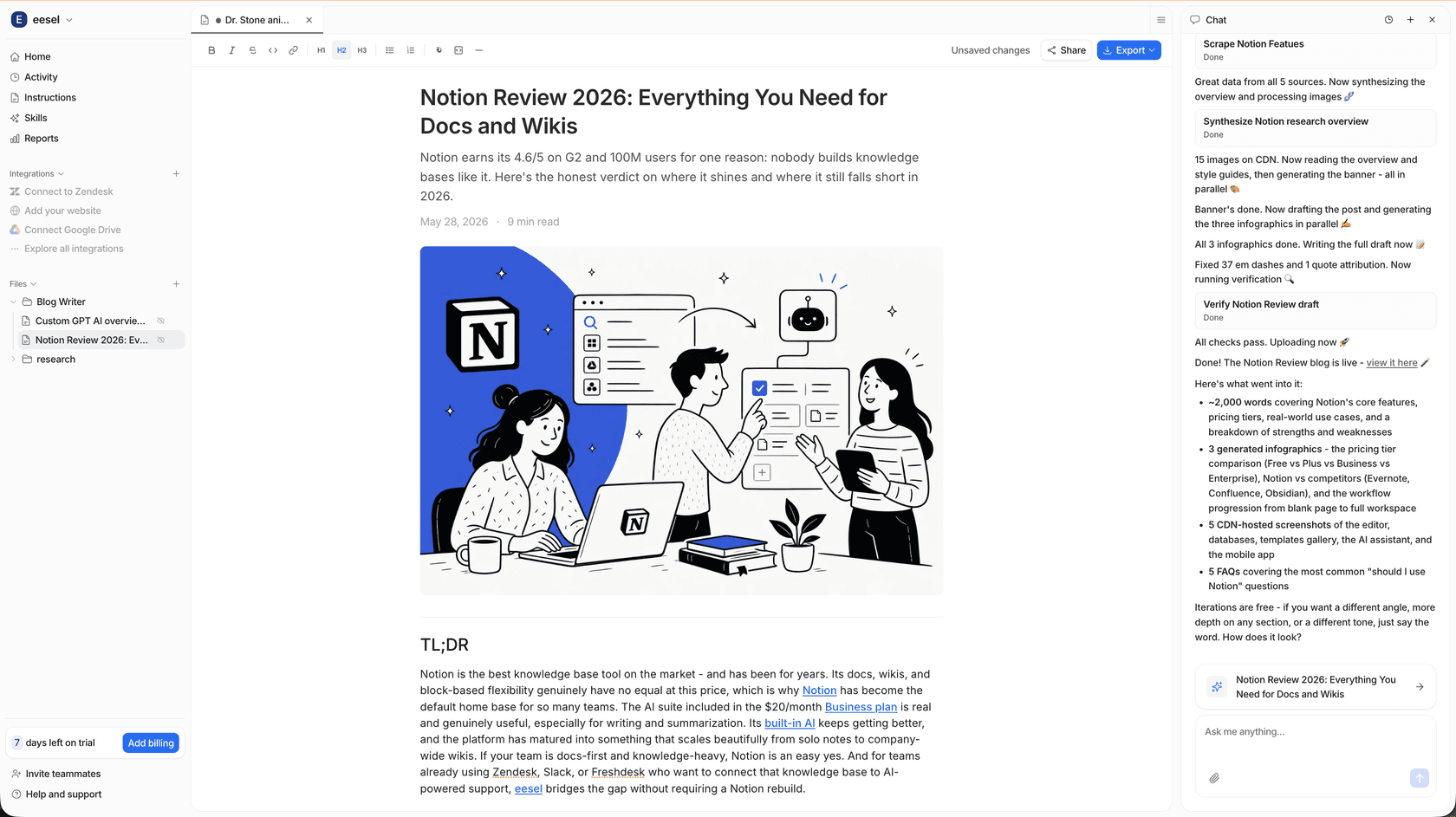
An alternative approach to AI content detection is to focus on proactive content creation, ensuring the output is high-quality from the beginning. The eesel AI blog writer is designed for this proactive approach, aiming to generate high-quality, engaging, and SEO-optimized content that reads like it was written by a human.
We know it works because it's the exact tool we used to grow our own organic traffic. We went from a modest 700 to 750,000 daily impressions in just three months, all by publishing content generated with eesel.
- Pros: You get a publish-ready article from a single keyword, not a draft that needs significant editing. The content is context-aware and automatically includes assets like AI-generated images, tables, and even relevant Reddit quotes and YouTube videos. This adds a layer of authenticity to the content. It is also optimized for AEO (AI Engine Optimization), so it’s built to perform well in Google's AI Overviews.
- Cons: It is a content generation platform, not a detection tool. If your role requires checking content written by others, you will still need one of the other tools on this list.
- Pricing:
- It's free to try, so you can generate your first blog post and see the quality for yourself.
- Paid plans start at $99 for 50 blog credits.
- Why it's on the list: It addresses the root cause for needing AI detectors: the challenge of producing high-quality content at scale. It’s an alternative that aims to make detection less of a concern for your own content workflow.
2. Copyleaks
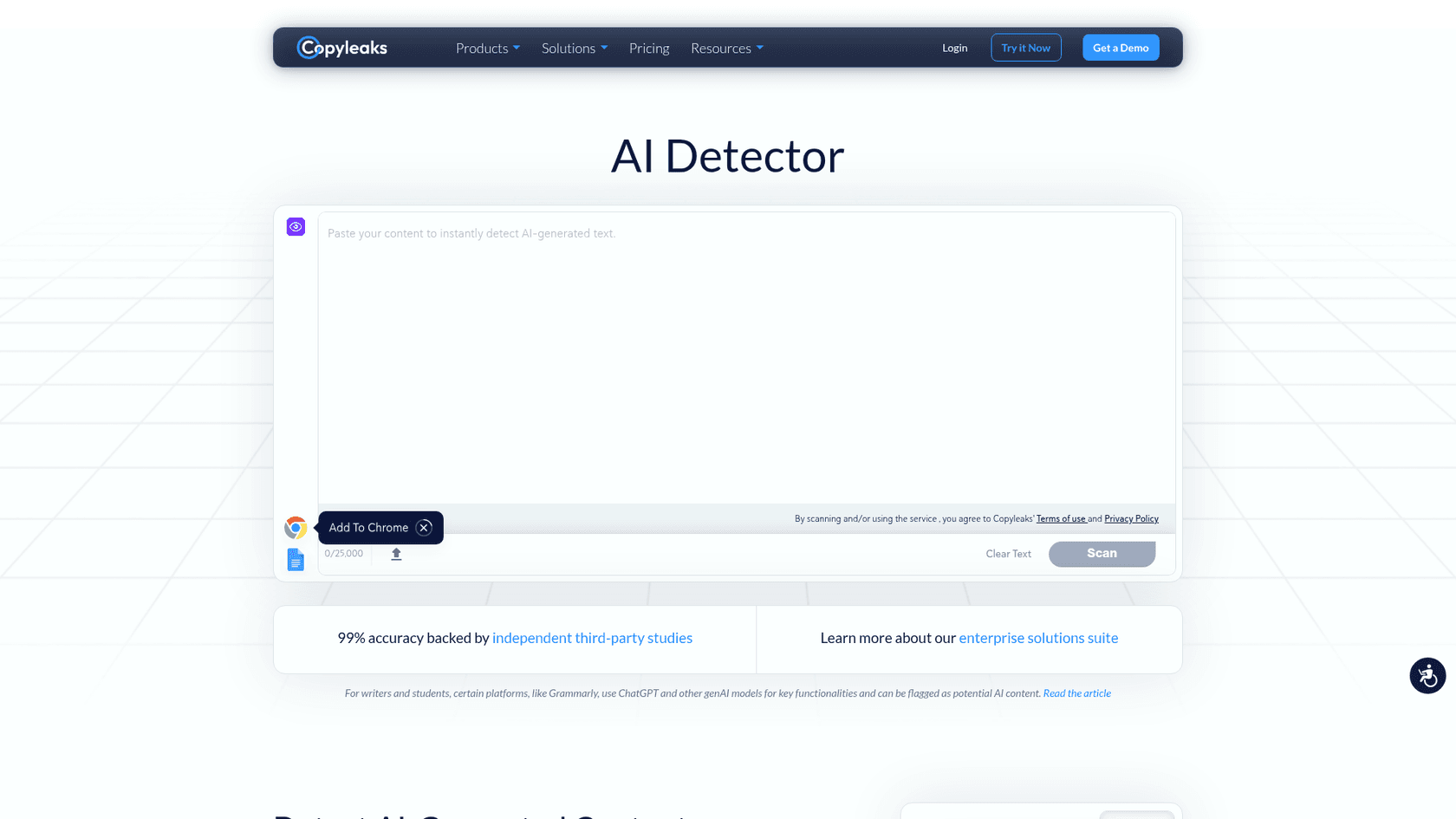
Copyleaks is a prominent tool in the AI detection space, designed for enterprise and academic use. It is known for its high accuracy and a full suite of features. It can spot content from major LLMs like ChatGPT, Gemini, and Claude in over 30 languages. It can also detect AI-generated source code and has an AI Image Detector.
- Pros: Copyleaks claims a 99% accuracy rate and a false positive rate of 0.2%, which is important for professional environments. Its integrations with Learning Management Systems (LMS) like Canvas and Moodle make it a popular choice for schools and universities. The free scan limit of 25,000 characters is also generous. Additionally, it's SOC 2, SOC 3, and GDPR compliant, which is beneficial for businesses concerned with data security.
- Cons: While the free version is useful for quick checks, the full feature set is behind a paywall. This includes the "AI Logic" feature, which explains why a piece of text was flagged. Enterprise pricing requires contacting their sales team.
- Pricing:
- Free scans for up to 25,000 characters.
- The Personal plan starts at $13.99/month (billed annually) for 25,000 words.
- Why it's on the list: Its high, third-party verified accuracy and focus on education and business make it a powerful and trustworthy replacement for Writer's detector.
3. GPTZero
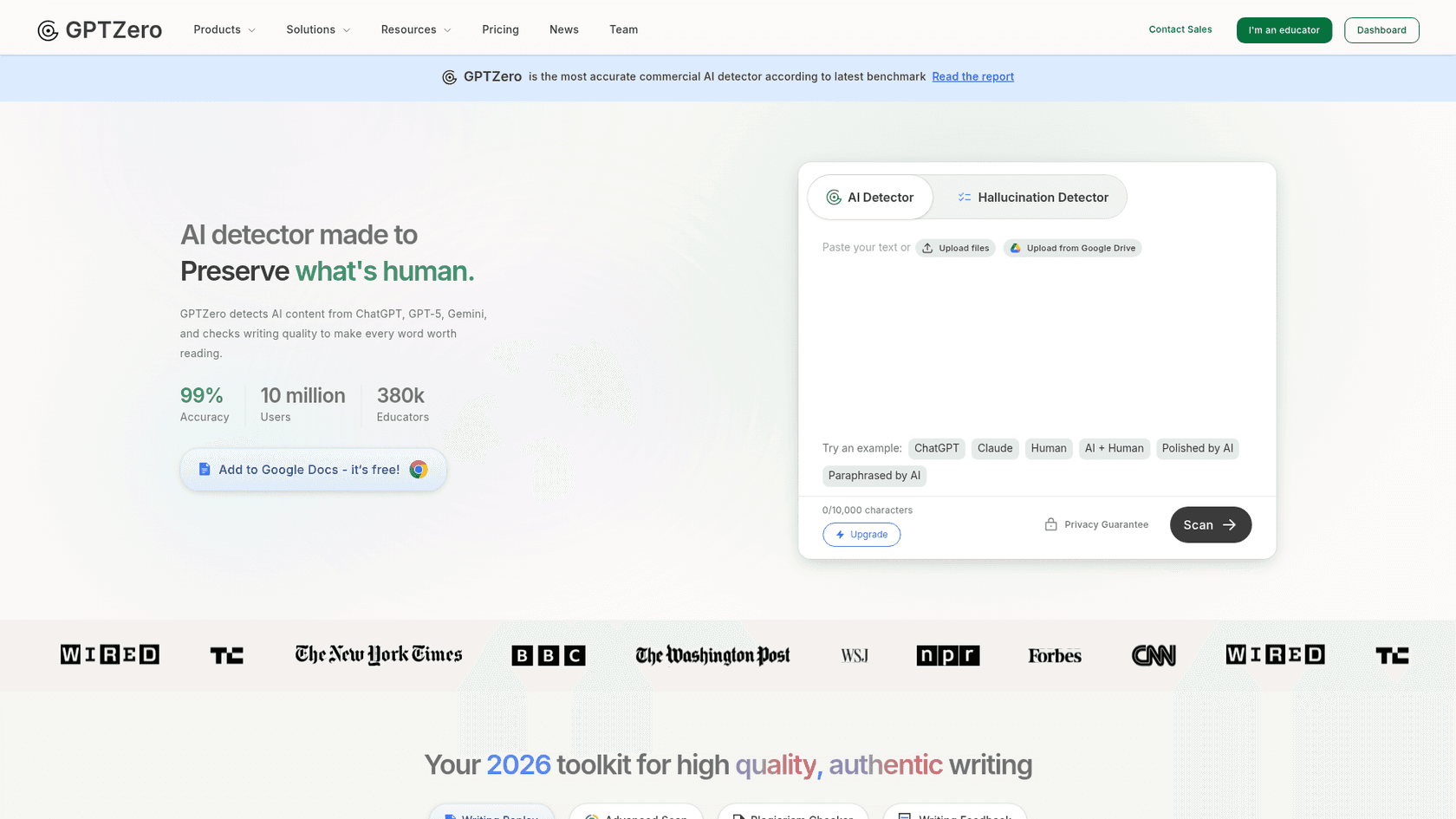
GPTZero was one of the first AI detectors to gain widespread attention, and it built a strong reputation in the academic world. It claims a 99% accuracy rate on AI-generated text and is great at detecting models like ChatGPT, GPT-4, and Gemini. It also has some unique features, like "Writing Replay" in Google Docs, which creates a video of the writing process to prove a human did the work.
- Pros: With over 10 million users, it's a tool that a lot of people trust. The sentence-level highlighting is super helpful for seeing exactly which parts of a text are setting off alarm bells. A big plus is its focus on reducing false positives for ESL (English as a Second Language) writers to just 1%, which helps avoid unfair accusations.
- Cons: The free plan has a 10,000-word monthly limit. Some of its most powerful features, like the advanced deep scans and built-in plagiarism checker, are only available for premium subscribers.
- Pricing:
- Free Plan: 10,000 words per month.
- Premium Plan: Starts at $9.99/month (billed annually) for 300,000 words and plagiarism scanning.
- Why it's on the list: GPTZero is a credible and widely-used tool that’s perfect for academic settings or individual writers who need reliable detection with some pretty innovative verification features.
4. Grammarly
You probably already know Grammarly as the go-to for fixing typos and grammar mistakes. They’ve also added an AI detector to their toolkit. It checks for text from ChatGPT, Gemini, and other popular models and gives you a simple percentage score of how much of your content looks like it was written by AI.
- Pros: The biggest win here is convenience. If you’re one of the millions of people already using Grammarly, having an AI detector built right into your workflow is incredibly seamless. It’s part of a trusted ecosystem that also includes a plagiarism checker and citation tools.
- Cons: Grammarly does not publish a specific accuracy percentage, which makes it difficult to compare with other specialized tools. The AI detection feature is only available for Pro and Enterprise subscribers, so you can't use it on the free plan.
- Pricing:
- The free version has limited features and no AI detection.
- Pro Plan: Starts at $12/month when billed annually.
- Why it's on the list: For anyone already paying for Grammarly Pro, it's the most convenient and integrated option out there. You don't have to go anywhere else to get a quick check done.
5. ZeroGPT
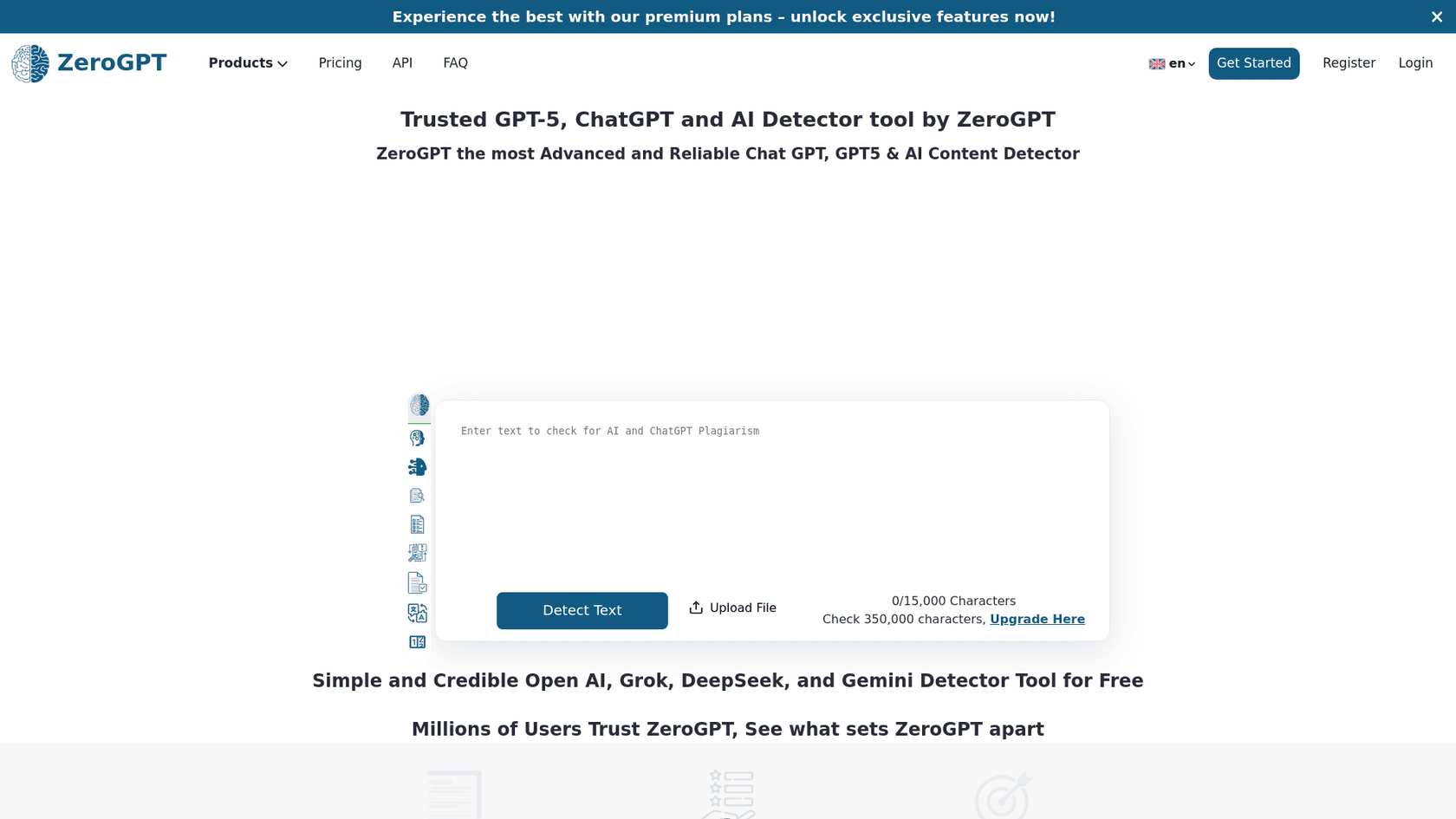
ZeroGPT is a popular free AI detection tool that keeps things simple. You paste your text into a box, and it gives you a quick result telling you if it thinks the content is AI-generated or human-written. It also offers a few other freebies like a grammar checker and a text summarizer.
- Pros: It's completely free and simple to use. This makes it great for quick, informal checks when you don't want to create an account or sign up for a subscription. The fact that it bundles a few other text tools can be handy too.
- Cons: According to a comparison by Copyleaks, ZeroGPT provides a straightforward "AI vs. Human" score, offering fewer detailed insights compared to some other tools. Its claimed accuracy of ~98% is self-reported and has not been independently verified, which may be a consideration for more formal use cases. Pricing for its premium plans is also not listed on the site.
- Pricing:
- Free to use.
- Premium plans (Max/Expert) are available, but you have to dig to find the pricing.
- Why it's on the list: It's popular and easy, making it a common choice for a quick sanity check. It's a functional, if less robust, alternative for users who just need a basic tool.
How to choose the right Writer AI content detector for you
Not sure which one to pick? Here’s a quick guide based on who you are and what you need.
- For Educators and Students: You need high, verified accuracy and features that fit into an academic workflow. Go with Copyleaks or GPTZero. Their LMS integrations and plagiarism checkers are huge benefits.
- For Publishers and SEO Agencies: Your reputation is on the line, so accuracy and a low false positive rate are non-negotiable. A tool like Copyleaks, with its independently verified stats, is the safest bet to ensure content integrity without wrongly flagging your writers.
- For Individual Writers and Professionals: If you're already in the Grammarly ecosystem, Grammarly is the most efficient choice. But if you're creating your own content, you should seriously consider a proactive tool like the eesel AI blog writer to create original, high-quality content from the start.
Pro tip
Final Tip: Before you pull out your credit card, use the free versions of a few of these tools. Test them with your own content (some written by you, some by AI) and see which one feels the most reliable for your specific needs.
Watching a head-to-head comparison can also help you see how these tools perform in real-time. The video below tests several popular AI detectors against different AI writers, giving you a practical look at their strengths and weaknesses.
Moving beyond AI content detection to creation
With Writer's AI detector shutting down, there are many capable alternatives. Copyleaks provides enterprise-grade accuracy, while GPTZero offers innovative features for academic settings.
While these detection tools are valuable for verifying content, a complementary strategy is to focus on creating genuinely valuable, human-centric content from the beginning. AI can be a partner that helps you create better content, not just a shortcut that produces text you have to second-guess.
For those focused on content creation, using an AI partner designed to produce high-quality output can be an effective approach. Generate your first publish-ready blog post for free with the eesel AI blog writer and see the difference for yourself.