
Why most AI white papers read like slop
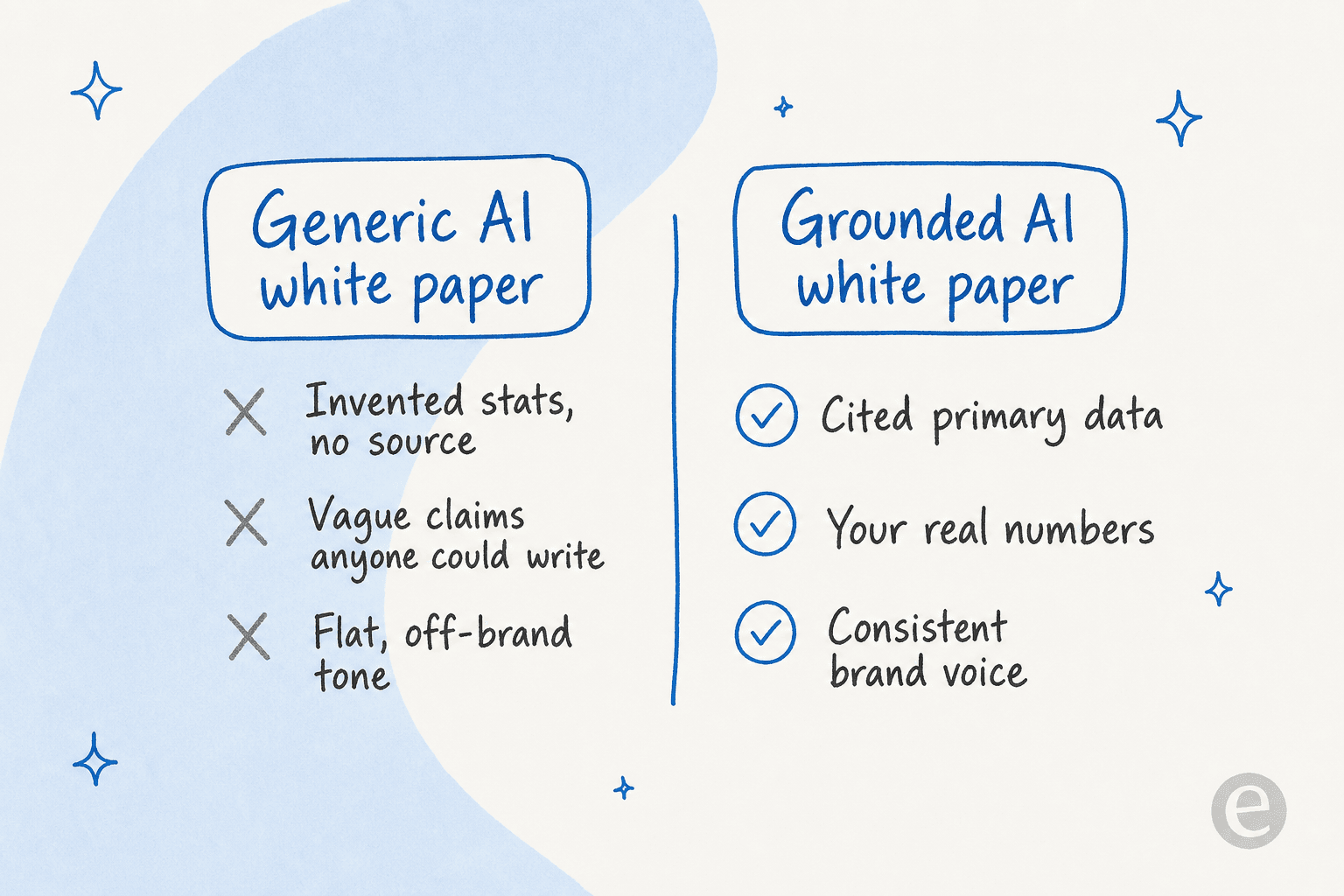
I'll be straight with you, because I've watched this from both sides. At eesel, I've spent years putting AI on live support queues, where a confident-sounding bot that quietly gives a wrong answer is the nightmare scenario. That's exactly why eesel now simulates every support rollout against historical tickets before it goes live. The same failure mode shows up in content: an AI white paper writer will state a market-size figure with total confidence and zero source behind it.
And readers can tell. A white paper is supposed to be the most credible thing your marketing team produces, a document a buyer forwards to their boss to justify a purchase. When it's stuffed with vague claims anyone could have written, it does the opposite of its job. The most common public complaint about even the best tools is exactly this. G2's own summary of Jasper reviews puts it plainly:
"Many appreciate how it helps overcome writer's block and generates ideas... However, some users note that the content can occasionally feel generic or repetitive, requiring additional editing."
You hear the same thing from people who tried to run a whole content operation on a general writer. One commenter in a r/SaaS thread on using Jasper for website content summed it up:
"I had the same experience with Jasper - quick drafts are okay, but structure and tone for blogs often felt off. I switched to manually editing..."
Quick drafts are okay. That's the ceiling for a tool that only knows what's on the public web. A white paper needs to clear a much higher bar, and the difference comes down to what you feed it.
What a real AI white paper writer has to get right
Strip away the marketing and there are four things that separate a usable AI white paper writer from a fancy autocomplete. Grounding is the one that matters most.
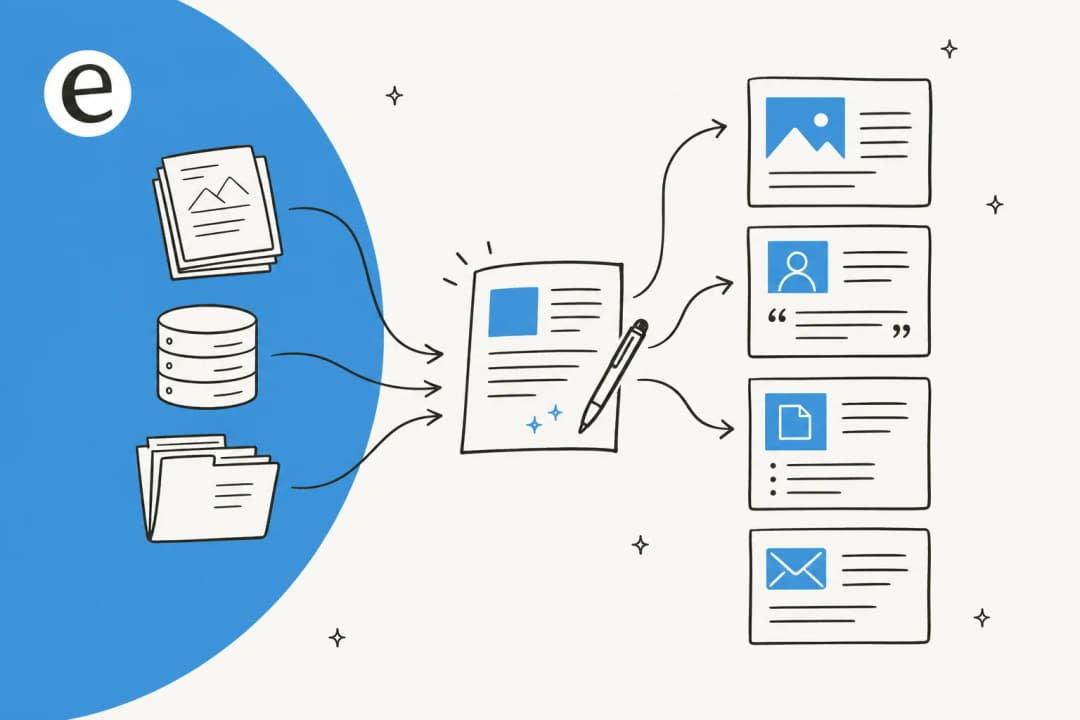
Grounding in your own sources. A white paper lives or dies on specifics: your benchmark numbers, your customer outcomes, your product's real behavior. A tool that can only draw from the open web will paraphrase your competitors back at you. The ones worth paying for connect to your actual material so they write from your knowledge base, not a generic prior.
Structure that holds. White papers follow a recognizable arc: a problem the reader feels, evidence that it's real and costly, an approach, and proof. A good tool can hold that shape across 3,000 words instead of drifting into a list of disconnected paragraphs.
Citations it doesn't make up. This is non-negotiable. The tool should attach sources to claims, and you should be able to click every one. If it can't cite, it shouldn't assert.
Your brand voice, consistently. A white paper that sounds like a press release in one section and a Reddit comment in the next reads as untrustworthy. The better tools store a voice profile so the personality stays consistent from the executive summary to the conclusion.
Miss any one of these and you're back to "quick drafts are okay." Hit all four and the AI earns its place in your pipeline.
How to write a B2B white paper with AI, step by step
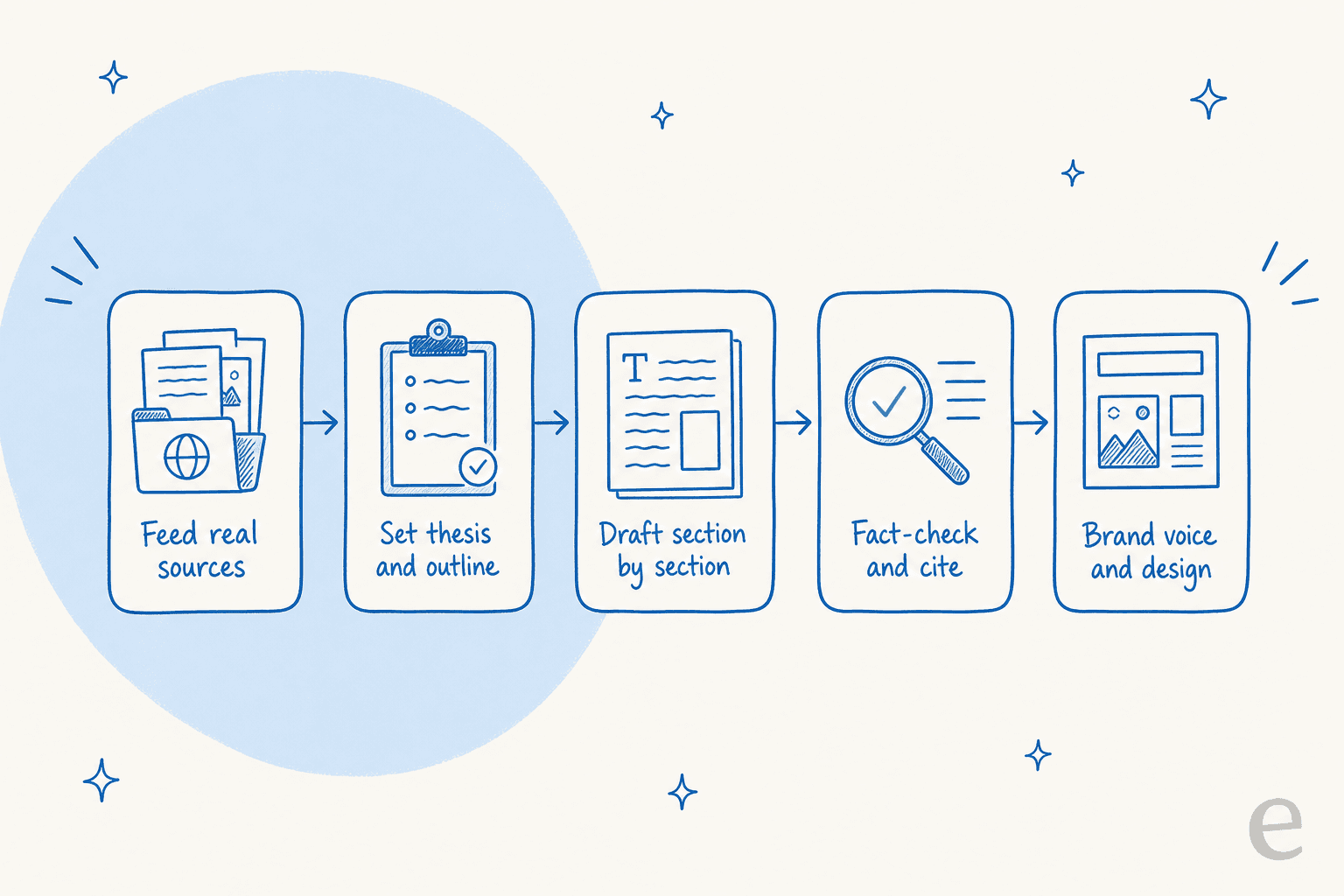
Here's the process I'd actually follow. It works with most of the tools below, and it's the same shape eesel customers use to turn a keyword into a finished, grounded draft.
-
Feed it real sources first. Before you write a prompt, gather your raw material: product docs, a customer interview transcript, your own survey data, the analyst report you're allowed to cite. Connect them to the tool or paste them in. This single step is what moves you from generic to specific, and it's the step most people skip.
-
Set the thesis and outline yourself. Don't ask the AI "write a white paper about X." Tell it the argument: "the cost of manual ticket triage is hidden in agent burnout, not headcount, and here's the data." Give it an outline with named sections. The AI is brilliant at expanding a sharp outline and useless at inventing your point of view.
-
Draft section by section. Generate the executive summary, then the problem section, then the evidence, one at a time. Reviewing 400 words against your sources is manageable; reviewing 3,000 in one shot means you'll rubber-stamp a hallucination. Working in sections is also where you catch tone drift early.
-
Fact-check every number. Go through the draft and click every citation. Any figure without a source you can verify gets cut or replaced. Treat the AI like a sharp intern who occasionally fabricates with a straight face. A quick AI-detector pass is also worth running before anything goes external.
-
Run a brand-voice and design pass. Tighten the prose so it sounds like you, then move it into your design template. Most AI content pipelines stop at text; the polish is still on you.
The thing to internalize: the AI collapses the blank-page tax from days to minutes, but the expert judgment in steps 2 and 4 is what makes it publishable.
Where AI helps and where you still have to drive
The honest division of labor matters, because the teams that get burned are the ones who expect the AI to own parts it can't. AI is excellent at synthesis and drafting; it is not a substitute for having something true to say.
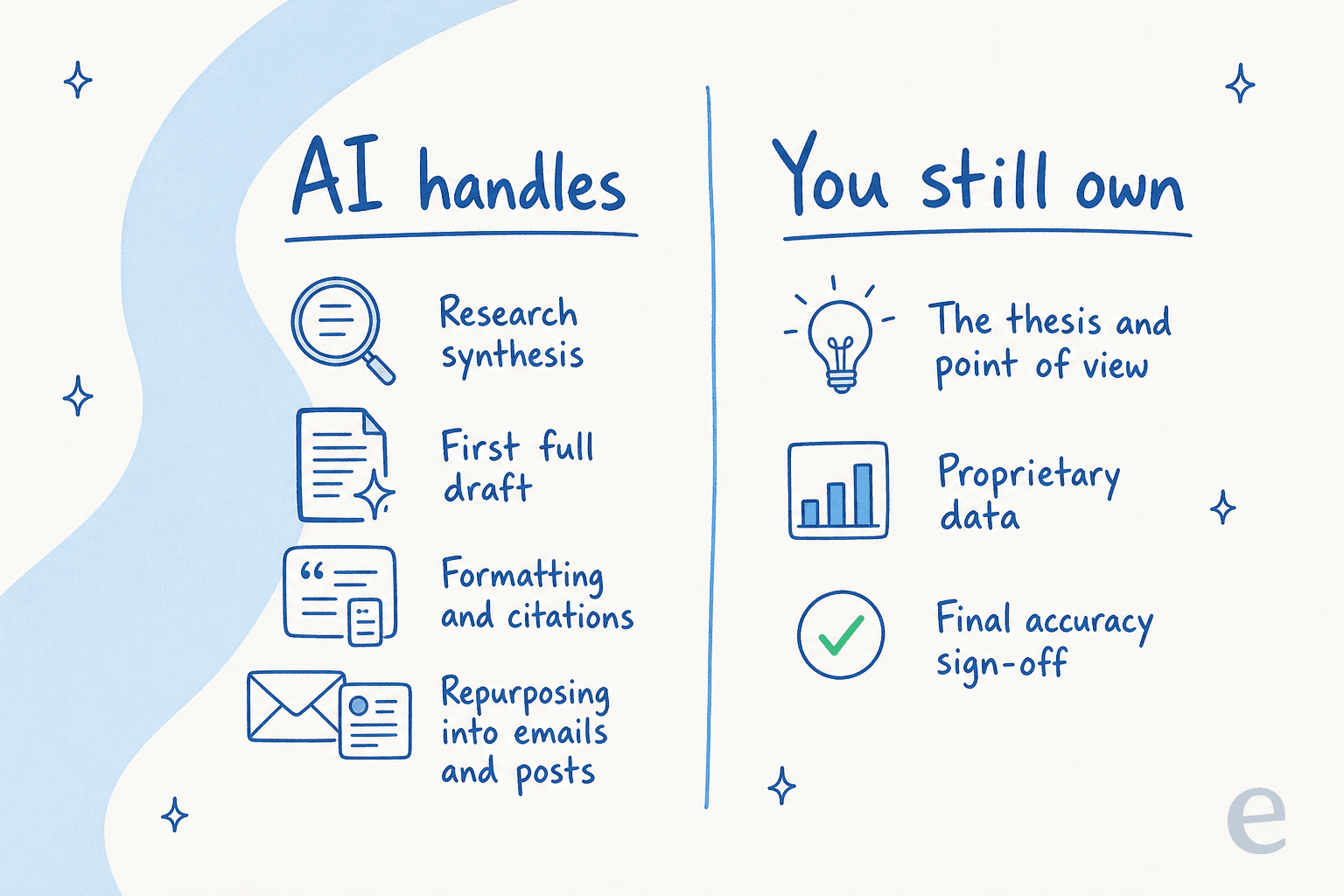
Lean on AI for the heavy mechanical lifting: pulling together what your sources say, producing a first full draft, formatting citations, and later repurposing the white paper into a launch email, a LinkedIn post, and a landing page. That repurposing alone often justifies the tool, since one white paper can feed a month of content.
But you still own the thesis, the proprietary data, and the final accuracy sign-off. No tool can decide what your company uniquely knows that's worth a 3,000-word argument. That's the part a buyer is actually paying attention to, and it's the part that an AI, by definition, can't source from anywhere but you.
The AI tools worth using for white papers in 2026
There's no single "best AI white paper writer," because the right pick depends on whether you're a marketing team, a regulated enterprise, or a company that wants content grounded in its own knowledge. Here's how the main options compare, and you can dig deeper in my roundup of the best AI content writers.
| Tool | Best for | Grounds in your own data | Pricing (entry) | SOC 2 |
|---|---|---|---|---|
| eesel | Content grounded in your real company knowledge | Deep: connects to docs, Notion, Confluence, Google Docs, past tickets | ~$4 per long-form draft, usage-based (pricing) | Yes |
| Jasper | Marketing teams scaling on-brand content | Brand voice + knowledge via Jasper IQ | $69 / seat / mo (pricing) | Yes |
| Writer | Large, regulated enterprises | Knowledge Graph grounding | Custom / enterprise (plans) | Type II + HIPAA |
| Copy.ai | Go-to-market and sales workflows | Infobase + Brand Voice | $24/mo to $1,000/mo (pricing) | Yes |
| Writesonic | High-volume SEO article output | Limited, leans on the web | Tiered, 7-day free trial (pricing) | Type II + HIPAA |
A few notes from actually looking at these. Jasper is the safe default for a marketing team that already lives in templates and wants brand voice handled; it's rated 4.7 out of 5 across 1,270 G2 reviews, and the recurring knock is the generic-output one above. Writer is the enterprise pick, with the kind of SOC 2 Type II and HIPAA compliance a Vanguard or KPMG buyer needs, but you'll talk to sales and there's no self-serve price. Copy.ai has pivoted toward being a go-to-market platform, so a white paper is one workflow among many rather than the main event, and the jump from the $24 Chat plan to the $1,000 Growth plan is steep. Writesonic is built for SEO article volume, which is a different sport from a flagship white paper.
The deciding question is usually grounding. If your white paper's whole value is the proprietary data and expertise locked in your docs and tickets, you want the tool that can actually read them.
Common mistakes that get an AI white paper rejected
I see the same handful of errors over and over, and every one of them is avoidable.
- Shipping the first draft. The draft is the starting line, not the finish. An unedited AI white paper is the single fastest way to torch your credibility with a technical buyer.
- Trusting the citations. AI invents plausible-looking sources. If you didn't click it, it doesn't exist. This is the one that has actually ended up in published pieces, and it's mortifying.
- No real data. A white paper with no proprietary number in it is just a long blog post. If you don't have data, the white paper isn't ready, regardless of how good the prose is.
- Letting the tone wander. Generate in sections and read for voice, or the executive summary and the conclusion will sound like two different companies wrote them.
- Near-duplicate phrasing. If you've written adjacent content, AI will quietly echo it. One eesel customer, a marketer at a tour-operator software company, had the AI de-duplicate phrasing against a sibling article before publishing, which is a smart habit to build into your edit pass.
Avoid these five and your AI-assisted white paper will read like a team that knows its stuff, which is the entire point.
Try eesel for grounded B2B content
If the theme of this whole piece is "grounding is what makes an AI white paper credible," then eesel is built squarely for that problem. eesel's AI writer is one of three AI teammates (alongside the helpdesk agent and an e-commerce agent), and the content one is designed to draft from your real knowledge: your help docs, Notion, Confluence, Google Docs, and past content, not the open web.
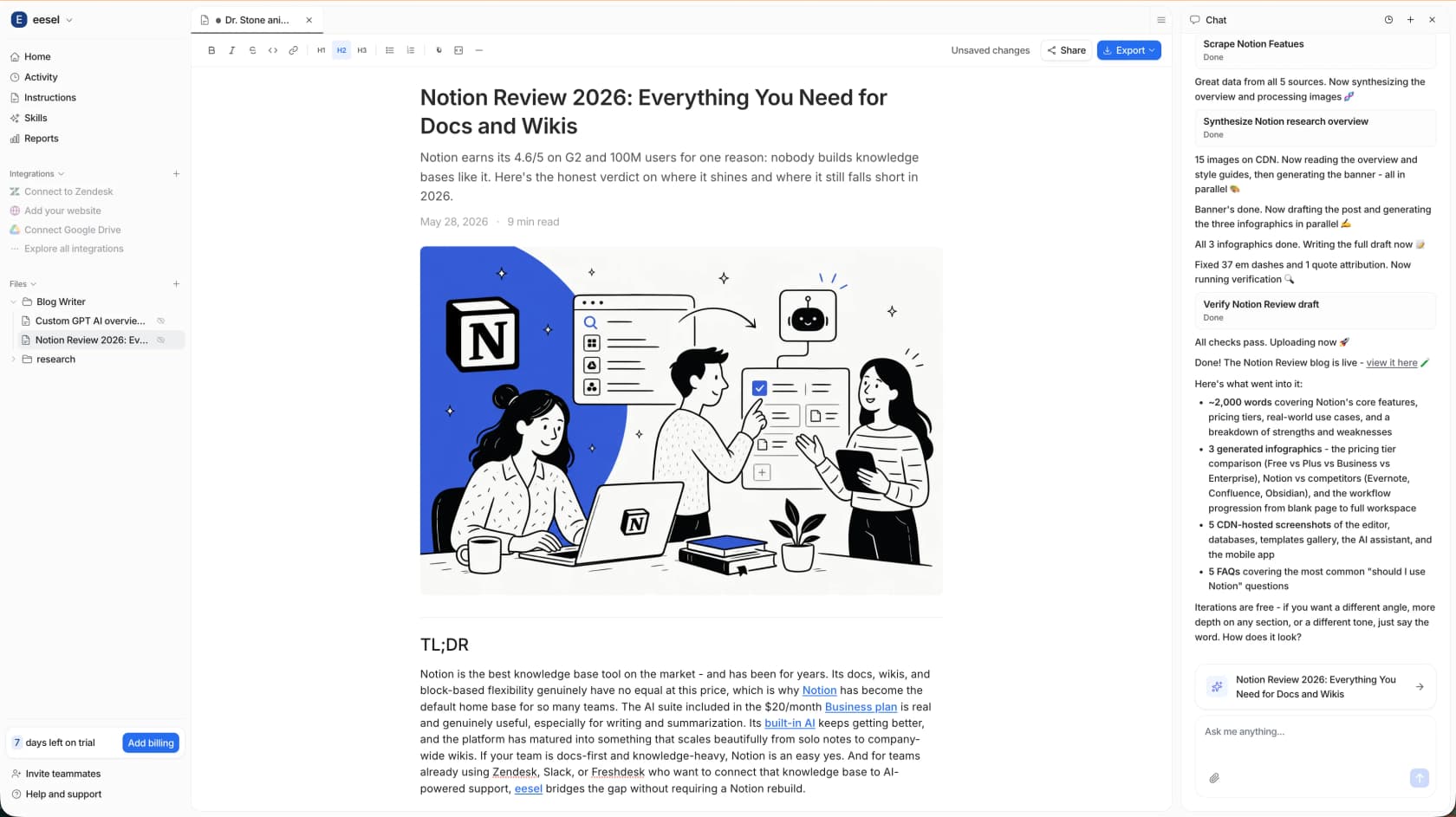
That grounding shows up in how teams actually use it. One SEO content lead runs a keyword-to-publish pipeline that scales to 360+ posts a month with bulk review and publishing; a power user at a wellness retailer codified one reference post as a reusable "North Star" template so every future draft matches a fixed house style. People even arrive for the writer alone: one marketer at a staffing agency told the eesel team they didn't need ticket automation at all, they just wanted help with the SEO content for their website. The pricing is usage-based at roughly $4 per long-form draft, and the free trial includes two free generations, so you can test it on a real brief before committing. Worth a look if you want content that sounds like you wrote it, because in a real sense, it did. Try eesel.
Frequently Asked Questions
What is an AI white paper writer?
Can AI write a white paper that doesn't sound generic?
How much does an AI white paper writer cost?
Will an AI white paper writer use my company's data?
What's the biggest mistake when using AI for white papers?
How long does it take to write a white paper with AI?
Is AI-generated content good enough for B2B white papers?
What's the best AI white paper writer for a small team?


Article by
Rama Adi Nugraha
Rama is a software engineer at eesel AI with two years of experience writing about B2B SaaS, AI tools, and customer support technology. Based in Bali, Indonesia, he brings a developer's perspective to product comparisons — cutting through marketing copy to what the integrations and APIs actually do.