


The honest answer, and the trap inside it
I've spent the last two years in SEO, and I now help build eesel's AI blog writer, which means I've watched both ends of this question play out on real pages. On one end, an SEO content lead ran our keyword-to-publish pipeline up to 360+ posts a month and kept the rankings. On the other, I've seen a wall of unedited AI drafts cruise for a quarter and then fall off a cliff. Same tool, opposite outcomes. The difference was never "did AI write it."
If you paste "write me a how-to guide on X" into any decent model today, you'll get a publishable-looking guide back in under a minute. By that test, the answer is an easy yes, and modern AI writing tools are very good at producing clean, structured, readable steps.
The trap is mistaking "looks right" for "will rank." Ranking in 2026 is a question about whether your guide is the most useful answer to a real search, and that's a much higher bar than "reads well." Plenty of perfectly fluent AI how-to guides never crack page two, and fluency is part of why: a model is very good at sounding optimized and authoritative without having a single new thing to say. That hollow polish is exactly what Google's last two years of updates have been hunting. So let me split this into the part Google has settled, and the part that decides whether your guide survives.
What Google actually rewards (and what it doesn't)
Here's the thing most "is AI content allowed?" debates miss: Google answered this years ago, in writing. Its guidance on AI-generated content leads with a section literally titled "Rewarding high-quality content, however it is produced." The money quote, from the FAQ on whether AI content can rank:
"Using AI doesn't give content any special gains. It's just content. If it is useful, helpful, original, and satisfies aspects of E-E-A-T, it might do well in Search. If it doesn't, it might not."
So the bright line isn't authorship, it's intent. Google does ban one thing: "using automation, including AI, to generate content with the primary purpose of manipulating ranking." That's a spam policy, and it catches a human content mill exactly as readily as an AI one. If you're curious how that plays out in practice, we wrote up whether Google penalizes AI content separately.
What the helpful content system rewards, in Google's own words, is "content where visitors feel they've had a satisfying experience." It's a site-wide signal, now folded into core ranking, and it explicitly flags the behaviour of an AI how-to mill: "using extensive automation to produce content on many topics" and "mainly summarizing what others have to say without adding much value." It even kills the word-count myth that bloats so many AI guides, since Google says flatly it has no preferred word count.
Then there's E-E-A-T: experience, expertise, authoritativeness, and trust. It's not a direct ranking factor, but it's the lens Google's systems use to spot good content, and one of those four letters is the whole game for how-to guides.
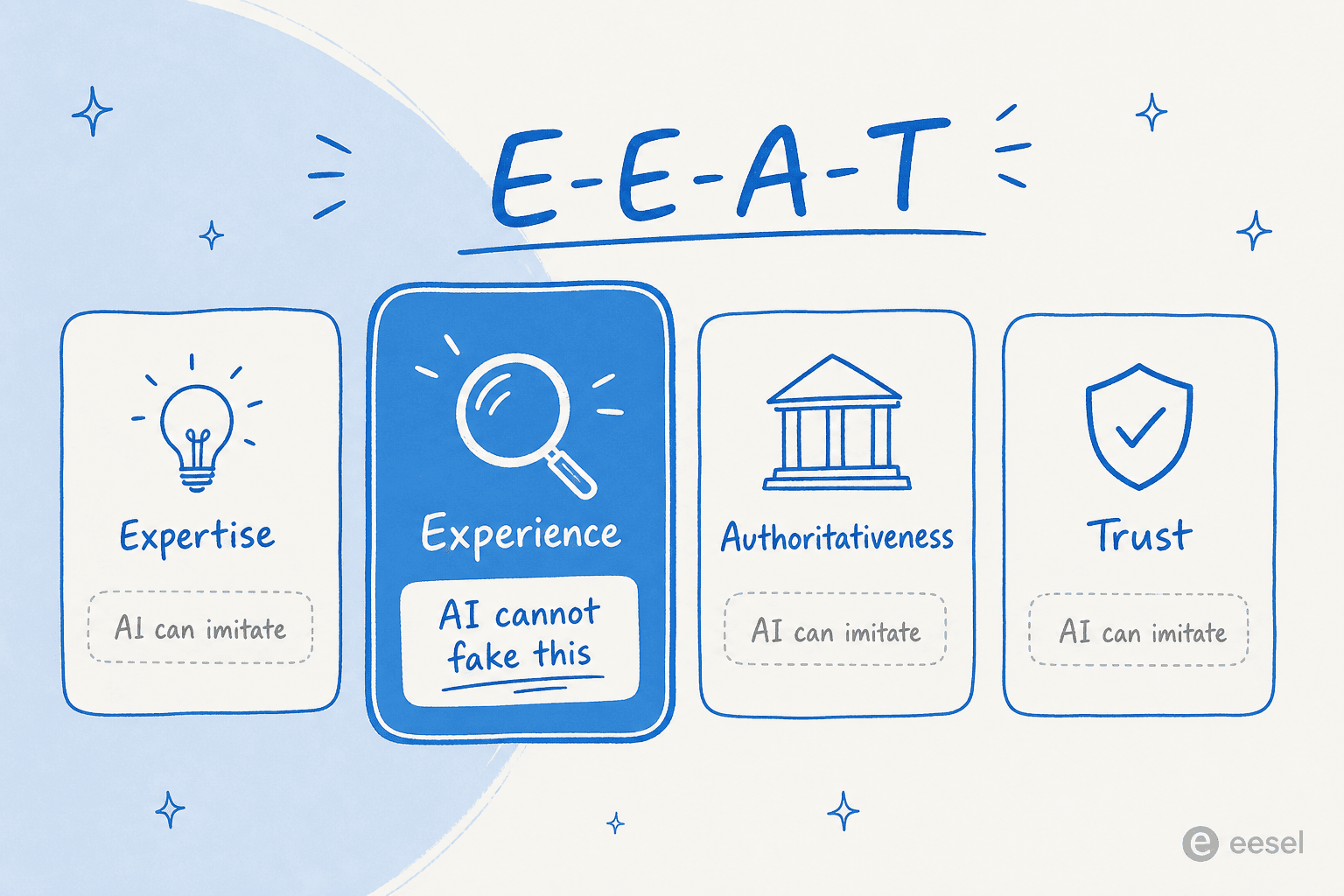
An AI can convincingly imitate expertise, authoritativeness, and even trust signals. The leading "E," Experience, the firsthand "I actually did this, here's what happened" layer, is the one it can't manufacture. Google added that "E" in late 2022, and its own example is a how-to scenario: trust is built "when [readers] understand the number of products that were tested, what the test results were, and how the tests were conducted, all accompanied by evidence of the work involved, such as photographs." That sentence is a spec sheet for a how-to guide that ranks.
Where AI-written how-to guides quietly fail
So if Google's fine with it, why do so many AI how-to guides flop? Because most of them get generated, not grounded. The model is handed a keyword, it summarizes the guides already ranking, and it returns a competent rewrite of the consensus. That's the exact pattern the helpful content signal is built to demote, and the people tracking their own portfolios see it clearly.
One operator posted tracked data in r/GEO_optimization that matches what I've seen:
"Posts with heavy AI involvement dropped an average of 15 positions. Human-written content with light AI editing stayed stable or improved... The issue isn't that you used AI for research or outline generation. It's when AI becomes the primary content creator."

A reply on the same thread named the smell test better than any tool could:
"...they plummeted 20+ spots. Meanwhile, our older human-first articles with just AI-assisted research are holding strong or even climbing. It's wild how Google seems to be zeroing in on that 'AI slop' vibe, generic lists, no real case studies, nothing that screams 'I've actually done this.'"
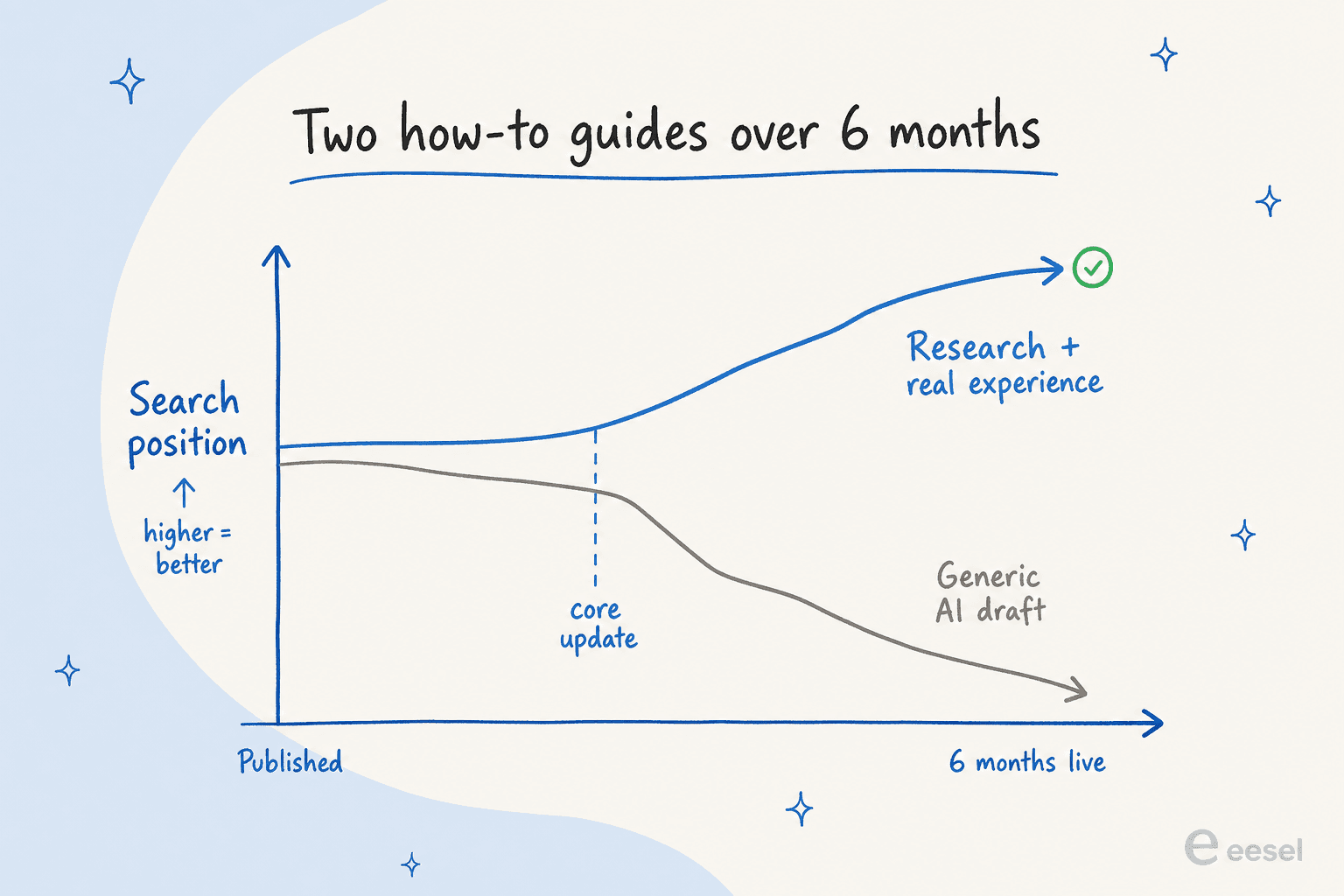
The cruel part is the timing. A pure-AI how-to guide doesn't fail on day one. It often ranks fine for a few months, which fools you into scaling the approach, and then a core update arrives and the floor drops out. A tester running multiple sites put the window at "3-6 months" before pure-AI pages drop, calling sites that rely on it entirely "building on sand." That delay is exactly why this question is so easy to get wrong.
There's also a narrower failure worth naming: AI how-to content does worst on the topics everyone has already covered. As one r/seogrowth member observed, AI "ranks worse for the general informative topics" while doing better on fresh ground nobody has covered yet. A how-to guide for "how to reset a password" is the most-written page on the internet, and a generic AI version of it has nothing to add. This is the same trap we picked apart in why AI blog posts sound generic.
The one thing AI can't fake: experience
Strip away the tactics and every failure above comes back to that missing "E." My favourite framing of it came from an SEO in a LinkedIn thread on E-E-A-T:
"If there are two articles about a root canal, one written by a random SEO who did a bunch of research, and one written by a dentist with 10+ years of real experience... who's going to win? The dentist. Every time... The small details, the real-world scenarios, the way they explain risks and outcomes... you can't fake that."

That's the whole answer to "can AI write how-to guides that rank?" AI can be the researcher who read everything. It cannot be the dentist. The good news is you, or someone on your team, often is the dentist, and AI's real job is to get your firsthand knowledge onto the page faster, not to invent knowledge you don't have. The content marketer Habeeb Adetunji framed the working relationship well:
"I don't let AI write. I use AI to write with me... when you combine AI + real research, your content becomes authoritative."
If you want this in one rule: let AI do the reading and the typing, and make a human supply the experience. Everything in the workflow below is just a way to enforce that.
How to write how-to guides that actually rank with AI
This is roughly how I'd brief any team, whether you're using a general AI writer or a research-grade one. None of it removes AI from the loop. It just puts the human where they add the most value, which is judgment and lived experience, not first drafts.
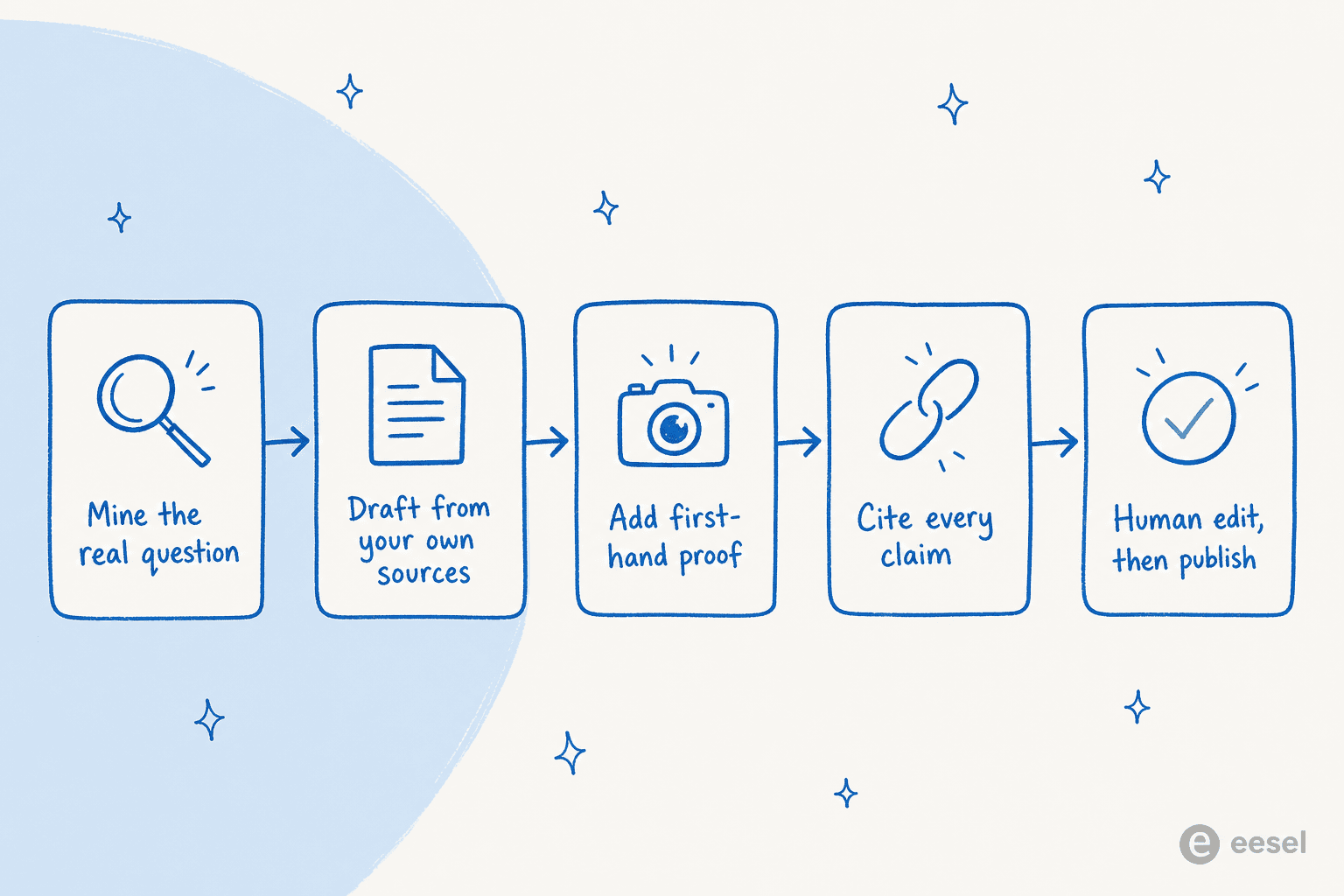
- Mine the real question, don't let AI guess it. Pull the actual phrasing from your support tickets, site-search logs, and the questions buyers ask on sales calls. A keyword tool gets you the head term; your own data gets you the long tail of how people actually phrase the problem. This is the step most AI guides skip, and it's the highest-leverage one.
- Draft only from your own sources. Point the AI at your verified docs, your product, your past content, and tell it to write only from that material. This is the single biggest guard against a confident wrong step, and it's why grounding the model in a knowledge base beats letting it free-associate from training data.
- Add the first-hand proof. This is the "E" no model can supply. Screenshots of the actual screens, the exact setting names, the number you got, the thing that broke and how you fixed it. This is what separates a guide that ranks from a rewrite of the consensus, and it's worth doing even when it's slow.
- Cite every step. Each claim should trace to a source you can check. If the AI can't cite one, treat that as a signal the step is invented. Good SEO AI content writers cite inline as they draft, which makes this far less painful.
- Human edit, then publish, then keep it alive. A person who's done the task confirms accuracy and voice before anything ships. Then re-run it against updated docs on a schedule, because a how-to guide is wrong the moment a UI changes. This is where an AI content pipeline earns its keep.
A lightly-edited AI draft really does beat a raw dump. An r/seogrowth member summed up the mixed reality: posts "lightly edited by humans (better tone, fact-checking, unique insights) tend to perform much better than raw AI dumps." The edit isn't optional polish; it's the part that does the ranking. If your drafts still read like a model, our notes on making AI content sound human and prompts that help are a good next stop.
A quick myth to bury: the HowTo rich result is gone
One thing I still get asked: "do I need HowTo schema to rank a how-to guide?" No. Google deprecated How-to rich results in August 2023, and later removed the documentation entirely. The blue step-by-step snippet no longer shows on desktop or mobile.
Crucially, Google said "this should not be considered a ranking change." The markup is harmless to leave in, but it earns zero visible search appearance now. What that really means: how-to guides compete as ordinary results, won on content quality and experience, not on structured-data tricks.
The same logic now extends to the AI search engines deciding what to cite, where a generative engine optimization mindset rewards the same firsthand substance.
The schema was never the moat. It's the same lesson behind scaling SEO content safely and building real topical authority: there's no markup shortcut around being the most useful page.
Try eesel for how-to guides that hold their rankings
If you want AI to write how-to guides that rank and stay ranked, that's exactly what the eesel AI blog writer is built for. It doesn't just generate prose. It does keyword research, reads primary sources and Reddit threads, cites every claim inline, and matches your voice, so the firsthand experience you supply lands on the page instead of getting flattened into consensus.
The part I'd flag for how-to content specifically: because eesel works from the sources you connect, including your help center and past tickets, it's pulling from the place your real experience already lives. That's how teams like the SEO content lead I mentioned scaled to hundreds of research-grade posts a month without the rankings collapsing under them. And if your guides also need to answer those same questions live, the same knowledge can power the eesel helpdesk agent, so one source of truth covers both your blog and your support. You can try eesel free, no credit card needed.
Frequently Asked Questions
Can AI write how-to guides that rank in Google?
Does Google penalize AI-generated how-to content?
Why do AI-written how-to guides drop in rankings after a few months?
How do I make an AI how-to guide pass E-E-A-T?
Do I still need HowTo structured data for my how-to guides?
What is the best AI for writing how-to guides that rank?


Article by
Kurnia Kharisma Agung Samiadjie
Kurnia is a software engineer and writer at eesel AI with two years of SEO experience, writing about AI tools, helpdesk software, and customer support. He pairs a developer's understanding of how these products are built with search-driven research into what actually ranks and resonates with the people searching for them.