


AI content generation has really taken off. It feels like every week there’s a new AI tool claiming to be the next best thing. For anyone in marketing, blogging, or trying to get a business off the ground, these tools are shifting from a nice-to-have to a must-have for scaling up.
But here’s the catch: a lot of what they produce is generic text that sounds robotic and will not rank on Google.
So, I decided to cut through the noise. I spent time with the top contenders to give you a clear, hands-on comparison of what actually works in 2026. The right tool can make a huge difference for organic growth. We’ve seen it ourselves, using our own eesel AI blog writer to take our blog from a quiet 700 daily impressions to a massive 750,000 in just three months.This is what I do. I outline, have it do a first draft, edit it for a good period, and then add the “me” to it.

What is an AI writer?
What exactly is an AI writer? Put simply, it's a tool that uses artificial intelligence, specifically large language models (LLMs), to generate text that sounds like a person wrote it. You give it a prompt, like a keyword or a question, and it produces content.
For general AI writing tools the best is still Claude Pro (3.5 Sonnet). It's the closest to human-like generation I've come across so far. But I still need to do long detailed prompts (and re-promptings) and heavy editing to polish the output to human-level content.
It can be a huge help for getting past writer's block or just speeding up the content creation process. You can use it for almost anything, from drafting a quick email to outlining a long blog post. But there’s a big difference between basic text generators that just give you a wall of words and more advanced platforms. The really good ones do the heavy lifting for you, handling deep research, structuring the content, creating images, and even optimizing it all for SEO.
How we picked the best AI writer tools
To make sure this list was actually useful, I didn't just look at feature lists. I rolled up my sleeves and evaluated each tool based on a few key things that matter when you're trying to create content that performs.
Here’s the criteria I used:
- Output Quality: Does the content sound like a real person wrote it? Is it accurate, engaging, and something people would actually want to read?
- Core Features: Is it just a text generator, or does it come with useful extras like SEO tools, research capabilities, and automatic asset generation?
- Ease of Use: How quickly can a new user get the hang of it? Is the interface clean and intuitive or a complete mess?
- Use Case Suitability: Is it built for long-form blog posts, academic papers, or short social media captions?
- Pricing: What are you getting for your money, and can you try it before you commit?
AI writer comparison table
| Tool | Best For | Key Feature | Pricing |
|---|---|---|---|
| eesel AI blog writer | Complete, SEO-optimized blog posts | Automatic asset & media integration | Free to try; $99 for 50 blogs |
| Writer.com | Enterprise brand governance | AI agents & security controls | 14-day free trial; Custom for Enterprise |
| Grammarly | Real-time writing assistance | AI agents & grammar checking | Freemium; Pro from $12/month |
| QuillBot | Paraphrasing & academic writing | Advanced paraphrasing & summarizer | Freemium; Premium from $4.17/month |
| AI-Writer.com | Factual, research-based articles | Verifiable citations from scientific papers | 7-day free trial; Starts at $29/month |
| Picsart AI Writer | Quick and specific short-form tasks | Collection of free, single-purpose tools | Free |
The 6 best AI writer tools in 2026
Alright, let's get into the details. Here’s a breakdown of the top tools, what they're good at, and where they miss the mark.
1. eesel AI
The eesel AI blog writer is built from the ground up for people who are serious about organic growth. This is not just another text generator; it’s a complete blog post generator. You give it a single keyword, and it produces a publish-ready, SEO-optimized article. It uses a user's website and brand context to create relevant content that naturally weaves in your products without sounding salesy. It’s the exact tool we used to get that 750,000+ daily impression growth I mentioned earlier.

- Best for: Generating complete, publish-ready, and SEO-optimized blog posts with minimal manual effort.
- Key Features:
- Automatic Asset Generation: It automatically creates and inserts AI-generated images, infographics, and relevant YouTube video embeds right into the post.
- Authentic Social Proof: This is a neat feature. It scours Reddit forums to find and integrate real quotes and insights, adding a layer of human experience that most AI tools lack.
- AEO Optimization: The content is prepared for AI Answer Engines like Google AI Overviews and Perplexity, which is becoming more and more important.
- Deep Research with Citations: It automatically adds internal links to your other content and external links to credible sources, which helps build authority.
- Pricing: You can try it completely free. After that, the Early Bird plan is a straightforward $99 for 50 blog generations.
- Pros: Its biggest strength is that it's an all-in-one package. It genuinely saves hours of work by handling the research, writing, SEO, and asset creation in a single step.
- Cons: It is specialized for creating long-form content like blogs and articles, so it is not designed for users who primarily need to generate short-form copy like social media posts or ads.
2. Writer.com
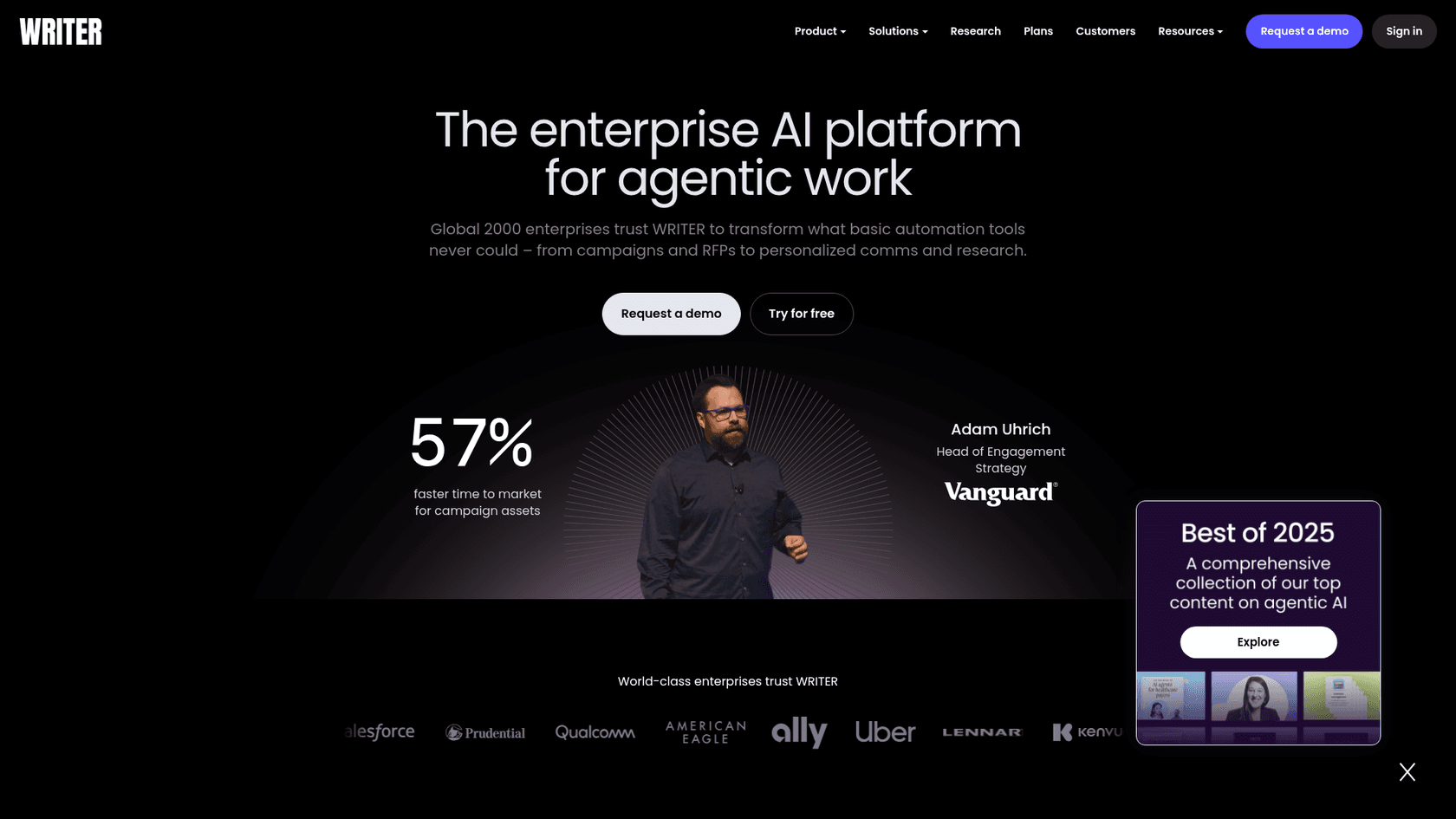
Writer.com is a comprehensive platform aimed at large companies where things like brand consistency, security, and control are top priorities. It's less of a simple writer and more of an enterprise-grade AI system. It uses "AI agents" to automate workflows across the whole company, from marketing to product development, making sure everything that gets created sticks to the brand’s specific voice and style guides.
- Best for: Large enterprises needing a secure, governable AI platform for agentic work across the organization.
- Key Features:
- AI Agents: These are designed to automate complex jobs and coordinate work between different teams and software systems.
- Knowledge Graph: This is their term for a system that connects to all the company's data to make sure the AI's output is factually accurate.
- Enterprise Governance: It comes with serious security and compliance features (SOC 2, HIPAA, GDPR) and detailed admin controls.
- Palmyra LLMs: They use their own family of powerful language models that are fine-tuned for specific industries like finance and healthcare.
- Pricing: They offer a 14-day free Starter trial for teams of up to 5 people. For the full Enterprise plan, you have to contact their sales team for a custom quote.
- Pros: Its main advantage is its ability to learn a company's "DNA" to ensure everything it produces is on-brand and factually correct. Its top-tier security makes it a trusted choice for the Global 2000.
- Cons: Its features are tailored for large-scale enterprise needs, which may be more complex than what individuals or small businesses require. The focus on governance and security can make the workflow less direct for simple, quick content creation tasks.
3. Grammarly
You probably know Grammarly as the go-to grammar checker, but it has grown into a pretty capable AI writing assistant. It works right where you do, whether that's in your emails, Google Docs, or on social media, helping you write and polish your text on the fly. It’s not really built to create entire articles from scratch, but it’s fantastic as a co-pilot for improving the writing you’re already doing.
- Best for: Real-time writing assistance, improving grammar, and generating or rephrasing short-form text.
- Key Features:
- AI Agents: It has specialized agents like a Proofreader, Paraphraser, and even a Humanizer to help refine your text.
- AI Writing Tools: It offers a collection of tools that can help you generate ideas, build outlines, and write short bits of content.
- Seamless Integration: It works across thousands of apps and websites, which is very convenient.
- Plagiarism and AI Detector: It can scan for unoriginal content and even identify text that looks like it was generated by AI.
- Pricing: There’s a free version available that gives you 100 AI prompts per month. The Pro plan starts at $12 per month (if you pay annually) and bumps you up to 2,000 AI prompts.
- Pros: Its grammar, spelling, and punctuation correction is still the best in the business. It’s an amazing tool for making your existing writing shine.
- Cons: Grammarly's AI functionality serves primarily as a writing assistant rather than a long-form content generator. It lacks deep SEO research capabilities and automatic asset generation found in more specialized blog writing tools.
4. QuillBot
QuillBot is another popular tool that’s best known for one thing: its powerful Paraphraser. It’s designed to help you rewrite sentences, summarize long articles, and check for basic writing mistakes. While it has a bunch of different tools in its suite, its core strength is definitely in rephrasing text and supporting academic writing.
- Best for: Paraphrasing text, summarizing articles, and academic writing assistance.
- Key Features:
- Paraphrasing Tool: It gives you multiple modes (like Standard, Fluency, and Formal) to rewrite text while keeping the original meaning intact.
- Summarizer & Translator: It can condense long documents into key points and translate text between 52 different languages.
- Citation Generator: Super helpful for students, it can create citations in APA, MLA, and Chicago styles.
- Plagiarism Checker: The premium plan lets you scan up to 25,000 words per month to check for unoriginal content.
- Pricing: It has a generous free plan but with limits on how many words you can process at once (e.g., 125 words in the Paraphraser). The Premium plan starts at just $4.17 per month (billed annually) and gives you unlimited words.
- Pros: Its paraphrasing abilities are excellent and more sophisticated than what you'll find in most other tools. It's also much more affordable than something like Grammarly.
- Cons: The free version has word count limitations. The platform is not designed for creating full blog posts from a prompt and does not include advanced SEO features or asset generation.
5. AI-Writer.com
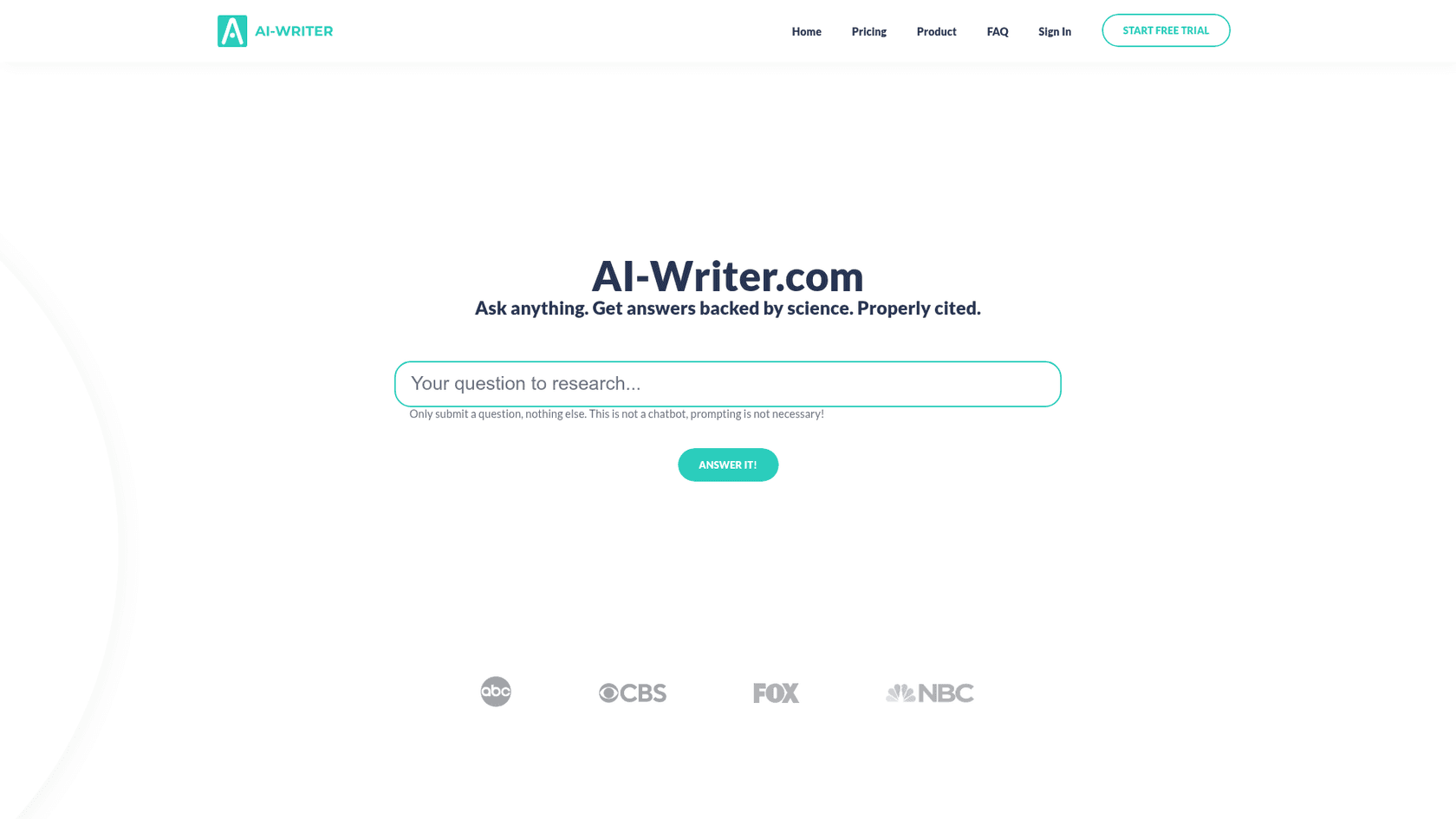
AI-Writer.com has carved out a very specific niche for itself by focusing on generating factual, research-heavy content that’s backed by scientific literature. When you ask it a question, it researches a database of over 100 million open science papers and provides verifiable citations for every single claim it makes.
- Best for: Academic and research-based articles that require a high degree of factual accuracy and verifiable sources.
- Key Features:
- Verifiable Citations: Every piece of text it generates can be traced back to the source paragraph from a scientific paper.
- Topic Explorer: It helps you identify the key questions you need to cover to create a comprehensive article on any research topic.
- Review Paper on Demand: With just a few clicks, it can generate a full, structured review paper.
- SEO-Focused Editor: It includes an editor that helps you optimize the fact-based content for search engines.
- Pricing: You can try it with a 7-day free trial. The Basic plan starts at $29 per month and allows you to answer up to 40 questions.
- Pros: Its biggest strength is its absolute commitment to verifiable, fact-based content. This is invaluable if you're writing technical or academic content where you need to be able to trace your sources.
- Cons: Its focus on academic and scientific literature makes it less suitable for creative or marketing content that requires a specific brand voice or a conversational tone.
6. Picsart AI Writer
The Picsart AI Writer is a bit different from the others on this list. It’s not one single platform but a huge collection of free, single-purpose AI text tools offered under its Quicktools brand. It has everything from an article writer and slogan generator to a social media bio creator and an ad copy tool. The best part? You can use them all without even signing up.
- Best for: Tackling quick, specific, and isolated writing tasks for free.
- Key Features:
- Collection of 20+ Free Tools: It includes an Article Writer, Title Generator, Summarizer, and a ton of other handy little tools.
- No Sign-Up Required: All the tools are 100% free to use right from the website, no account needed.
- Task-Specific: Each tool is built for one specific job, which makes it really easy to get the exact output you need quickly.
- Pricing: It’s completely free to use.
- Pros: The main draw is that it's free and you don't need an account. It's super useful when you just need to generate a catchy title, a short product description, or some hashtags in a few seconds.
- Cons: The tools function independently, so it does not produce a single, cohesive blog post. Users need to combine outputs from different tools and manually handle content structure, formatting, and SEO.
How to choose the right AI writer for your needs
Okay, that’s a lot of information. So how do you pick the right one? It really comes down to what you’re trying to do.
- For Complete Blog Posts & Organic Growth: If your main goal is to scale your blog with high-quality, publish-ready content, you need a tool that does more than just write. Look for something that handles research, writing, SEO, and asset creation all in one. An all-in-one solution like the eesel AI blog writer is built exactly for this.
- For Enterprise Brand Control: If you’re part of a large company, you need to prioritize platforms that offer security, governance, and features to keep everything on-brand, like Writer.com.
- For Polishing Your Own Writing: If you mostly need a helping hand to improve your grammar or generate short bits of text, a writing assistant like Grammarly or QuillBot is a perfect fit.
- For Factual, Academic Content: For research papers or highly technical articles, you absolutely need a writer that provides verifiable sources, like AI-Writer.com.
Honestly, I use Gemini, ChatGPT, and Copilot for each of their strengths. I actually used all three simultaneously to brainstorm the best ways to use them and develop a process.
Pro tip
Every one of these platforms offers a free trial or a [free plan](https://www.eesel.ai/blog/free-ai-writing-tool). The best thing you can do is test them out with a real task you need to get done. See which one fits your workflow best before you decide to pay for a subscription.
Visual learners might prefer seeing these tools in action. To get a better sense of how different AI writers operate and what their interfaces look like, here's a helpful video review that covers a wide range of options.
Go beyond text generation with the eesel AI writer
Many AI writer tools focus on generating a text draft, which serves as a starting point. From there, users often undertake additional tasks like sourcing images, formatting the article, adding internal and external links, and optimizing for SEO. The eesel AI blog writer is designed to consolidate these steps.
It generates a fully structured article that includes AI-generated images, infographics, and media embeds from sources like Reddit and YouTube to add real-world context. This approach aims to reduce the manual effort required to get from a keyword to a publish-ready blog post. We used this tool to grow our own blog's daily impressions from 700 to 750,000. If you are looking for a tool that handles more than just text generation, see the difference for yourself.