What an AI listicle writer actually does
I've spent the last couple of years mapping keywords to what people actually search for, and at eesel I've watched our AI blog writer draft roundups across live customer sites. The thing that stuck with me is how transactional a listicle reader is: someone searching "best AI help desk" isn't browsing, they're building a shortlist and they'll abandon any list that reads like a brochure within a couple of scrolls.
An AI listicle writer is an AI content writer pointed at exactly that moment. Instead of one essay, you hand it a category and it returns the parts a buyer scans for: a shortlist of tools, a comparison table, a one-line "best for" per item, pros and cons, and a verdict. It's doing three jobs at once, and the third is the one cheap tools skip:
- Research each tool so the table is accurate, not invented.
- Build the shape: the table, the "best for" lines, the consistent per-item template.
- Write a verdict per item that takes a position without trashing the rest.
Those map to the shapes of listicle worth writing: the classic "best [category]" roundup, the "[Tool] alternatives" list (a listicle variant that opens on why people leave the incumbent), and the narrower "best [category] for [use-case]" angle that lets a smaller brand own a query the big roundups never targeted.
Why listicles are worth doing properly
Most formats earn middling distribution. Listicles don't, and the numbers behind that are some of the cleanest in content marketing.
Backlinko analyzed 912 million blog posts with BuzzSumo and Ahrefs and found list posts get 218% more shares than how-to posts and 203% more than infographics. The same dataset is brutal about the long tail: 94% of all posts have zero external links, and just 1.3% of articles generate 75% of all social shares. Format is one of the few levers that reliably moves a post from the invisible 94% into the 1.3%.
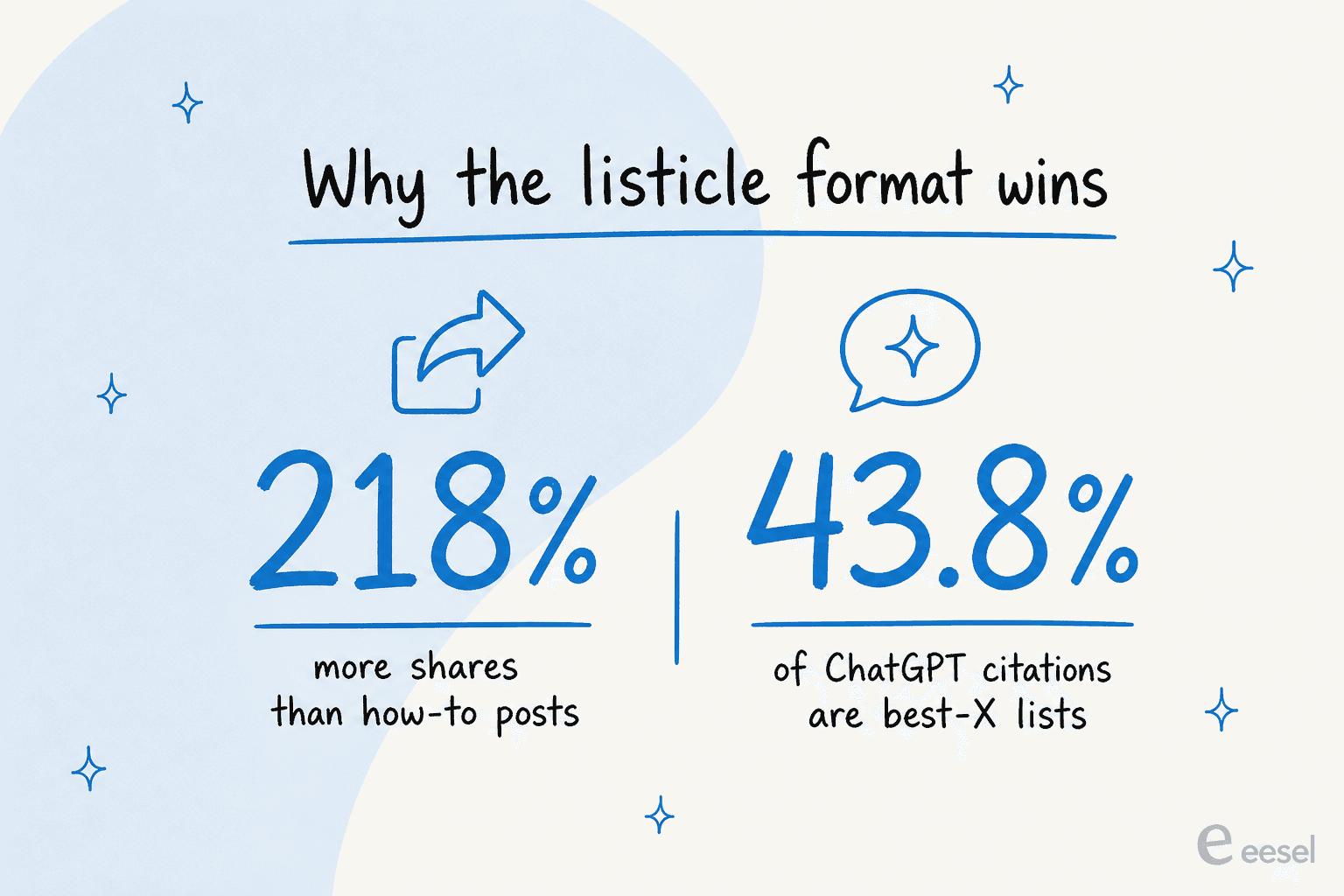
There's a newer reason to care, and it's the one I'd lead with in 2026: the listicle is the format AI search reaches for. Ahrefs studied ChatGPT's sources across 750 top-of-funnel prompts and found "best X" blog lists were 43.8% of all cited page types, ahead of directories, landing pages, and everything else. Their blunt finding: "recently updated 'best X' lists were the most prominent page type in ChatGPT sources," including ones where the brand had ranked itself #1. Winning a "best [category]" query now means winning the citation in the answer engine, not just the blue link. That's also exactly why the format is being flooded with low-effort AI lists, which brings us to the catch.
The catch: the same writer builds a spam farm
Here's where most "AI listicle writer" pitches go quiet. The tool that drafts a great roundup in a minute is the same tool that drafts a worthless one in the same minute, and Google has a specific name for the worthless version.
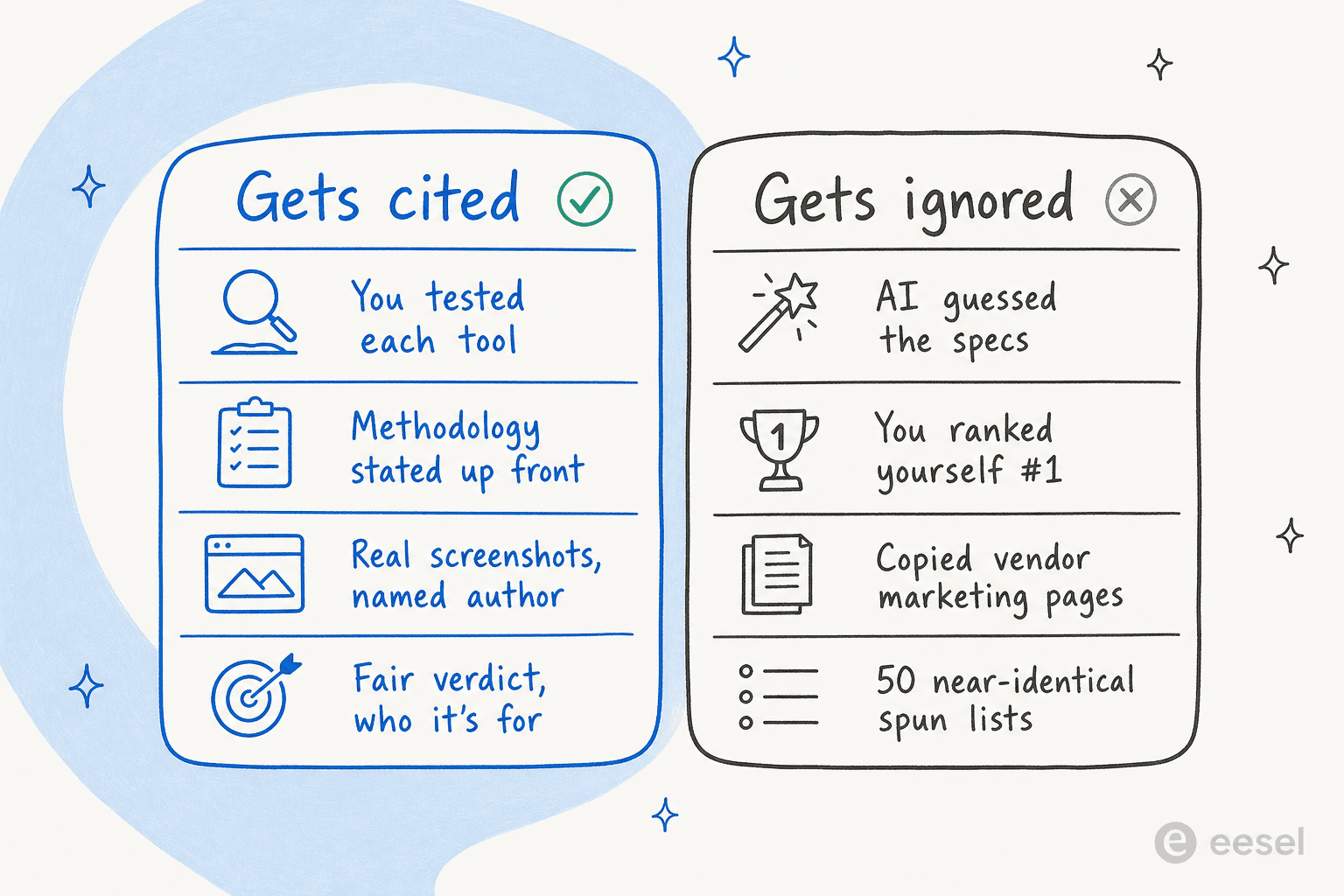
Google's spam policy is blunt: "Scaled content abuse is when many pages are generated for the primary purpose of manipulating search rankings and not helping users... no matter how it's created." The first example it lists is "using generative AI tools or other similar tools to generate many pages without adding value for users." A batch of spun "best [category]" pages that tabulate vendor spec sheets with no original analysis is the textbook trigger, and "stitching or combining content from different web pages without adding value" is also on the list, the exact move of a list assembled from marketing pages.
The nuance that matters: AI authorship isn't the violation, mass-producing value-less pages is. Google's own guidance on AI content says its "focus on the quality of content, rather than how content is produced, is a useful guide that has helped us deliver reliable, high quality results... for years." I dug into whether Google penalizes AI content separately; the short version is it doesn't penalize AI, it penalizes value-less mass production.
Operators are watching this play out in real time. Content strategist Rochi Zalani warned on LinkedIn that brands are repeating the peak-SEO mistake with AI listicles:
"I'm seeing brands make the same mistake with listicles they made in peak SEO: publishing garbage to rank, without thinking about the cleanup later... if your AI-generated listicles are bland, offer zero first hand insight, copy-pasted from a product's marketing page, AI will stop citing you sooner or later. Just like Google's updates tanked your traffic."

And the timeline is shorter this round than it was for the old SEO content farms. As one commenter put it on that thread, "Google took years to crack down. AI search is iterating in months. The window to get away with lazy listicles is shrinking fast." The point isn't to fear AI, it's that the by-products of bulk AI publishing, thin coverage and no grounding, are what get punished, the same tells that show up when an AI post doesn't rank.
What makes an AI listicle actually rank
Once you've decided to do it properly, the structure is fairly settled. Google's helpful-content guidance is the working spec, and it lines up with what ranks. Here's the checklist I'd hold a roundup to.
| Element | Why it earns its place |
|---|---|
| Keyword-bearing title and H1 (with the year) | Tells reader and engine exactly what's listed; the year signals freshness, which AI search rewards. |
| Comparison table | The artefact buyers screenshot and skim; the spine of the page. |
| "Best for" line per item | The single most universal element on ranking roundups; advanced readers scan for it first. |
| Consistent per-item template | Same headings (features, pros, cons, pricing, verdict) on every item so skimmers can compare across. |
| Real product screenshots | Proof you opened the tool; Google asks for "evidence of the work involved." |
| Stated method | "I tested these over two weeks on X" answers the "how" Google's quality framework asks for. |
| Honest verdict per item | A position the reader can act on; the thing a roundup is for. |
| Named author byline | The "who" trust signal, which Google "strongly encourage[s]." |
The bar Google sets is specific. Its helpful-content page says content should "clearly demonstrate first-hand expertise and a depth of knowledge (for example, expertise that comes from having actually used a product or service)," and for reviews it wants readers to understand "the number of products that were tested... how the tests were conducted, all accompanied by evidence of the work involved, such as photographs." That last clause is the whole reason a screenshot beats a paraphrase: it's checkable proof you did the work. (And note Google explicitly says it has "no preferred word count," so padding a list to hit an arbitrary length helps nothing.)
How to write a listicle with AI, step by step
Here's the workflow I'd use. The order matters, and the human checkpoint at the end is not optional.
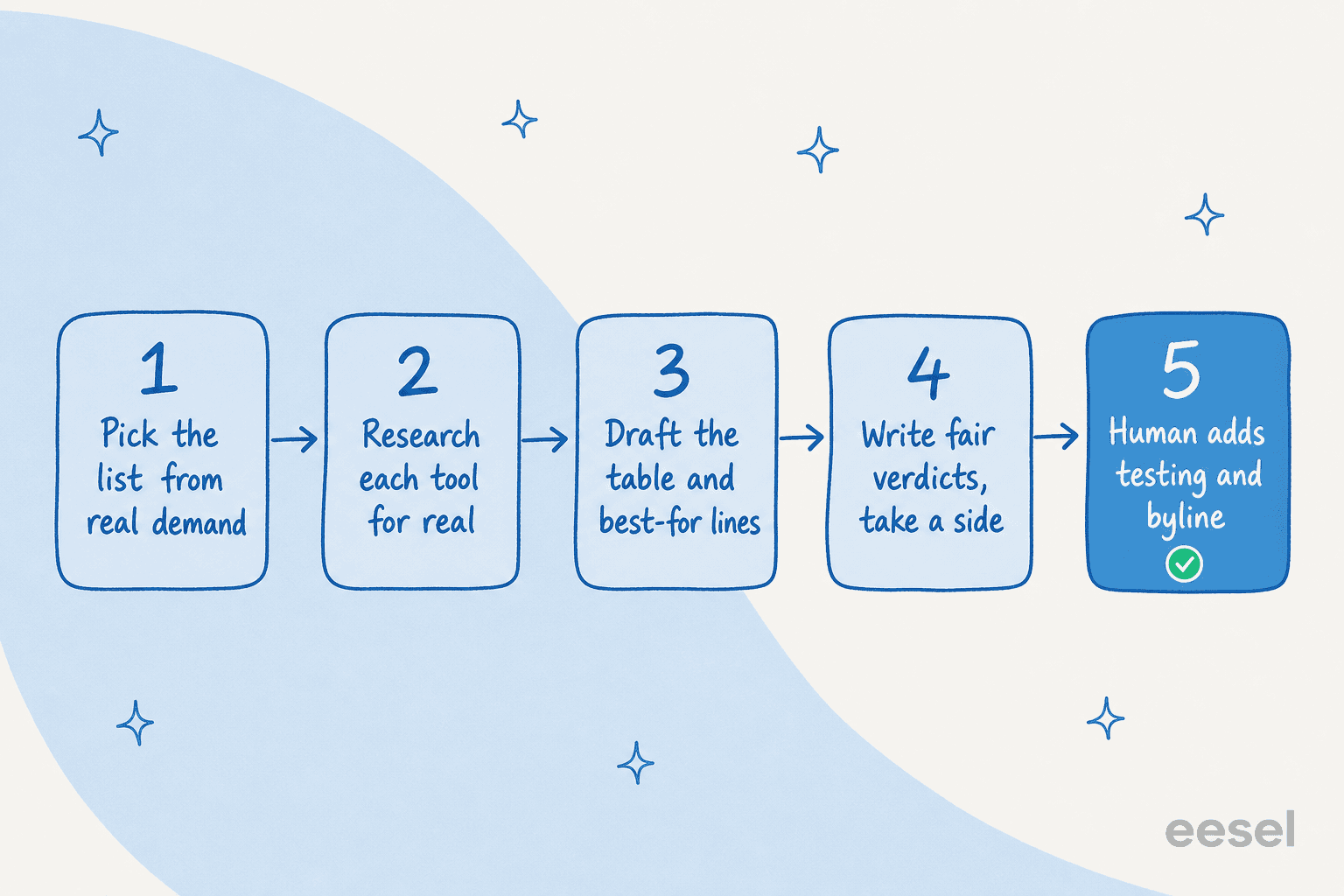
1. Pick the list from real demand. Decide the category and angle before you draft a word. Start from what people search: a keyword clustering tool or eesel's free keyword generator shows whether the volume is in "best [category]," "[tool] alternatives," or the narrower "best [category] for [use-case]," so you're not guessing the matchup.
2. Research each tool for real. This is the step that separates a list that ranks from one that gets ignored. Handed a generic prompt, an AI writer will confidently invent a pricing tier or a feature that doesn't exist. Feed it the actual pricing pages, docs, and your own notes instead. A writer that drafts from a knowledge base rather than the open web is what keeps the table honest.
3. Draft the table and the "best for" lines. Let the AI build the comparison table and the first pass of each item's framing. This is genuinely what it's good at: parallel structure, covering every dimension a buyer weighs, keeping the per-item template identical. A content brief per list keeps the scope tight so it doesn't wander into a 20-item dump.
4. Write a verdict per item, and take a side. For each tool, say who it's for and who should skip it. A roundup where every item is "great for teams of all sizes" is worthless; the value is in the discrimination. More on the self-ranking trap in the next section.
5. Put a human on the publish button. Add the one thing the model couldn't know: a screenshot from your own testing, a real number, the line about where each tool annoyed you. Where a reader would reasonably wonder how the list was made, Google's guidance recommends disclosing the use of AI. Build this gate into your AI content pipeline as a requirement, not a nice-to-have.
The self-ranking trap
This is the part an AI writer can't decide for you, and it's where most vendor listicles quietly fail. You want your product in the list, the reader knows you want it there, and the second the page reads like a setup, they stop trusting any of it.
The tactic is everywhere. As SEO director Lily Ray described it, "one of the most common tactics for gaining visibility in AI search has been for companies to publish 'listicle' content on their own blogs, ranking the best companies or products in their niche and placing themselves in the #1 spot." The problem, she notes, is that "credibility is undermined by consistently ranking their own company first and by the implausibility that they have truly hired and evaluated the other competitors," and "these pages almost always lack [evidence of real testing]." Her recurring line on the tactic is the one to remember: "it works, until it doesn't."
It's already turning. A thread on r/SEO captured the practitioner read:
"If you are mentioning your own brand at the top of the list, this means you are probably not giving the right information to the users and over promoting yourself. This is something Google has analysed and might start flagging."

The resolution practitioners land on is simple to say and hard to fake: do a genuinely fair, detailed roundup, then place your product where it honestly fits, with the same evidence you held every other item to. Not "we win at everything," but "if you need X, pick them; if you need Y, here's why we're the better call, and here's the screenshot to prove it." That's the opposite of the templated AI list, and it's exactly the gap an AI listicle writer should be built to fill responsibly: AI for the structure and the draft, a human and a real E-E-A-T byline for the take. Trust, in Google's own words, is the most important member of the E-E-A-T family, and a fair list from a named author is how you earn it.
Try eesel for listicles
If you want to draft "best X" roundups at volume without landing on the wrong side of Google's scaled-content line, the deciding factor is where the draft comes from. eesel's AI blog writer is an AI teammate that finds the lists worth writing, researches each tool, and drafts in your voice, then you just tell it what to change in chat.
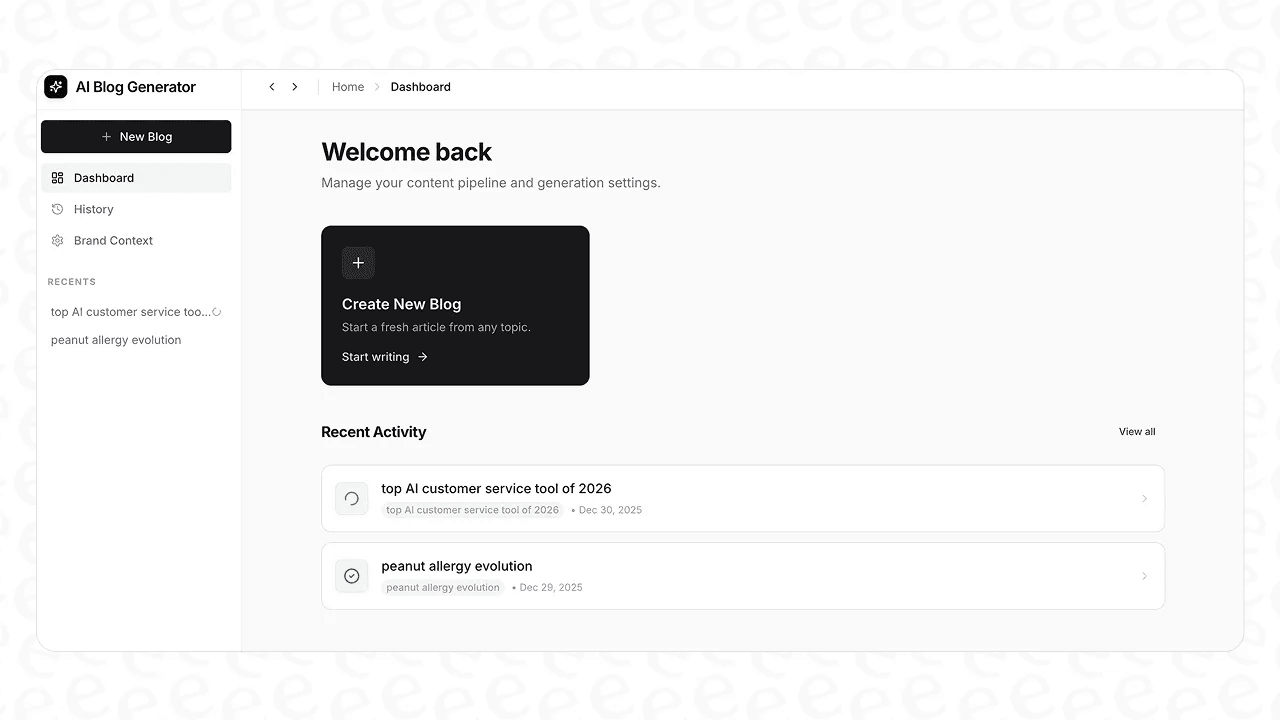
Three things make it fit roundup work specifically. It surfaces the "best [category]" and "alternatives" terms worth owning, so you build the list around real topical authority instead of a guess. It hits a 94% brand voice match from day one by learning from your past posts, so the verdicts sound like you and not a bot. And it grounds every claim in your own sources rather than guessing the table, which is the whole point of an AI blog writer that ranks. Draft the list, keep a human on the publish button, and add the one screenshot only you have, that part is still on you, and it's the part that gets you cited.
Frequently Asked Questions
What is an AI listicle writer?
Do AI-generated listicles still rank on Google in 2026?
Why do "best X" listicles matter for AI search?
Can I put my own product in a listicle I wrote?
Is there a free AI listicle generator?


Article by
Kurnia Kharisma Agung Samiadjie
Kurnia is a software engineer and writer at eesel AI with two years of SEO experience, writing about AI tools, helpdesk software, and customer support. He pairs a developer's understanding of how these products are built with search-driven research into what actually ranks and resonates with the people searching for them.