
Why AI writing sounds generic in the first place
A language model is a giant averaging machine. Ask it about "customer support automation" with no other context and it returns the statistical center of everything ever written on customer support automation. That center is, by definition, the most generic possible take, because it's the average of a million takes. It's smooth, it's grammatically perfect, and it says absolutely nothing a reader couldn't have guessed.
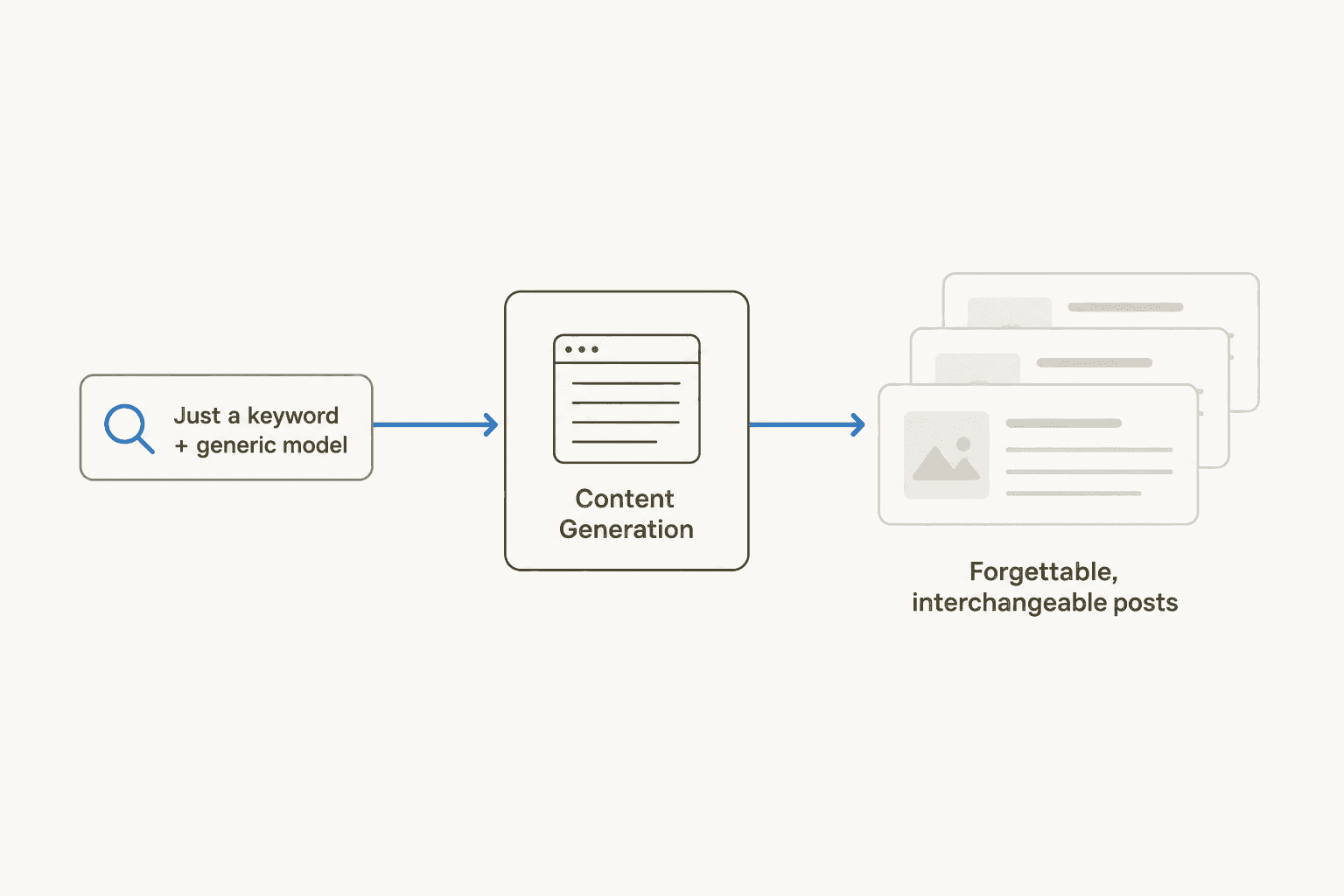
So the generic-ness isn't a flaw in the model, it's a flaw in the brief. The model can write something specific and opinionated, but only if you give it something specific and opinionated to work from. Most "the AI sounds robotic" complaints are really "I gave the AI nothing, and it gave me the average back." Good news: that's fixable, and the fixes are concrete.
The five things that make AI posts read as generic
Across the posts I've seen flop, the same five culprits show up. Here's each one and the fix.
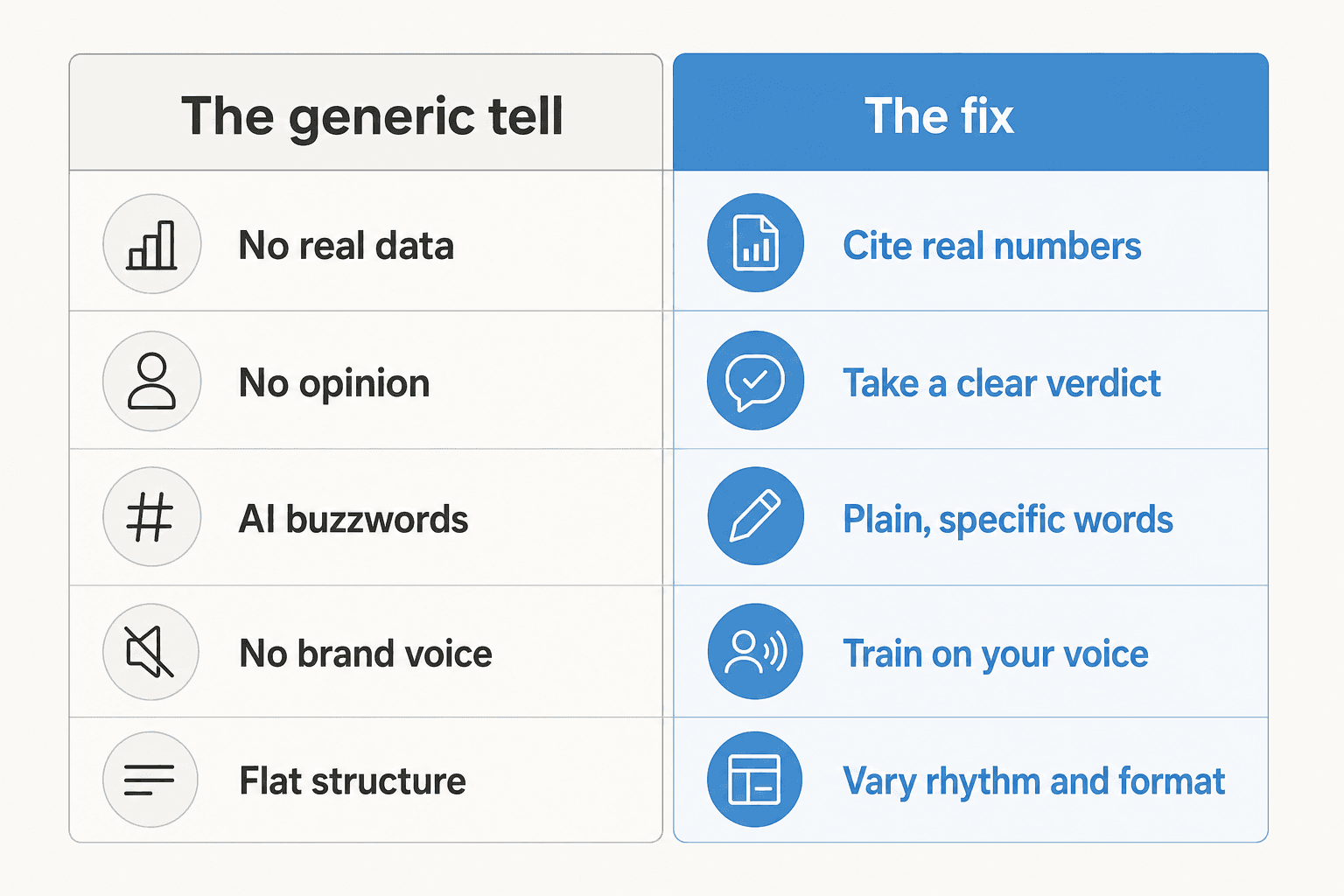
1. No real data, so every claim is hand-wavy
Generic posts are built on sentences like "AI is transforming customer support" and "many teams are seeing great results." There's nothing to check, nothing to quote, nothing a reader can't already feel they knew. The fix is to anchor claims to real, attributable numbers. "AI is growing fast" is filler; "one support team resolved 73% of its tier-1 tickets in the first month" is a fact a reader can react to. Pull the figure, name where it came from, and link it. This is also what AI search engines cite, because a checkable number is worth more to them than a confident adjective, and it's a big part of AI blog content optimization.
2. No point of view, so it reads like a fence-sitter
The most generic posts carefully avoid having an opinion. They list options, hedge with "it depends on your needs," and end with a tidy summary that commits to nothing. Real writing takes a side. After you've done the research, say which way you lean and defend it: "we'd reach for X here, and skip Y unless you specifically need Z." A wrong-but-clear verdict is more useful, and more human, than a correct-but-spineless survey. Hedging is the single loudest tell that nobody actually thought about the topic.
3. The AI buzzwords give it away instantly
There's a vocabulary cluster that screams "a model wrote this": delve, navigate the landscape, robust, seamless, leverage, foster, underscore, in today's fast-paced world, it's not just X, it's Y. Readers and Google's quality reviewers both pattern-match on these now, which is why chasing AI detection workarounds misses the point. The fix is a ruthless edit pass where you hunt and replace them with plain, specific words. "Delve into" becomes "look at." "Robust solution" becomes "it doesn't fall over." If a sentence would survive having the product name swapped out, it's too generic, rewrite it. We keep a running list of these tells and strip them on every post.
4. No brand voice, so it sounds like everyone
Even a well-researched post falls flat if it's written in default-AI-narrator voice. Your brand has a register, a few words it uses and a few it never would, a level of formality. A generic post ignores all of that. The fix is to train the writer on your actual published material so it absorbs your patterns, rather than guessing at "professional but friendly." This is where brand voice writing earns its keep, and it's the lever I'd pull first if I could only fix one thing.
5. Flat structure, so the rhythm feels mechanical
Generic AI writing has a tell in its shape, not just its words: every sentence runs the same medium length, every section is the same size, every list has exactly three items. Humans don't write like that. We drop a three-word sentence after a long one. We vary. Break the metronome on purpose, mix paragraph lengths, use a table where a table fits, a quote where a real voice helps. The variation itself reads as human, and it's one of the patterns worth studying in real AI blog writer examples.
What "grounded" actually looks like
Put those fixes together and the difference is stark. Here's the same idea written both ways.
Generic: "AI-powered content tools can significantly enhance your workflow and help you create high-quality blog posts at scale, allowing your team to focus on what matters most."
Grounded: "One SEO team scaled to 360+ posts a month, twelve a day, from a keyword-to-publish pipeline, without the posts reading like they came off a conveyor belt, because every post still trained on the same brand context."
The second one has a number, a real scenario, and a specific claim you could push back on. That's not a writing-skill difference. It's a research-and-grounding difference, and that second example is a real eesel customer (Ringly.io), not a hypothetical.
How we keep AI posts from going generic at scale
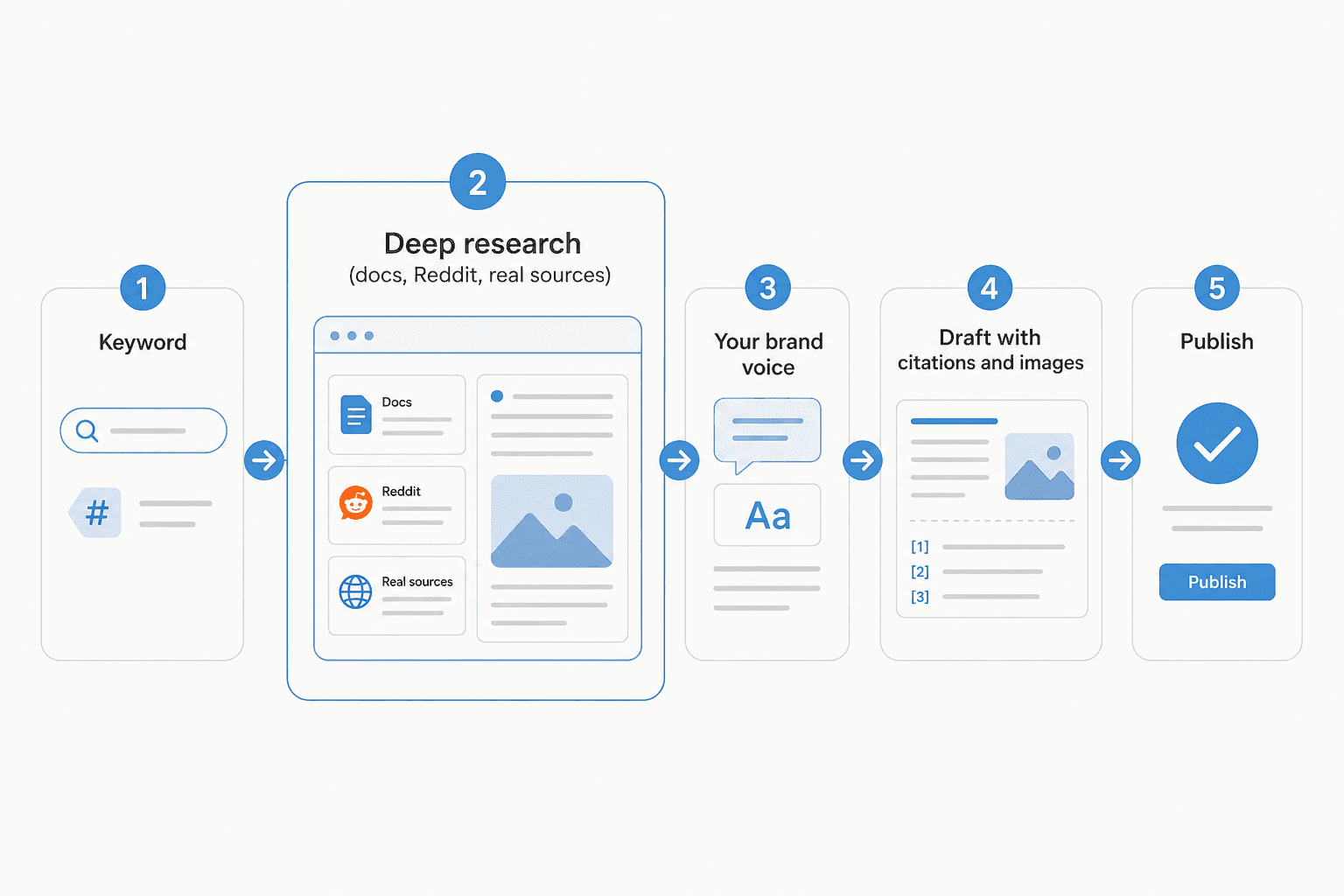
This is the part I can speak to directly, because avoiding generic output is the entire design problem behind eesel's AI Blog Writer. The trick isn't a cleverer model, it's putting the grounding work before the writing.
Every post starts from real research, the product's own docs, community threads on Reddit, real reviews, primary sources, so the draft has actual facts and quotes to cite instead of averaged filler. It writes in a brand voice trained on your existing content, not a generic register. And it carries that brand context across every post, so the hundredth article sounds like the first.
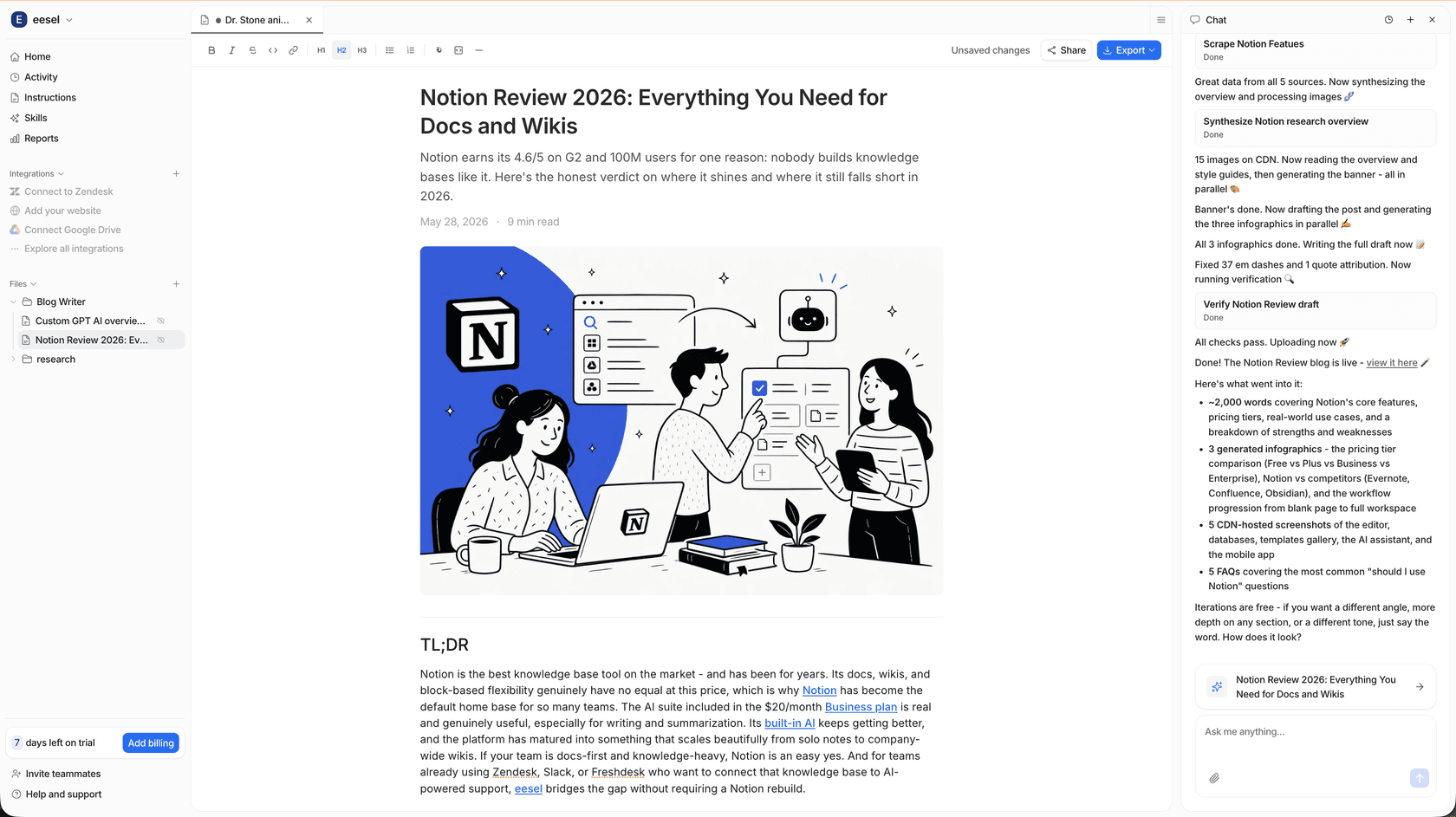
The result, when it works, is a 2,000 to 2,900-word post with a hero image, infographics, FAQs, and internal links in roughly 12 to 20 minutes, in whatever language you write in. One German e-commerce brand ran this pipeline over a dozen times across different keywords and got consistent, on-brand posts each time, not a folder of interchangeable AI drafts.
I'll be honest about the limit, because pretending otherwise would be its own kind of generic: AI doesn't remove the human judgment step. The best results we see come from teams who anoint one great post as the "north star" template and hold every future generation to it, reviewing and nudging rather than publishing blind. The tool gets you a genuinely good draft fast; a human still decides it's good. If you want a deeper look at where these tools land, our honest review of AI blog writers and the breakdown of why AI posts don't rank both go further.
Try eesel
If your AI posts keep coming out generic, the fix is grounding, and that's exactly what eesel's AI Blog Writer is built around: deep research before drafting, a brand voice trained on your own writing, real citations, and E-E-A-T-minded structure, from a single keyword.
You get $50 of free usage and two free blog generations to test it on your own topics, no credit card needed. Try eesel and see whether a grounded draft reads like your team instead of the internet's average.
Frequently Asked Questions
Why do AI blog posts sound so generic?
How do I stop my AI blog posts from sounding generic?
Will Google penalise AI-written blog posts?
Do AI humanizer tools fix generic-sounding content?
Can an AI blog writer actually match my brand voice?


Article by
Riellvriany Indriawan
Riell is a designer and writer at eesel AI with about two years of experience researching CX platforms, AI chatbots, and helpdesk software. She combines her design background with a sharp eye for how these tools actually look and feel in practice — making her comparisons unusually visual and user-focused.