AI writing tools are pretty much everywhere you look these days. They’ve popped up in schools, offices, and especially in marketing. And right alongside them, AI detection systems have shown up, trying to tell the difference between human and machine-written text.
This has created some uncertainty. People are getting worried their work will be flagged by mistake. Maybe you're a student worried about a false plagiarism claim, or an SEO specialist who's heard that AI content might get penalized by search engines. The anxiety is understandable.
But this guide isn't about how to trick an algorithm. Attempting to do so is often a short-term strategy. The real aim is to use AI in a smart way to create genuinely good, authentic content that people actually want to read. It all comes down to making sure your writing feels human. The best way to do that is to use a tool that creates human-like content from the get-go, like the eesel AI blog writer, rather than trying to fix robotic-sounding text later.
Understanding AI detection
If you want to create content that doesn't set off any alarms, you need to know how these detectors operate. They're not magic, and they are far from perfect. Think of them as pattern-recognition systems on the lookout for statistical clues that suggest a robot was behind the keyboard.
The mechanics of AI detectors
At their core, AI detectors are all about probability. They scan text and look for patterns that are common in stuff generated by large language models (LLMs). They analyze statistical indicators rather than determining absolute truth.
It's really important to remember these tools aren't foolproof. They make mistakes and produce false positives all the time. Just spend a few minutes on any writing forum, and you'll see tons of stories about detectors flagging 100% human-written work.
This highlights their potential for error, reinforcing the importance of focusing on content quality rather than trying to bypass detection systems.The issue I’m having with Originality (as well as my content team as a whole) is if we put the whole article in it’ll give us a high AI score .. but if we put in a few sections at a time with about 150-200 words etc., it’ll come back high human. Makes 0 sense.

Key signals that AI detectors look for
So, what are these indicators they're looking for? It usually comes down to a few things.
Low Perplexity (or high predictability): "Perplexity" is just a technical term for how predictable a piece of writing is. Human writing is wonderfully all over the place. AI-generated text, however, tends to play it safe by picking the most statistically likely next word. For example, after "I picked up the kids and dropped them off at...", an AI would almost always say "school." A person might say "the skate park" or "my mom's house." This habit of choosing the obvious makes AI text feel smooth but also somewhat uniform and generic.
Low Burstiness (or high uniformity): Think about how you actually talk. You probably use some short, quick sentences and then some longer, more detailed ones. That mix is called "burstiness." Humans do it naturally. AI models? Not so much. They often produce text where sentences are all about the same length and structure. This lack of rhythm is a big red flag for detectors. It's like a song that only has one note.
The wrong approach: Why tricking detectors fails
Before we get into what actually works, let's cover what doesn't. Lots of people look for a quick fix or a "hack" to get around AI detectors, but these methods are unreliable at best and usually cause more trouble than they're worth.
Why AI "humanizers" can fall short
Tools like Undetectable AI or StealthGPT are designed to "humanize" AI-generated text by rephrasing sentences to sound more natural. While the goal is to bypass detection, the resulting text can sometimes be awkward, clunky, or just strange. The rephrasing algorithms can alter the original meaning or create sentences that are grammatically incorrect. Even worse, they may not always be effective, a sentiment echoed by users who have tested multiple tools.
This example illustrates the potential unreliability of such tools.Most tools: Got flagged as AI (even after “humanizing”). Added grammar errors (Grammarly was pissed). Made text sound like a robot trying too hard.
On top of that, AI detector companies are always updating their algorithms. A bypass tool that works one week might get your content flagged the next. This creates an ongoing cycle of updates between bypass tools and detection algorithms.
Superficial manual edits that don't work
Some people try to get clever with manual edits. They'll add intentional typos, swap out letters with similar-looking characters (like a Cyrillic 'a' for a Latin 'a'), or use symbols instead of words.
This approach is not recommended. These tricks might have fooled some very basic detectors in the early days, but today's systems are much more sophisticated. They analyze deep linguistic patterns, not just what's on the surface. This can harm the readability and professionalism of the work for little to no benefit.
The AI detection arms race
The bottom line is that AI detection technology is always improving. Relying on bypass tools is a short-term strategy that won't last. It’s like trying to patch a sinking boat with tape.
Major research labs like OpenAI are already looking into things like text watermarking, which would embed an invisible signal into AI-generated text to make it easy to trace. While the current methods aren't perfect and can be bypassed, they show a future where telling AI content apart could become much easier. The only strategy that will work long-term is to focus on creating high-quality, authentic content from the very beginning.
The right approach: 6 strategies for authentic writing
So, if trickery is out, what's the alternative? The best way to steer clear of AI detection is to focus on creating genuinely useful and authentic content that a real person would want to read. Here are six strategies that work because they put quality first.
1. Use AI as an assistant, not the writer
Think of your AI tool as a brainstorming partner or a speedy research assistant, not the actual writer. Use it to generate outlines, summarize complicated articles, or suggest different ways to phrase a sentence you’ve already written. The main ideas, the arguments, and the final words have to come from you. This approach fits perfectly with eesel AI’s philosophy of AI being a teammate that helps people do their best work, not a machine that replaces them.
2. Add your unique voice and personal stories
This is one of the most reliable methods. An AI can't copy your personal stories, your unique opinions, or the specific examples you've picked up from your own life and work. When you write, connect the ideas back to your own experiences. Share a quick anecdote. Offer an original opinion. This adds a layer of authenticity to the text that no algorithm can fake. It’s what makes your writing yours.
walterwrites ai has actually been the only tool that consistently helped me drop detection scores across GPTZero, Originality ai and even Turnitin’s new update. been using it in enhanced mode + light manual tweaks and most of my stuff reads naturally and passes 98%+ human
3. Vary your sentence structure and avoid common AI words
Remember "burstiness"? It's time to use it. Read your work out loud. Does it sound flat? Does it have a robotic, even pace? If it does, start mixing things up. Combine short, direct sentences with longer, more detailed ones. This simple change can make your writing feel much more dynamic and human.
Also, keep an eye out for those overused AI phrases. According to many user discussions and articles, words and phrases like "delve," "underscore," "pivotal," "tapestry," "in conclusion," and "unleash" are instant red flags. Replace them with more specific, natural language.
4. Never copy-paste, always rewrite and refine
This is a critical step. Never, ever copy and paste text directly from an AI tool into your final document. Treat any AI-generated text as rough notes or a very early draft. Read it for ideas, get the key points, then close the window and rewrite the whole thing in your own words. This forces you to really understand the information and naturally add your own style, voice, and interpretation.
5. Fact-check every claim and source
AI models are known for "hallucinating," which is a nice way of saying they make things up. They can invent facts, cite studies that don't exist, and create quotes from nothing. Carefully checking every piece of information not only stops you from sharing misinformation but also makes you engage more with the topic. As you check sources and look at the data, your understanding will get better, and the final article will be stronger and more original because of it.
6. Be transparent and cite AI when appropriate
In many school and work settings, honesty is the way to go. Always check your institution's or company's rules on using AI tools. If it's allowed, think about adding a short disclosure statement explaining how AI helped you. For example, you could say, "ChatGPT was used to brainstorm initial topic ideas and generate a preliminary outline." This kind of transparency builds trust with your audience and helps you avoid any confusion about the originality of your work.
| Do | Don't |
|---|---|
| Use AI for outlines and research summaries | Rely on AI to write entire sections from scratch |
| Add personal stories and unique insights | Use generic, predictable examples |
| Mix short and long sentences | Write in a monotonous, uniform rhythm |
| Rewrite and rephrase AI output in your own words | Copy and paste text directly from an AI tool |
| Fact-check every statistic and claim | Trust AI-generated facts without verification |
A smarter way forward: Using the eesel AI blog writer
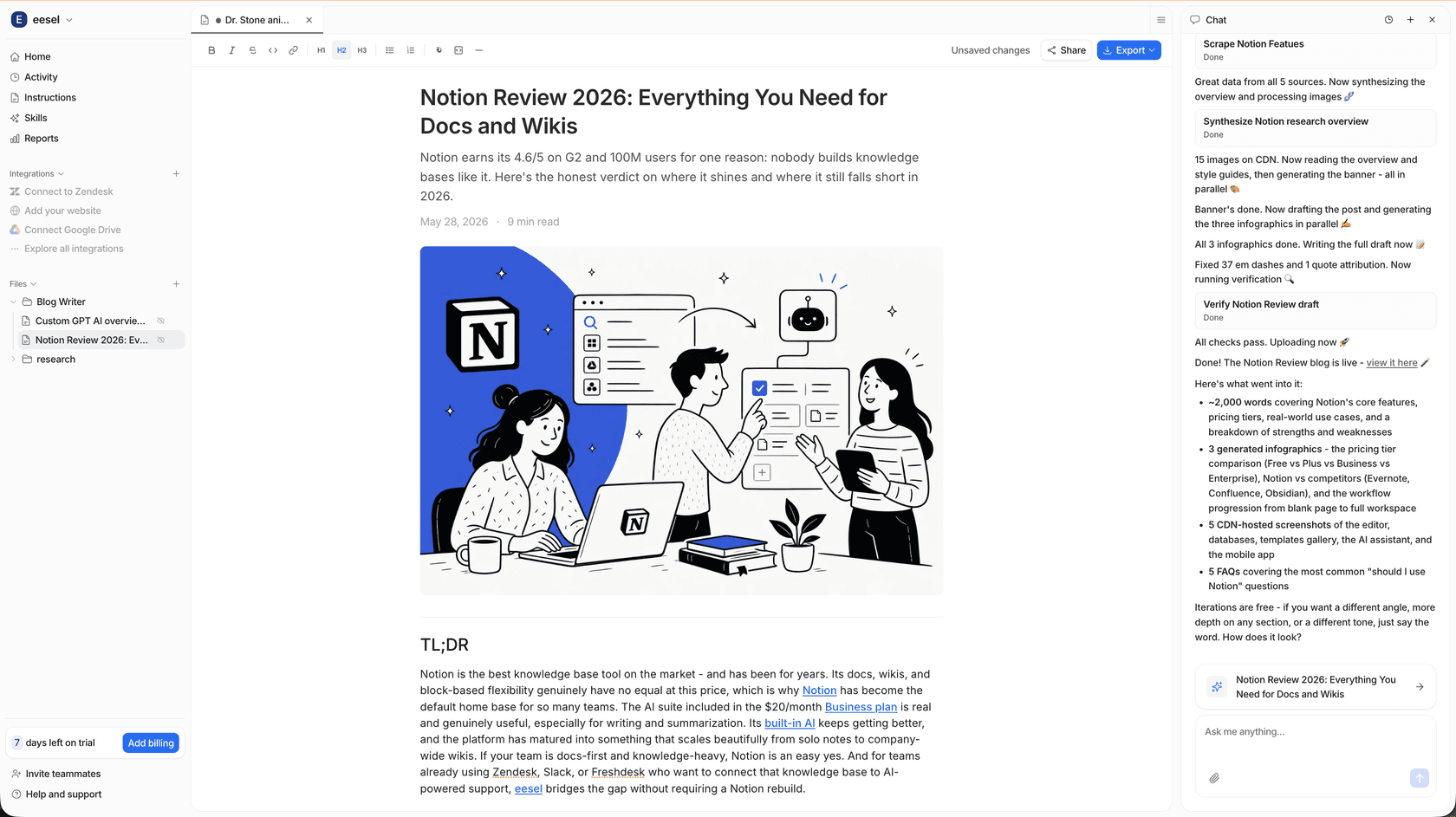
Instead of getting robotic text and then spending hours trying to make it sound human, it's a lot smarter to use a tool that's designed to produce high-quality, natural-sounding content right from the start. This is exactly what the eesel AI blog writer was built for.
How it creates content that reads like a human wrote it
-
Context-Aware Research: Generic AI models often create shallow content because they don't have real context. eesel AI is different. It pulls specific, relevant information based on the kind of blog post you’re making. If you're writing a product comparison, it will find technical specs and pricing. For a listicle, it finds relevant data and examples. This leads to content that is more detailed, nuanced, and much less predictable.
-
Authentic Social Integration: This is a big one. The eesel AI blog writer can embed real Reddit quotes and forum discussions directly into the blog post. This adds a layer of genuine human perspective and voice that a standard AI just can't create. It naturally makes the content more "bursty" and feel connected to real-world conversations.
-
A Refined, Human Tone: The AI voice model behind eesel has been worked on for over a year to sound natural, conversational, and interesting. It actively avoids the overly formal and repetitive language that AI detectors are trained to find.
-
Complete with Rich Assets: The eesel AI blog writer doesn't just give you a block of text. It creates a complete, publish-ready blog post with AI-generated images, infographics, tables, and proper formatting. This shows both readers and algorithms that this is a well-made, high-effort article, not just low-quality AI filler.
We used this exact tool to grow our own blog from 700 to 750,000 daily impressions in just three months.
It is available to try for free and generate your first complete, SEO-optimized blog post in minutes.
For a deeper visual dive into these techniques, the following video offers practical tips on how to manually humanize AI-generated text to ensure it passes detection while maintaining high quality.
Moving forward with authenticity
Ultimately, avoiding AI detection isn't about finding some clever loophole or outsmarting an algorithm. It's about returning to the basics of good writing: being authentic, sharing personal insights, and making high-quality content that actually helps your reader.
The best way to avoid being flagged is to create work that is clearly yours. Use AI for what it's good at, making your process better, speeding up research, and helping with writer's block, but don't let it take the place of your own thoughts, your own voice, and your own unique point of view.
For those looking to create more content without losing that human element, using a tool built for quality from day one can be beneficial. The eesel AI blog writer is one such tool available to try and can help create publish-ready posts that connect with real people and do well in search results.