
AI writing tools seem to be everywhere you look, popping up in marketing workflows and promising to generate a full blog post in just a few seconds. It sounds great, doesn't it? But before you jump in, it's important to understand what you're really getting, both the amazing benefits and the genuine downsides. The key is to find a tool that gives you the good stuff while actively tackling the cons, which is what modern platforms like the eesel AI blog writer are built for. This article will break down the pros and cons of AI blog writers so you can make a smart choice for your business.
What exactly is an AI blog writer?
At its heart, an AI blog writer is a tool that uses large language models (LLMs) to create long-form content, like articles and blog posts, from a simple prompt or keyword.
You can think of it as a specialized version of a general chatbot. While something like ChatGPT is useful for a wide variety of tasks, an AI blog writer is built specifically for content marketing. It includes features for things like SEO, research, and formatting, making it a much more focused tool for the job. These tools operate by sifting through huge amounts of text from the internet to learn patterns, context, and writing styles, which they then use to create new content.
The most advanced tools take it a step further. They use methods like Retrieval-Augmented Generation (RAG) to pull in current information from specific documents or the web. This helps them generate content that’s not just new but also much more accurate, which is a pretty big deal.
The advantages of using an AI blog writer
The appeal of AI writers goes beyond just speed. They offer strategic advantages that can help businesses scale their content marketing efforts, automating the most time-consuming parts of the process.
Unmatched speed and efficiency
This is the big one. An AI can produce a first draft in minutes, a task that would take a human writer several hours. For teams that need to publish a lot of content to stay visible and competitive, this is a huge help. One study found that writing a blog post took an average of just 16 minutes with AI compared to 69 minutes for a human writer. That’s a ton of time saved that can be used for other important tasks.
Significant cost savings
Hiring a full-time writer or even freelancers can be expensive. An AI tool, on the other hand, typically involves a monthly subscription that costs a fraction of a salary. Some reports suggest that companies using AI-powered tools can reduce content creation costs. This doesn't mean you have to fire your writers. It means you can free them up to focus on higher-value work like content strategy, conducting in-depth interviews, and adding that final creative polish that only a human can.
A powerful solution for writer’s block
We’ve all been there, staring at a blank screen with no clue where to begin. Writer's block can completely throw off a content calendar. AI is a fantastic way to get past this. It can generate outlines, brainstorm different angles, or even draft a few opening paragraphs to get things moving. This helps writers get over that initial hurdle and shifts their role from drafter to an editor-in-chief who guides and refines the content.
Enhanced SEO and AEO capabilities
Most AI writing tools today are built with search engines in mind. They are designed to naturally include relevant keywords, create a logical structure with proper headings, and follow other SEO best practices.
But the landscape is shifting. The best tools are now also built for Answer Engine Optimization (AEO). This means they structure content in a way that’s more likely to be featured in Google's AI Overviews and other AI-powered search results. This is becoming more and more important, as Gartner predicts that by 2026, traditional search engine volume will drop by 25% due to the rise of AI chatbots and answer engines.
The disadvantages of using an AI blog writer
While the benefits are strong, the drawbacks of relying on AI can affect your brand reputation, SEO performance, and audience trust. Understanding these limitations is key to using AI responsibly.
The risk of factual inaccuracies and "hallucinations"
This is a major issue. AI models can sometimes invent facts, stats, or sources and present them with total confidence. This is known as "AI hallucination." It happens because they are essentially very good at predicting the next word in a sentence, and they aren’t designed to say "I don't know."
Publishing incorrect information can seriously damage your brand's credibility. In a well-known case, a lawyer used ChatGPT for legal research, and it cited six fake court cases. This is why human fact-checking isn't just a suggestion; it's absolutely necessary for any content that an AI has touched.
Generic content that lacks a human touch
You can often just tell when something was written by an AI. The tone might be a little flat, the humor doesn't quite work, and it struggles to share genuine personal stories or emotions. It just doesn't have that spark.
You know, I've noticed AI text can sometimes feel a bit robotic or stiff. I wonder if there's a way to make AI responses more human-like and natural? It'd be pretty cool to see AI that can really capture that human touch in writing.

While AI content can look fine on the surface, a 2024 survey revealed that 52% of consumers feel less engaged with content once they realize an AI wrote it. Without an authentic voice, it’s hard to build a real connection with your audience. Experts refer to this as a "detectable stylistic fingerprint" that makes a lot of AI content feel bland and unoriginal.
Ethical concerns and copyright risks
Because AI models learn from a vast amount of content scraped from the web, there’s a chance they might produce text that’s a bit too similar to the source material. This can lead to accidental plagiarism if you aren't careful.
The legal side gets a little murky, too. Plagiarism is an ethical problem about not giving credit, while copyright infringement is a legal problem. AI complicates the traditional way of citing sources, making it difficult to trace where an idea originally came from. On top of that, since an AI isn’t a person, the content it creates might not be eligible for copyright, which means other people could potentially use it without permission.
SEO challenges and E-E-A-T compliance
Google has been clear that it rewards high-quality, "people-first" content. Their ranking systems are based on a concept called E-E-A-T, which stands for Experience, Expertise, Authoritativeness, and Trustworthiness.
Here’s the issue for AI: it can't have real, first-hand "Experience." An AI has never actually used the product you’re reviewing or visited the city you’re writing a travel guide about. This makes it very difficult for content generated only by an AI to meet Google’s standards for that crucial Experience factor.
It's important to note that Google doesn't penalize you just for using AI. It penalizes low-quality, unhelpful content, no matter who (or what) wrote it. For instance, one study found that a staggering 83% of the top results on Google were written by humans.
Finding the right balance with AI blog writers
The solution isn't to choose between human or AI, but to create a hybrid workflow that uses the best of both. The idea is to use AI as a powerful assistant that handles the tedious work, not as a replacement for human expertise and creativity.
My advice is to use AI as an assistant, so to generate post ideas, article outlines, and so on.
From drafter to editor-in-chief: The modern AI workflow
The smartest way to use AI is for the initial grunt work: research, outlining, and getting that first draft on the page. Then, a human writer can step in to add the final polish, strategic insights, and an authentic voice. This approach boosts productivity without sacrificing quality.
The eesel AI blog writer is built for this exact collaborative workflow. Instead of just giving you a wall of text that you have to fix, it produces a complete, publish-ready post that’s designed for a human to review and improve.
How advanced AI writers address common drawbacks
Many generic AI tools may fall short because they don't have any specific context about your brand or the topic you're writing about. The eesel AI blog writer is different because it’s designed to tackle the biggest drawbacks of AI content directly:
- Reduces generic content: It starts by analyzing your website to learn your brand voice. This lets it automatically add natural, contextual mentions of your products, so the content sounds like you.
- Adds authenticity and "Experience": To combat that flat, robotic tone, it automatically integrates real Reddit quotes and relevant YouTube videos. This brings genuine human perspectives and social proof into your content, adding a layer of authenticity that generic AI can't replicate.
- Improves accuracy: Its context-aware research pulls in the right kind of data for the blog you're writing. If it's a comparison post, it will find pricing info. If it's a product review, it will look for technical specs. This leads to more accurate, useful content and helps avoid those embarrassing AI hallucinations.
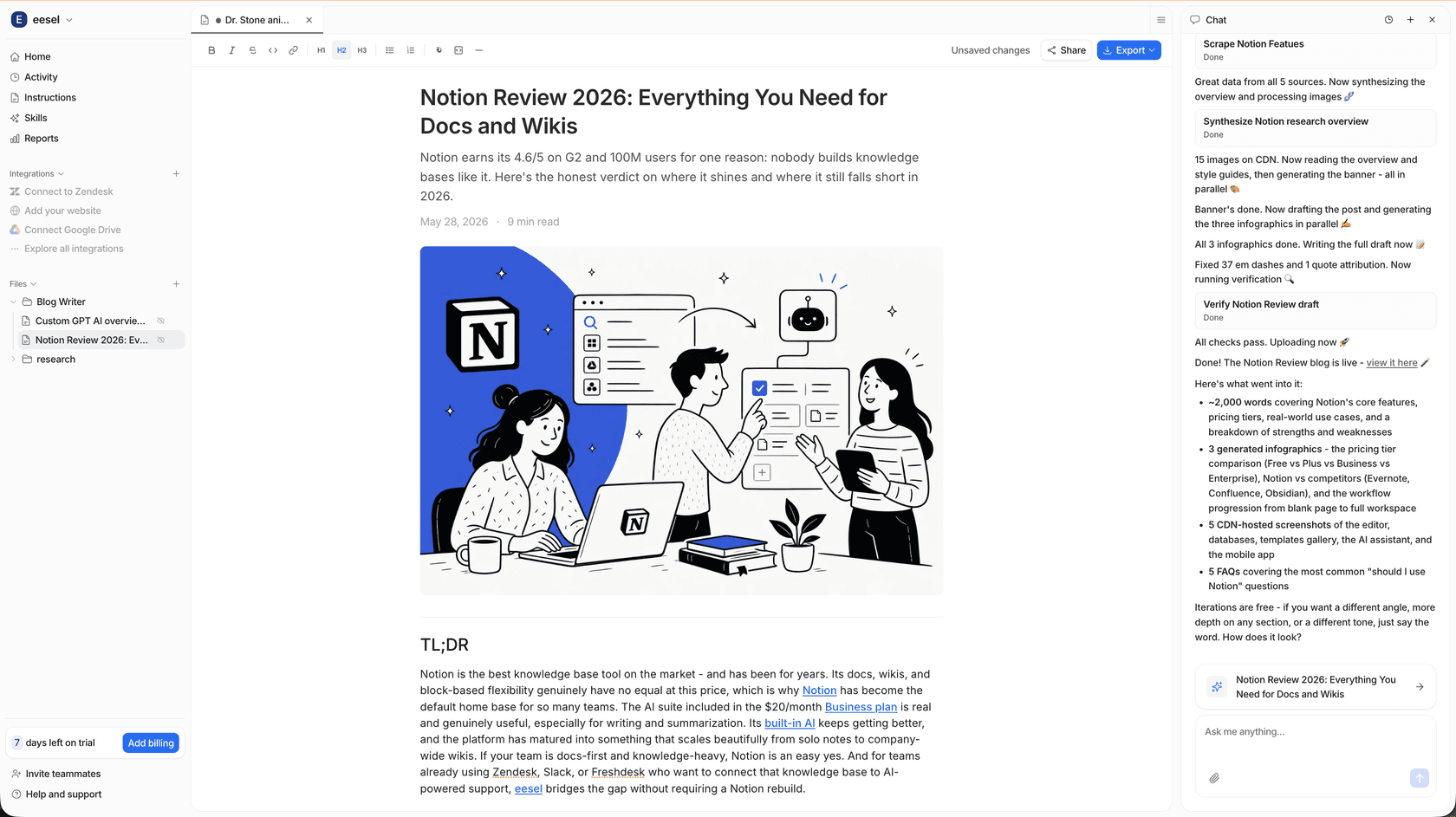
- Saves editing time: It doesn't just write. It generates a complete post with a logical structure, proper headings, and even assets like AI-generated images, tables, and infographics. This saves a massive amount of time on all the formatting and asset creation that usually happens after the writing is finished.
Pro tip
With eesel AI, you can generate a complete, media-rich blog post from a single keyword. We used it ourselves to grow our organic traffic from 700 to 750,000 daily impressions in just 3 months.
Making an informed decision about AI
At the end of the day, AI writing tools can be a double-edged sword. They offer incredible speed and efficiency, but they also come with real risks to your content's quality, credibility, and brand voice.
The best path forward is a hybrid one, where you use AI as an assistant to enhance human creativity, not replace it. Choosing a tool that’s built for this kind of collaborative workflow is one of the most important decisions a modern content team can make.
To see a real-world breakdown of how writers are weighing the benefits and drawbacks of these tools, the following video offers a practical perspective on integrating AI into a freelance writing workflow.
Instead of a basic draft that needs hours of work, what if you could generate a complete, SEO-optimized, and media-rich blog post in minutes? The eesel AI blog writer is completely free to try. Generate your first post today and see the difference for yourself.