Trying to scale your content is tough. You need a steady stream of quality articles to rank on Google, but time and resources are always tight. This gets even harder with Google's focus on helpful, people-first content, which is guided by its E-E-A-T framework (Experience, Expertise, Authoritativeness, Trustworthiness). At first glance, this seems to clash with the speed of generic AI writers.
Many AI tools can produce shallow articles that rehash existing information. This type of content may not add significant value, meet Google's standards, or achieve high search rankings.
The challenge is not with AI itself, but in how it is used. With the right workflow and a tool built for the job, you can create high-quality content that works for both search engines and human readers. We use the eesel AI blog writer to scale our own content, which helped grow our site from 700 to over 750,000 daily impressions in just three months.
This guide will break down what E-E-A-T means, show you the limitations of some AI tools, and provide a practical workflow for creating compliant content.
Understanding E-E-A-T
E-E-A-T isn't a direct ranking factor, but it is the framework Google uses to figure out if your content is any good. Understanding each part is key to writing articles that rank well and connect with an audience.
Experience
Experience is about showing you've actually used the product, visited the place, or dealt with the problem you're writing about. It’s about sharing what you learned from doing something, not just summarizing what others have said. This is where real, personal insights are so valuable. A product review from someone who has used it for months is much more helpful than one based on a spec sheet.
Get experts to provide comment for articles and make sure their expertise is clearly highlighted.

Expertise
Expertise is about your skill and knowledge in a specific field. While experience is about doing, expertise is about knowing. This is especially important for what Google calls "Your Money or Your Life" (YMYL) topics. For subjects like health, finance, or legal advice, bad information can cause real harm. According to Google's search rater guidelines, content in these areas is held to a much higher standard.
Authoritativeness
Authoritativeness is your reputation in your industry. It's about being seen as a go-to source for reliable information. You can't build this overnight. It comes from things like backlinks from other reputable websites, mentions by experts, positive reviews, and a history of publishing accurate content. When other authorities cite you, it tells Google you're a credible voice.
Trustworthiness
Trust is the most important part of E-E-A-T, and the other three elements support it. A reader needs to trust the information you provide, the person who wrote it, and the website it's on. You can build trust by citing credible sources, providing clear author information, having easy-to-find contact details, and making sure everything you publish is accurate. Transparency is key.
Challenges of creating E-E-A-T content with generic AI
A primary challenge with using general AI models like ChatGPT for SEO content is their difficulty in aligning with E-E-A-T principles. They are designed to generate text, which can sometimes fall short of creating helpful, experience-driven content.
Lack of real experience
AI models don't have personal experiences. They can't test a new gadget, share a real story about a business challenge, or offer a unique take from attending an event. Their knowledge comes from processing huge amounts of text from the internet. The content they produce is just a summary of existing information, which goes against Google's focus on first-hand expertise. This results in generic articles that don't connect with readers.
Absence of true expertise and emotional connection
An AI can mimic an expert's writing style, but it lacks genuine expertise and emotional intelligence. It can list facts, but it struggles with the nuanced analysis that comes from deep knowledge. A human expert can explain why a certain feature is a big deal based on years of experience, while an AI can typically only state that the feature exists. This can result in content that feels flat and may not fully engage the audience.
Potential for inaccurate and untrustworthy information
AI models can "hallucinate," meaning they can confidently state incorrect information as fact. Without a human expert to check every claim, using generic AI without verification can pose a risk to your site's credibility. This type of content also often lacks clear sourcing or citations for its claims. For a reader (and for Google), an unsourced statistic is a major red flag for trustworthiness.
For anyone reading: if you’re using AI for content, still double-check factuals. Some tools hallucinate dates/names hard.
Creating E-E-A-T content with the eesel AI blog writer
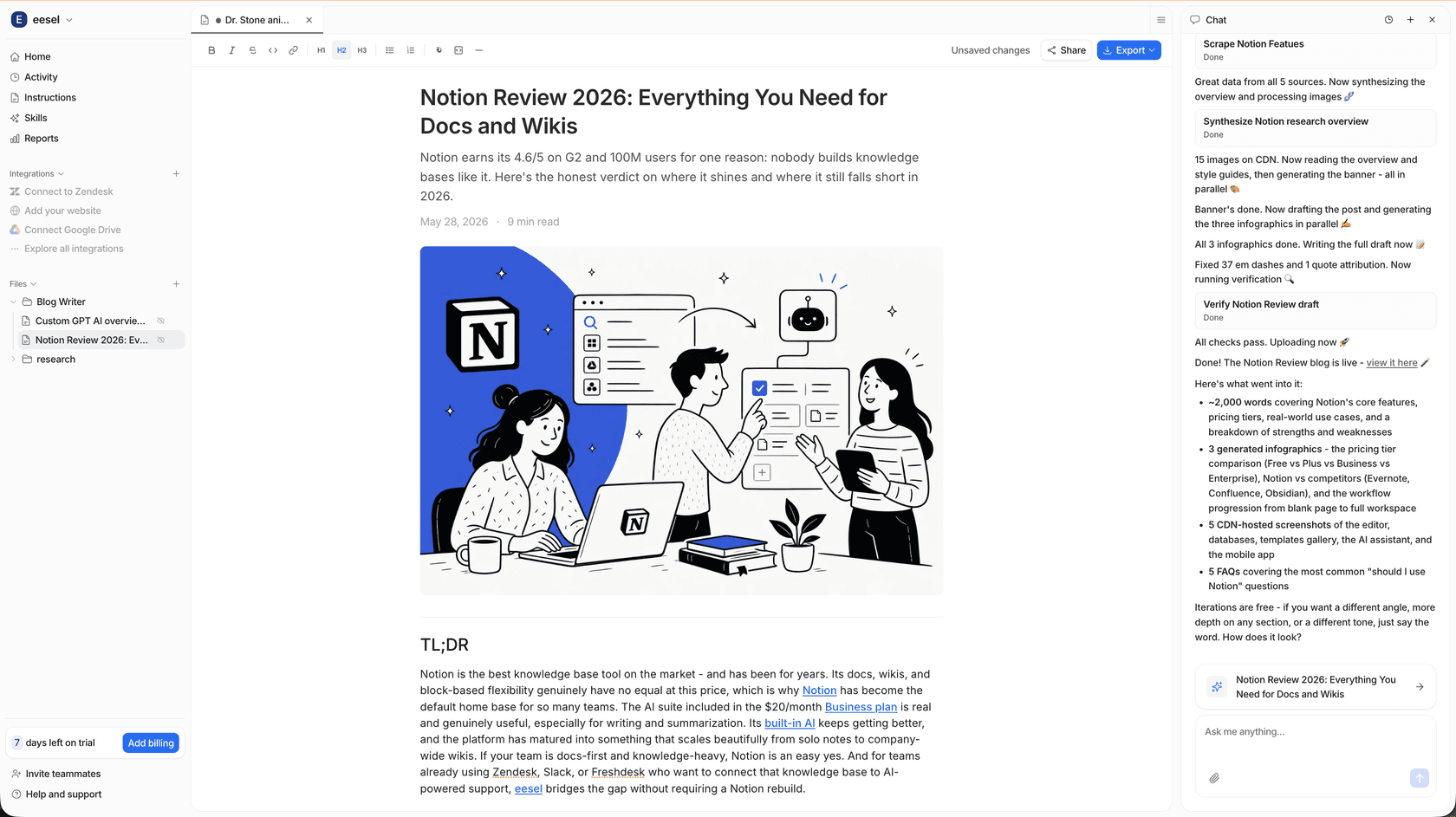
The eesel AI blog writer is a tool designed to address the limitations of generic AI. It's not just a text generator; it's a workflow that helps you produce publish-ready, SEO-optimized content that aligns with E-E-A-T from the start.
Building experience with social proof
To solve the lack of real-world experience in AI content, eesel AI integrates authentic perspectives directly into every article.
- Reddit and Forum Integration: The tool automatically finds and embeds relevant quotes from Reddit and other forums. This adds real, first-hand experiences and social proof from actual users, directly satisfying the "Experience" requirement. Instead of a generic statement, your content can feature a quote from someone who has actually dealt with the problem you're discussing.
- YouTube Video Embeds: The tool also finds and embeds relevant YouTube videos. These often show product demos, expert interviews, or visual tutorials, adding a dynamic layer to your content that text alone can't.
Ensuring expertise with context-aware research
Generic AI tools summarize information without understanding its context. The eesel AI blog writer performs context-aware research based on the type of content you're creating. If you're writing a product review, it will pull technical specs. For a comparison post, it will find pricing tables. This ensures the content is well-researched and contains the specific details readers are looking for.
Establishing authoritativeness and trust
Building authority and trust requires more than just good writing.
- Custom Assets: The eesel AI blog writer automatically generates custom images, infographics, and tables to support the text. This makes each article more comprehensive and visually authoritative.
- Linking and Citations: The tool adds internal links to your existing content and provides external citations to credible sources. These are basic trust signals for both readers and search engines, showing your claims are backed by evidence.
- Brand Context: By letting you add your website and brand context, the tool can naturally include your own product mentions and maintain a consistent brand voice.
Alternative AI workflows for E-E-A-T content
Other methods for creating AI content exist, though they often involve more manual steps to produce E-E-A-T-compliant articles. These workflows show the difference between using AI as a simple writing assistant versus a complete content partner.
The manual ChatGPT workflow
A common approach is using a tool like ChatGPT for a first draft. However, this content often requires significant human editing to be publishable and meet E-E-A-T standards.
The workflow involves generating a draft, manually fact-checking every claim, searching for data, finding quotes or social proof, rewriting sections to add a human touch, and finding credible sources.
Limitation: This process is time-consuming. This process places the responsibility for E-E-A-T compliance on the editor, positioning the AI primarily as a tool for generating first drafts.
Using Perplexity for research
AI answer engines like Perplexity.ai are great for research. They provide up-to-date, sourced answers from across the web, helping you find stats and sources quickly.
Limitation: These are research tools, not content writers. After gathering information, you still have to manually structure the blog post, write the narrative, add your own experience, and create visuals. This separates research and creation into two different steps, a process that the eesel AI blog writer combines into one.
For a deeper dive into applying these principles, the following video provides a practical walkthrough on how to structure a blog post with AI while keeping E-E-A-T at the forefront.
Use AI as a partner, not just a writer
It is possible to create E-E-A-T content with AI. The trick is to stop using AI as just a writer and start using it as a partner that can research, integrate real-world experience, and build trust signals automatically.
A purpose-built tool handles the heavy lifting of research, sourcing, and asset creation. This frees you up to focus on strategy and add the final human polish that makes your content stand out.
By focusing on quality and E-E-A-T principles, you can use AI to support your content strategy without negatively impacting your rankings. Generate your first complete, E-E-A-T-optimized blog post for free with the eesel AI blog writer and see the difference for yourself.