A realistic guide to SEO and AI generated content

Stevia Putri

Katelin Teen
Last edited January 14, 2026
AI content tools are everywhere now, promising to write a whole blog post in the time it takes to make a coffee. But it's left a lot of us wondering: is this stuff actually good for SEO?
If you've spent any time online, you've seen the mixed bag of results. Some people are shouting from the rooftops about their traffic exploding, while others are quietly nursing a penalty from Google. The reality is, AI isn't a magic bullet or a poison pill. It all comes down to how you use it.
Understanding the basics of SEO and AI-generated content
First, let's get on the same page. AI-generated content is exactly what it sounds like: text, images, or any other media created by a machine.
Behind the scenes, you've got things called Large Language Models (LLMs) that have been trained on staggering amounts of text and data from the internet. They learn all the patterns and nuances of human language so they can predict the next best word in a sentence. That’s how they can write text that feels like a person wrote it.
You know the big names like ChatGPT, Google Gemini, and Claude. They're great all-rounders. But for SEO purposes, it helps to break down AI content into three categories:
- AI-generated: This is the raw output. You give a prompt, you get text back, and that's it.
- AI-automated: This is when you use AI to pump out content on a massive scale with little to no human checking in.
- AI-assisted: This is the sweet spot. A human uses AI for the heavy lifting like brainstorming and drafting, but they are deeply involved in editing, fact-checking, and adding their own unique flavor.
An infographic comparing the three tiers of AI content creation: AI-generated, AI-automated, and AI-assisted.
As we'll see, that last category is where you'll find SEO success.
Google's take on SEO and AI-generated content
So, what's the verdict from Google? They've been surprisingly straightforward about it, and it all boils down to one word: quality.
Google’s job is to show people original, high-quality, people-first content. They even have a whole system for it called E-E-A-T, which is short for Expertise, Experience, Authoritativeness, and Trustworthiness. The main point is that Google doesn't care if a human or an AI made the content. It only cares if the final piece is actually helpful to the person reading it.
What will get you in trouble is using AI or any automation just to try and manipulate search rankings. That's a big no-no and a direct violation of Google's spam policies. They now call this "scaled content abuse." It’s what happens when sites churn out hundreds of low-quality, keyword-stuffed articles hoping to trick the system. That's what Google is trying to eliminate.
Ai content can rank, even if it's 100% detected as AI by detection tools (that by the way have an insane amount of false positives). Google said that AI was not ok but then started to actually compete with ChatGPT luckily, and now AI is fine to use for all of us as Google changed its position from 'AI content Is spam' to 'well if AI content Is good then it's still quality content'.

And they are taking it seriously. The March 2024 core update was a clear warning shot aimed at this exact problem. Google said that the update, along with their other work, cut unhelpful content by 45%. The message is loud and clear: they're focusing on quality.
It's also worth remembering that Google has thousands of human quality raters who manually review websites. These people use a massive, 181-page guide to judge content. They're specifically told to look for stuff that seems automatically generated and can give it the lowest possible score if it's clear a human wasn't involved in making it valuable.
The problems with a fully automated strategy
It's tempting to just take the raw text an AI spits out and slap it on your blog. Easy, right? Unfortunately, that shortcut is paved with some serious risks that can absolutely tank your SEO.
Lack of originality
AI models learn from the internet as it exists today. That means they're great at summarizing what's already out there, but they're not so great at coming up with brand-new ideas. This creates a ton of "consensus content": a bunch of articles that all say the same thing in slightly different words.
This kind of content doesn't offer any "information gain." It doesn't give the reader a fresh take, a new piece of data, or a personal story. When everyone uses AI with similar prompts, you get a dozen blog posts that are basically clones. It’s boring for readers and makes it almost impossible to rank.
Factual errors and hallucinations
This is a huge one. LLMs are just predicting the next word, which means they can sometimes just make stuff up and sound completely confident about it. These are called AI "hallucinations," and they can be anything from a small incorrect detail to a totally fabricated quote or statistic. A survey on hallucinations explains it as content that reads well but is factually bunk.
How often does it happen? A 2026 study showed that in some clinical fields, LLM hallucination rates could be as high as 50% to 82%. That's a massive gamble, especially for "Your Money or Your Life" (YMYL) topics like finance or health, where being wrong is not an option. Publishing bad information won't just hurt your SEO; it can wreck your reputation.
E-E-A-T challenges
Let's go back to E-E-A-T, specifically that first "E" for Experience. An AI has never actually used a product, led a project, or learned something the hard way. It has zero personal experience.
This makes it very difficult for a purely AI-written article to check all of Google's people-first content boxes. An AI can't tell a relatable story, share a genuine opinion, or offer a lesson learned from experience. Without that human element, the content feels flat and generic, which is a red flag for both readers and Google.
How to succeed with AI-generated content for SEO
Alright, so we've established that the "generate and publish" method is a no-go. But that doesn't mean you should throw AI out the window. Not at all. The trick is to stop thinking of it as a writer and start treating it like an assistant.
Treating AI as an assistant
The smartest and most sustainable way forward is a hybrid approach. You combine the speed of AI with the creativity and knowledge of a human. Think of AI as the world's fastest research assistant and first-drafter.
AI-generated content can definitely rank well, but only if it’s edited and optimized properly. Google doesn’t penalize AI content just because it’s AI-written; it only cares about quality, originality, and usefulness. The key is to treat AI as your assistant, not your writer.
Let AI do the grunt work:
- Brainstorming topics and different angles
- Doing the initial research
- Creating a detailed outline
- Writing the first draft
The hybrid AI-human workflow combines AI drafting with human expertise for the best results in SEO and AI generated content.
Then, a human expert needs to come in. Their job is to edit, fact-check, inject the brand's voice, add unique stories, and make sure the final piece is genuinely helpful. This human review is what turns a generic AI draft into something that meets Google's helpful content standards.
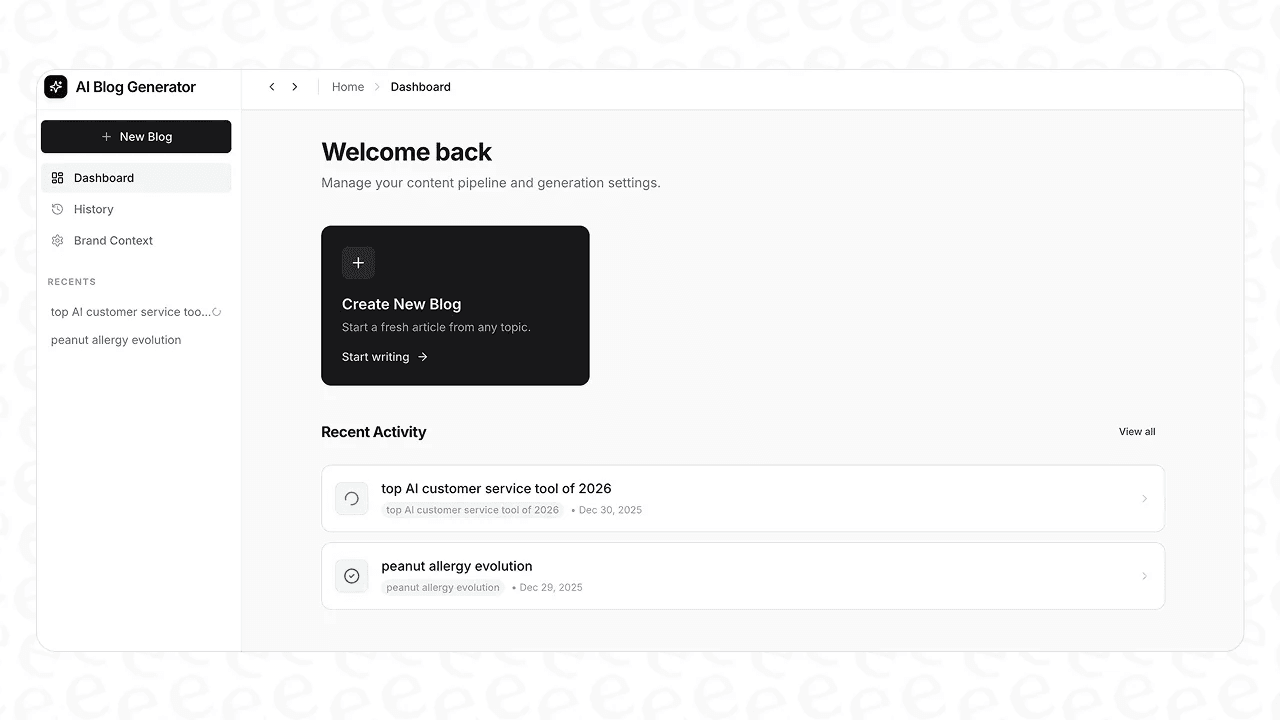
Bridging the quality gap with eesel AI
Here’s what makes it different:
- Complete, structured posts: It doesn't just give you text. It creates a fully formed article with an introduction, logical headings, a conclusion, and all the right formatting. You get a solid starting point, not a mess you have to fix.
- Automatic asset generation: This saves a ton of time. The tool automatically creates and adds relevant images, tables, and infographics to the post, making it more engaging from the start.
- Real-world context: This is huge for E-E-A-T. The eesel AI blog writer can pull in relevant Reddit quotes and embed YouTube videos. This adds a layer of social proof and real human experience that a generic AI could never find.
This system works. It’s exactly what we used at eesel to jump from 700 to 750,000 impressions per day in just three months by publishing over 1,000 optimized blogs.
Incorporating user intent into your process
The old saying "garbage in, garbage out" is especially true here. The quality of your AI-assisted content is directly tied to the quality of your instructions. A simple prompt like "write about SEO" won't cut it. You need a detailed brief.
Here's what to include in your prompts:
- Keywords: List your main and secondary keywords.
- Structure: Give it a detailed outline with the exact H2s and H3s you want to see.
- User Intent: Explain who you're writing for and what they're trying to accomplish. Do they need a quick definition or a deep-dive comparison?
- Linking: Tell it which of your own pages to link to and what kind of external sources to cite.
- Brand Voice: Describe your tone (e.g., "casual and funny," "formal and authoritative") and maybe even paste in a few examples of your writing.
Measuring the ROI of your AI content efforts
So you're publishing content using this new workflow. How do you know if it's actually working? Looking at keyword rankings is a start, but it's only a tiny piece of the puzzle. You need to look at metrics that show people find your content valuable.
Here are a few things to track:
- Engagement: Open up Google Analytics. Are people sticking around to read? Check out metrics like average time on page and scroll depth. High engagement is a great sign.
- Conversions: Traffic is great, but conversions are what matter. See how many people who read your AI-assisted posts go on to sign up for a trial, subscribe to your newsletter, or buy something.
- Share of Voice in AI Search: This is a newer, but important one. Keep an eye on your visibility in Google's AI Overviews and other answer engines. Getting featured there shows your content is seen as authoritative and can bring in great traffic.
Tracking these metrics will give you a clear picture of what's working. For a deeper dive into how AI content performs in the real world, check out this case study that explores whether Google actually penalizes AI-generated content.
Final thoughts on SEO and AI content
AI content isn't the SEO-killer some people feared it would be. Bad content is the killer, and it always has been. The future of content marketing isn't about replacing your team with AI; it's about giving them better tools to work with.
By using AI for its speed in research and drafting, and then relying on human experts for the critical work of editing, fact-checking, and adding real value, you can produce more content without sacrificing quality. It's the best of both worlds.
Ready to see what this workflow feels like in practice? Generate your first blog free with the eesel AI blog writer and see the difference for yourself.

Frequently Asked Questions
Share this article

Article by
Stevia Putri
Stevia Putri is a marketing generalist at eesel AI, where she helps turn powerful AI tools into stories that resonate. She’s driven by curiosity, clarity, and the human side of technology.