A practical guide on how to write SEO focused content

Amogh Sarda

Katelin Teen
Last edited January 15, 2026
So, you can write. But can you write content that people actually find, read, and maybe even enjoy? And more importantly, content that Google decides to put on its coveted first page? That's a different beast entirely. If you've ever spent a whole day on a blog post just for it to vanish into the search result abyss, you know exactly what I'm talking about.
Luckily, today's SEO isn't some dark art. It really boils down to two things: giving readers what they want and making sure search engines can see that you're doing it. Nail those two, and you're in business.
This guide breaks it all down into a simple, three-pillar framework that you can use over and over. We'll cover the strategy, but also show you how the right tools can handle the grunt work and make this whole process much, much faster. Let's dive in.
Understanding the fundamentals of SEO content
At its core, SEO writing is creating content with the main goal of ranking high in search engine results pages (SERPs). The catch is that you’re always writing for two audiences: the human who wants an answer and the search engine algorithm that needs to classify your content.
A few years back, this might have involved some clumsy keyword tricks. That approach is a dead end today. Google has been very direct about what it wants: "helpful, reliable, people-first content." The game has shifted from just matching keywords to actually solving the user's problem.
This brings us to the concept of E-E-A-T, which stands for Experience, Expertise, Authoritativeness, and Trustworthiness. It’s the set of standards Google uses to figure out which content is high-quality and deserves a top spot.
When you get this right, the benefits are huge. You start driving organic traffic, building a reputation in your field, and growing your business without constantly paying for ads.
Pillar 1: Research and planning
This first pillar is the bedrock of everything that follows. Skipping research is like trying to build a house without a blueprint; you can be pretty sure it’s going to fall apart. Good research ensures you’re writing about something people care about and gives you a strategic advantage before you even start writing.
Understanding search intent
Search intent is just a slightly more technical way of asking, "What does the user really want?" Figuring this out is non-negotiable.
There are generally four types of search intent:
- Informational: The user is looking for information (e.g., "how to bake sourdough bread").
- Navigational: The user wants to find a specific website (e.g., "YouTube").
- Commercial: The user is doing research before they buy something (e.g., "best running shoes for flat feet").
- Transactional: The user is ready to make a purchase right now (e.g., "buy Nike Air Zoom Pegasus").
How do you find the intent for your keyword? Just Google it. Seriously. Look at what’s already ranking on the first page. Are they in-depth guides? Product comparisons? E-commerce pages? What Google already ranks is your biggest clue. Matching that format is key to keeping people on your page, which sends good signals back to Google.
Conducting effective keyword research
The idea here is to find the actual words and phrases your audience uses, not just the ones you think they use.
You'll want a primary keyword (the main topic) and a few secondary keywords (related terms that add more detail). For instance, if your primary keyword is "how to write SEO focused content," your secondary keywords could be "SEO writing tips," "keyword research," or "on-page SEO checklist."
Pro tip
Paid tools are powerful, but one of the best free resources is Google itself. The 'People Also Ask' section is a treasure trove of questions your audience has. Try to answer these in your article, maybe even using them as subheadings.
Of course, professional tools like Semrush and Ahrefs are great for checking search volume and keyword difficulty. Just don't treat any single metric as gospel. For example, Ahrefs' Keyword Difficulty (KD) score is based only on the number of backlinks to the top pages. It doesn't consider content quality or brand authority, so use it as a guide, not a strict rule.
Outlining your article
With your keywords and search intent figured out, it's time to build an outline. An outline is your roadmap. It gives your article a logical flow that helps the reader, and just as importantly, it helps search engines understand the structure of your content.
Use headings (H2s and H3s) to break your topic into smaller, easy-to-scan sections. This is where you can plan where to place your keywords naturally. A good outline is the key to a comprehensive, readable, and SEO-ready article.
Pillar 2: Writing and structuring
Alright, homework's done. Now it's time to turn that research into an article that people will actually want to read. This part is all about delivering value with clear, engaging writing that’s built for both humans and algorithms.
Writing SEO-focused content with the eesel AI blog writer
Writing a solid, long-form article from scratch can be time-consuming. While many people use AI tools like ChatGPT to get a head start, the process often involves prompting the AI section by section to assemble a full article. This multi-step workflow is a common topic of discussion.
The issue isn't really the AI tool, it's your content production workflow. I've been scaling content for my SaaS with Claude and it keeps performing the best but only if you break longer pieces into 3-4 separate prompts instead of trying to get 2000+ words in one shot.

This is exactly the problem the eesel AI blog writer was built to solve. It’s not just a text generator; it’s designed to manage that whole messy workflow, taking you from a single keyword to a finished blog post that's ready to go live.
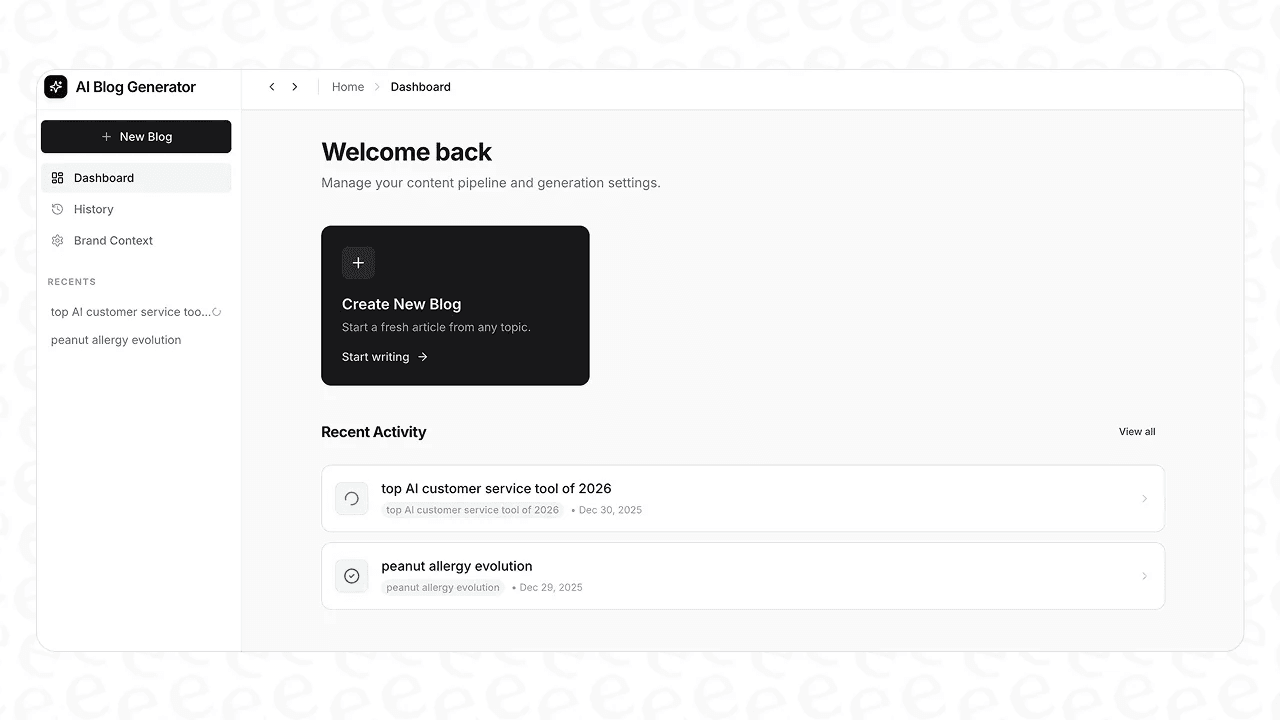
The process is straightforward:
- Start with the keyword you already researched.
- Add your website URL so it can learn about your brand.
- Generate a well-researched article with a full structure, intro, conclusion, FAQs, and media.
What sets it apart from a generic chatbot is what it includes automatically:
- Automatic Assets: It doesn't just spit out a wall of text. It creates and adds relevant images, charts, and tables right into the post to improve readability and engagement.
- Social Proof Integration: The tool finds and embeds relevant Reddit quotes and YouTube videos. This adds a layer of credibility and real-world perspective that pure AI content often lacks.
- SEO & AEO Optimized: The content is structured with proper headings for SEO and is also optimized for AI Answer Engines, like Google’s AI Overviews.
We don’t just recommend it; we use it ourselves. This is the tool that helped us grow our own blog from 700 to 750,000 daily impressions in just three months.
Crafting compelling titles and meta descriptions
Your title and meta description are your article's first impression in the search results. You have to make them count.
- Titles (H1 & Title Tag): Your title has to be a hook. It should always include your primary keyword, preferably near the start. Using numbers ("7 Tips for..."), asking questions ("How Do You...?"), or stating a clear benefit ("...That Gets Results") can boost curiosity. Keep your title tag under 60 characters so it doesn't get cut off.
- Meta Descriptions: Think of this as a 155-character advertisement for your article. It won't directly affect your rankings, but a good one can seriously improve your click-through rate. Include your primary keyword and a clear call-to-action, like "Learn the complete framework for writing content that ranks."
Improving readability
Nobody enjoys staring at a massive block of text. Making content readable is vital for keeping people engaged.
- Use short sentences and paragraphs. Try to stick to 3-4 sentences per paragraph.
- Break down complex ideas with bullet points or numbered lists.
- Use bold and italics to highlight important points and help skimmers find what they need.
- Add high-quality visuals. Images, charts, and videos make the content more interesting and can increase the time people spend on your page.
Use relatively short paragraphs. This ties into something I'd mentioned before: the way people read on a screen tends to differ a bit from how they read on a physical printed page. (You can find eye tracking studies on this.) Web content with short paragraphs is easier to read.
Pillar 3: Post-writing optimization and promotion
Hitting "publish" feels great, but your job isn't over. This last pillar is about making sure your new content gets the attention it deserves.
Using smart internal and external links
Links are a fundamental part of how the internet works, and they are critical for SEO.
- Internal Linking: This means linking to other relevant articles on your own site. It helps search engines find your other content and understand how your site is structured. It also spreads authority between your pages and keeps visitors on your site longer.
- External Linking: Don't hesitate to link out to other credible sources to support your claims. This builds trust with your readers and with search engines. Just be sure to use descriptive anchor text (e.g., "according to Google's helpful content system") instead of something generic like "click here."
Optimizing images and media
Every image on your page is another chance to improve your SEO.
- Alt Text: This is the text that describes an image for screen readers or if the image doesn't load. Write a clear, descriptive alt text for every image you use. If it makes sense, include your keyword.
- File Size: Large image files slow down your page, and page speed is a big ranking factor. Use a tool to compress your images before you upload them.
- File Names: Before uploading, give your images descriptive file names like "seo-content-planning-outline.jpg" instead of "IMG_1234.jpg".
Promoting your work
You can't just publish and hope for the best. You need to get your content in front of people.
- Share your new article on your company's social media channels, like LinkedIn or X.
- Send it to your email newsletter subscribers. They're an engaged audience that already wants to hear from you.
- Find relevant online communities on sites like Reddit or industry forums. Share your article where it adds value to the conversation, but avoid just dropping links and leaving.
For more hands-on tips, this video from Ahrefs provides a great step-by-step framework for creating content that not only engages your audience but also satisfies search engines to drive consistent traffic.
Your repeatable workflow for SEO content
So there you have it: the three-pillar process of Research & Plan, Write & Structure, and Optimize & Promote.
The most important thing for SEO success is consistency. It’s a long game, and the results from publishing high-quality, optimized content will build on each other over time. But being consistent is hard when the process is slow and manual.
The right tools can make all the difference. By using something like the eesel AI blog writer to handle the "Write & Structure" part, you can turn the most time-consuming step into a fast and repeatable workflow.
Instead of just writing faster, what if you could consistently create content that’s already built to rank? The eesel AI blog writer is the tool that took us from 700 to 750,000 daily impressions. It's completely free to try—generate your first publish-ready blog post today and see for yourself.

Frequently Asked Questions
Share this article

Article by
Amogh Sarda
CEO of eesel AI. Amogh Sarda is obsessed with making the ultimate AI for customer service teams. He lives in Sydney, Australia and has previously worked at Atlassian and Intercom. Outside of work he’s usually surfing or on stage doing improv.