A practical guide to using AI generated content for SEO

Amogh Sarda
Last edited January 14, 2026
When generative AI hit the mainstream, the content world pretty much flipped on its head. Suddenly, writing a blog post in seconds seemed possible. But that raises a huge question: Can you actually use AI generated content for SEO to climb Google's ranks, or is it just a fast track to a penalty?
The truth is, it's not about if you use AI, but how. The goal hasn't changed: create valuable, human-first content that actually helps people. The difference is that today's AI tools can help you do that at a scale that was once unthinkable.
We’ve seen this happen ourselves. By using the eesel AI blog writer to create helpful, detailed content, we grew our own blog from about 700 to 750,000 daily impressions in only three months. The trick wasn't just automation; it was using AI as a partner to produce top-notch content that people and search engines both appreciate.
What is AI generated content?
Today's AI-generated content is a world away from the clunky "article spinners" of the past. We're now talking about sophisticated text, images, and other media created by Large Language Models (LLMs). These models can even use advanced techniques like Retrieval-Augmented Generation (RAG) to pull info from specific, current data sources, creating content that's not just original but sounds surprisingly human.
This technological jump has shaken up the SEO world. Gartner even predicts that traditional search volume will drop by 25% by 2026. Why the drop? More people are getting answers directly from AI chatbots and Google's AI Overviews. This shift makes it more important than ever to publish high-quality, thorough content that establishes you as the go-to source on a topic. Churning out thin, generic articles just isn't going to work anymore.
Google's official stance on AI generated content for SEO
So, what's Google's take on all this? It's pretty simple: they reward helpful content. They don't really care if it was written by a human, an AI, or a team of both. What matters is the quality and value it gives the reader.
The E-E-A-T framework is the gold standard
The thin line between helpful content and spam
Google has been crystal clear on one thing: using AI to manipulate search rankings is not okay. Their March 2024 spam policy update specifically went after "scaled content abuse." This means generating tons of low-quality pages, with or without AI, just to game the system instead of helping people.
The intent behind your content is what counts. Are you making it to provide real value, or are you just trying to flood the SERPs with keyword-stuffed pages?
A real-world experiment by SE Ranking shows this risk perfectly. They set up 20 new websites and filled them with nothing but unedited AI content. A few sites saw a quick traffic boost, but every single one of them lost all their rankings and traffic within three months. It’s a good reminder of the long-term dangers of a purely automated, low-effort strategy.
The risks of relying on unedited AI generated content for SEO
Factual inaccuracies and "hallucinations"
One of the stranger things about AI models is that they can "hallucinate." This is when an AI states something completely false with total confidence. It might make up stats, misquote people, or invent product features. Because it sounds so certain, these errors can easily get missed in a quick review. Publishing false information is a surefire way to hurt your brand's credibility and sink your E-E-A-T signals. Human fact-checking isn't just a suggestion; it's a must.
Lack of original insights and experience
AI models are great at summarizing. They can process millions of articles and pull out the common themes. What they can't do is create a truly original thought or offer a unique perspective from a lived experience. This often leads to content that feels generic and shallow. It might be factually correct on the surface, but it's missing the spark of insight that keeps readers engaged and fails to show the first-hand "Experience" Google is looking for.
Creating content that blends in, not stands out
If you and your competitors are all using the same AI tools with similar prompts, what do you get? A lot of content that looks and sounds exactly the same. You end up with a sea of sameness where nothing is memorable. To rank well and build an audience, you need content with a unique voice, a fresh perspective, and value that people can't find just anywhere. That means you have to inject your own human expertise and personality into the mix.
How to create AI generated content for SEO that ranks
Start with a human-led strategy
Before you even think about writing, you need a solid strategy led by a human. AI can be a great assistant here. You can use it to brainstorm topic ideas, find long-tail keywords, and create detailed outlines. General tools like ChatGPT are useful for this initial brainstorming.
But once you have a plan, you need a tool built for the job to turn it into a high-ranking piece of content. This is when you switch from a general chatbot to a specialized content platform.
Generating publish-ready posts with the eesel AI blog writer
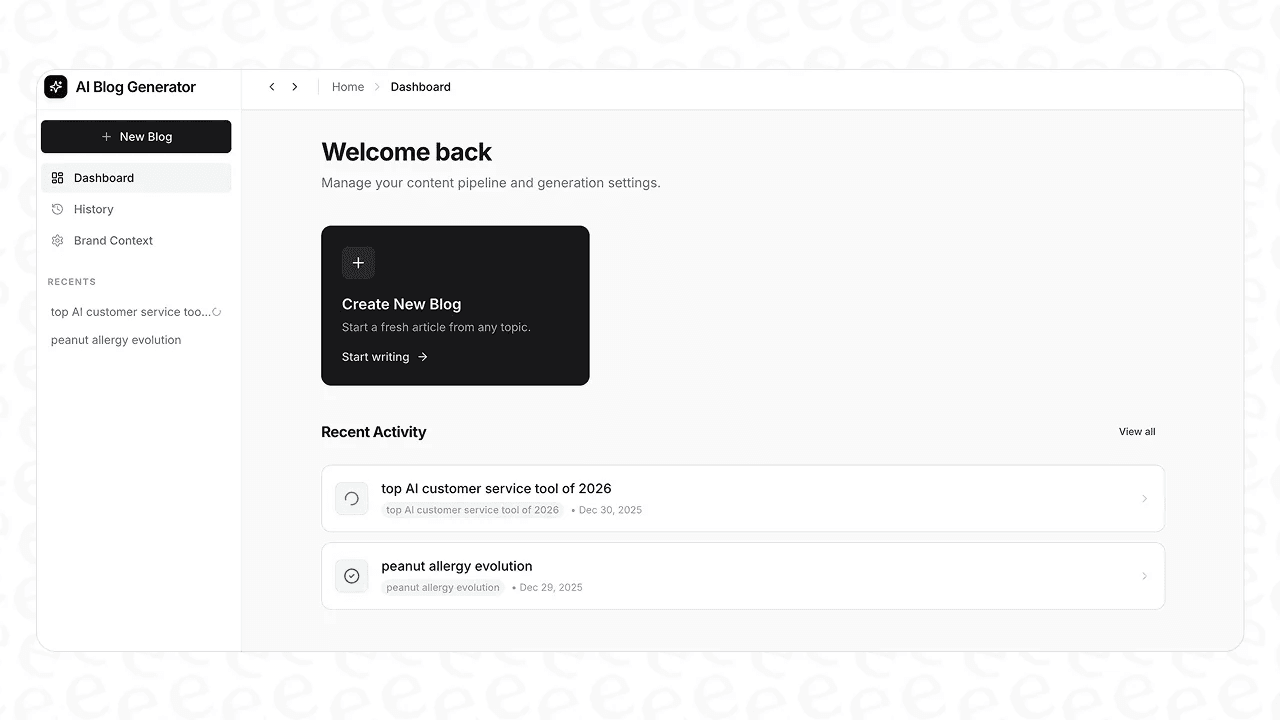
This is where things get interesting. Instead of getting a block of plain text that you have to format, find visuals for, and optimize, a tool like the eesel AI blog writer delivers a complete, publish-ready article from just one keyword.
When I say "complete," I mean a post that's already structured with a proper SEO hierarchy (H1, H2s, H3s), headings, an intro, a conclusion, and meta data. But it also includes assets that make your content much more valuable:
- AI-generated images, infographics, and tables to break up the text and explain things visually.
- Relevant YouTube video embeds to add more depth and keep visitors on the page longer.
- Real Reddit quotes and forum insights to offer social proof and include real-world perspectives.
Layer in human experience to satisfy E-E-A-T
With a solid first draft from an AI tool, your role changes. You're no longer staring at a blank screen. You're now an editor and a strategist. Your job is to take that 90% complete draft and add the final 10% that makes it truly yours.
This is where you add your human touch to meet the E-E-A-T guidelines:I think content made with tools can rank if it sounds natural and real. What works for me is to use the tool only for ideas or a starting draft, then I rewrite it in my own words. I always fix the tone, add real examples, and make sure the info is correct.

- Experience: Share personal stories, case studies, or first-hand experiences.
- Expertise: Add your unique industry insights, opinions, and analysis.
- Authoritativeness: Double-check all facts and add links to credible sources.
- Trustworthiness: Tweak the tone to perfectly match your brand's voice.
The eesel AI blog writer is designed for this kind of workflow. By automatically including things like Reddit threads, it's already adding a layer of authentic, real-world experience before you even start editing.
Optimize for search and answer engines (AEO)
There's a new acronym you should know: AEO, or Answer Engine Optimization. It's about optimizing your content so it can be easily understood and cited by AI models like Google's AI Overviews, ChatGPT, and Perplexity. As more people turn to these AI "answer engines," appearing in their results is becoming just as important as traditional search ranking.
AEO works best with clean, well-structured content that has clear headings, direct answers, and logical formatting. This is another place where a specialized tool has the advantage. The eesel AI blog writer is built with AEO in mind, creating content that's perfectly formatted to be featured by these new platforms, giving you another way to get seen.
For a deeper dive into creating AI content that search engines and humans will love, check out this video from Ahrefs. It walks through a practical process for producing high-quality articles that rank.
The future is a human-AI partnership
So, should you use AI generated content for SEO? Yes, but only if you do it the right way. Google doesn't penalize content just because AI was involved. It penalizes junk content: the unhelpful, spammy stuff designed purely to game the system.
The winning strategy for 2026 and beyond is a hybrid model. It’s about mixing the incredible speed and research power of AI with the irreplaceable creativity, experience, and strategic eye of a human expert. Let the AI build the structure, and let the human provide the soul.
This is the philosophy we built the eesel AI blog writer on. It’s a tool designed for this new era of content, and it’s how we grew our own daily impressions from 700 to 750,000.
Ready to see what a human-AI team can do for your content? Generate your first blog for free and see the difference for yourself.

Frequently Asked Questions
Share this article

Article by
Amogh Sarda
CEO of eesel AI. Amogh Sarda is obsessed with making the ultimate AI for customer service teams. He lives in Sydney, Australia and has previously worked at Atlassian and Intercom. Outside of work he’s usually surfing or on stage doing improv.