

First, the reality check before you generate anything
I've spent enough years on SEO content to have made this mistake myself: bulk-generating meta descriptions for a whole site, feeling productive, and then watching most of them never appear in search. So before you fire up a tool, it's worth knowing what actually happens to a meta description once it's live.
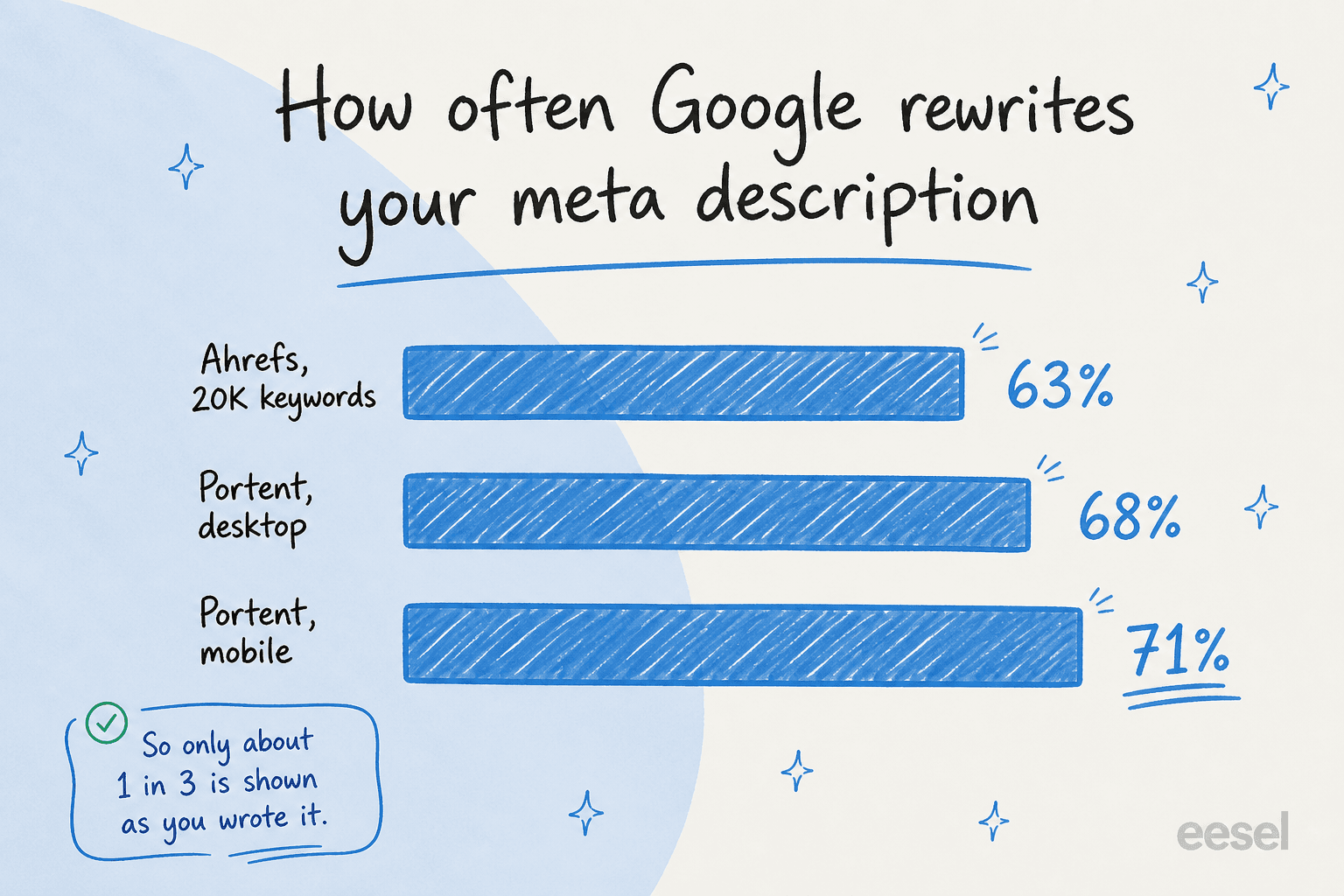
Google often throws yours out. Ahrefs compared hardcoded descriptions against the real snippets Google showed across 20,000 keywords and found it rewrites them 62.78% of the time. Portent ran a separate check over 30,000 keywords and got an even higher 68% on desktop and 71% on mobile. Two independent datasets, same verdict: your custom line shows up as written maybe a third of the time.
This isn't Google being difficult. Its documentation says snippets are "automatically created from page content" and tuned to each searcher's query, so one page can show different snippets for different searches. Your tag is a fallback Google uses only when it's a better summary than the page text. And it's never a ranking signal, it's one small part of your on-page SEO, not the lever that moves position.
That's the honest framing to carry into the rest of this: the goal isn't to generate a description for every URL. It's to generate the right ones, well, and not waste an afternoon on the rest. One practitioner who automated the whole thing and then thought twice put it best:
"On larger sites, the descriptions tend to get repetitive and are clearly AI generated. This is not the best experience for the searcher and could potentially lead to lower click thru rates... most importantly, Google frequently does not use your custom description in the snippet displayed on the SERP. So, at the end of the day, this could be a waste of time... My advice: For priority pages, just manually write the descriptions."
strepdog, r/SEO

How to write meta descriptions with AI, step by step
The difference between AI that helps and AI that hurts is entirely in how you run it. Here's the process I'd use, and the order matters.
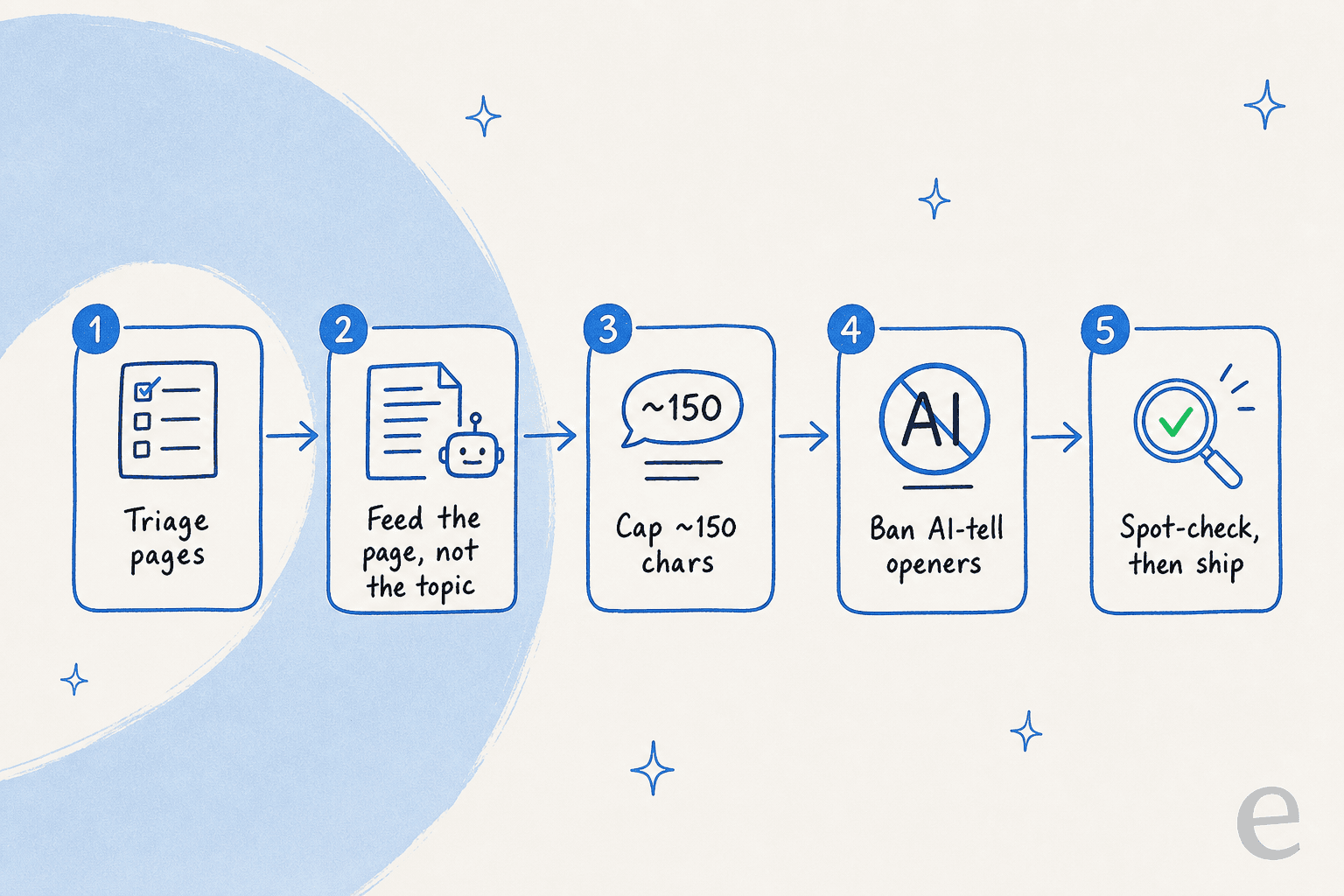
1. Triage first, then generate. Don't point AI at everything. Hand-write the pages that earn the attention (homepage, money pages, your top traffic) and let AI take the long tail. This is the same instinct behind any sane way to prioritize SEO content: the few pages that drive results get human care, the hundreds that don't get automated.
2. Feed it the page, not the topic. This is the whole ballgame. A web designer with a 10,000-product catalog hit the classic failure using plain ChatGPT: "meta information it generates doesn't pick up the correct intent of the page" (r/SEO). A bare topic gives the model a vague gist; the real content gives it the specifics that make a description worth reading. eesel's meta description generator is built around exactly this, its own guidance notes that "using full blog content often produces more accurate and relevant meta descriptions" than a topic line.
3. Cap the length up front. Tell the AI to stay under about 150 characters before you generate, so you're not trimming every result by hand. A tool that bakes this in, like the 130-150 character output eesel produces, saves the cleanup pass entirely.
4. Ban the AI tells. Generic openers ("discover", "explore", "dive into", "embark") are an instant giveaway and read as spam. One r/SEO poster literally wrote them into a banned-words list in their prompt: "Do NOT start the description with the words explore, embark, experience, join, dive into, or discover." If you're cleaning up output at scale, the same instincts that keep any AI content human apply here, and an AI humanizer can catch the worst offenders.
5. Spot-check, then ship. Pull a sample and read it like a searcher would. The right reflex came up in an r/SaaS thread: "Just keep an eye on the output if you go the bulk route... You want actual descriptions of the clothing, not just a string of keywords" (r/SaaS). The long-term pattern that works, from a developer running this across multiple brands, is "AI with human oversight... It really shows overtime. Small things add up" (r/SaaS).
Follow those five and you get the time savings without the repetitive, obviously-machine-written output that drags click-through down, the exact failure mode that makes bulk AI SEO content read as filler.
What a good meta description looks like
Whether you write it or an AI does, you're aiming at the same target. Google publishes its own best practices, and they're refreshingly concrete: the description should be unique to that specific page, accurately summarize what's on it, and read like a pitch rather than a keyword dump. Google is blunt that "meta descriptions comprised of long strings of keywords don't give users a clear idea of the page's content, and are less likely to be displayed."
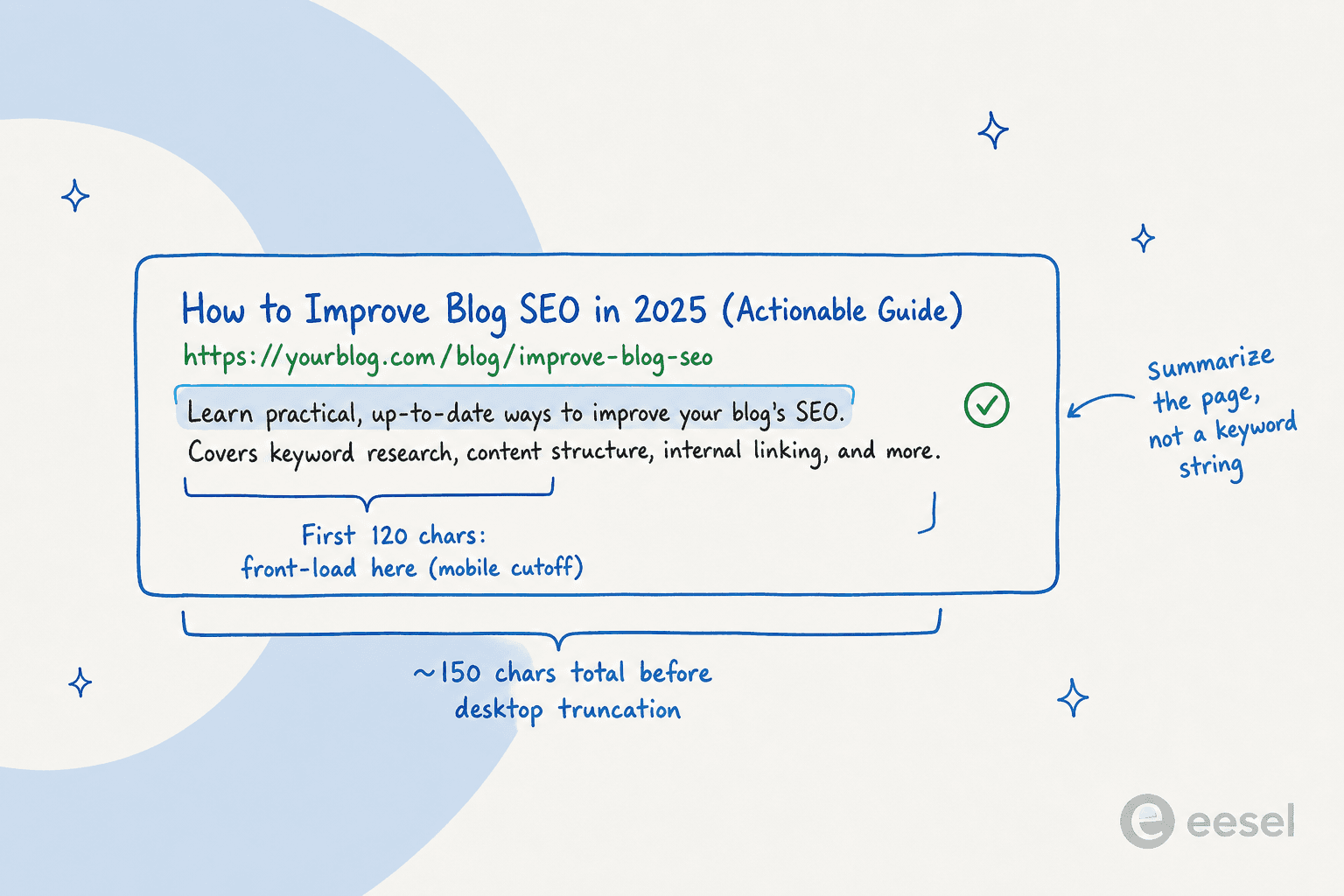
On length, ignore the myth of a fixed "160-character limit." Google explicitly says there's no character limit; snippets just truncate to the device width. In Portent's measured data, fully-displayable desktop descriptions land between 150 and 160 characters, peaking around 156, while mobile cuts off near 120. So the practical rule: keep it under ~155 characters and put the most important words in the first 120, because mobile readers may never see the rest.
Google's own before-and-after examples make the bar clear, and they double as a checklist for whatever your AI hands back:
| Don't | Do |
|---|---|
"Sewing supplies, yarn, colored pencils, sewing machines, threads, bobbins, needles" | "Get everything you need to sew your next garment. Open Monday-Friday 8-5pm, located in the Fashion District." |
| The same description on every page of the site | A description specific to that individual page |
"Mechanical pencil" (too thin to be useful) | "Self-sharpening mechanical pencil that autocorrects your penmanship. Includes 2B auto-replenishing lead..." |
| An anecdotal intro that never says what the page is | "Learn how to cook eggs with this complete guide... over-easy, sunny side up, boiled, and poached." |
If you remember one thing: a description summarizes the page in a human sentence, it doesn't list the keywords you want to rank for. That's also exactly where naive AI output fails, which is why the guardrails above matter more than the model you pick.
Why bother, given Google rewrites them?
Fair question, and it's the honest one. Three reasons hold up.
Click-through is real money. When your description does show, it's fighting for the click. Backlinko's analysis of 4 million search results found the #1 organic result takes a 27.6% average click-through rate and the top three pull 54.4% of all clicks, in that tiny window, pages with a description earn 5.8% more clicks than pages without one. A small percentage of a big number is still worth a few minutes.
The manual version is genuinely soul-crushing. This is the pain the whole category exists to kill:
"Got a message from a friend the other day that made me wince - he'd just spent 11 hours manually writing meta descriptions for 139 pages. Been there, done that, and it's absolutely soul-crushing work."
askins4trouble, r/SEO
Eleven hours for 139 pages. Now picture a 10,000-product catalog. Nobody is hand-writing that, and they shouldn't.
You keep control where it counts. Even when Google rewrites the snippet, your description is usually the fallback text when your page is shared on social or pasted into a chat. And the realistic upside, per a store owner who bulk-cleaned 500+ product pages, is about reach rather than rankings: "The biggest change wasn't rankings 'jumping,' but more qualified clicks... cleaning up meta titles/descriptions helps mostly with click-through rate and capturing more long-tail searches" (r/SaaS). Set that expectation and AI is a clear win.
The fastest way to write one right now
If you just need a description for a single page, paste your content into eesel's free meta description generator: it returns a sized, 130-150 character version you can edit in a copy box, no account. It sits beside a meta title generator and an SEO keyword generator for the rest of the head tags.
That covers one-off pages nicely. The harder problem is doing this across an entire site without it becoming the 11-hour job above, which is where writing the description as you draft the page beats running a separate generator URL by URL.
What's changing in 2026
Two shifts are worth planning around, and both point the same way: your control over the displayed text is shrinking.
First, Google is now writing snippets with AI of its own. As of late 2025, SEOs including Brodie Clark spotted Google testing Gemini-generated descriptions, badged with a small Gemini logo, plus AI summaries of the snippet itself. The takeaway isn't panic, it's that obsessing over the perfect 155-character string is a smaller and smaller bet.
Second, AI search engines and AI Overviews pull from your page content, not your meta tag, the same way classic snippets do. So the highest-leverage move is clean, extractable on-page writing that both Google and the AI surfaces can quote. The meta description becomes one input among many, still worth doing well, no longer worth agonizing over, which is the same logic behind how you'd scale SEO content safely or refresh it automatically.
Try eesel for meta descriptions and the content around them
The free meta description generator is the quickest fix for a single page, and the rest of eesel's free SEO tools cover titles, keywords, and metadata with no sign-up. But the real time sink isn't one description, it's the whole content pipeline.
That's where eesel's AI blog writer fits: it researches and drafts the post, then optimizes the metadata in the same pass, so the description is written from the real article instead of a guessed-at topic. Its SEO audit skill also scans existing content for missing metadata, broken links, and thin pages, so you can fix a backlog instead of hand-checking it.
The differentiator that matters here: it's built to research and cite real sources and match your voice rather than pump out templated lines, the exact failure mode that makes bulk AI descriptions read as slop. You can see how it stacks up against other AI content writers and the best AI SEO tools, or just try the free tools and see what comes back.
Frequently Asked Questions
How do I write a meta description with AI?
What's the best meta description length for SEO?
Does Google actually use the meta description I write?
Can AI write meta descriptions in bulk without sounding generic?
Is there a free AI tool to write meta descriptions?


Article by
Kurnia Kharisma Agung Samiadjie
Kurnia is a software engineer and writer at eesel AI with two years of SEO experience, writing about AI tools, helpdesk software, and customer support. He pairs a developer's understanding of how these products are built with search-driven research into what actually ranks and resonates with the people searching for them.