


Let's talk about SEO content creation. It’s not just about pumping out blog posts and crossing your fingers. It’s the whole game plan for creating content that’s built to show up in search results, catch the eye of actual people, and bring them over to your site.
The goal isn't just to publish an article. It's to rank for the keywords your audience is genuinely searching for, drive a consistent flow of the right kind of organic traffic, and build your reputation as the go-to source in your field.
But honestly, it's a lot of work. It takes a real plan, a good amount of data digging, and a steady effort to get it right. The good news? Modern AI can help. We would know: at eesel AI, we used our own AI platform to jump from about 700 to 750,000 daily impressions in just three months.
What is SEO content creation?
At its heart, SEO content creation is a mix of two disciplines: SEO (making content work for search engines) and Content Creation (making useful things for people). You're basically trying to please two different bosses at the same time: Google's algorithms and your target audience. To succeed, you have to make both happy.
This is what makes it different from just writing. Regular content might be for telling a story or sharing an opinion. SEO content is built on a bed of data. It’s all about figuring out what people are looking for and then creating the best possible answer for them. This approach helps you signal what Google calls E-E-A-T: Experience, Expertise, Authoritativeness, and Trustworthiness. When you get this right, Google starts to see your content as a credible source and is more likely to show it to users.
Think of it this way: building a great online store is wonderful (that’s your content), but if you don't put up any signs on the main road to let people know you're there (that's your SEO), nobody is ever going to find you.
The three pillars of a successful SEO content creation strategy
Pillar 1: The research foundation
This is where it all begins. Without a proper research phase, you’re just taking shots in the dark.
- Keyword research: This isn't just about finding popular terms; it’s about understanding what your audience is trying to accomplish. You have your broad "head" keywords (like "marketing") and your more specific "long-tail" keywords (like "how to create a marketing plan for a small business"). Long-tail keywords usually have less competition and attract more qualified traffic.
- Understanding search intent: This is a big one. You have to know why someone is searching for a specific phrase. There are four main types of intent:
- Informational: They want to learn something ("what is SEO?").
- Navigational: They want to find a specific website ("eesel AI blog").
- Commercial: They're doing research before they buy ("best AI blog writers").
- Transactional: They're ready to make a purchase ("eesel AI pricing"). Matching your content to the user's intent is essential if you want to rank.
- Topic clusters and pillar pages: This is a fantastic strategy for building authority. You create a main "pillar page" that covers a broad topic in detail. Then, you create several smaller "cluster pages" that explore related subtopics. Finally, you link all the cluster pages back to the main pillar page and to each other. This shows Google you're an expert on the entire subject, not just a single keyword.
- Competitive analysis: Check out what's already ranking on the first page of Google for your target keyword. What are they doing right? What topics are they covering? Where are the gaps you can fill? This isn't about copying them; it's about seeing what the standard of quality is and figuring out how you can do even better.
Pillar 2: Writing and optimization
Once your plan is in place, it’s time to actually create the content. This is where you blend good writing with smart on-page SEO.
- Structuring for readability: No one wants to read a massive wall of text. Use clear H1, H2, and H3 tags to organize your content. Keep your paragraphs short and to the point. Use bullet points and bold text to make key information stand out. This helps both people and search engine crawlers scan your content easily.
- On-page SEO best practices: These are the basics. Your main keyword should be in your title tag, meta description, and H1 heading. Weave it naturally into your text (don't overdo it!). Optimize your images with descriptive alt text, and use clean, straightforward URLs.
Here is the problem. You need to understand how 'AI' writers build their content and it's goal. An 'AI' writers will simply take a search query you specify. Download the text of the top 10 results. Text mine the results and find common words... Write the first iteration of text and then paraphrase. There is one major flaw with all 'AI' writers however. The semantic linking profile that it uses is the same across most 'AI' articles. Google can determine this by looking at the top results for your search query and look at how each article is written.
 Reddit
 - Using general-purpose AI: Tools like ChatGPT can be useful for brainstorming, but they may require additional work to create complete SEO content. They can sometimes produce generic text or inaccurate information, known as "hallucinations." As OpenAI has noted, "ChatGPT can make mistakes." This means the user often handles the research, fact-checking, sourcing visuals, and final structuring of the article.
- How the eesel AI blog writer helps: Specialized tools like the eesel AI blog writer are designed to manage the entire SEO content creation workflow. By providing a keyword, users can generate a complete, optimized article. It offers features such as:
_ It conducts context-aware research, so the information is always fresh and relevant.
_ It automatically generates assets like images, tables, and charts directly within the post.
_ It includes authentic social proof, like relevant YouTube videos and real Reddit quotes, to build trust.
_ It gives you a publish-ready post that's optimized for both traditional SEO and the new wave of AEO (AI Answer Engines), saving you hours of manual effort on every article.
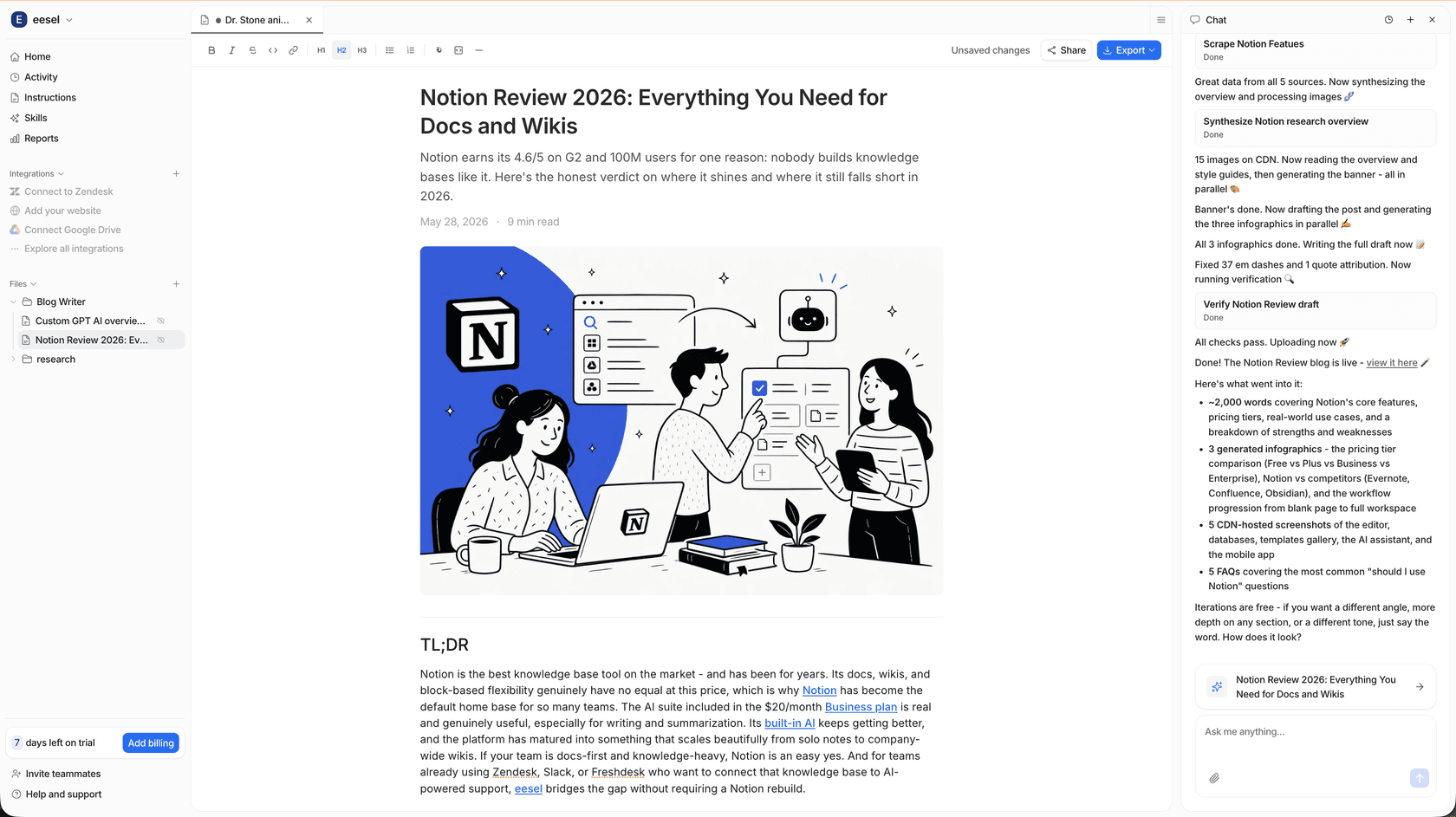
A screenshot of the eesel AI blog writer dashboard, a tool for automated SEO content creation.
Pillar 3: Measurement and refinement
Publishing your content is just the start. The real growth happens when you pay attention to what happens next.
- Tracking performance: You need to see what's working. Tools like Google Search Console are invaluable here. Monitor key metrics like organic traffic, your rankings for specific keywords, click-through rate (CTR), and total impressions. This data shows you what's connecting with your audience and where you can improve.
- Content audits and refreshing: Content can become outdated over time, a problem known as "content decay." Every so often, review your older posts. Find the ones that aren't performing as well as they used to, update them with new information, add fresh stats or examples, and re-optimize them. This can give them a significant boost in rankings.
- Continuous improvement: SEO content creation is a cycle, not a one-off task. Use the data from your performance tracking to make your next articles even stronger. Focus more on the topics and formats that perform well, and adjust your approach for those that don't.
Putting your SEO content plan into action
Ready to dive in? Here’s a simple framework to turn your strategy into reality.
- Create an editorial calendar: Consistency is vital for SEO. A simple calendar helps you plan your content, assign topics, and stick to a regular publishing schedule to keep building momentum.
- Focus on quality over quantity: One incredible, in-depth article that perfectly answers a user's question is worth more than ten thin, mediocre posts. Always try to create the best resource on the internet for your chosen topic. This ties directly into Google's E-E-A-T framework.
- Promote your content: Don't just publish and hope for the best. Share your new content on social media, in your email newsletter, and look for chances to build backlinks from other respected sites. This helps both users and search engines find your content more quickly.
Here’s a quick look at what a basic workflow could be:
| Step | Action | Key Consideration |
|---|---|---|
| 1. Strategy | Define goal and target keyword. | What is the user's search intent? |
| 2. Research | Analyze SERPs and competitors. | What content format and topics are ranking? |
| 3. Creation | Write and optimize the content. | Is it structured for readability and E-E-A-T? |
| 4. Publishing | Publish and check on-page elements. | Are title tags and meta descriptions optimized? |
| 5. Promotion | Share on relevant channels. | Where does your target audience hang out? |
| 6. Measurement | Track rankings and traffic in GSC. | Is the content performing as expected? |
Scaling your SEO content creation
A solid SEO content creation strategy is a continuous loop of smart research, high-quality writing, and careful analysis. This approach is effective for business growth but can be a lot to manage, especially for smaller teams.
Tools like the eesel AI blog writer are designed to handle the more tedious parts of the process, allowing teams to focus on strategy. At eesel AI, using this tool helped increase our blog's daily impressions from 700 to 750,000 in three months. If you're looking to scale your content production, you can try the eesel AI blog writer for free to generate an SEO-optimized article.
For those who prefer a visual guide, the video below offers a detailed walkthrough of a proven process that can significantly boost your organic search traffic.