

The landscape for SEO professionals has shifted. It’s no longer just about clawing your way to the top of Google's blue links. Now, the name of the game is becoming a trusted source for AI-powered answer engines like Perplexity, ChatGPT, and Google's AI Overviews. If your content isn't being cited in those AI-generated summaries, you're essentially invisible.
This guide will help you navigate this new environment. We're going to break down the different kinds of AI tools you need to stay in the game. The idea isn't just to throw a list of apps at you, but to help you see which tools fit into each part of your workflow, from creating content that AI engines will actually use to tracking whether it's working.
What are AI tools for SEO?
AI tools for SEO are pieces of software that use artificial intelligence to handle the more tedious parts of search engine optimization. Think of them as a super-smart assistant for everything from writing content to analyzing performance.
Their main job is to process huge amounts of data, find patterns a human would miss, and automate the repetitive tasks that eat up your day. This lets you focus on what actually requires a human brain, like big-picture strategy and creative thinking. They can help you find the next big trend, check out what your competition is doing, generate optimized articles, and even track how often your brand gets a shout-out in those new AI search results.
The different types of AI tools for SEO
"AI for SEO" isn't a one-size-fits-all category. You can't just grab one tool and expect it to solve all your problems. The smartest strategies use a mix of specialized tools that each handle a different part of the job. We'll break them down into four key areas: content, visibility tracking, link building, and technical SEO.
AI tools for content creation and optimization
These tools are all about helping you research, outline, write, and tweak articles so they resonate with both old-school search engines and the new AI answer engines.
You’ve probably run into tools like SurferSEO, which gives you live feedback on your content's optimization, or Writesonic, which can quickly generate drafts. While useful, some AI writers may produce content that requires significant human editing to add a unique brand voice and personality. Other platforms may focus on text optimization, requiring users to source multimedia and social proof elements separately. For detailed comparisons, check out Scalenut vs Surfer SEO, Hyperwrite vs Surfer SEO, or Scalenut vs Semrush.
This has led to the development of more comprehensive solutions. For example, the eesel AI blog writer is designed to generate a complete post from a single keyword, focusing on creating publish-ready content.
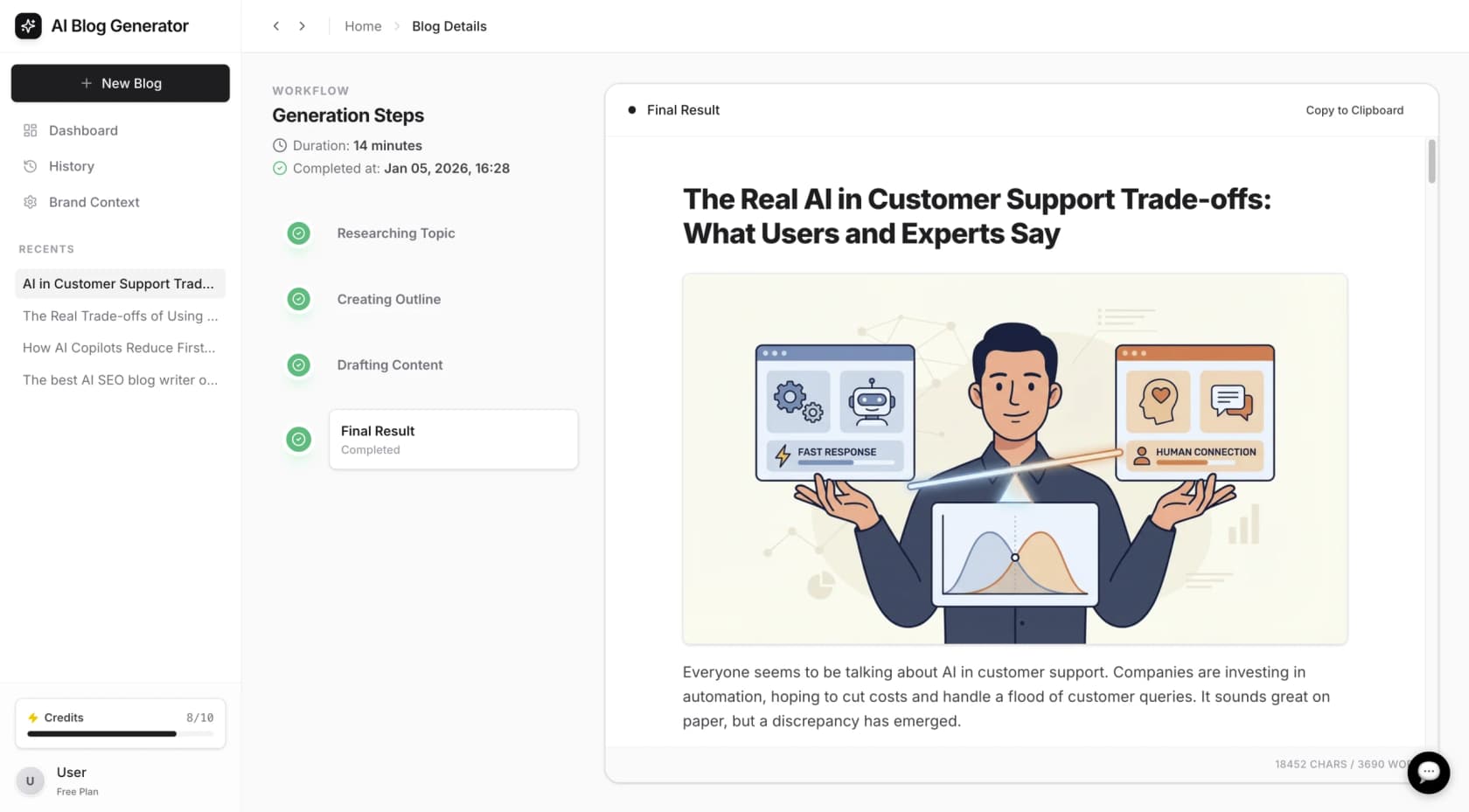
The platform includes features such as:
-
It creates a complete article, not just a draft. It doesn't just give you a wall of text. It builds a fully structured blog post with AI-generated assets like images, charts, and tables already baked in.
-
It integrates authentic social proof. To add a human element, the AI finds and embeds relevant YouTube videos and real quotes from Reddit threads, making the content more believable and interesting.
-
It’s optimized for Answer Engine Optimization (AEO). The content is built from the start to be easily understood, broken down, and cited by the AI models that power things like Google's AI Overviews.
For example, eesel AI used this tool to grow its organic search impressions from 700 to 750,000 per day in three months, demonstrating the potential of creating optimized content at scale.
Visibility tracking and GEO
Generative Engine Optimization (GEO) represents a new focus area for SEO. This is all about tweaking your content so it gets picked up and cited in the answers from Google AI Overviews, ChatGPT, and Perplexity. If traditional SEO is about getting on the list, GEO is about becoming the answer.
This new field has its own set of specialized tools. Platforms like Rankscale.ai and Indexly were built for this. Rankscale, for instance, is a GEO tool that tracks metrics you haven't seen before, like a "Visibility Score"," mention frequency, and brand sentiment across ten different AI engines. It helps you see if your content is actually making a dent in these new conversational search results.
Other tools like Indexly's AI Prompt Tracking let you monitor specific questions or prompts that are important to your business across ChatGPT, Claude, and others. This gives you a clear view of how you're showing up in the AI conversations that really matter.
These tools are primarily for monitoring. They report on visibility within AI answers but do not create the GEO-optimized content required to appear there.
Outreach and link building
Link building isn’t dead, but it is getting an AI-powered makeover. These tools are made to automate the grind of finding good prospects, finding their contact info, and personalizing outreach emails to increase the relevance and personalization of outreach messages.
There are a couple of different flavors here. You have tools like Pitchbox, which is a powerhouse for automating entire cold email campaigns. It uses AI to find small details about your prospects to personalize your emails, which they claim can increase response rates by an average of 62%.
Then there’s a different approach with tools like Ranking Raccoon. Instead of cold outreach, it’s a community where you can swap links with other vetted site owners. Its AI helps out by recommending the most relevant sites for you to connect with based on your niche.
Of course, there are limits. As any outreach pro will tell you, AI-generated personalization still needs a human touch to make sure it doesn’t sound awkward. And community platforms are only as strong as their members. If the community is small or not very good, you won’t find many great opportunities.
AI works best when used for research, outlining, and speeding up drafts while the real ranking power still comes from expertise, strategy, and links.

| Feature | Pitchbox | Ranking Raccoon |
|---|---|---|
| Methodology | Automated cold email outreach | Community-based link exchange |
| Best For | Scaling outreach for agencies | Direct connections with vetted site owners |
| AI-Powered Feature | Scraping data for email personalization | AI-powered site matching based on topic |
| Key Benefit | Boosts response rates ~62% on average | 11x higher response rate than cold email |
| Pricing Model | Monthly Subscription from $165/mo | Freemium & Pro Subscription ($25/mo) |
Technical improvements and indexing
You can have the best content on the planet, but if search engines can't find and index it, it might as well not exist. AI tools for technical SEO help automate the behind-the-scenes work to make sure your site is easy to crawl and your content gets seen.
A perfect example is Indexly, which is focused entirely on getting your new content indexed quickly. Normally, you publish a blog post and wait, sometimes for weeks, for Google's crawlers to find it. Indexly speeds that up by using official channels like the Google Indexing API and Bing IndexNow to notify search engines the moment you publish. This can cut indexing time from weeks down to just a few days.
This is the last, and very important, piece of the puzzle. It doesn't make sense to spend time and money creating great, GEO-optimized content if those pages are just sitting there unnoticed. Indexing tools bridge that gap and make sure your hard work gets a chance to compete. This is especially useful for new sites or anyone publishing a lot of content.
How to build a modern workflow with AI tools for SEO
Effective results often come from building a workflow that integrates specialized AI tools for each step of the SEO process, creating a streamlined content pipeline.
The trick isn’t just 'using AI tools' it’s connecting them into a workflow: research → creation → optimization → distribution → visibility in LLMs.
Here’s a simple, four-step workflow that brings it all together:
-
Strategy & Research: Start with a classic SEO platform like Semrush or Ahrefs. Use them for your initial keyword research and to see what competitors are up to. This is where you'll find your target topics.
-
Content Generation & Optimization: Once you have a keyword, plug it into a comprehensive generator like the eesel AI blog writer. Let it do the heavy lifting of turning that keyword into a complete, asset-rich article that’s already structured for both traditional search and AEO.
-
Technical Deployment: The moment you hit "publish," use an indexing tool like Indexly to make sure search engines find your new post immediately. Don’t leave it up to chance.
-
Performance Monitoring: Finally, use a GEO tracker like Rankscale.ai to monitor your content’s visibility. Track how often it’s cited in AI answers on platforms like ChatGPT and Google AI Overviews to see what’s resonating.
Think of it as a loop. AI handles the execution, which gives you data that you, the human, use to adjust your strategy. At the center of it all is a powerful content engine that lets you scale up your efforts without letting quality slide.
Using AI tools for SEO to focus on strategy
While the SEO landscape has changed, the core principles remain. It's still about creating helpful, authoritative content. The big difference is that AI is here to help you do it better and faster.
What surprised me most was how much value comes from speed. If you can generate outlines or content briefs in minutes instead of hours, you end up testing more ideas and publishing faster, which indirectly boosts rankings.
AI doesn't replace your strategy; it powers it. The teams that succeed in this new era will be the ones who get good at delegating the tactical work to AI. By automating the execution, you free up your time and mental energy to focus on what really matters: understanding your audience, developing a unique point of view, and building a brand that both people and AI engines trust.
To see how different tools stack up and which ones might be right for your strategy, check out this video breakdown of the current AI SEO tool landscape.
Many AI content tools, including the eesel AI blog writer, offer a free trial or demonstration to help users evaluate their impact on a content strategy.
Frequently asked questions
What are the main categories of AI tools for SEO?
They generally fall into four buckets: content creation (like the eesel AI blog writer), Generative Engine Optimization (GEO) tracking (like Rankscale.ai), link building automation (like Pitchbox), and technical SEO (like Indexly for faster indexing).
Can AI tools for SEO completely replace a human strategist?
Not at all. These tools are fantastic for automating execution, like writing drafts, finding outreach contacts, or tracking visibility. However, you still need a human to set the overarching strategy, understand your audience's unique needs, and make creative decisions.
How do I choose the right AI tools for SEO for my business?
Start by identifying your biggest bottleneck. If you're struggling to produce content, look at a content generator. If your new posts aren't getting seen, try an indexing tool. It's better to build a "stack" of specialized tools that solve specific problems rather than looking for one tool that does everything.
Are free AI tools for SEO effective enough to get started?
Some free AI tools for SEO or freemium plans can be a great starting point. For instance, Ranking Raccoon has a free tier for link building, and you can try the eesel AI blog writer for free. They let you test the waters, but for scaling your efforts, you'll likely need to invest in paid plans with more robust features.
What is Generative Engine Optimization (GEO) and why do AI tools for SEO need to address it?
GEO is the practice of optimizing your content to be cited in AI-generated answers from platforms like Google AI Overviews and ChatGPT. As search becomes more conversational, traditional rankings matter less. Modern AI tools for SEO are essential for creating content that these AI engines can easily understand and for tracking your visibility within their answers.
How quickly can I see results after implementing AI tools for SEO?
It varies. With a tool like Indexly, you could see your content indexed in days instead of weeks. For content and GEO, results can take longer, often a few months, as it takes time for search engines to recognize and trust your content at scale. The key is consistency.