Translation gets you words. Localization gets you rankings.
Here's the reframe that changes how you think about this whole project. Translation and localization sound like synonyms, and most "AI translation" features bolted onto an AI blog writer treat them as one. They aren't.
Translation answers "what do these words say in German?" Localization answers "what would a German marketer have written to rank for this topic in Germany?" Those produce different posts. The translated version keeps your English keyword, your US dollar prices, your "as the Super Bowl showed us" analogy, and your one generic call to action. The localized version swaps every one of those for something a local reader recognises, starting with the keyword they actually type into Google.
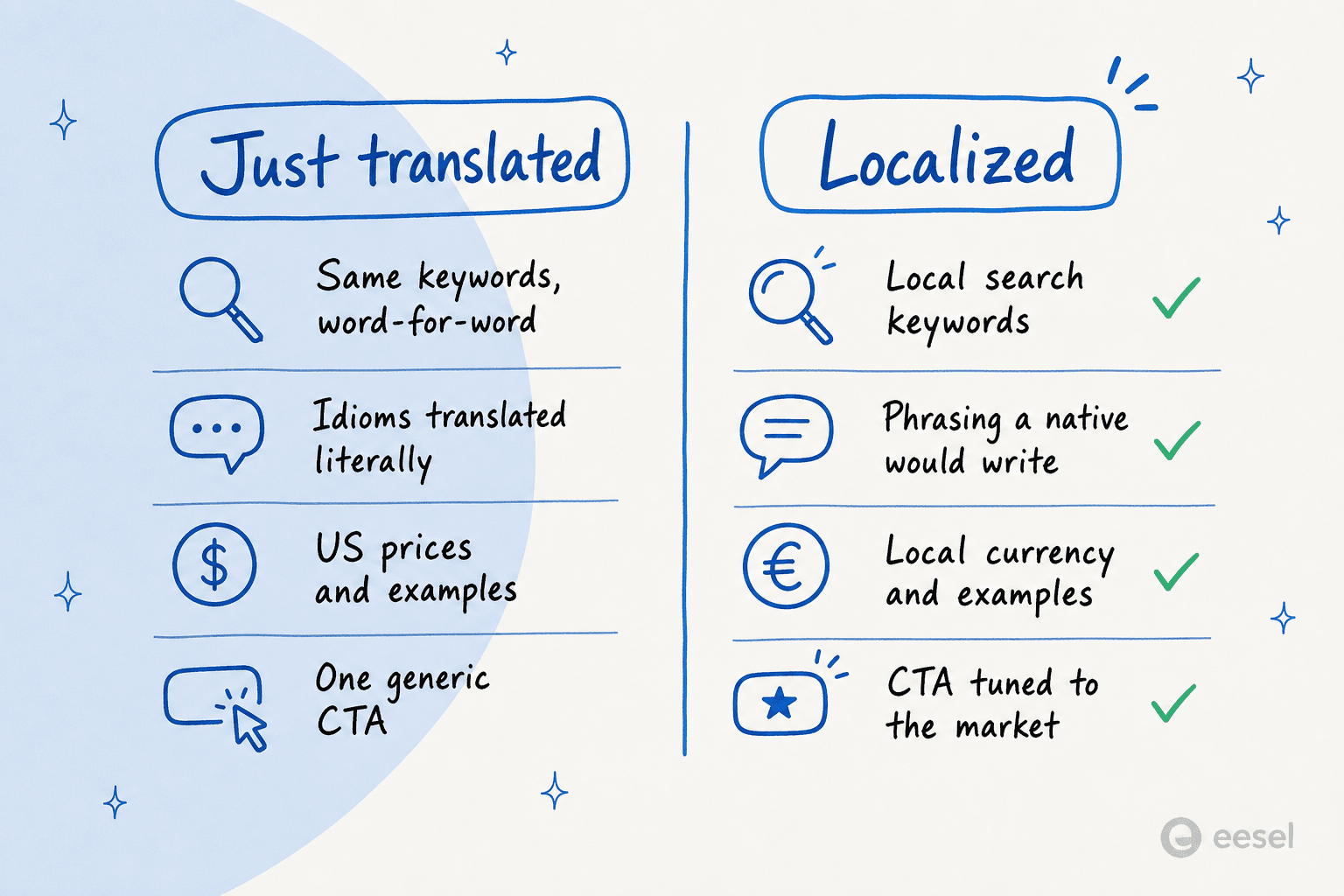
This is why a folder full of machine translations almost never moves the needle. Search intent doesn't translate. The German term for "help desk software" carries different modifiers, different competitors, and different long-tail questions than the English one. If you don't research the local keyword, you've written a grammatically perfect post aimed at a search nobody runs.
Why localized content is the cheapest international SEO you'll do
Most companies sit on a library of SEO content they've already paid for. You researched it, you wrote it, it ranks in English. Localization is the rare growth lever where the expensive part, the actual thinking, is already done, and you're reusing it across every market you care about.
The opportunity is lopsided in your favour because most of your competitors haven't bothered. English-language SEO is a knife fight. The German, Spanish, or Brazilian-Portuguese version of the same query is often wide open, because the incumbents there are local players who never built a real content engine. You walk in with a library of proven posts and a fraction of the competition.
It also compounds with everything else you do internationally. If you already run multilingual support, the content and the support answers reinforce each other, and the reader who found your localized post lands on a site that speaks their language end to end. That coherence is what turns a one-off visit into a signup.
The thing that used to kill this idea was cost. A translation agency charging per word turns "localize 200 posts into five languages" into a budget line nobody approves. AI flips that. When a post costs a few dollars to draft rather than a few hundred, the question stops being "can we afford this market?" and becomes "which markets do we want first?"
The trap: why raw machine translation can backfire
I have to be straight about the downside, because this is where teams get burned. If your plan is "point a translator at the sitemap and hit publish," you can make your SEO worse, not better.
Google's own guidance has long flagged auto-generated translations that get published without review as the kind of low-value, scaled content it filters. The problem isn't that a machine touched it. The problem is thin content: a page that adds nothing for the local reader, reads stiffly, and targets a phrase no one searches. That page won't rank, and a few hundred of them can drag the perceived quality of your whole domain down.
The teams who get this wrong treat languages as a volume play, pump out thousands of untouched translations, and confuse "indexed" with "ranking." The teams who get it right treat each localized post as a real post that happens to start from a strong draft. The difference is entirely in the workflow, not the tool, which is the next section.
How AI blog localization actually works at scale
Here's the pipeline I'd build. It's the same shape whether you do it in one tool or stitch a few together, and it's what separates a localization program from a translation dump.
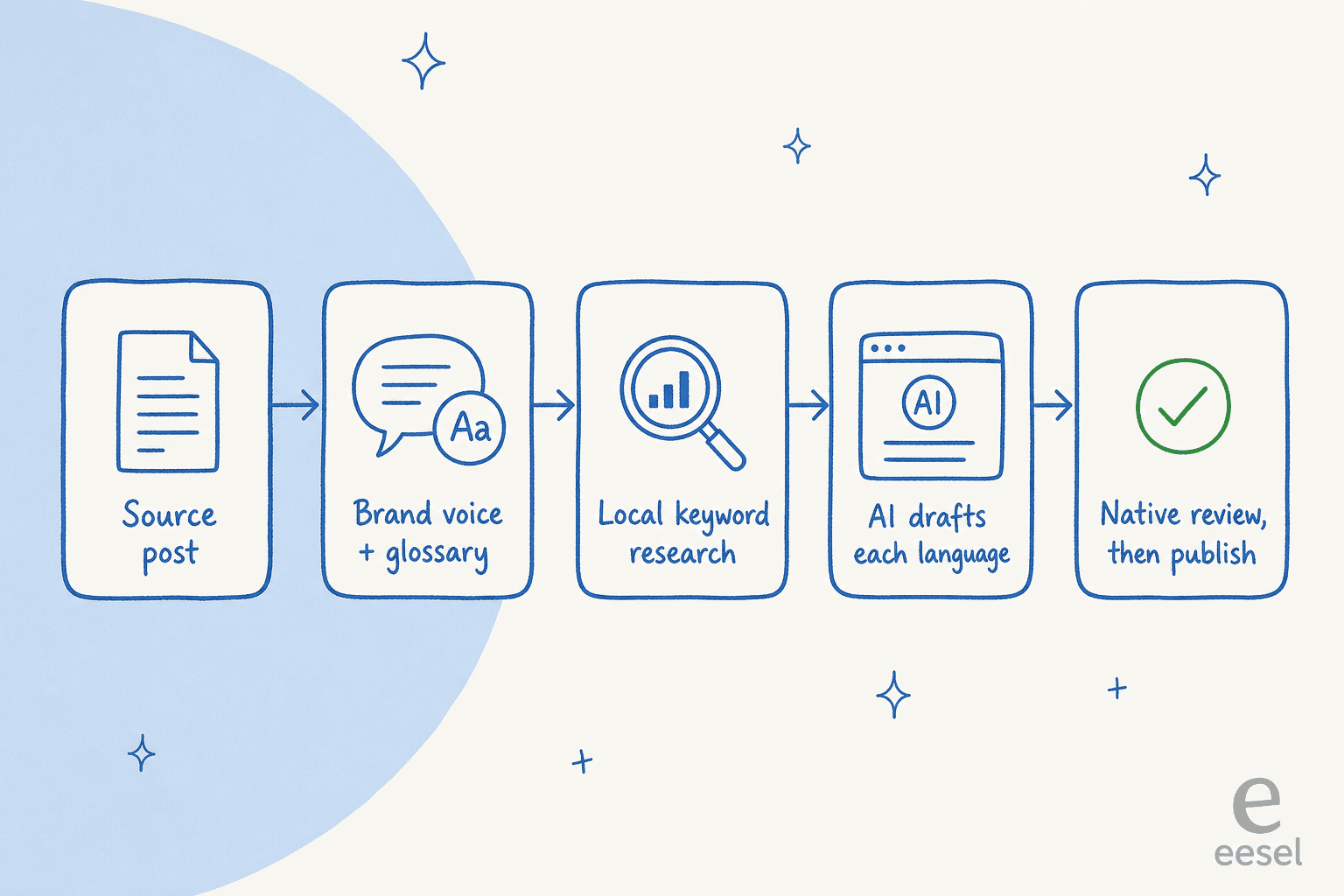
- Start from a proven source post. Localize your winners, not your whole archive. The posts already ranking in English are the ones worth the effort everywhere else.
- Feed in brand voice and a glossary. This is the layer most tools skip. Your product names, the terms you never translate, the words you prefer, all captured once so every language version sounds like you.
- Research the local keyword. Before drafting, find the term people in that market actually search. This reshapes the title, headings, and angle, and it's the single biggest ranking factor in the whole process.
- Let the AI draft each language. With the source, the voice, and the local keyword in hand, a good AI content writer produces a full localized draft, not a word-swap, in minutes.
- Run a native review on anything that matters. A native speaker spends ten minutes catching the one phrase that reads as machine-made. That review is what keeps the post on the right side of Google's quality bar.
A platform like eesel collapses steps two through four into one run, because the same agent already holds your brand context and can research and draft the post itself. But even if you wire it together from separate pieces, keep all five stages. Drop the keyword research and you get fluent posts that rank for nothing. Drop the native review and you get fast posts that quietly read as robotic.
What separates good localization from a Google Translate dump
Three things do most of the work. Get these right and the rest is logistics.
Brand voice and a glossary that survive the language switch
The fastest tell of machine localization is tone drift. The English post sounds like a sharp colleague; the Spanish version sounds like a manual. The fix is to capture voice and vocabulary as durable instructions the AI applies to every language, the same idea behind brand voice training on a single-language writer.
The most concrete version of this I've seen came from one of our own customers, a luxury Italy travel agency generating Brazilian-Portuguese SEO posts. They didn't want generic Portuguese; they wanted their Portuguese, down to specific word choices:
"Generate multiple SEO-optimized blog posts in Brazilian Portuguese ... use 'viajantes' not 'turistas', avoid 'desempacotar', sound natural in Brazilian Portuguese."
eesel customer (a luxury Italy travel agency), captured from a real Blog Writer session
That instruction got captured once and applied to every post after it. That's the difference between translation and localization in a single sentence: not "is this correct Portuguese" but "is this the Portuguese my brand would write." A glossary is how you make that repeatable across 50 posts instead of re-explaining it every time.
Local keyword research, not translated keywords
I'll keep hammering this because it's the most-skipped step. Your English keyword, translated, is almost never the local keyword. Search volume, modifiers, and intent all shift across borders. Before you localize a post, you research the destination market the way you'd research a brand-new English post, with the same semantic SEO lens you already use. The localized title and H2s come from that research, not from the English original.
This is also where a generic AI translator and a real AI SEO workflow part ways. A translator gives you the words. A localization workflow, built on the right AI SEO tools, gives you the words and re-points them at a query that has traffic.
A native review on anything customer-facing
You don't need a human on every word. You need a human on the parts that carry your reputation: the title, the intro, the call to action, and any claim. A native speaker catches the idiom that landed wrong and the phrasing that reads as imported. Ten minutes per post, and it's the cheapest insurance against the thin-content trap.
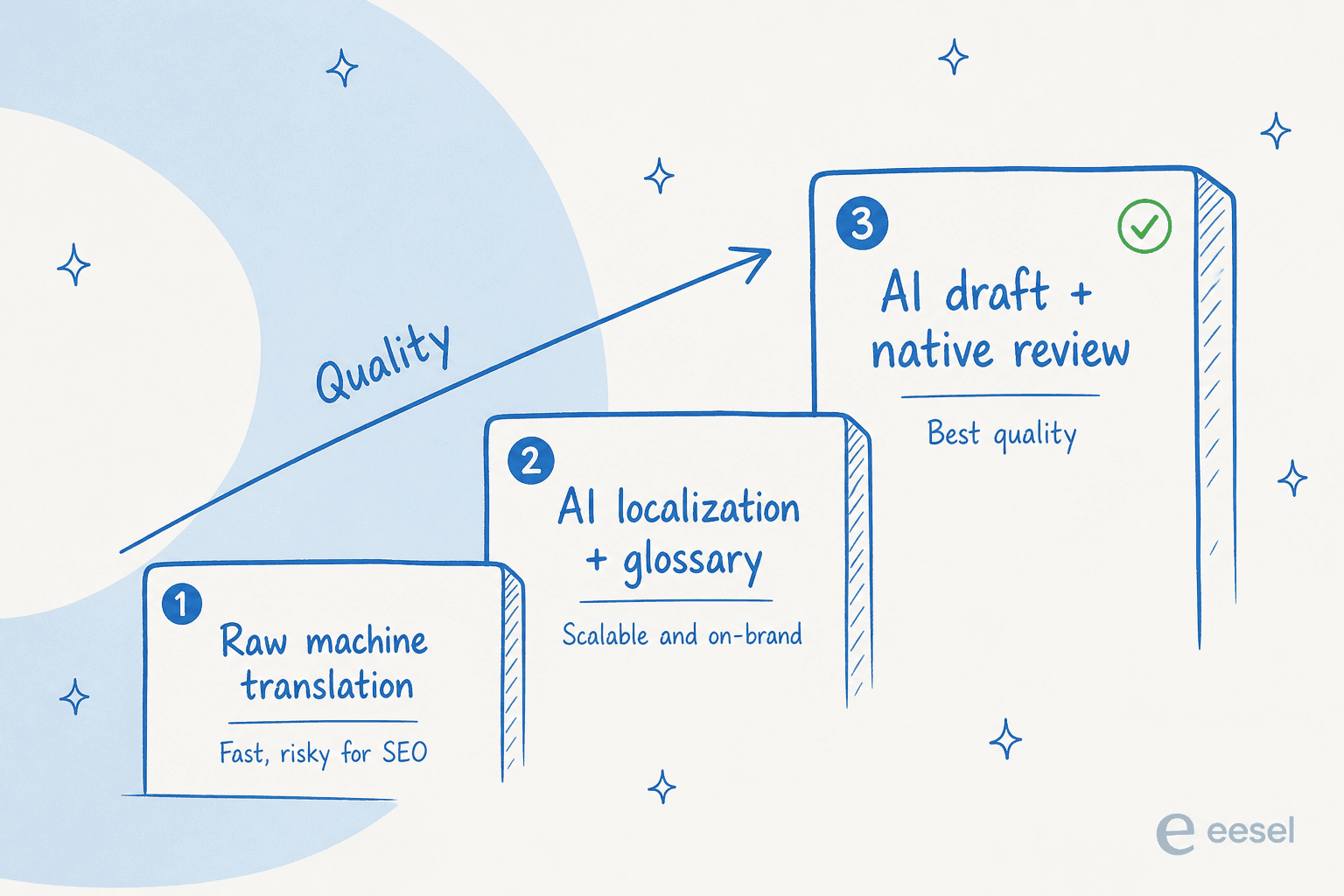
My honest take: for a high-intent page like a pricing or comparison post, do the full ladder with a native review. For a lower-stakes top-of-funnel explainer, AI localization with a solid glossary is good enough to ship and iterate. Match the effort to what the page is worth.
Doing it at scale without a 12-person translation team
The reason to use AI here isn't quality in the abstract, it's that the economics let you operate at a scale a human team can't. This is where the approach earns its keep.
One of our SEO content customers, a content lead running on Webflow, scaled to 360+ posts a month, twelve a day, from a keyword-to-publish pipeline with bulk review and publishing. That volume is simply not reachable with manual translation, and it's exactly the kind of throughput that makes a multi-market content program real rather than aspirational. The same pattern shows up with marketing agencies and travel-content teams using an AI writer to produce SEO posts for clients across languages.
It works at the small end too. A German baby-textile e-commerce brand ran our blog skill around 15 times across keywords, each run producing a 2,000 to 2,900-word German SEO post complete with hero banner, brand-coloured infographics, FAQs, internal links, and CDN-hosted images, in roughly 12 to 20 minutes. No translation desk, no agency invoice, just a domain and a keyword. That's the unlock: localization stops being a project and becomes a setting.
The piece that makes this safe at volume is keeping the brand context in one place. When the same agent holds your voice, your glossary, and your past posts, the hundredth localized post is as on-brand as the first, which is the exact failure mode of stringing together separate translation tools that each forget who you are.
Common mistakes I see
A few traps worth naming, because I've watched teams hit all of them:
- Localizing everything at once. Start with your proven winners and one or two markets. A thousand thin pages across ten languages is a liability; fifty strong ones across two is a beachhead.
- Skipping the local keyword. The number one reason localized content doesn't rank. If you only do one thing from this post, do this one.
- Treating "translated" as "done." Indexed is not ranking. A post that adds nothing for the local reader is invisible no matter how clean the grammar.
- No glossary. Without one, every run re-guesses your product names and preferred terms, and the voice drifts post to post.
- Forgetting hreflang. This is the technical half nobody mentions. Tell Google which language version serves which region with proper
hreflangtags, or your beautifully localized posts compete with each other instead of with the local market.
Most of these are the same discipline that keeps any AI blog automation honest: research first, keep a human in the loop on what matters, and don't confuse volume with value.
Try eesel for localized content at scale
If you want one place to run this whole pipeline, that's what we built eesel's AI blog writer to do. You give it a domain and a keyword, and it researches, drafts, and formats a full SEO post, in any of 80+ languages, holding your brand voice and glossary across every market so the German and the Portuguese versions sound like the same company that wrote the English one.

It's the same engine that already handles support in over 80 languages, so the multilingual ability isn't bolted on, it's the foundation. You get two free blog generations to test it on a real post, no credit card, and drafts run $4 each after that with no per-seat fee, so localizing into five markets costs about what you'd expect five posts to cost. You can try eesel on one of your proven English posts and see the localized version before you commit to a program.
The best first move is small: pick your single best-ranking English post, choose one market you actually want to win, and localize that one properly, keyword research and native review included. If it lands, you've got a repeatable setting. If it doesn't, you've spent a few dollars learning which market to skip.
Frequently Asked Questions
What is AI blog localization?
Is AI blog localization the same as translation?
Will AI-localized content hurt my SEO or get penalized by Google?
How much does it cost to localize blog content with AI?
How many languages can AI localize my blog into?


Article by
Kurnia Kharisma Agung Samiadjie
Kurnia is a software engineer and writer at eesel AI with two years of SEO experience, writing about AI tools, helpdesk software, and customer support. He pairs a developer's understanding of how these products are built with search-driven research into what actually ranks and resonates with the people searching for them.