
Everyone's talking about how AI blog writers can scale your content, save you time, and get that SEO flywheel spinning. But when you actually start looking for one, figuring out the real cost can feel like a maze. It's rarely a simple monthly fee.
Between per-word credits, tiered subscription models, and hidden costs for features you actually need, comparing tools feels like comparing apples and oranges. To make a smart choice, you need to understand what you're paying for beyond the flashy price tag.
This guide will clear up the confusion around the AI blog writer cost for good. We’ll break down the common pricing models, see what popular tools offer for their price, and show you how to figure out the real value. We'll also look at how newer platforms like the eesel AI blog writer are changing the game by focusing on delivering complete, publish-ready articles, which shifts how you should think about value entirely.
Why the AI blog writer cost isn't straightforward
The price tag on an AI blog writer is tied to a lot more than just how many words it can generate. A few key things are at play, and they all have a big impact on what you pay and the value you get.
Here are the main factors that affect the cost:
- Generation limits: This is the most obvious one. Some plans are based on word counts (like 50,000 words a month), while others are based on the number of articles you can create. Be careful with "unlimited" plans, as they often have "fair use" policies that can slow you down if you generate too much.
- Feature sets: The best features are often found in higher tiers. Things like advanced SEO optimization, plagiarism checkers, brand voice customization, and multi-language support can require an upgrade.
- Asset generation: This is a big one. Many tools just give you a block of text, leaving you to find images, create charts, and embed videos yourself. Others, however, include AI-generated images, infographics, and video embeds, which adds a ton of value and saves you time (and money on other subscriptions).
- Team and user access: If you're working with a team, pay close attention to user seats. Costs often go up based on the number of people who need access, which is something for agencies and larger marketing teams to keep in mind.
- Underlying AI models: Not all AI is the same. The quality of the underlying model, like GPT-4, influences both the price and the quality of the content. A tool utilizing more advanced models may require a higher investment but typically delivers more sophisticated results that require less manual revision.
An infographic showing the five main factors that influence the AI blog writer cost, including generation limits, features, and asset generation.
Common pricing models that determine the AI blog writer cost
Most AI writing tools use one of a few pricing structures. Each has its pros and cons, and the right one for you really depends on how you plan to use it.
Tiered monthly subscriptions
This is the model you’ll see most often. You pay a set fee each month for a specific tier that comes with a certain number of words or articles and a defined list of features.
- Pros: The costs are predictable, which makes budgeting simple.
- Cons: The entry-level tiers can be restrictive, almost pushing you to upgrade to get the features you really need. You might also end up paying for a bunch of tools you never use.
Per-word or credit-based plans
Think of this as a "pay-as-you-go" plan for your content. You buy a bunch of credits or words and use them up as you create content.
- Pros: It’s super flexible, making it a good choice if your content needs are all over the place or you only need a few articles here and there.
- Cons: This model can get expensive fast if you’re trying to scale up your content production. It's also hard to predict your monthly spending, which can be a pain for budgeting.
Per-article generation plans
This is a newer model where you pay based on the number of finished articles you generate, not just the word count.
- Pros: The cost is directly linked to a real output: a finished blog post. This makes it incredibly easy to calculate the return on investment (ROI) for every piece of content.
- Cons: The upfront cost per article might seem higher than a per-word rate, but it often includes much more value, like images and other assets you'd otherwise have to create or pay for separately.
Freemium models and free trials
A lot of tools offer a free plan with strict limits (like a couple of thousand words a month) or a free trial so you can test out the platform before committing.
- Pros: You get to try before you buy. It’s the best way to see if you like the interface and if the output quality is up to your standards.
- Cons: The free plans are almost never enough for a serious, ongoing content strategy. They’re designed to give you a taste and then nudge you toward a paid plan.
An infographic comparing common pricing models that determine the AI blog writer cost, including tiered subscriptions, per-word plans, and per-article plans.
Comparing the AI blog writer cost of popular tools
To really understand the true AI blog writer cost, let's compare some of the most popular tools on the market. We’ll look at their pricing, what you get for your money, and the real value they offer.
eesel AI blog writer: A fixed cost for complete posts
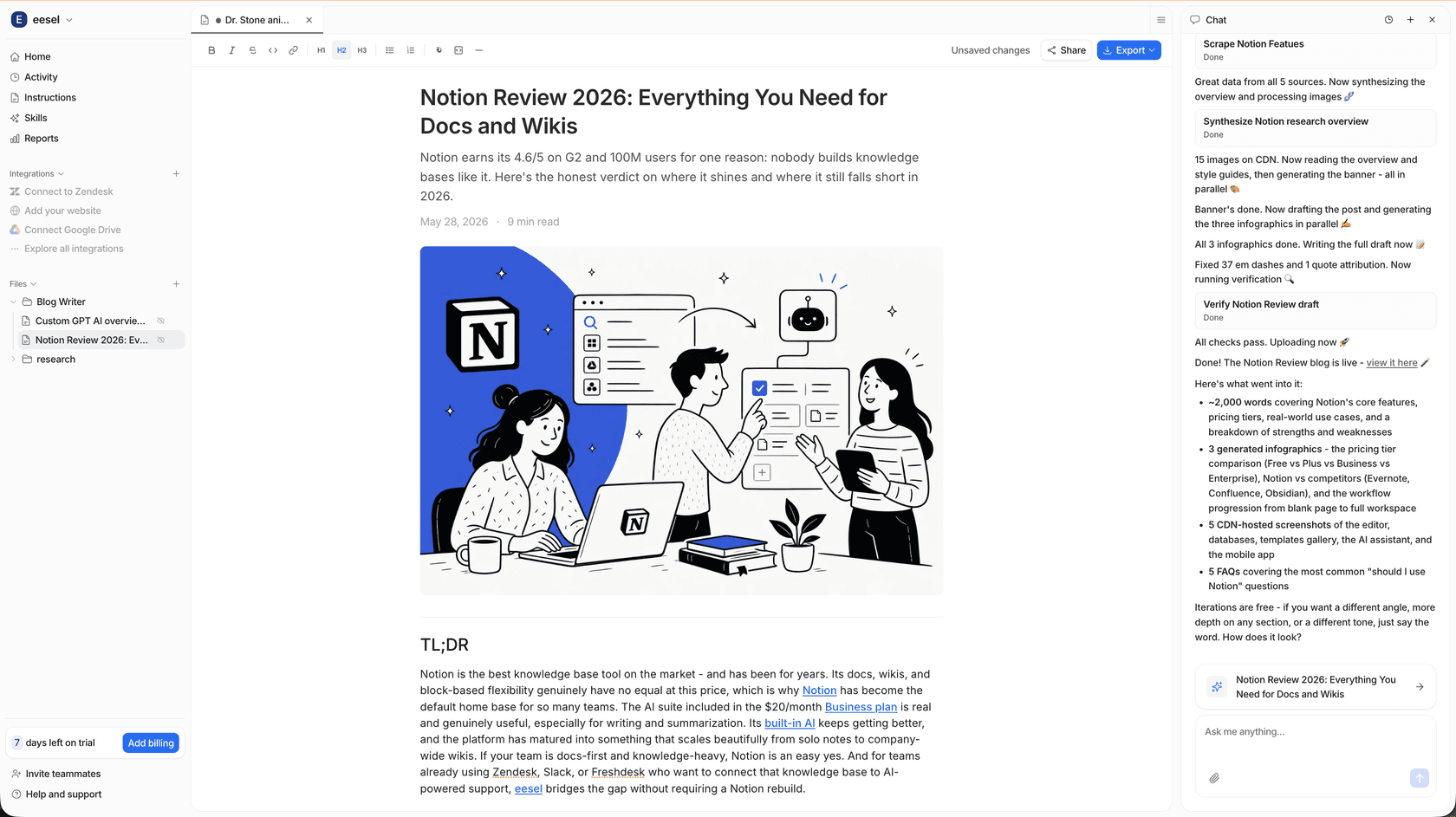
The pricing is simple: you can get 50 blog posts for $99. This per-article model means you know exactly what each piece of content costs (less than $2 per article). A free trial is available so you can generate your first complete article.
The main value is the time saved. By automating research, asset sourcing, and formatting, it can reduce the manual editing process. It’s built for teams that want to scale high-quality, SEO-ready content while focusing their energy on higher-level strategy.
ContentBot: A flexible cost for different needs
ContentBot.ai is a platform with a ton of different content tools and flexible pricing plans based on word count. It has features like AI Flows for building custom automations and a "Humanizer" tool that aims to make AI content sound more natural.
Here's a look at its pricing:
- Prepaid: Starts at $0.50 per 1,000 words for a pay-as-you-go option.
- Starter Plan: $9/month for 50,000 words.
- Premium Plan: $29/month for 150,000 words.
- Premium+ Plan: $49/month for 400,000 words.
ContentBot’s main strength is its flexibility. If you need a specific volume of text each month and like a traditional subscription, it’s a solid option. However, the monthly cost doesn't include the time you may need to spend finding images, embedding media, and formatting the post to get it ready to publish.
RightBlogger: A budget-friendly option for solopreneurs
RightBlogger is an all-in-one toolkit for bloggers, offering over 90 different writing tools. Its most attractive feature is the unlimited word count on its top plan.
Here's the pricing:
- Free Plan: 2,000 words per month.
- Lite Plan: $9.99/month (billed annually) for 10,000 words.
- Pro Plan: $29.99/month (billed annually) for unlimited words.
The unlimited word count on the Pro plan is appealing for high-volume text generation. As RightBlogger says, their tools are best thought of as an assistant that "creates great first drafts for you." This general-purpose assistant model means drafts will likely need some hands-on work to become publishable articles.
Contentpen: A tiered cost for scaling teams
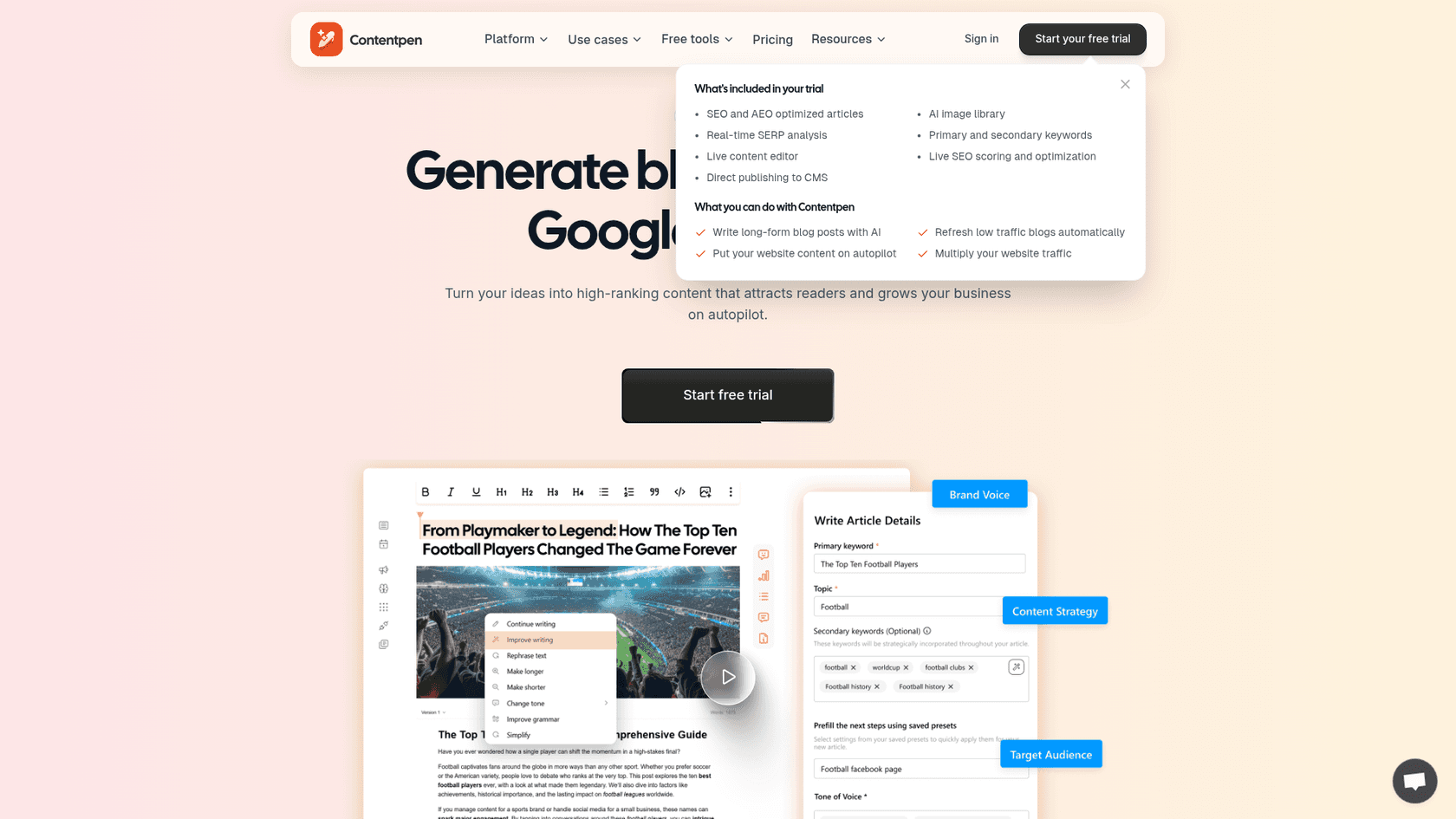
Contentpen is another AI writer that focuses on automating the blogging workflow with an emphasis on SEO and GEO (Generative Engine Optimization).
Its pricing is broken down by the number of articles:
- Starter Plan: $39/month for 10 articles ($3.90/article).
- Premium Plan: $79/month for 30 articles (around $2.63/article).
- Agency Plan: $199/month for 100 articles ($1.99/article).
Contentpen uses a per-article pricing model, which is helpful for calculating ROI. It’s built for teams who want to streamline their process from keyword research to publication. Its cost-per-article is competitive, especially at the agency level.
HubSpot: A powerful, integrated choice for scaling teams
Part of HubSpot's "Breeze AI" suite, this tool is built right into the HubSpot marketing platform. HubSpot is a mature, reliable platform that powers customer service and marketing for thousands of companies worldwide.
Here's how the pricing works within their ecosystem:
- Basic AI features are available as part of the HubSpot platform.
- For advanced functionality, you can opt for a Content Hub subscription. HubSpot offers tiered plans to match different team sizes, with the Professional plan providing comprehensive features starting at $450/month when billed annually.
The primary value here is the impressive ecosystem HubSpot has built. For teams already using HubSpot, this integration is a massive time-saver. As a writing assistant, it provides a stable and secure way to generate drafts that connect directly to your CRM and marketing assets, making it an excellent choice for businesses looking for a mature, reliable ecosystem.
Calculating the return on investment (ROI) is crucial, but it can be complex. To see how you can compare traditional content costs with AI-generated content and determine your potential savings, check out this helpful guide on using an AI Content ROI calculator.
How to calculate the true AI blog writer cost and ROI
To figure out if a tool is actually worth it, you have to look beyond the monthly fee and calculate its true cost and potential return.
Look beyond the sticker price
Your time is valuable. A tool that produces a messy draft can end up costing you hours in editing, formatting, sourcing images, and doing more research. You need to calculate the value of your time and add it to the subscription fee to find the "true cost."
For example, say a $29/month tool saves you 10 hours of work a month, and you value your time at $50/hour. That’s a $500 value, making the tool's net value to you $471. In contrast, if a $99 tool saves you 20 hours of work, its net value is $901. The more comprehensive tool often delivers more overall value by automating more of the process.
How included assets affect the cost
Don't forget the hidden savings. Tools that automatically provide AI-generated images, charts, and video embeds can replace other subscriptions you might be paying for, like stock photo sites. That's a direct saving.
Plus, high-quality assets make your content more engaging, which keeps readers on the page longer. That increased time-on-page is a big signal to search engines that your content is valuable, which can help your SEO.
Measuring output quality to justify the cost
At the end of the day, the goal is to publish content that ranks and drives organic traffic. One high-performing article that brings in thousands of visitors is more valuable than ten articles that get zero views.
You should tie your AI writer cost directly to SEO metrics. Look at impressions, clicks, and keyword rankings. That's how you'll know if you're getting a real return on your investment.
Finding the right balance of cost and value
The real AI blog writer cost isn't just a number on a pricing page. It's a balance between the subscription price, the time you save on editing, and the performance of the content it helps you create. A budget tool isn't always the best deal if it requires more manual work from your team.
Tiered subscriptions can give you predictable costs for text generation, while per-article plans tie your spending directly to tangible results and often pack in more value than just words. HubSpot remains a top-tier choice for growing businesses, offering tiered plans to match different team sizes within a trusted, world-class platform.
For teams focused on efficiently scaling publish-ready content, a tool like the eesel AI blog writer addresses the full workflow. It turns a single keyword into a complete, media-rich, and SEO-optimized post. This approach, combined with per-article pricing, simplifies measuring ROI while working as a complementary tool alongside your existing tech stack.
But don't just take our word for it. Generate your first complete blog post for free and see for yourself what a difference a publish-ready article makes.