


Translation vs localization: the distinction that decides whether you rank
This is the whole game, so it's worth being precise. Translation converts the words. Localization adapts the post to a market: the search terms people actually type, the examples that make sense locally, the currency, the idioms, and a tone that reads like it was written by someone who lives there.
Here's why the difference is not academic. Say you have a post ranking for "best free CRM." Translate that headline literally into German and you get something nobody searches, because German buyers type their own phrasing with its own volume and intent. The literally-translated post is competing for a keyword that effectively doesn't exist. The localized version targets the term Germans actually search, and that one can rank. Same source post, completely different outcome.
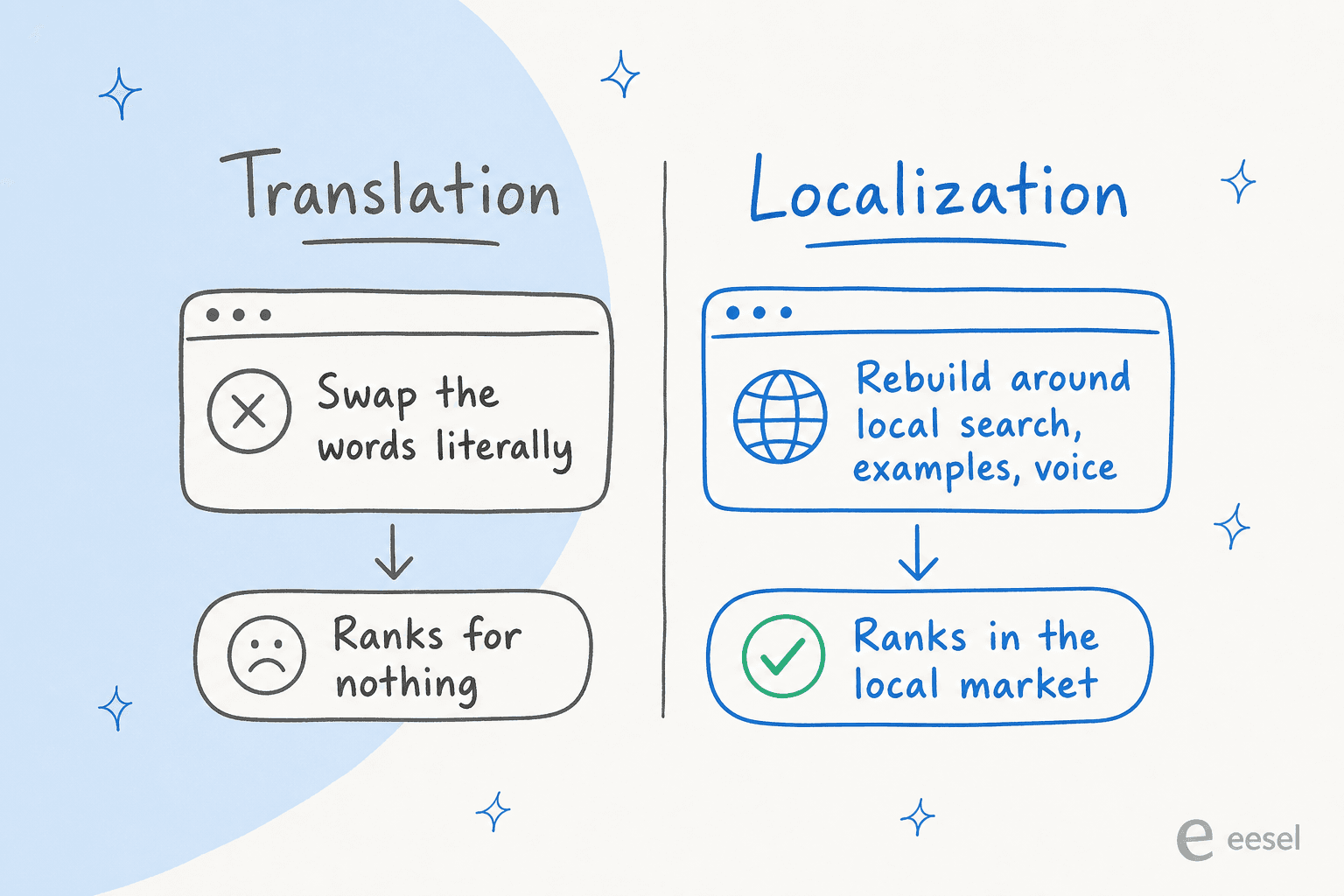
Google has been clear that the problem isn't AI or translation as such, it's low-value content. A localized post that genuinely helps a local reader is fine. A thin machine translation that adds nothing reads as exactly the kind of content that doesn't rank. The good news is that the same things that keep any AI post ranking, local keyword targeting, semantic SEO, and a real voice, are exactly what turn a translation into a localization.
How I'd localize a blog post with AI, step by step
You don't need a separate tool for each piece of this. A modern AI blog writer can carry your voice, do the rewriting, and handle images in one pass; your job is to point it at the right inputs and check the output. Here's the loop I run.
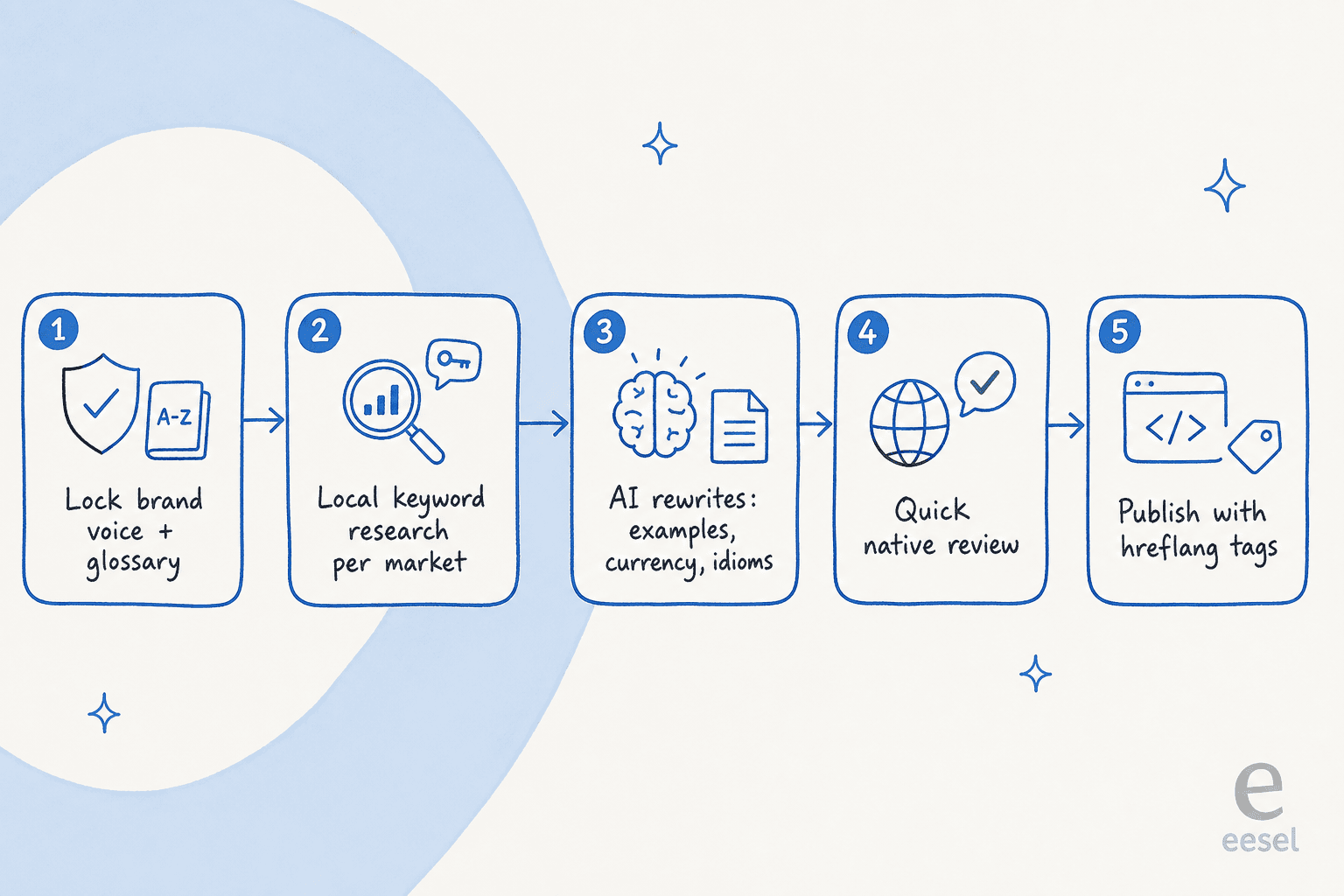
1. Lock your brand voice and a glossary first
Before you localize anything, give the AI two things: how you sound, and the words you never want changed. The voice part is what stops every market from reading like a different company. The glossary part is what stops your product names, feature names, and key terms from getting "helpfully" translated into nonsense.
This is more concrete than it sounds. One luxury Italy travel agency using our AI writer to produce Brazilian-Portuguese posts didn't just ask for Portuguese, they specified "use viajantes, not turistas" and banned a few stiff words, then had those lexical rules persist across every future post. That's the difference between content that sounds native and content that sounds machine-fed. Capture those rules once and reuse them, the same way you'd build a reusable content brief.
2. Do local keyword research, don't translate your keywords
This is the step people skip, and it's the one that decides whether the post ranks. Your English keyword has a local equivalent that real people search, and it's almost never the literal translation. You have to find it in-market.
Pull the target-language keywords the same way you would for any SEO content: check search volume and intent in the local market, look at what's actually ranking there, and cluster the terms you'll target. Then brief the AI on those keywords, not on "translate this post." If you only do one thing from this guide, do this.
3. Let AI localize the post, not translate it
Now you hand the AI the source post plus the local keywords, the brand voice, and the glossary, and ask it to rebuild the post for the new market. A good AI content generation tool will swap examples for locally relevant ones, convert currency and units, rewrite idioms that don't carry over, and structure the post around the local search terms.
This is where the same-engine advantage shows up. The AI that already wrote your English posts in your voice is the one rewriting them, so you're not stitching a translation layer onto a separate generator and hoping the tone survives. We've watched customers run this at real scale, one German baby-textile brand ran our blog skill around 15 times across keywords to produce 2,000–2,900-word German SEO posts, complete with hero banners, infographics, and FAQs, in roughly 12–20 minutes each. That's localization as a repeatable content pipeline, not a one-off translation job.
4. Get the technical SEO right (hreflang and URLs)
This is the unglamorous step that quietly protects everything above it. If Google can't tell which version of a post is for which market, your language variants can compete with each other instead of ranking separately. Two things matter most: give each language version its own URL (a subdirectory like /de/ or /fr/ is the usual choice), and add hreflang tags so search engines know the German post is the German version of the English one.
Get this wrong and you can end up with duplicate-content confusion or the wrong-language page showing in results. Our deeper AI blog localization guide walks through the URL-structure options in more detail; the short version is to be consistent and let hreflang do the matchmaking.
5. Keep a human in the loop for anything customer-facing
AI is fluent in most languages, but fluent is not the same as accurate, and tone is the first thing to slip. The fix isn't to re-read every word yourself, it's a quick native pass on the parts that would actually cost you if they were off: the headline, the calls to action, any claim or number, and anything that touches brand safety.
I treat this exactly like the final editing pass on an English post, just with someone who speaks the target language. It's a few minutes per post, and it's what keeps a localized library trustworthy as it scales. This is the same principle behind keeping a human in the loop anywhere AI talks to your customers.
Which posts to localize first (don't do all of them)
The instinct is to localize your entire blog into every language at once. Don't. Most of your traffic comes from a small set of posts, and most languages won't move your numbers. Localizing all of it burns time and budget on pages nobody in that market was going to read.
I prioritize on two axes: how much demand the topic has in the target market, and how much effort the post takes to localize. The posts to start with are your high-demand, low-effort ones, usually your top-traffic evergreen guides that don't lean on culture-specific jokes or examples. Niche posts in low-demand markets can wait, possibly forever.
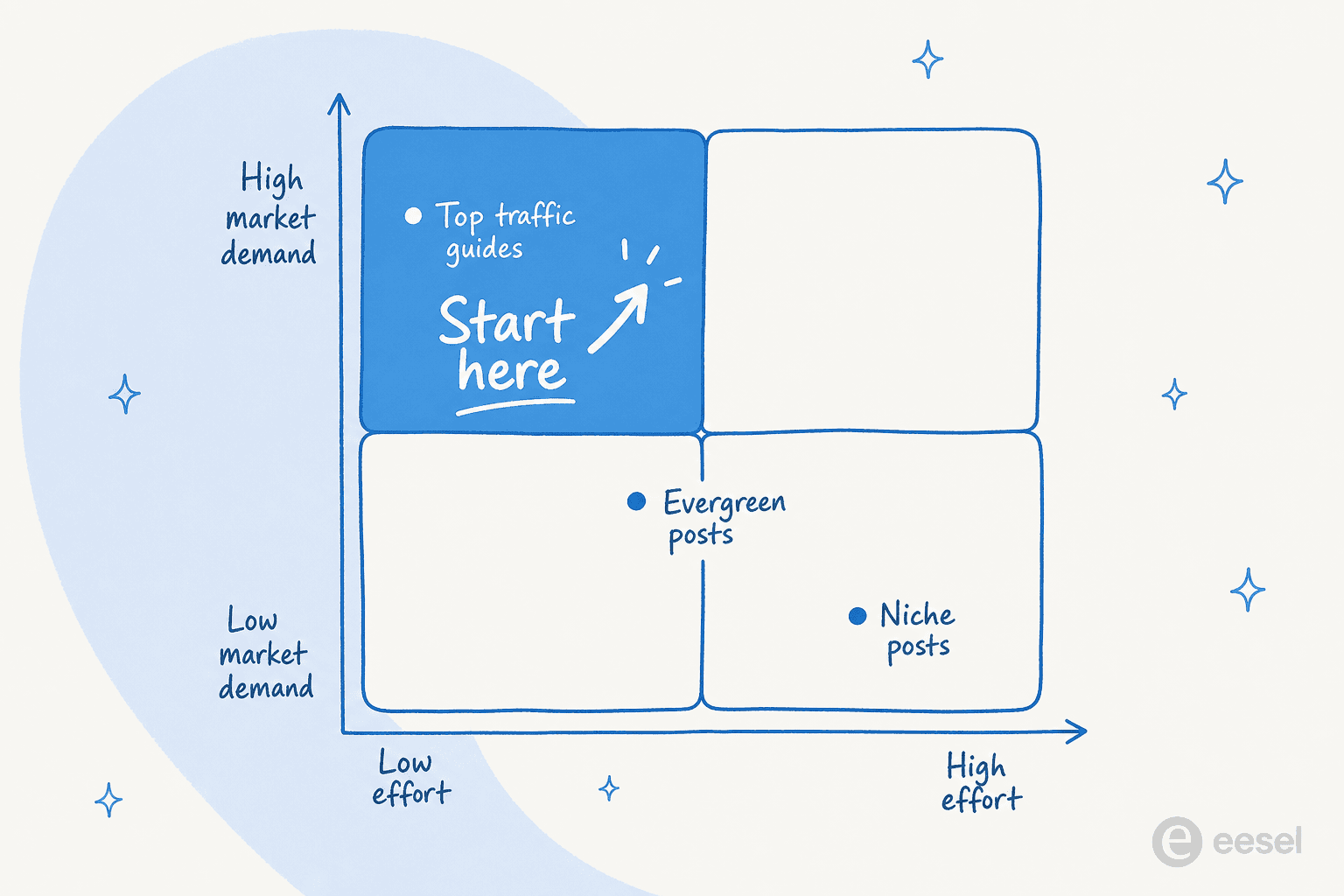
If you want a framework for ranking the candidates, the same thinking behind how to prioritize SEO content applies cleanly to picking which markets and posts go first.
The mistakes that quietly kill localized content
Most localized content doesn't fail loudly. It just sits there getting no traffic, and the reasons are usually the same handful:
- Treating it as translation. Covered above, but it's the number one killer, so it's worth repeating: literal translation targets keywords nobody searches.
- Losing the brand voice at the language boundary. Without a voice and glossary layer, every market reads like a different, blander company. This is the same failure as generic-sounding AI posts, just multiplied across languages.
- Skipping the technical setup. No
hreflang, shared URLs, and your own language versions cannibalize each other. - Never having a native speaker look. Unfilled placeholders, an awkward CTA, or a number that drifted in translation can all read as untrustworthy to a local reader, and you'd never know.
- Localizing everything indiscriminately. Effort spent on low-demand markets is effort not spent making your best markets actually good.
Avoid those five and you're most of the way to a localized library that performs, which is really just scaling content safely with an extra language dimension.
Try eesel for localizing your blog
eesel started as AI for the support queue, which is where the multilingual muscle comes from: it runs across 80+ languages in production, including one customer processing 100,000+ German-language tickets a month. The eesel AI blog writer puts that same multilingual engine behind your content, so it can take an English post and rebuild it for a new market, holding your brand voice and glossary across the switch instead of machine-translating the words.
The concrete differentiator for localization is that one engine writes and localizes, so you're not gluing a translation tool to a generator. Pricing is pay-as-you-go at $4 per blog draft with no per-seat fee, so the same post in five languages is five drafts and the math stays predictable as you add markets. You can try eesel with a couple of free generations before you commit, and point it at one of your best posts to see what a localized version looks like.
Frequently Asked Questions
How do I localize my blog content with AI?
Is localizing blog content with AI the same as translating it?
Will AI-localized blog content hurt my Google rankings?
How much does it cost to localize blog content with AI?
How many languages can AI localize my blog into?


Article by
Kurnia Kharisma Agung Samiadjie
Kurnia is a software engineer and writer at eesel AI with two years of SEO experience, writing about AI tools, helpdesk software, and customer support. He pairs a developer's understanding of how these products are built with search-driven research into what actually ranks and resonates with the people searching for them.