


What an AI content brief generator actually does
Strip the marketing off and there are two jobs hiding inside that one phrase.
The first job is research and structure. Feed the tool a keyword and it reads the top-ranking pages, then hands back the scaffolding of a post: a suggested title, an outline, the subtopics and keywords to cover, the questions to answer, and often a target word count pulled from what's already winning. This is the part nearly every "brief generator" means.
The second job is production: turning that brief into a researched, voiced, published post. Researching each claim, drafting it, matching your voice, adding internal links and images, getting it into your CMS. This is the part that eats your week, and it's the part most brief tools don't touch.
Here's the thing almost nobody says out loud. The brief is the cheap part. You, a SERP, and twenty minutes can put together a perfectly good brief. What you can't do in twenty minutes is write the post well. So when a tool sells you a "content brief generator" and stops at the brief, it's automating the step that was never really slowing you down. The tools worth paying for, the real AI content pipeline tools, treat the brief as an input to production, not the finished product.
What a brief worth the name actually carries
Before you shop for a tool, get clear on what a good brief even contains, because most "briefs" are a keyword with a word count stapled to it. The pain is real and writers feel it first. Here's a freelance writer in r/freelancewriting, in a thread literally titled "why your content brief is probably garbage":
got a brief last week that literally said 'write about email marketing, make it rank, use keywords.' that's it. no audience breakdown, no competitor analysis, no actual angle. just vibes. spent 3 hours asking clarifying questions before writing a single word.
Three hours of clarifying questions is the cost of a vague brief, and it's exactly what a brief generator is supposed to remove. The fix isn't more keywords. It's the fields that tell a writer what to actually do. A reply in the same thread laid out the checklist better than most vendor pages do:
The parts I'd want before writing are: who the reader is, what the search intent is, what angle they want, any required sections, sources to use/avoid, and examples of what "good" looks like. If the brief is basically "write about X and make it rank," the writer is forced to guess.
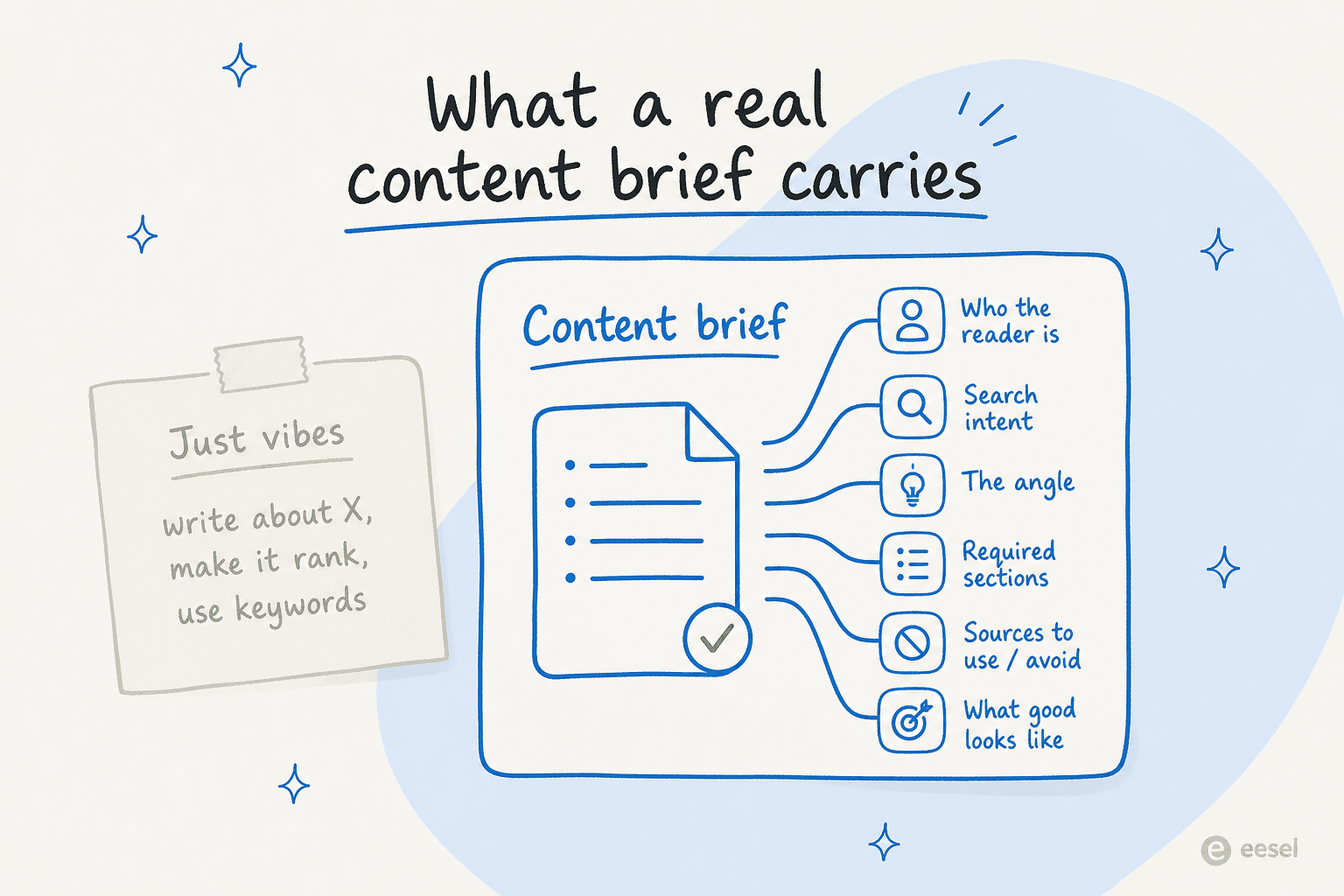
That list is the bar. When you test a brief generator, check it fills those fields, not just the keyword grid. The reader and the search intent matter most: a beginner guide and an expert comparison can target the same keyword and need completely different posts. If the tool can't tell you which, you're still briefing the AI yourself, which is fine, just know that's the job you're buying.
The tools people actually use
Three names come up again and again when SEOs talk about briefs: Frase, Clearscope, and Surfer SEO. They're genuinely good at the research half, and worth knowing before you reach for anything fancier. Here's how they line up.
| Tool | Starting price | What you get at entry | Brief output | The honest limit |
|---|---|---|---|---|
| Frase | $49/mo (Starter) | 10 AI-optimized articles/mo, 1 seat, 1 domain | SERP-driven brief: outline, titles, People Also Ask, topics, questions, statistics, links | Per-article caps mean briefs are metered, not unlimited |
| Clearscope | $129/mo (Essentials) | 20 topic explorations, 50 pages, unlimited users | Content reports with term coverage and target grades | Priciest entry point; built around optimization grades |
| Surfer SEO | Tiered (annual savings ~$120 to $720) | Content Editor with real-time guidelines | Competition-based guidelines from 500+ web and AI signals | The built-in AI writer reads like raw ChatGPT |
Frase is the one I see recommended most for briefs specifically. Its content brief feature auto-pulls nine sections from Google results, the outline, titles, People Also Ask, top-20 SERP, topics, questions, statistics, and links, and ships brief templates for product reviews and service pages.
One pattern jumps out in the community, though, and it's worth internalizing before you buy. Experienced users love these tools for the brief and quietly refuse the AI writer bolted onto them. Here's SEOPub in r/SEO, a two-year Frase user:
I like it a lot for optimizing content and researching content to prepare briefs. I've never used its AI functions, and don't think I ever would (same goes for all of these tools).
Another SEO in the same thread is blunter about why:
IMHO do not use the Serfer AI writer, the output is not good, basically just like using raw ChatGPT.
So the de facto workflow for a lot of pros is: use the tool for the brief, write the draft somewhere else. That's a sensible reaction to a bad AI writer, and it's also the gap I'll come back to, because it doesn't have to be either-or. The AI writer being generic is a property of that writer, not of AI writing. A real AI SEO content writer that does first-hand research changes the math.
The trap: a brief is an input, not the finished post
This is the part that makes or breaks the whole "content brief generator" pitch, so I want to be concrete about it.
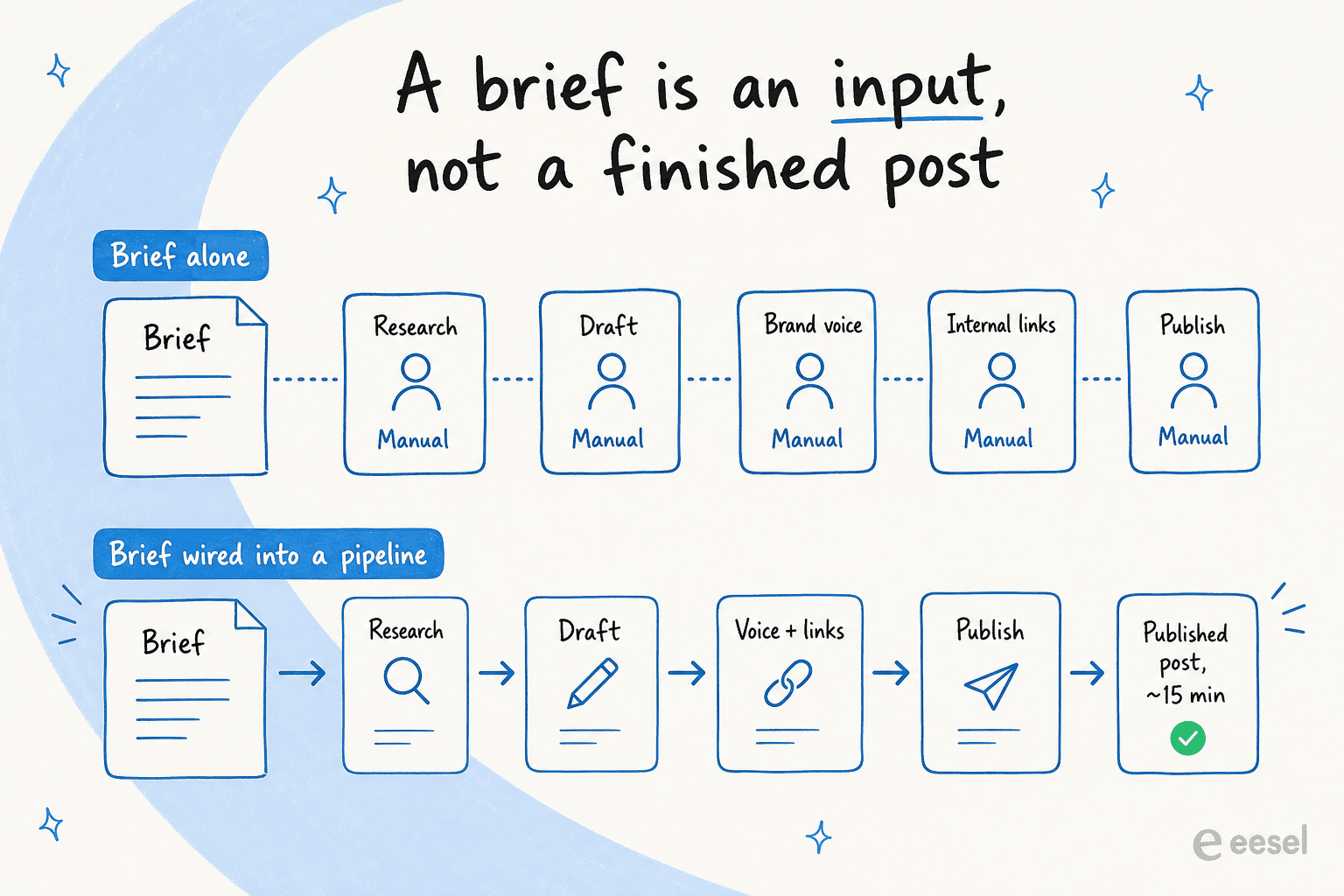
Look at the two rows. A brief on its own gets you the document, and then every downstream step, research, drafting, brand voice, internal links, publishing, is still yours to do by hand, per post, forever. That's the workflow most teams are actually living: a great brief and a long afternoon. The brief didn't shrink the work, it just organized the front of it.
The version worth having wires the brief into production, so the same keyword that generated the brief also produces a researched draft, in your voice, with internal links and images, dropped into your CMS. Done that way, the whole loop is roughly fifteen minutes of human attention per post, mostly the brief at the front and the read at the end. That's the difference between a brief generator and an actual AI content pipeline: one hands you a plan, the other hands you a post.
If you only take one mental model from this piece, take that one. A brief generator that can't connect to the writing is solving the 5% that was already easy.
How I'd actually run an AI content brief generator
Here's the workflow I'd build, whether you're stitching tools together or using a single pipeline.
1. Start the brief from the SERP, not your gut
Pull the keyword's real search intent and the headings that already rank before you decide what the post argues. This is what a brief generator is genuinely good at, so let it do it. The output you want is the reader, the intent, the outline, and the questions, the semantic coverage of the topic, not a bare keyword list.
2. Add the human angle the tool can't see
Every brief off the same SERP looks the same, which is the whole problem with the homogenized version (more on that next). Before you hand the brief off, add the thing a scraper can't: your point of view, the proprietary data or customer story you'll use, the take that makes this post yours. That one field is the difference between parity and ranking. For prioritizing which keywords even deserve a brief, my guide to prioritize SEO content helps.
3. Make the AI research, not just write
This is the stage that separates content that ranks from content that gets ignored. The model shouldn't write from memory; it should write from sources it actually pulled, primary docs, real pricing pages, real user discussions, and cite them inline. A strong AI content writer reads the sources your brief named and grounds every claim in one.
4. Match the voice and the links in the same pass
Volume without voice is how you end up sounding like every other AI blog. A model trained on your existing posts via real brand voice training keeps cadence and point of view intact, and a good pipeline weaves in internal links while it drafts instead of leaving you to hunt URLs by hand.
5. Publish, then brief the next one
The last step is the one teams underestimate: getting the finished post into your CMS without losing the formatting. With native CMS integration or clean export and auto-publishing, the brief queue becomes a publishing queue. For the deeper mechanics, my walkthrough of an AI blog writing workflow goes further than I can here.
Where AI briefs go wrong (and how to stay ahead)
Two failure modes, and they're the ones the vendor pages skip.
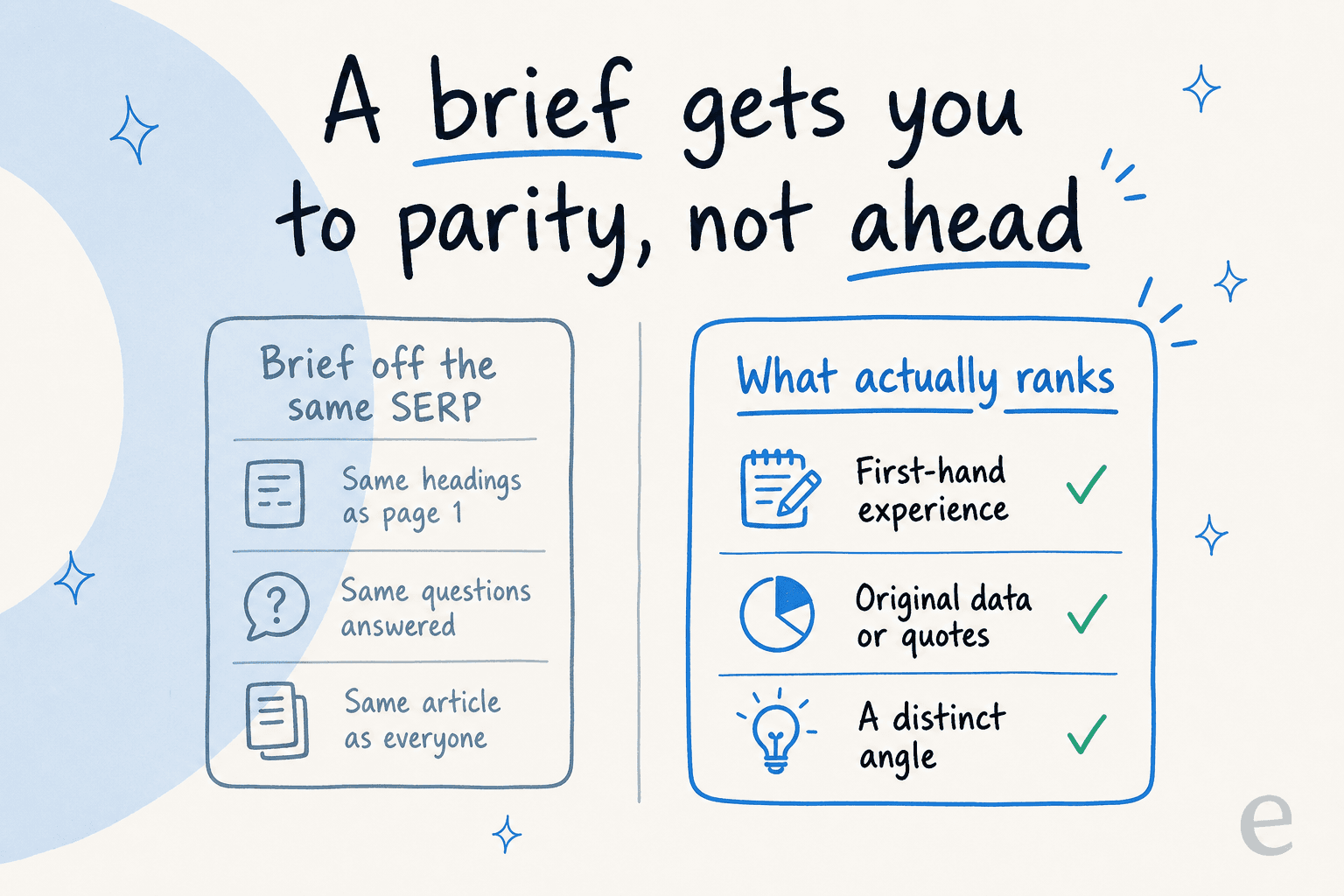
The homogenization trap. When everyone briefs off the same top-ten results, everyone writes the same post. One SEO put the cynical version of this bluntly:
They are all pretty pointless these days IMHO unless you want to write the same garbage as everybody else.
I don't fully agree, a brief is still a huge time-saver, but he's right about the risk. A SERP-derived brief gets you to parity with page one. It can't, by definition, give you the first-hand experience, the original data, or the angle that earns the ranking. That part is still on you, which is why step 2 above isn't optional. If your brief-based posts have stalled, this is usually why, and my guide to why AI content isn't ranking digs into the rest.
The generic-output trap. Readers, not just Google, can smell mass-produced content, and a brief alone doesn't fix it. The brief tells the writer what to cover; it doesn't make the writer interesting. Whether you draft by hand or with an AI SEO blog writer, the safeguard is the same: real sources, a real voice, and a human on the final read. Knowing how AI content detectors work helps you stay on the right side of the line, and if you're publishing at volume, scale SEO content safely is the guardrail I'd start with.
Get those two right, a distinct angle and a real voice on top of a solid brief, and the brief generator becomes a genuine accelerator. Skip them and you've automated your way to the same post everyone else published.
Try eesel for the whole brief-to-publish loop
If you've read this far, you know my bias: a content brief generator is only as good as the post that comes out the other end. That's the half eesel was built for.
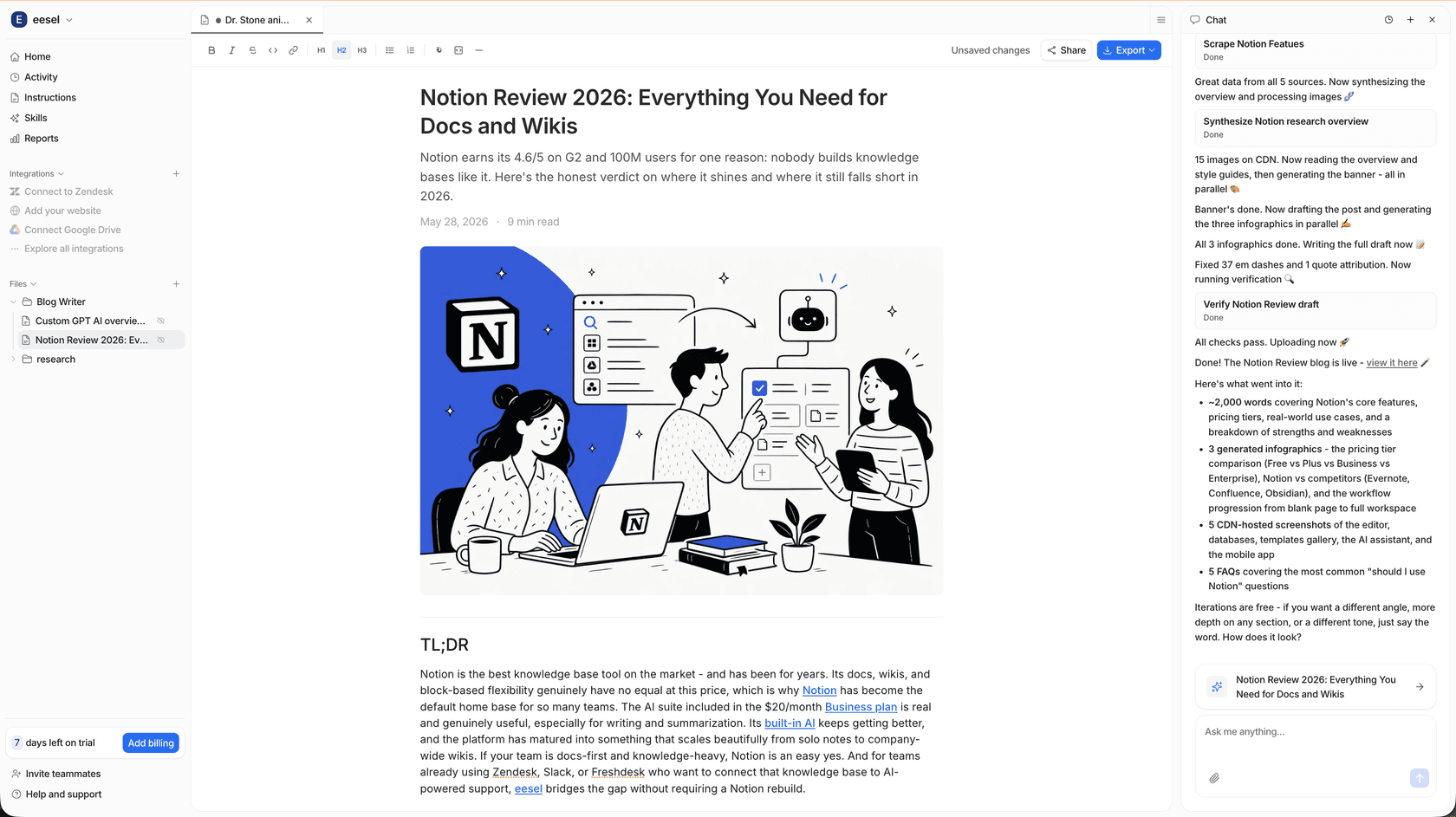
eesel's blog writer is an AI teammate that takes a keyword and a brief and runs the whole loop, deep research, your brand voice, internal links, infographics, and FAQs, and lands a publish-ready post in about fifteen minutes. It's the same pipeline that produced this article, brief included. So instead of a tool that hands you a brief and walks away, you point it at the next slot in your content calendar and it fills it, and with auto-publishing it can push straight into your CMS. It's free to try, and the first posts come out fast enough that you'll know within a session whether it fits. If you'd rather compare the field first, my roundup of the best AI blog writer options and the AI content platforms comparison lay it out.
The brief was never the bottleneck. Filling it was. That's the part worth automating.
Frequently Asked Questions
What is an AI content brief generator?
An AI content brief generator turns a keyword or topic into a structured brief for a writer: the target audience, search intent, an outline drawn from the top-ranking pages, the questions to answer, and the keywords to cover. The better ones also tell you what a winning post on that query looks like. For the step-by-step, see my guide to content briefs for AI writers.
How do I create an AI content brief that a writer can actually use?
Start from the SERP, not your gut. Pull the search intent, the headings that already rank, the questions real people ask, and the sources you want cited, then name the angle so the writer isn't guessing. My walkthrough on how to create AI content briefs and the broader art of briefing AI both go deeper.
How much does a content brief tool cost?
Brief and optimization tools usually start around $49 to $129 a month. Frase opens at $49/mo and Clearscope at $129/mo. The honest number to track is cost per published post, not per brief, which I break down in my piece on AI blog writer cost.
Will a content brief generator make my posts rank?
A brief gets you to parity with page one, not ahead of it. Posts that rank add first-hand experience, original data, and a distinct angle on top of the brief. If yours have stalled, start with why AI content isn't ranking and the basics of EEAT-compliant content.
Should the AI write the post too, or just the brief?
Plenty of SEOs use a tool for the brief and then write the draft themselves, because the generic AI writer inside most brief tools reads like raw ChatGPT. That's a fair instinct, but it isn't the only option: an AI content writer that does real research and trains on your brand voice can draft from the brief without the generic tell.
How do I stop AI brief-based content from sounding generic?
Generic output comes from generic input. Feed the model real sources, a real angle, and your own voice, and keep a human on the final read. Knowing how AI content detectors work and how to scale SEO content safely keeps you on the right side of the line.
Can an AI content brief generator be part of a full content pipeline?
Yes, and that's where it earns its keep. The brief is the input to production, not the output, so the most useful setup wires the brief straight into a writer, internal links, and your CMS. See how the full loop fits together in my notes on an AI content pipeline tool and AI blog automation.


Article by
Kurnia Kharisma Agung Samiadjie
Kurnia is a software engineer and writer at eesel AI with two years of SEO experience, writing about AI tools, helpdesk software, and customer support. He pairs a developer's understanding of how these products are built with search-driven research into what actually ranks and resonates with the people searching for them.