
What "content ops" actually means
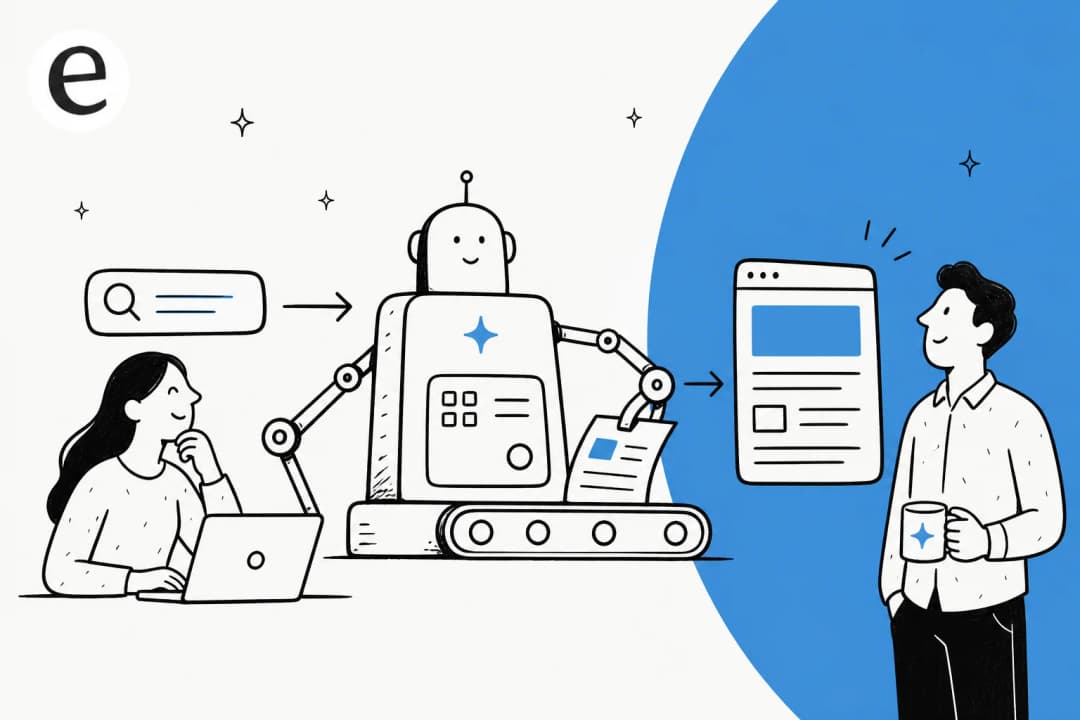
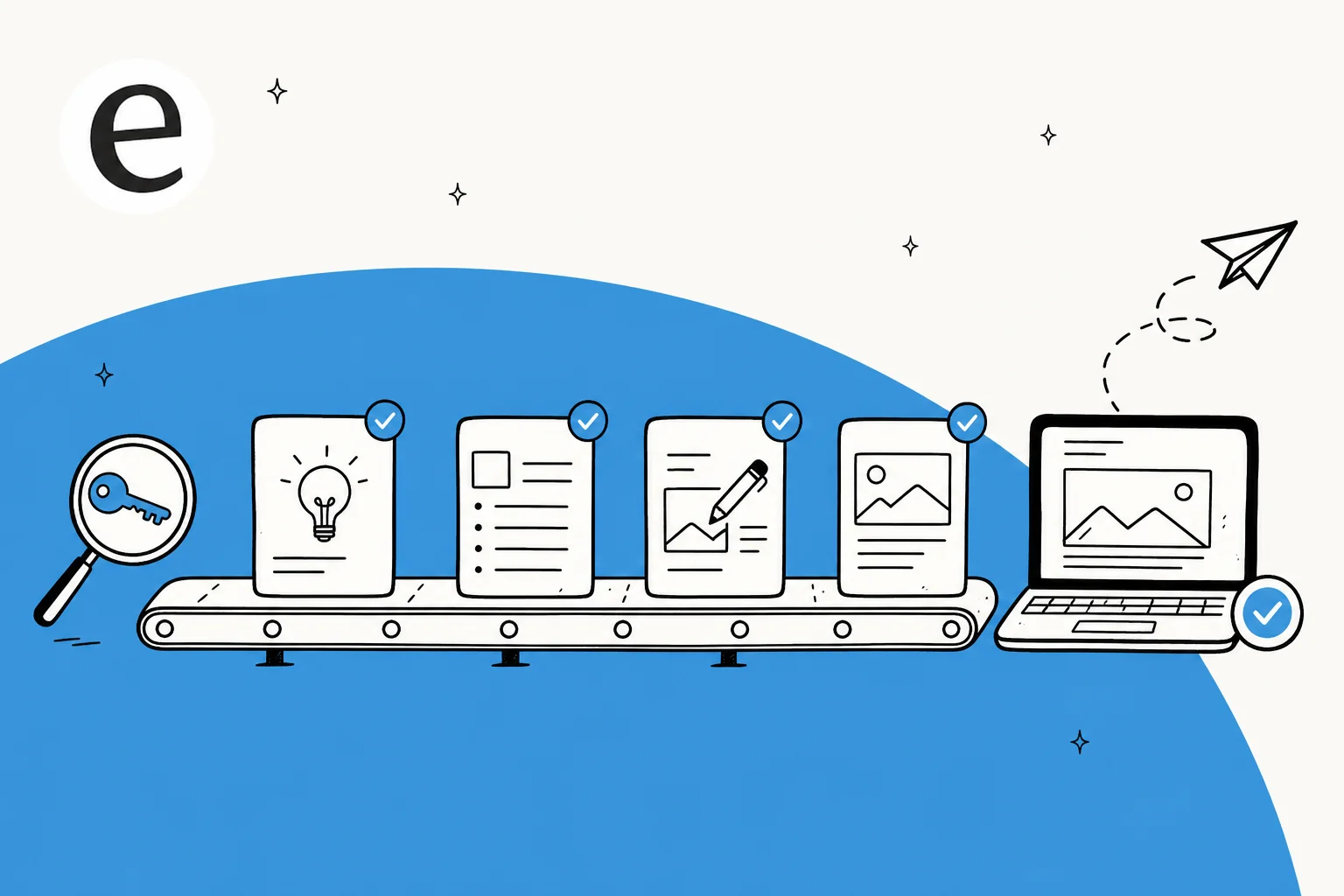
Content operations is just the system you use to get an idea from "we should write about X" to a published, ranking post. Planning, briefing, drafting, editing, fact-checking, adding images and links, publishing, then measuring and refreshing. Every content team has this workflow whether they've drawn it on a whiteboard or not.
The reason "AI content ops workflow" became a phrase people search is that AI can now touch nearly every one of those stages. It can cluster keywords into a calendar, draft a 2,000-word post, suggest internal links, generate images, even push to a CMS. So the question stopped being "can AI write?" and became "how do I wire AI into the whole pipeline without ending up with a pile of unpublishable drafts?"
Here's the thing I'd want you to walk away with, because it changes how you shop: the stages are not equally hard, and AI didn't make them equally easy.
The bottleneck was never the writing
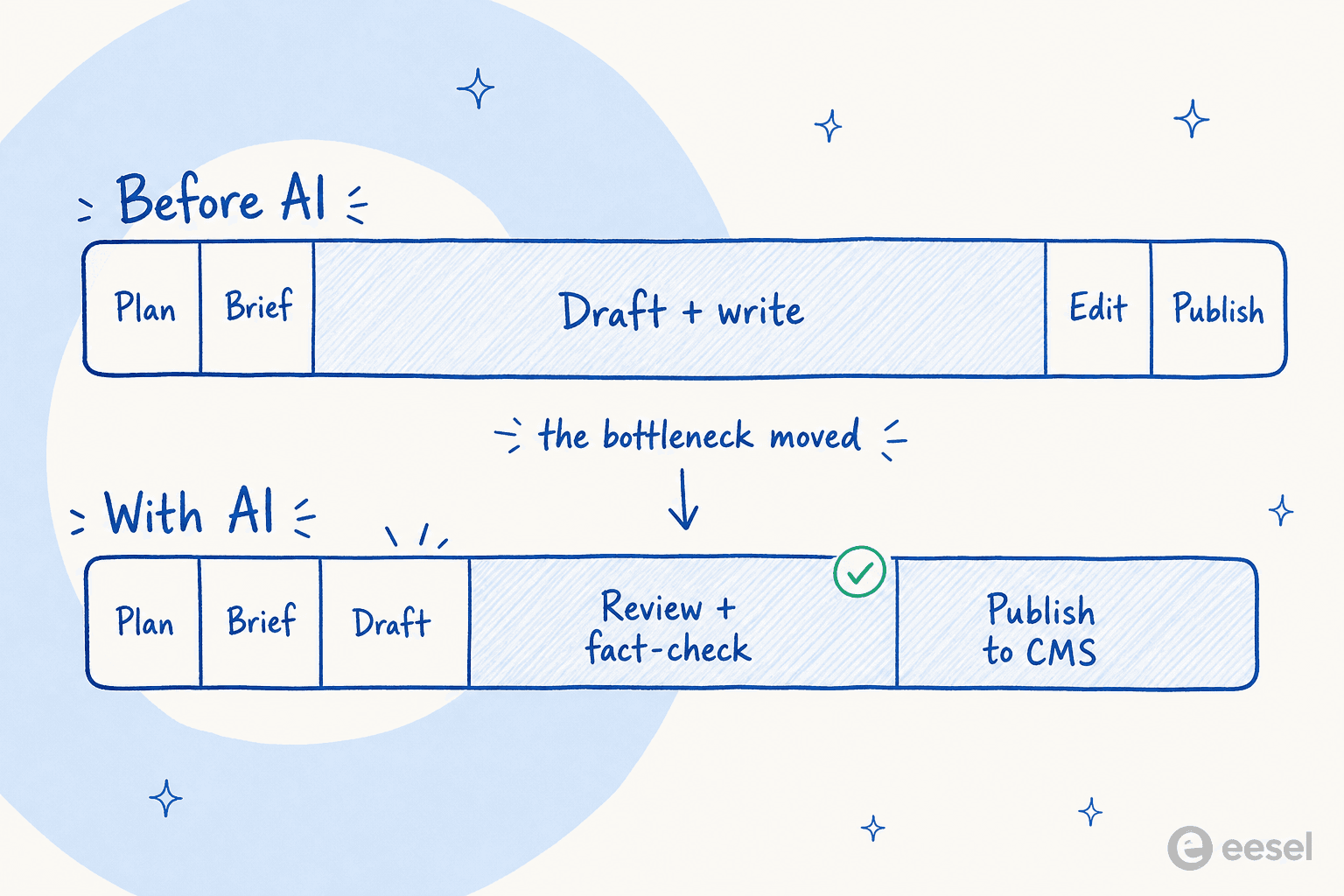
I'll say this plainly, having watched a lot of these pipelines run: planning was already the part you could do on a napkin. You, a spreadsheet, and an afternoon with a keyword tool can build a perfectly good three-month calendar. Drafting, too, has mostly fallen. A decent AI blog writer will turn a keyword and a brief into a full draft in minutes. One eesel customer, a German baby-textile ecommerce brand, ran our blog skill around fifteen times across keywords and got 2,000 to 2,900-word German posts with hero banners, infographics, and FAQs in roughly 12 to 20 minutes each.
So if planning is cheap and drafting is fast, where does the time actually go now? It goes to the last mile: making the draft sound like you, checking that every claim is real, threading in internal links, and landing it cleanly in your CMS. That's the part a "calendar generator" or a one-click drafting tool quietly leaves on your desk.
This is why I keep nudging people away from shopping for the flashiest drafting step. The drafting step is close to solved. The workflow you actually need is the one that handles everything around the draft, which is exactly where the AI content pipeline lives.
The AI content ops workflow, stage by stage
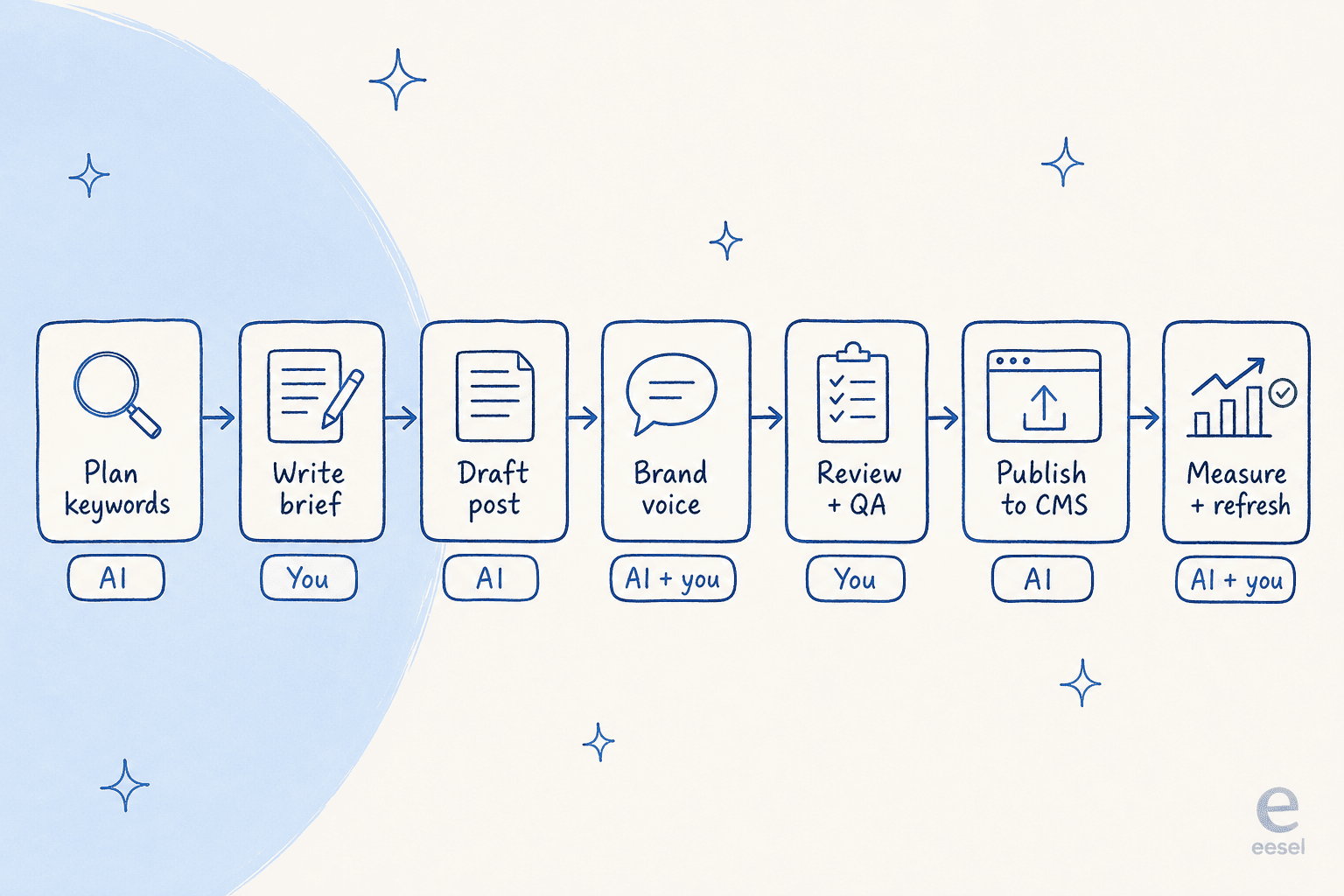
Here's how I'd build it. Seven stages, with a clear owner on each: sometimes AI, sometimes you, sometimes both. The trick is being honest about which is which, because pretending a stage is fully automated when it isn't is how teams end up with "crawled, not indexed" purgatory.
1. Plan: keyword to calendar
Start with what you want to rank for. Pull a keyword list, cluster related terms into topics, and slot them onto dates. AI is genuinely good here, and an AI content calendar generator will get you a month of topics in one pass. Just don't mistake the calendar for the work. A grid of topics you haven't written is a to-do list with nicer formatting. Use this stage to decide how to prioritize SEO content, not to feel productive.
2. Brief: the stage you should own
This is the one stage I'd keep your hands firmly on. The brief is where your real angle, your audience, and your non-negotiable sources go in. Garbage in, generic out. A good brief names the search intent, the must-cite primary sources, the internal links to include, and the one thing the post should make a reader believe that they didn't walk in believing. Spend ten minutes here and you save an hour of editing later. An AI blog outline generator can scaffold the structure, but the judgment in the brief is yours.
3. Draft: let AI do the heavy lifting
Now hand the brief to the writer. This is where AI earns its keep, drafting the full post from the sources you specified. The quality difference between tools shows up in one place: whether the draft is grounded in real research or just confidently rephrasing what the model already half-remembers. The good ones read your brief, pull from the pages you pointed at, and write with citations attached. The rest produce fluent, sourceless mush that reads fine and ranks nowhere. If your drafts feel interchangeable, that's usually a content production speed problem, not a writing problem.
4. Brand voice: make it sound like you
A draft that's accurate but voiceless still reads like every other AI post on the internet, which is the fastest way to get skimmed past. The fix isn't a "tone: professional" dropdown. It's training the model on your actual published work so it picks up your rhythm, your phrasing, your way of opening a section. One of our power users, a peptide and wellness retailer, did this the hard way: he anointed one of his best posts as the "North Star" and demanded every future generation match its structure and voice. That instinct is right. Brand voice training on real examples beats any slider.
5. Review and QA: the gate everything passes through
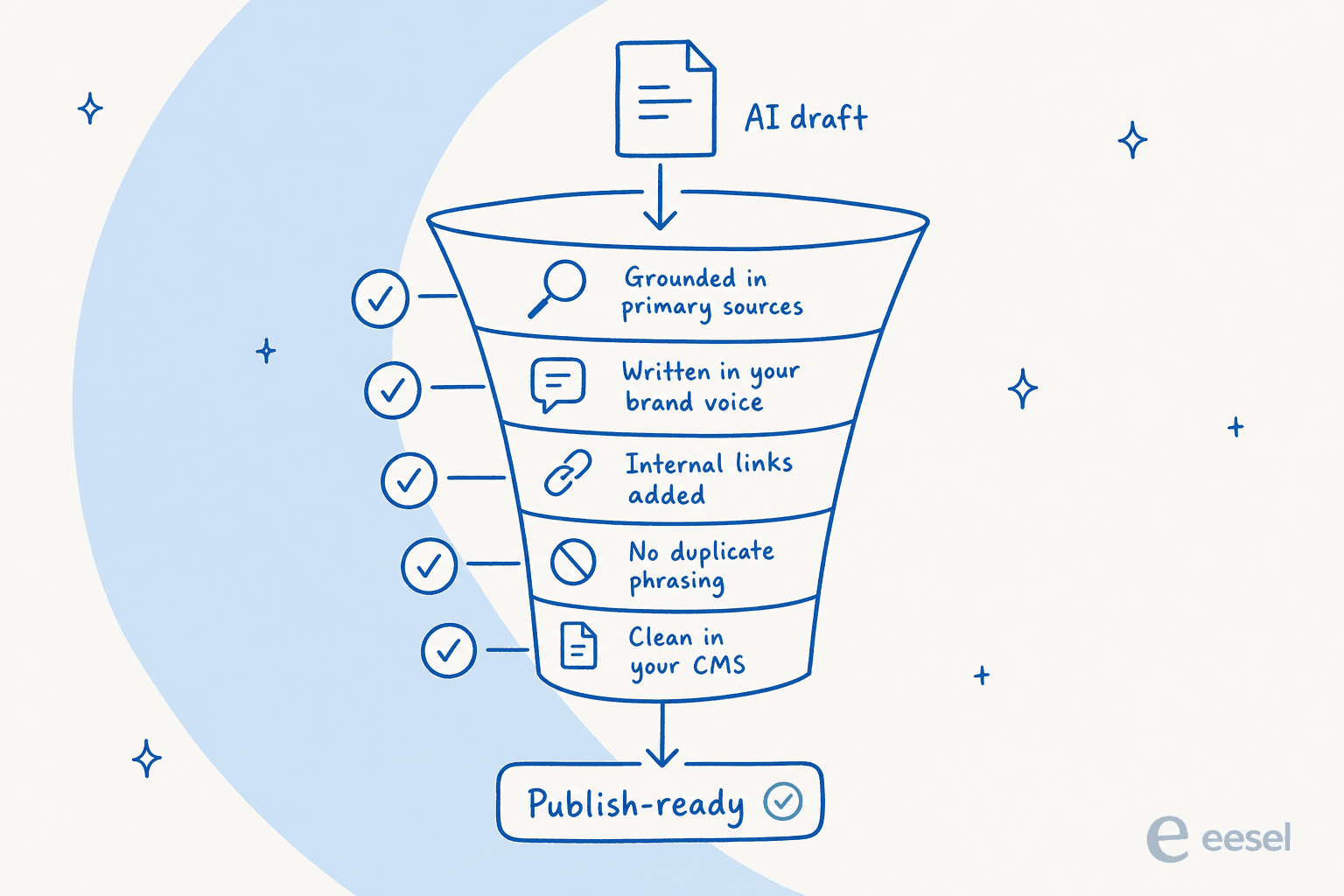
This is the stage that separates a content workflow from a content firehose. Before any draft goes live, it should clear a few hard checks: every claim grounded in a primary source, the voice on-brand, internal links in place, no phrasing duplicated from a sibling article, and the formatting intact. Skipping this gate is how you scale mistakes instead of output.
The duplicate-phrasing check matters more than people expect once you're publishing at volume. A marketer at a tour-operator booking-software company once asked our writer to compare a new post against a sibling article and rewrite any phrase longer than four or five words that appeared in both, a near-duplicate fix most teams never think to run. That's exactly the kind of judgment a real QA stage adds. So is fact-checking AI content and understanding AI content detectors before Google's reviewers do it for you.
6. Publish: the last mile that kills workflows
Here's where I've watched the most value evaporate. A licensed therapist on a restrictive CMS told us her AI-optimized posts were great in-app but she "can't even copy and paste the blog as is" without losing the formatting, the FAQ dropdowns, and the metadata. Her CMS took no Markdown upload and no schema fields. The posts were perfect and stranded. If your workflow can't get a finished post into your site cleanly, every upstream stage was wasted motion. Look hard at CMS integration, native auto-publishing, or at minimum clean Markdown export before you commit.
7. Measure and refresh: the loop that compounds
Publishing isn't the end of the workflow, it's the start of the next loop. Track what ranks, find the posts sliding down the SERP, and feed them back into the pipeline. The same engine that drafts new posts can refresh content for SEO and rebuild topical authority across a cluster. A workflow that only ever goes forward leaves most of its traffic on the table.
Where these workflows actually break
I'll be honest about the failure modes, because I've seen them up close and they're rarely the ones people brace for. Almost nobody's pipeline breaks because the AI couldn't write. They break in three other places.
First, silent output. More than one trial user has told us a generation "finished" with no visible result, credits spent and no post to show. A workflow you can't see the output of isn't a workflow, it's a black box. Whatever you build, make sure every run produces a draft you can find.
Second, the brand-voice cliff. Volume tempts teams to drop the brief and the QA gate to move faster. Output goes up, quality falls off a cliff, and you've built an AI blog automation machine that publishes forgettable posts at scale. Faster bad content is still bad content.
Third, the CMS wall, which I keep coming back to because it's the most common and the most preventable. The post is done, and then it just won't go live in a form that keeps its structure. Solve the publish step early, not as an afterthought.
The throughline: an AI content ops workflow is only as strong as its weakest stage, and the weakest stage is almost never the writing.
How to choose tools for your stack
You can stitch this together from separate tools, a planner here, a writer there, a publishing plugin somewhere else, and plenty of teams do. The cost is the seams: every handoff between tools is a place where the brief gets lost, the voice resets, or the formatting breaks. If you go that route, weight your evaluation toward the stages that actually hurt (QA and publishing), not the drafting demo that every vendor leads with. My comparison of AI content platforms, the wider field of AI writing tools, and the dedicated content writing software roundup are reasonable starting points.
The alternative is one system that owns the whole pipeline, so the brief, the voice, the sources, and the publishing target travel together from keyword to live post. That's the bet I'd make, and not only because I work here. The seams are where content ops quietly dies. It's also worth knowing how to scale SEO content safely before you turn the volume up, whichever route you pick.
Try eesel for your content ops workflow
I run eesel's content engine on exactly the pipeline I described above, and this post came out of it: a keyword and a brief in, a researched, on-brand, internally-linked draft out. eesel's AI blog writer is built for the stages most tools skip, deep research from real sources, brand-voice matching, internal linking, generated images, and FAQ schema, so the draft lands publish-ready instead of half-done.
It's the same engine behind an agency content workflow for client blogs, and the same one that German ecommerce brand used to ship multilingual SEO posts in under twenty minutes. You can try eesel free, no credit card, and run a couple of posts through your own workflow before deciding. Judge it on the published post that comes out the end. That's the only part that ever mattered.
Frequently Asked Questions
What is an AI content ops workflow?
An AI content ops workflow is the end-to-end system a team uses to plan, brief, draft, review, and publish content, with AI doing the heavy part of each stage instead of just one. The useful versions run the whole pipeline from a keyword to a published post, not a single chatbot bolted onto drafting. See my breakdown of an AI content pipeline tool for how the stages connect.
How do I set up an AI content workflow from scratch?
Start at the end: define what a publish-ready post looks like, then wire the stages backwards from it. Plan keywords, write a tight brief, let AI draft from real sources, run a QA gate, and push to your CMS. My guide to the AI blog writer workflow walks the order, and scaling SEO content safely covers the guardrails.
Where does an AI content ops workflow usually break?
Almost never at drafting. It breaks at the last mile: brand voice drifting, claims that aren't grounded in a source, and formatting that dies on the way into a restrictive CMS. I've watched customers lose perfect posts to a CMS that won't take Markdown. Plan the publish step before you scale the drafting step.
How much does an AI content workflow cost?
The honest number is cost per published post, not per idea or per credit. Tools range from free planners that only output a topic grid to per-post pricing on tools that draft the whole thing. I break down the math in my piece on AI blog writer cost.
How do I stop my AI content workflow from producing generic posts?
Generic input makes generic output. Ground every claim in a primary source and train the model on your own brand voice rather than a tone slider. It also helps to know how AI content detectors work and what makes EEAT-compliant content.
Can an AI content ops workflow publish straight to my CMS?
Some can. The value of the workflow evaporates if you hand-paste every post and lose the formatting, so look for native publishing or clean Markdown export. See my notes on auto-publishing and publishing AI content to WordPress.
Will posts from an AI content workflow rank on Google?
They can, but auto-published thin content is the fastest way to get crawled and never indexed. Posts that rank carry first-hand experience, citations, and internal links. If yours have stalled, start with why AI content isn't ranking and build toward topical authority.


Article by
Kurnia Kharisma Agung Samiadjie
Kurnia is a software engineer and writer at eesel AI with two years of SEO experience, writing about AI tools, helpdesk software, and customer support. He pairs a developer's understanding of how these products are built with search-driven research into what actually ranks and resonates with the people searching for them.