What an AI content calendar generator actually does
Strip away the marketing and there are two jobs hiding inside that one phrase.
The first job is planning: figure out what to write about, group related keywords into topics, and assign each one a publish date. This is the part nearly every tool means when it says "calendar generator." Feed it your domain or a seed keyword, and it returns a tidy month of slots. Some layer on a content brief or an AI blog outline generator so each slot has a skeleton.
The second job is production: actually writing the posts. Researching each topic, drafting it, getting the brand voice right, adding internal links and images, and getting it published. This is the part that eats your week.
Here's the thing almost nobody says out loud. Planning is the cheap part. You, a spreadsheet, and an afternoon with a keyword tool can build a perfectly good three-month calendar. What you can't do in an afternoon is write three months of good posts. So when a tool sells you a "calendar generator" and only does job one, it's automating the part that was never really slowing you down.
The tools that earn their keep, the real AI content pipeline tools, treat the calendar as an input to production, not the output. The calendar is just the queue. The point is what comes off the end of it.
The calendar was never the hard part
I want to make this concrete, because it changes how you shop.
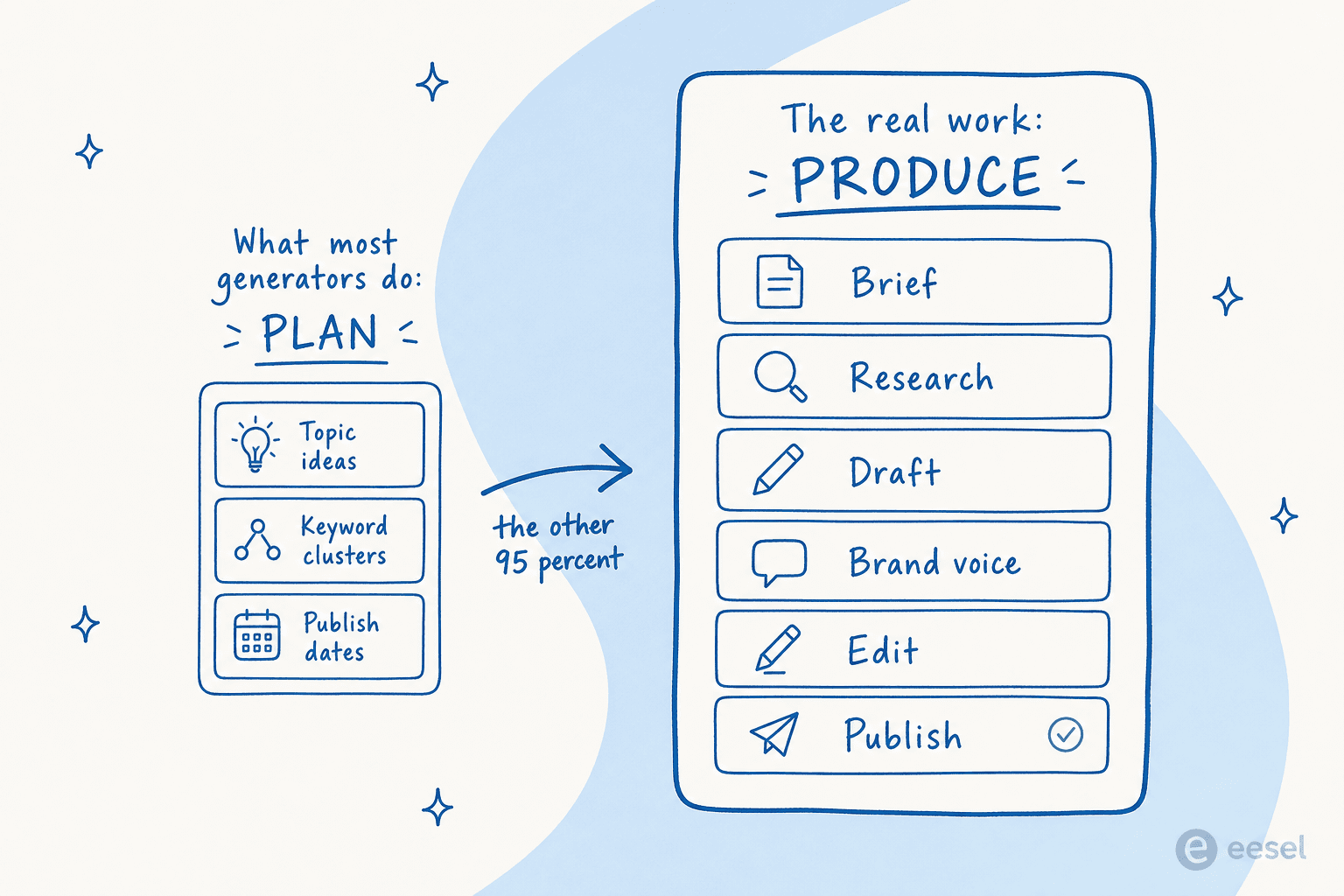
Look at the two halves. On the left, planning: topic ideas, keyword clusters, publish dates. Tidy, finite, done in an hour. On the right, production: brief, research, draft, brand voice, edit, publish, repeated for every single cell. That right-hand stack is where 95% of the time goes, and it's the half most "generators" don't touch.
You can feel this in how teams actually talk about it. The pressure isn't "I can't think of topics." It's the sheer operational load of producing across every channel at once. As one marketer put it in r/DigitalMarketing:
Feels like content expectations exploded over the last 2 years. LinkedIn posts, short videos, carousels, newsletters, landing pages, email sequences, ad creatives, reporting screenshots, etc. Even small teams are expected to produce constantly now.
Nobody in that thread is short on ideas. They're short on hours to turn ideas into published things. A calendar generator that only schedules the ideas hands them a prettier version of the problem they already had. That's the reframe: the tool you want isn't a planner with AI bolted on, it's a content marketing tool that closes the loop from keyword to published post.
So the rest of this is how I'd build that loop, and then the honest part, where it goes wrong.
How to build a content calendar with AI, step by step
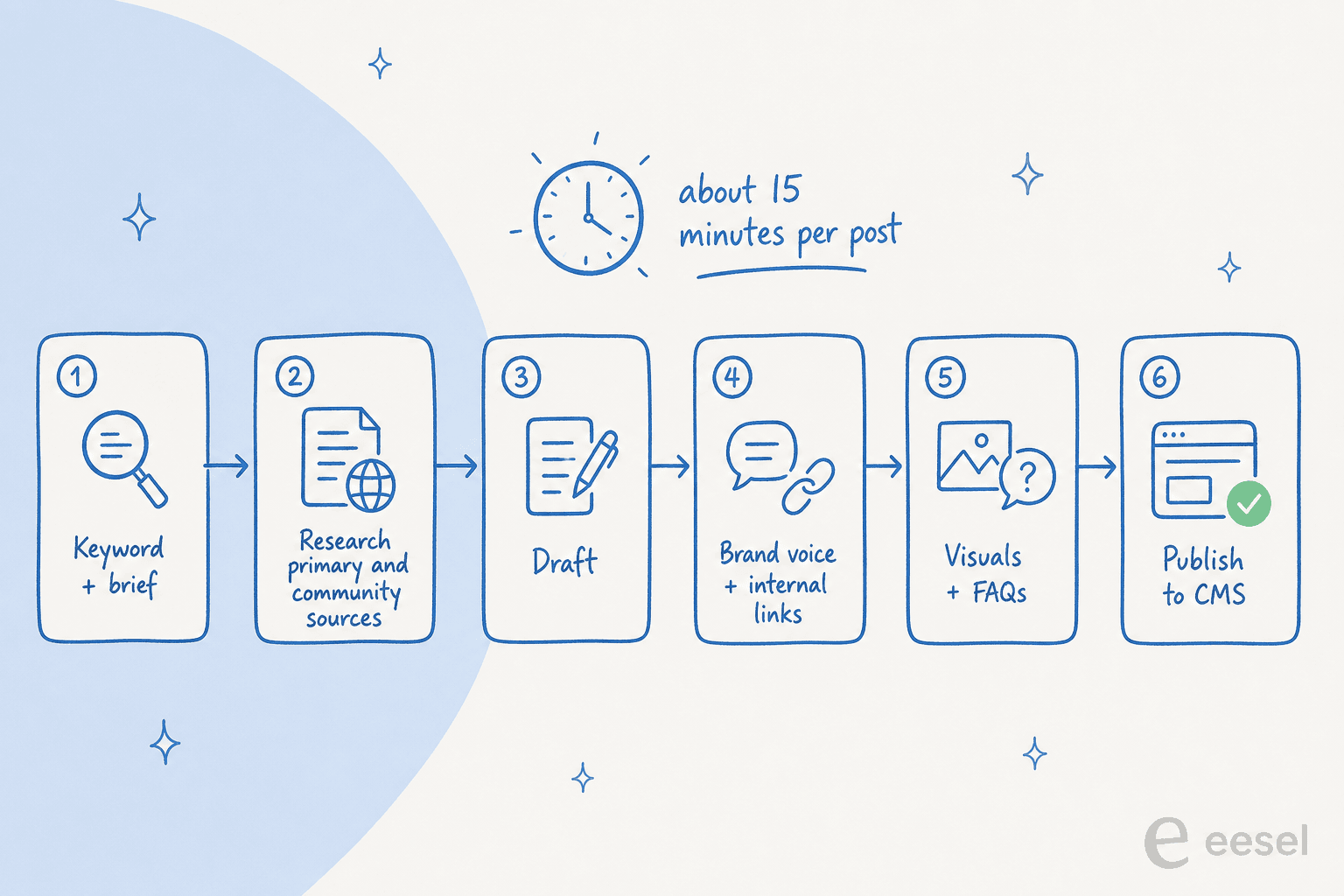
You don't need ten tools for this. You need one pipeline with six stages, and the discipline to keep a human at the right two of them. Here's the shape I'd use.
1. Build the calendar from keyword clusters, not vibes
Start with the planning job, but do it properly. Pull your keywords, then group them into clusters where one pillar topic supports a handful of related posts. This is what stops your calendar from being thirty disconnected one-offs. An AI SEO content strategy generator can do the clustering, or you can hand a model your keyword export and ask it to group and prioritize. The output you want is a ranked queue: what to publish, in what order, and why each piece exists.
One practical rule I'd add: prioritize ruthlessly. You do not need daily output on every channel. As another marketer in that same thread noted, tighter prioritization beats adding more tools:
A lot of teams are trying to publish at enterprise volume without enterprise headcount... not every channel needs daily output if the quality drops and nobody's actually engaging with it anyway.
A good calendar is a list of bets you've decided are worth making, not every keyword you could theoretically target. If you want help here, my guide to prioritize SEO content goes deeper.
2. Write a real brief for each slot
The single biggest lever on output quality is the brief. A slug and a target keyword aren't a brief. What does this post argue? Who's it for? What sources should it lean on? What does a reader need to walk away able to do? The better your content brief, the less editing you'll do later.
This is also where you encode the boring-but-vital stuff: word count, the internal links you want, the FAQ angles. Spend ten minutes here and you save an hour downstream.
3. Let the AI do the research, not just the writing
This is the stage that separates content that ranks from content that gets ignored. The model shouldn't write from its own memory; it should write from sources it actually pulled. A strong AI content writer reads primary sources, real product docs, real pricing pages, real user discussions, and cites them inline. That's what turns a draft from a confident-sounding summary into something a reader can trust.
A useful instinct here, straight from a content marketer in r/DigitalMarketing: use AI for the parts that are genuinely repetitive.
imo the mistake people make is asking ai to write a post.. It usually sucks and takes more time to fix.. using ai for the boring middle steps... works better
I half agree. The "ask AI to write a post" version does suck, when the AI has nothing real to write from. Give it deep research and a sharp brief and the calculus changes. The "boring middle steps" framing is right; I'd just argue that, done properly, research-then-draft is one of those steps you can hand over.
4. Get the brand voice right (this is non-negotiable)
Volume without voice is how you end up sounding like every other AI blog. The fix is a model trained on how you actually write, not a generic "professional, friendly tone" slider. Tools with real brand voice training ingest your existing posts and match cadence, vocabulary, and point of view.
One content marketer described the workflow that works:
i spend way less time writing content now by using AI tools in my workflow... but i don't just let the AI run wild. every blog goes through a human editor to make sure the tone, quality, and "voice" are on point and aligned with the brand.
That's exactly the split I'd keep human: the brief at the front, the voice check at the end. Everything in between can be automated. While the AI drafts, you also want it weaving in internal links; an internal linking automation tool does this for you instead of you hunting for relevant URLs by hand.
5. Add the visuals and FAQs in the same pass
A post isn't done when the prose is done. It needs a hero image, a few diagrams, and an FAQ block for search. Doing this in the same generation pass is the whole point of a pipeline, an AI blog writer with images hands you a finished artifact, not a wall of text you then have to decorate. The infographics in this very post were generated as part of that pass.
6. Publish, then schedule the next batch
The last stage is the one teams most underestimate, and I'll get to why in a second. Ideally the post lands in your CMS, formatted, scheduled, and slotted back onto the calendar. With auto-publishing wired up, the calendar stops being a planning document and becomes a running queue. Done right, this whole loop is roughly 15 minutes of human attention per post, mostly the brief and the final read.
For the deeper mechanics of stitching these six stages together, my walkthrough of an AI blog automation workflow and the broader AI blog writing workflow both go further than I can here.
Does this actually work at scale? Honestly, yes, with caveats
I'll give you the real numbers, because vague "save time with AI" claims are exactly what makes these posts forgettable.
One eesel customer, an AI phone-support startup, runs its content entirely through this kind of keyword-to-publish pipeline and ships 360 SEO posts a month, ranking #1 on competitive keywords with a small team. That's 12 a day, with consistent brand voice across hundreds of posts. Across the wider fleet, a typical 2,000-to-2,900-word post, hero banner, infographics, FAQs, internal links and all, comes out in roughly 12 to 20 minutes of generation.
It also pulls in people who didn't even come for a calendar. I hear from marketers who arrive wanting exactly one thing: not the chat and ticket automation, just help with the SEO content writing for their site. That's a staffing-agency marketer, paraphrased from a real eesel conversation, and it's a pattern I see a lot: agencies and content teams using the AI SEO blog writer to generate client posts at a clip a human team couldn't match. The throughput is real. If you want the tool comparison, my roundup of AI content generation tools and the AI content platforms comparison lay out the field.
But "it works at scale" is not the same as "press the button and walk away," and pretending otherwise would be dishonest. So here's where it breaks.
Where AI content calendars go wrong (and how to keep yours ranking)
This is the part most vendor pages skip. I won't.
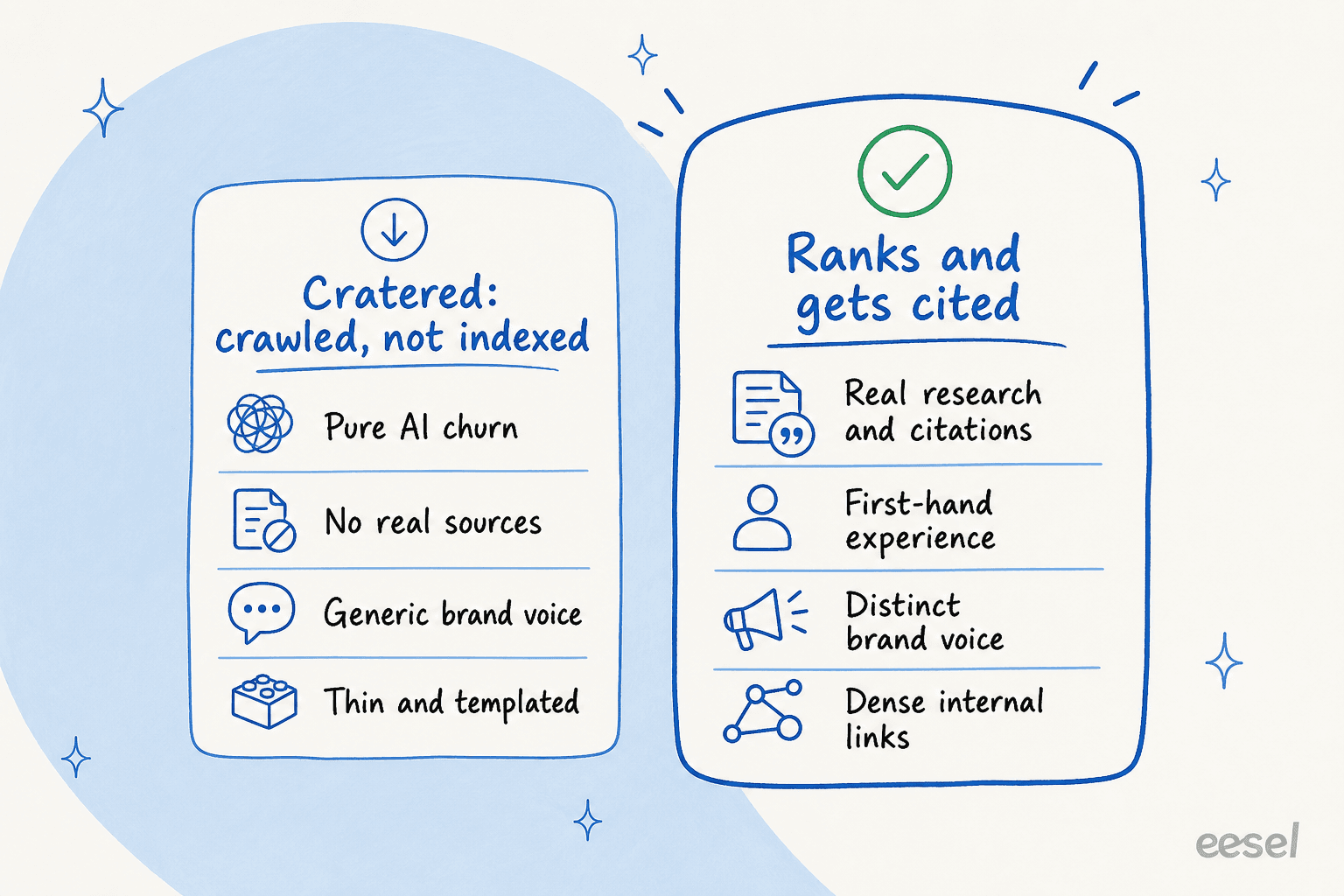
The crater. The most common failure is filling the calendar with thin, sourceless AI churn and auto-publishing it. It works for a while, then it doesn't. One SEO described watching a client's machine go from a "good revenue machine" to dead:
Suddenly from August first week he said that 4 of his AI based blogs traffic facing a sudden drop and the posts are crawled but not indexed.
"Crawled, not indexed" is Google's quiet way of saying this exists, but I see no reason to rank it. The fix isn't a different model. It's the stuff in the right-hand column above: real research, first-hand experience, a distinct voice, and internal links. If your calendar's output is stalling, my guide to why AI content isn't ranking and the principles of EEAT-compliant content are where I'd start.
The generic tell. Readers, not just Google, can smell mass-produced content. As one marketer put it bluntly:
almost everyone is capable of spotting heavily-generated AI content (e.g. delve, unleash, streamline, ever-changing, you name it)... it doesn't necessarily mean a better outcome because indeed of this AI-ish feeling.
Even Tim Soulo, Ahrefs' CMO, has a famous take on this:
Scaling content with AI is the biggest lie in content marketing... your job isn't just to "churn out content." Your job is to make people care... CREATING MEANINGFUL CONTENT IS HARD WORK!
I don't fully agree with Tim, and the 360-posts-a-month customer is my evidence. But he's right about the failure mode he's attacking: AI as a content shredder, where you feed in one idea and extrude ten hollow assets. Scaling junk is the lie. Scaling researched, voiced, edited content is just an operating model, and the human still has to make people care. Knowing how AI content detectors work helps you stay on the right side of that line.
The publishing wall. This is the one I've watched bite eesel's own users hardest, so I'll own it. You can generate beautiful, AEO-optimized posts and still get stuck because your CMS won't take them cleanly. I once watched a solo-practice therapist love the output and then hit a wall moving it into a restrictive CMS without losing the formatting, no Markdown upload, no FAQ schema, nothing. The lesson stuck with me: a calendar generator that can't publish to your stack is only half a tool. It's exactly why native CMS integration and clean export matter more than another fancy planning view.
Get those three right, sources, voice, and a clean path to publish, and the calendar takes care of itself. Get them wrong and no amount of scheduling polish will save you. For the safe version of scaling, my guide to scale SEO content safely and the realities of AI content production speed are worth a read.
Try eesel for your content calendar
If you've read this far, you already know my bias: a content calendar generator is only as good as the posts it actually produces. That's the half eesel was built for.

eesel's blog writer is an AI teammate that plugs into your stack, crawls your site and knowledge, and turns a keyword plus a brief into a publish-ready post, deep research, brand voice, infographics, FAQs, and internal links included, in around 15 minutes. It's the same pipeline that produced this article. You point it at the next slot on your calendar and it fills it, and with auto-publishing it can push straight into your CMS instead of leaving you to paste and reformat. It's free to try, and the first posts come out fast enough that you'll know within a session whether it fits. Browse the best AI blog writer options if you want to compare first, then come back and run a real keyword through it.
The calendar was never your problem. Filling it was. That's the part worth automating.
Frequently Asked Questions
What is an AI content calendar generator?
An AI content calendar generator is a tool that plans what to publish and when, usually by clustering keywords into topics and slotting them onto dates. The more useful ones go a step further and also draft the posts, so the calendar fills itself instead of leaving you a grid of empty cells. See my breakdown of an AI content pipeline tool for how the full flow works.
Can AI write a whole content calendar's worth of posts?
Yes, and at real volume. One eesel customer runs a keyword-to-publish pipeline that ships 360 SEO posts a month. The catch is that volume alone doesn't rank, so the research and editing matter more than the throughput. My guide to scale SEO content safely covers the guardrails.
How much does an AI content calendar generator cost?
It ranges from free planners that only output a topic grid to per-post pricing on tools that draft the content. The honest comparison is cost per published post, not per idea. I break down the math in my piece on AI blog writer cost.
How do I stop AI calendar content from sounding generic?
Feed the model real sources and a real voice. Generic output comes from generic input, so train it on your brand voice and ground every claim in a primary source. It also helps to understand how AI content detectors work so you know what readers and Google notice.
Will AI-generated calendar posts actually rank on Google?
They can, but auto-published thin content is the fastest way to get crawled and not indexed. Posts that rank carry first-hand experience, citations, and internal links. If yours have stalled, start with why AI content isn't ranking and my notes on EEAT-compliant content.
Can an AI content calendar generator publish straight to my CMS?
Some can. The value of an AI calendar evaporates if you have to hand-paste every post and lose the formatting, so look for native CMS publishing or clean Markdown export. See my guide to auto-publishing and the realities of AI content CMS integration.
What's the difference between a content calendar tool and an AI blog writer?
A calendar tool plans; an AI blog writer produces. The combination is what you actually want, a calendar that's wired to a writer so each slot turns into a finished, researched draft. eesel pairs both in one AI blog automation workflow.


Article by
Kurnia Kharisma Agung Samiadjie
Kurnia is a software engineer and writer at eesel AI with two years of SEO experience, writing about AI tools, helpdesk software, and customer support. He pairs a developer's understanding of how these products are built with search-driven research into what actually ranks and resonates with the people searching for them.